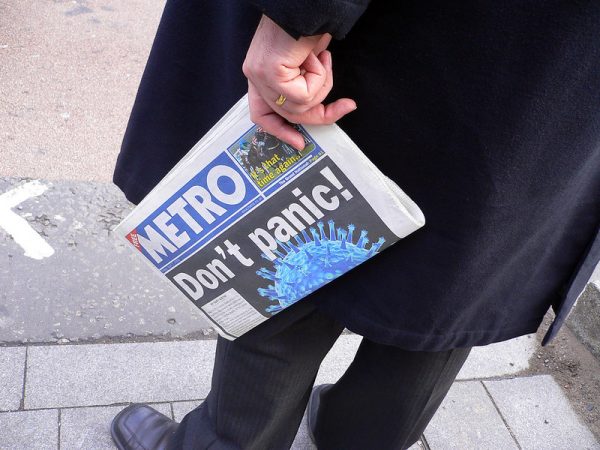
media

Photo by photologic, Flickr CC

This post was created in collaboration with the Minnesota Journalism Center

Coronavirus — also known as COVID-19 — has taken the global media world by storm. Over 2,000 have died and more than 79,000 are infected globally. The World Health Organization has been criticized for not declaring a public health emergency earlier than they did, but doctors including Dr. Emily Landon at the University of Chicago are saying that “people shouldn’t panic.” 

In cases of public health epidemics, whether people panic depends in part on how journalists cover the issue and which experts they cite. Journalists tend to quote official sources like government officials and public health officials to inform the public about outbreaks of illness including influenza, swine flu, Zika, Ebola, and more recently, coronavirus. Being quoted in news articles gives public health officials the opportunity to share their expertise on said topics to help inform readers about how to protect themselves and avoid infection. From a sociological perspective, focusing on the spread of information about pandemics and infectious diseases provides opportunities for scholars to comment on evolving social structures and processes in a way that will influence the biomedical sciences’ public and policy agenda.

As epidemiologist Adam Kucharski wrote in The Guardian, “stories sparking fear seem to have overtaken the outbreak in real life” and misinformation (a topic The Society Pages has written about here) seems to be more contagious than the virus itself. The “need for speed” in publishing journalistic updates about the virus as well as scholarly work has resulted in several retractions, including the retraction of a preprint of a scholarly paper after its analysis was found to be faulty. 

Further, the spread of information — and misinformation, including conspiracy theories — about health crises often occurs on social media platforms including Twitter and Instagram. Scholars found that false information spread especially quickly during Ebola outbreaks in West Africa and in the Zika outbreak in Brazil, which led to the formation of counterproductive policies passed by public health officials who struggled to combat false claims. In recent years, Instagram was found to be the most effective platform for health organizations including Centers for Disease Control, the World Health Organization, and Doctors without Borders to engage followers during global health crises.
Scholars, including Dr. Anita Varma, recently published five tips for journalists on covering coronavirus. These include paying attention to the frames used and including quotes from official sources like government officials as well as the people directly affected by the health concern. Dr. Karin Wahl-Jorgensen published an article on the role that fear plays in narratives about public health crises. The bottom line is: The way stories are told matters and affects the management of pandemics and policy responses.
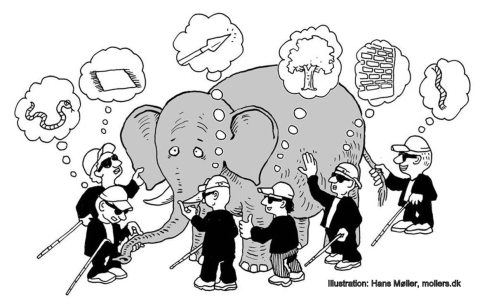
Cartoon. Six blind men touch different parts of an elephant and each has a different idea of what the elephant is based on what they've touched

This post was created in collaboration with the Minnesota Journalism Center

Objectivity and neutrality have been cornerstone norms of journalistic practice in democracies in the Western world for over a century. However, in recent years ideals of fairness, accuracy, and balance have come under increasing attack from many different and sometimes unexpected directions. 

Many beliefs about the need for media objectivity go back to Alexis de Tocqueville’s 19th century argument that the circulation of newspapers are integral to fostering a functional and effective democracy. Indeed, objectivity became a news value in the 1830s, partly to do with the rise of the Associated Press (AP), created in 1848 by a group of New York newspapers that wanted to take advantage of the speed of the telegraph in transmitting news to multiple outlets. To transmit news to a variety of news outlets with a variety of political allegiances consistently, a sense of objectivity had to be maintained to be relevant to as wide an audience and clientele as possible. 
Cutting against these norms was the sensationalism of newspaper content in the late 19th century. While the use of emotion in reporting has often been connected to the commercialization and tabloidization of journalism, in recent years it has also appeared in coverage of disasters, crises, and human rights abuses — and has come to be seen as positive and valuable as well. The roles of objectivity and impartiality have always been contested within journalistic practice, so rather than seeing emotion as the opposite of objectivity, some scholars now argue it can come alongside and inform journalistic practice worldwide.
The role of objectivity has also come into question as a mechanism that can silence marginalized writers and populations. Relatedly, news can also reinforce institutions of power in society, for better or for worse. In populist countries including Argentina, Bolivia, Ecuador, Nicaragua, and Venezuela, “professional journalism” is often pitted against “militant journalism” promoted by neo-populist governments and their sympathizers — a movement that has critical implications for the freedom of the press in societies in the Global South. Also, news media has been found to negatively portray protests and protesters.
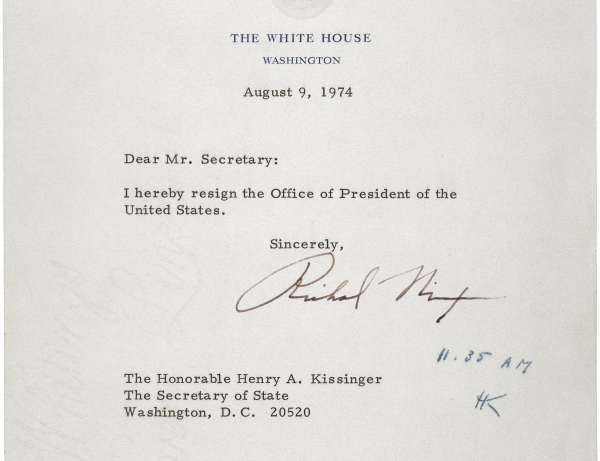
Richard Nixon’s resignation letter from August 9, 1974. Photo via Wikimedia Commons.

The impeachment proceedings have sparked contentious public debates about what should and should not be considered a “scandal” today. From the earliest days of the discipline, sociologists have employed theory and research to study why some incidents and individuals who seem scandalous have major impacts and lasting legacies, while others seem to make no mark whatsoever. They also help us see how both scandals and the public outcry that they can occasion are socially constructed by norms and values, organizational processes, and inequalities that extend well beyond any one individual person or event. It’s so sociological, it’s almost scandalous!

To begin, the identification of something as a social problem or “a scandal” requires that an issue is well known in society and intersects with a meaningful moral set of concerns. The construction of a scandal also involves who or what has the power to apply and enforce social norms about right and wrong. For example, public sanctions and normalized stigma against prominent queer citizens and pro-gray groups reinforced widespread bigotry, marginalization, and violence.
Media obviously plays an important role in creating and framing a scandal. Its coverage is shaped by often invisible social factors such as media businesses’ goals, newsroom budgets, and journalistic practices. In addition, the activities of political groups, social movements, and civic organizations can drive public debate and attention to certain issues or problems. Such groups’ impact is not necessarily a product of their moral beliefs or strength of conviction, but factors such as their name-recognition, finances, and networks. Thus, institutional processes, civic organizations, and material factors shape how a scandal is socially constructed.
Sociological factors such as status, gender, and race intersect with organizational contexts, media factors, and broader public norms to shape the aftermath of scandals as well. In political or corporate contexts, the power and resources of an individual or organization often determine whether and how they are punished for transgressions (or exonerated) and what kinds of reforms must be undertaken. Furthermore, the aftermath of a state scandal can be greatly determined by whether the government has a system of checks and balances, as well as whether criticizing state actors comes with consequences of its own. Unweaving such complex webs can show why some shocking scandals leave affected parties unscathed, while others leave long-lasting scars.

Photo is shows a child covering their ears while watching tv
Photo by Miles Bannan, Flickr CC

This post was created in collaboration with the Minnesota Journalism Center

Obstruction, quid pro quo, impeachment. The tweets, the news alerts, the endless headlines. This political landscape, and the overall media news landscape, can be exhausting, and news consumers are showing they are tired of it all. A June 2019 Digital News Report explained that this news fatigue has turned into news avoidance: 41 percent of respondents in the United States (and 32 percent worldwide) said they “often or sometimes” avoid the news. 

Scholars are exploring the reasons for news avoidance, with some readers finding news “too negative,” “frustrating” or “annoying.” Other research shows that women are more likely than men to avoid the news, a gap explained by structural inequalities, like family commitments and household responsibilities.
One of the first journalism studies on this topic found that participants avoided the news but counted on the news finding them. The study from Stephanie Edgerly identified participants who did not follow any news accounts or journalists on social media but relied on Facebook to notify them of significant news and events.
These news avoiders are less inclined to vote, a troubling fact to University of Minnesota researcher Benjamin Toff:

“I do have concerns about whether our news environment is all that conducive to creating an electorate of people who actually hear the other side, can think through complicated political debates and issues, and understand a variety of different perspectives.”

Women’s news avoidance is intertwined with a lack of political engagement. This can lead to women facing difficulty advocating for themselves in the political sphere and fewer women involved in the political process or even running for office.
One way to decrease the number of news avoiders is to improve the quality of news itself and make news consumption more appealing. “Solutions journalism” explores sociological problematic issues in communities (homelessness, childhood obesity, etc) and critically examines problem-solving efforts. This goes beyond more straight-forward traditional reporting of the facts and, instead, offers ideas on how to resolve issues important to community members. Research demonstrates that readers are more likely to engage with (share, like, etc) solutions-oriented content than traditional news content. In addition, findings reveal readers report more favorable attitudes towards the news story and news organization when news discussed solutions.

Another important avenue in combating this news avoidance issue is media literacy. For more on media literacy, click here.

1894 newspaper illustration by Frederick Burr Opper, Library of Congress via Wikimeida commons

The election of President Donald Trump in the United States in 2016 ushered in an era of attacks on the media and accusations that outlets such as The New York Times and The Washington Post are publishing “fake news.” But what exactly is “fake news”? And why are claims about information, misinformation, and disinformation in American journalism so troubling?

TSP has previously published articles summarizing scholarly concerns about fake news–in particular, its role in the political polarization phenomenon. Media scholars also now see these trends as part of a larger, longer-term crisis of democracy itself, beginning sometime in the final decades of the 20th century.

In spite of all of these questions and controversies, one thing is clear: there is no consensus on what exactly fake news is. The definition of fake news is unclear to many Americans. According to a 2018 study from The Media Insight Project, there are several understandings of what “fake news” really means to Americans nationwide:  

  • 71% of Americans think fake news is “made-up stories from news outlets that don’t exist”
  • 63% think fake news refers to “media outlets that pass on conspiracy theories and unsubstantiated rumors”
  • 62% think it means “journalists from real news organizations making stuff up” 
  • 43% think fake news refers to news organizations making sloppy mistakes
  • 25% call satire or comedy about current events fake news
Audiences play a key role in interpreting the news and acting on it — or not. Pew Research Center data shows 68 percent of American adults say that they get their news on social media even though 57 percent of them expect the news they see on social media to be “largely inaccurate.” Academic studies also find that “fake news” is often used by social media users to insult information shared by members of opposing political parties.  
Mural Showing Child Soldier from Iran-Iraq War, Photo by Adam Jones, Flickr CC

In 2014, Boko Haram made global headlines when militants kidnapped 276 girls from school in Nigeria. Policy makers, activists, and celebrities across the globe mobilized, calling for action to #BringBackOurGirls. But in the case of child soldiers, the moral lines are often less clear because they are simultaneously victims and perpetrators. Ex-Boko Haram fighters, including at least 8,000 children, currently face a new battle as they seek to reintegrate into civilian life despite stigma. Research on the social construction of victimhood and childhood can help us better understand child soldiers.

Ideas around morality, righteousness, and innocence of victimhood differ across time and place. In World War I, for example, soldiers who suffered from trauma were treated as weak or unpatriotic by superiors and medical professionals. In the aftermath of WWII and the Holocaust, humanitarian actors and mental health professionals led movements to redefine victims of violence as worthy of respectability and reverence. Characterizations of victimhood are also contrasted with perpetrators — the innocent, passive victim is defined in opposition to the active, wrong-doing perpetrator. Sociologists examine how such labels are constructed, and in practice, moral lines are rarely so clear.
Media outlets often depict child soldiers as helpless victims who are abducted and indoctrinated by militia groups. This is due to media representations of children as innocent and naive.  However, many children volunteer to enlist due to survival techniques. Thus, scholars have sought to depict child soldiers as “agentic,” rather than passive victims. While the media emphasizes the binary between childhood and adulthood, child soldiers occupy an ambiguous space between these categories. This ambiguity is the result of a child soldier being capable of extraordinary violence and simultaneously symbolizing the innocence of childhood. Scholars argue that challenges to reintegration stem from how children have been socialized into militias, as well as their young ages.

While child soldiers occupy the muddy moral grounds of victimhood, these categories remain important,  particularly for issues of restorative justice and reintegration in their communities. 


For more on victimhood across different contexts, see these TROTs:

Photo by Sasha Kimel, Flickr CC

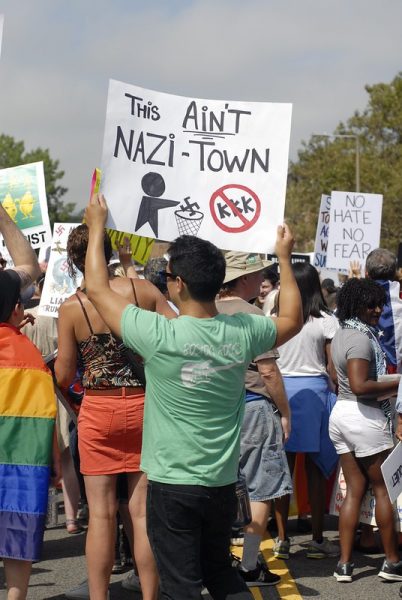
We at The Society Pages have written about the study of “white supremacy” in social science. This term can be used to describe overarching patterns of privilege and power that favor whites or a term that bigotry, prejudice, and belief that whites are a superior race. It may be easy to think that this latter meaning has become less relevant in the contemporary, “post-racial” world, but this is not the case.

In recent years, beliefs about the superiority of whites have actually re-emerged within the political mobilization of populist attitudes, anti-immigrant sentiment, and Right-wing political beliefs in Western democracies. To capture these distinctive and troubling realities, scholars, reporters, and cultural commentators have increasingly begun to use the term “white nationalism.” White nationalism is not just a remnant of outdated, obsolete prejudice; rather, it is has been reconfigured and revitalized for the new global world.

Modern white nationalist rhetoric constructs the image of a historically white country and populace under attack amidst a world of 21st-century immigration, globalization, and shifting racial landscapes. By advancing nativist rhetoric and mobilizing such sentiments in the political arena, white nationalist organizations forwarded understandings of “white” that draw on the idea that the Western world is meant for white people. This has had important political consequences in the USA and Europe; politicians and parties who advance anti-immigration platforms have been bolstered by these dynamics.
Even though relatively few politicians and political parties have openly endorsed white nationalist statements, research shows that white nationalist rhetoric and nativist messages can impact political discourse even among moderate groups. In essence, the presence of white nationalist rhetoric can shape the contours of political discourse more generally. Research has studied such dynamics with an eye to common digital media of the 21st century; the discursive impacts of white nationalist rhetoric are particularly visible in studies of the Internet, social media, and other such platforms. In the 21st century, prominence in the digital sphere is important to how contemporary white nationalist groups make their presence felt. 
It is important to remember white nationalism and right-wing beliefs are not simply empty rhetoric without material consequence. Authors have described how white nationalist rhetoric and organization can affect electoral results — the “Brexit” vote being one of the most obvious current examples. In addition, upticks in white nationalism and nativist sentiment have been paralleled by increased hostility and violence against minority and immigrant populations, as well as the institutionalization of laws that restrict such groups’ rights by targeting their cultural and religious practices. For example, the push for “burqa bans” in several European countries reflects mobilization by nativist groups that has cast the burqa as a symbolic challenge to national identity. This and example and ones like it highlight the white nationalist belief that the nation should be defined by whiteness and designed for whites.

Photo by Kandukuru Nagarjun, Flickr CC

This post was created in collaboration with the Minnesota Journalism Center.

Technology has its share of perks and benefits. Past articles on The Society Pages demonstrate how artificial intelligence and technology can help enhance journalism and curb trafficking and trolling online — but scholars have also found technology has a dark side. Meredith Broussard calls it, “technochauvinism,” a belief that tech is always the solution to the world’s problems. It is a red flag, she says, because “there has never been, nor will there ever be, a technological innovation that moves us away from the essential problems of human nature.”
One of these problems is unequal access to the internet. On The Society Pages, we highlighted how access to the internet influences activism. Other research shows how access to the internet influences various societal practices including predictive policing, real estate markets, affordable housing, social services and medical care. For example, predictive policing is a developing area of inquiry. This practice has come under scrutiny for its lack of transparency and potential to assign inaccurate risk scores to individuals that may become a victim or offender in a violent crime, which can lead to the overpolicing of already marginalized areas.
Scholars have also discovered that blue-chip companies, including Google, produce search results that marginalize underrepresented populations. Further, there is fear that algorithms are writing people out of jobs. While algorithms do have the potential to write people out of jobs, different fields may experience this to various degrees. This may be true for professions including paralegals: Up to 69 percent of paralegals’ time could be automated. In the journalistic profession, reporters and editors are in better shape due to their ability to animate algorithms to their advantage: As a human-centered process, algorithms have the potential to increase reporting outputs with less human effort. But algorithms aren’t neutral — they are produced by people, and they have the potential to reproduce marginalization.
Photo of a drone flying in the air near a statue of Joan of Arc.
Photo by Ted Eytan, Flickr CC

This post was created in collaboration with the Minnesota Journalism Center.

The landscape of journalism is changing every day. The Pew Research Center reported that newspaper newsroom employees declined by 45% between 2008 and 2017, and Nieman Lab argues that newsrooms are in the midst of a “do-or-die moment.” As traditional newsrooms lose hundreds of reporters and editors annually, content creators including WikiLeaks and Deadspin are coming alongside legacy media outlets including CNN, the BBC, and The New York Times to provide information to the public. All of these players publish content online in a journalistic fashion, raising the question of what journalism is as a profession.

In the midst of a shrinking workforce, scholars are starting to pay attention to “interlopers” and “intralopers:” Interlopers are actors or institutions who may consider the work they do to be part of news media, though they do not always define themselves as journalists; web analytics companies are one current example. Intralopers are similar to interlopers, but instead work from within news organizations as specialists in digital and social media and often produce emerging technology meant to complement journalists’ work. Both play increasingly key roles in journalistic spaces.
Machines and software packages are beginning to play a more central role in news gathering, news selection, news writing, news editing, and news distribution in newsrooms worldwide. Drones are one example of machines occupying space traditionally held by journalistic actors. 2016 was a turning point for the institutionalization of drones in newsrooms in the United States, when the Federal Aviation Administration (FAA) amended aviation regulations to allow for widespread experimentation with drones in American journalism. Since that date, journalists from outlets including The New York Times and The Washington Post have produced compelling stories, photos and videos but have also go through a comprehensive federal certification process (Columbia Journalism Review recently wrote about this phenomenon).
Analytics and metrics also play a key role in newsrooms nationwide. However, journalists have varying opinions of how influential their role is in their daily routines, with some arguing that analytics challenge journalists’ authority to decide which stories are newsworthy.
Beyond analytics and metrics, journalists and technologists often collaborate with each other on a regular basis to create open-source software programs. One example is “hackathons” — events where coders and journalists come together to find solutions to journalistic problems in the interest of creating a brighter future for news outlets worldwide.

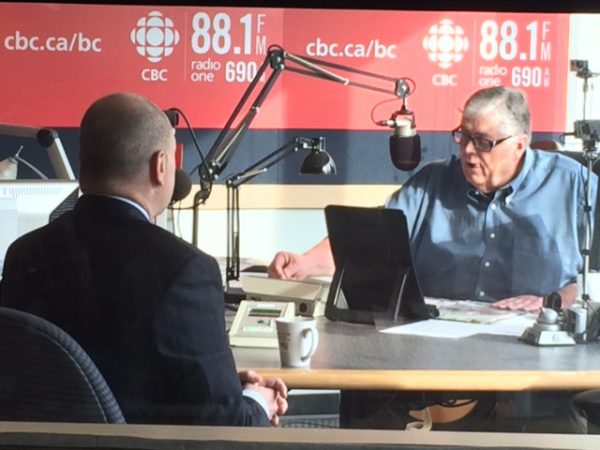
Photo of a radio interview by US Embassy Canada, Flickr CC

On January 31, The New York Times responded to a letter from Kimberly Probolus, an American Studies PhD candidate, with a commitment to publish gender parity in their letters to the editor (on a weekly basis) in 2019. This policy comes in the wake of many efforts to change the overwhelming overrepresentation of men in the position of “expert” in the media, from the Op-Ed project to womenalsoknowstuff.com to #citeblackwomen.

The classic sociology article “Doing Gender,” explains that we repeatedly accomplish gender through consistent, patterned interactions. According to the popular press and imagination — such as Rebecca Solnit’s essay, Men Explain Things to Me — one of these patterns includes men stepping into the role of expert. Within the social sciences, there is research on how gender as a performance can explain gender disparities in knowledge-producing spaces.

Women are less likely to volunteer expertise in a variety of spaces, and researchers often explain this finding as a result of self-esteem or confidence. In 2008, for example, only 13% of contributors to Wikipedia were women. Two reasons cited for this gender disparity were a lack of confidence in their expertise and a discomfort with editing (which involves conflict). Likewise, studies of classroom participation have consistently found that men are more likely than women to talk in class — an unsurprising finding considering that classroom participation studies show that students with higher confidence are more likely to participate. Within academia, research shows that men are much more likely to cite themselves as experts within their own work.
This behavior may continue because both men and women are sanctioned for behavior that falls outside of gender performances. In the research on salary negotiation, researchers found that women can face a backlash when they ask for raises because self-promotion goes against female gender norms. Men, on the other hand, may be sanctioned for being too self-effacing.
Knowledge exchange on the Internet may make the sanctions for women in expert roles more plentiful. As is demonstrated by the experiences of female journalists, video game enthusiasts, and women in general online, being active on the Internet carries intense risk of exposure to trolling, harassment, abuse, and misogyny. The social science research on online misogyny is recent and plentiful.

Social media can also be a place to amplify the expertise of women or to respond to particularly egregious examples of mansplaining. And institutions like higher education and the media can continue to intervene to disrupt the social expectation that an expert is always a man. Check out the “Overlooked” obituary project for previously underappreciated scientists and thinkers, including the great sociologist Ida B. Wells.

For more on gendered confidence in specific areas, such as STEM, see our TROT on Gendering Intelligence.