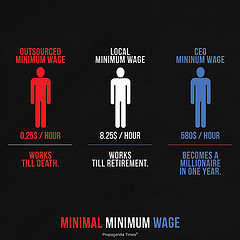
economy

For the first time since 2006, the Census finds a .5 percentage drop in the poverty rate, with children and Hispanics seeing the biggest declines. Before taking these encouraging statistics at face value, it is important to put them into context. Briefs produced by the Stanford Center on Poverty and Equality and the Center for American Progress outline important factors that often get ignored when focusing on the poverty rate alone, including the consistent struggle for young adults and minorities to find work and the ever-increasing working poor that often get left out of the poverty conversation entirely.

The high poverty rate among young adults is cause for concern. Experiencing poverty in early adulthood has been found to hinder future earnings, especially within minority populations. Young people may stay hungry if our definition of poverty doesn’t grow up with them.
While the poverty rate may have dropped slightly, this is largely due to the increase in the working poor. Millions of families are trapped in the middle, earning just enough to be considered above the poverty line but making far from enough to be considered economically secure. Poverty among working adults is linked to a broader decline in labor unions.
Most of the discussion around the poverty rate centers on what David Cotter calls “person poverty” as opposed to “place poverty.” In his analysis of Census data, Cotter finds that, regardless of any individual characteristic, households in rural America are more likely to experience poverty than their metropolitan counterparts.

Our partner Scholars Strategy Network has tons of great briefs on this issue, including this one on the need for a more comprehensive measure of poverty.
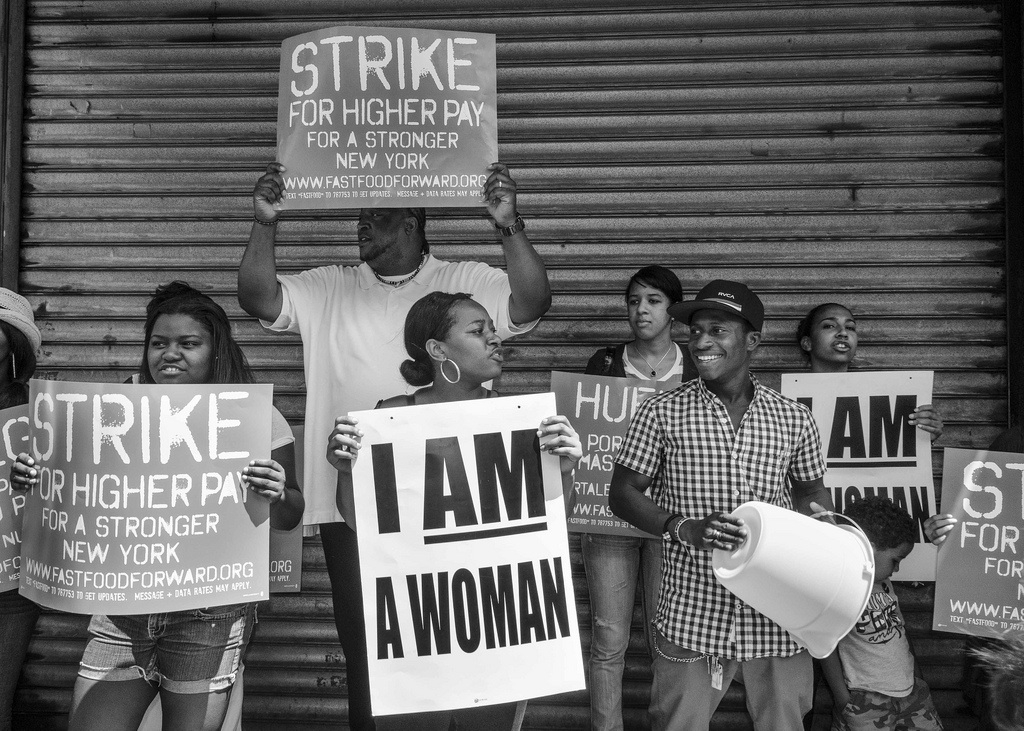

Image via Annette Burnhardt via Flickr Creative Commons

Flipping burgers at McDonald’s is the iconic dead-end job of the U.S. service economy with low-wages, few benefits and certainly no labor unions. But now a national movement of fast-food and other low-paid workers is growing and organizing to improve working conditions. In the past two years there have been seven national fast-food strikes, which reflect a broader resurgence in the U.S. labor movement and new forms of social mobilization from Occupy Wall Street to the Walmart Black Friday strikes. These recent protests have mobilized often marginalized communities in ways that question the service economy model based on cheap non-unionized labor.

Service work, and fast-food in particular, is a growing sector of employment that is indicative of larger trends in the U.S. economy towards contingent, temporary employment and low wages. Violations of workplace laws like mandatory overtime and minimum wage are part of corporate cost-cutting and common in low-wage industries, and unionization could help give workers power to resist these practices.
This revitalized labor movement is also mobilizing women, people of color and immigrants who were largely left out of the traditional craft and industrial unions.
Broader decline of unionization and decrease in the minimum wage has contributed to rising income inequality, and so attempts to organize low-wage workers could help all U.S. workers and reduce this inequality. Union membership provides a wage boost for workers, especially women, people of color and those with less education.

For more on the inclusive power of unions, check out this Girl w/Pen! post.

In the latest push against an FCC proposal that would create fee-based “fast lanes” on the Internet, a coalition of tech companies purposely slowed download speeds on their websites. The idea – to demonstrate to users how the new rules might slow traffic on non-paying sites – generated quite a stir: as of September 10th, the FCC received a record-breaking 1.4 million public comments on the proposal.

The coalition of protesting firms includes a roster of sites that rely heavily on user uploads: Mozilla, Etsy, PornHub, Kickstarter, Vimeo, and Reddit all voluntarily slowed traffic. Netflix also joined, displaying a message explaining to users “If there were Internet slow lanes, you’d still be waiting.” Tech giants Google and Twitter added their opposition as well. Protest organizers are asking the FCC to reclassify the Internet as a “Common Carrier” under Title II of the Telecommunications Act, thereby granting the government special regulatory powers designed to protect the web as a kind of public commons.

For most of us, the idea of a “commons” calls to mind a kind of protected natural resource, like the public lands that ecologist Garrett Hardin wrote about in his classic article, “Tragedy of the Commons.” The protesters, though, are asking the FCC to create a “commons” from a service that was built in-part by Internet service providers who now want to charge for speed. So, where might the government stake its claim on a proprietary public service? David Harvey and other social scientists have shown how and why capitalist societies engage in this kind of “commoning.”
The incredible outpouring of individual action in this protest owes a great deal to the organizing efforts of a number of large corporations, each with its own ideological and financial interests in the final ruling. What do you call a campaign that uses grassroots tactics, but takes cues from big business? “Astroturfing”, says Sociologist Edward Walker – and it’s more common than you might think.

The 1990s saw a surge in student activism surrounding labor issues, most prominently in campaigns against sweatshop labor for cheap clothing. College students around the country held sit-ins and rallies protesting companies like Nike and Gap that were in many ways credited with those companies improving their labor policies. Forever 21—a popular retail chain targeting youth and student shoppers—recently opened a new outlet with even cheaper clothes that has the media revisiting the 90s’ protests. According to an article in The New Yorker, “the grand opening of F21 Red, however, was marked not by picketers but by customers who lined up early for gift cards. What changed?” This question brings up a broader sociological question of how and why student and youth populations participate in activism, as well as how this might be changing.

The student activism in the 90s was not solely spurred by a common cause against sweatshop labor amongst students. Instead, this spike in activism was in many ways led and organized by already formed networks of labor activists that intentionally targeted students. Further, the successes were limited, and the movement did little to affect perceptions of cheap labor overall.
Activism and its outcomes are influenced by local and historical context. Sociologists have found that while today’s youth cohorts are participating in protests and other forms of traditional activism less than their parents, they are participating in alternative, more individualized forms of activism like petition signing and volunteering. They argue that what it means to be a “good citizen” is changing and that younger generations are driving this change.

Last month Italy announced that it would be including revenue from illegal activities such as drug trafficking and prostitution in its GDP. The Economist reports that this isn’t all new—Italy has been recording its “shadow economy” of unregistered businesses since 1987—but the news reminds us how difficult it is to properly measure economic growth even when we think the statistics are cut and dried. Recessions make us take resources seriously, and research shows that the best resources for some social groups can often be the least legit.

Both in-depth ethnographic work and statistical studies show that some of the poorest communities in the U.S. are booming with entrepreneurship—it’s just that most of the work is, well, off the books.
Legal and illegal markets share many of the same coordination problems, but state restrictions change the social relationships in illegal markets. Taxation and regulation may actually be better methods to quell illegal markets than prohibition.
This doesn’t just happen with poor communities or criminal enterprises, though. Secondary markets where companies resell their goods and services—such as “gray markets” for unauthorized transactions or the budding market for buying up strangers’ life insurance policies—highlight the shifting boundaries between market regulation and social morality.

For more on the social construction of markets and value, check out this Sociological Images post and a previous TROT on Bitcoin.


style=”display:inline-block;width:234px;height:60px”
data-ad-client=”ca-pub-4670099812817063″
data-ad-slot=”1069646635″>

The recent collapse of Mt. Gox—a prominent exchange site for the internet currency Bitcoin—has sparked wide discussion about the future of “virtual” money and the social groups that create it. Some remain cautiously optimistic (though pointing out that Bitcoin may take itself a little too seriously), while others have said the currency amounts to a “Ponzi scheme” with “no store of value.” As a post from our friends at Cyborgology noted last year,

Calling Bitcoins “virtual currency” is nonsensical because all currencies are virtual in that they are “collective hallucinations” about measurement of worth.

Classic sociological theory investigated how society creates value, and came to similar conclusions. Gold and paper money needed a lot of collective social support to become valuable.
What makes one currency more “valuable” than another is institutional support, but this wasn’t always guaranteed for the U.S. dollar, either.

Picture 2


Last month Comcast announced its plans to merge with Time Warner Cable, and internet subscribers may have to choose Comcast as their broadband provider even if they don’t want cable in the near future. With rising cable rates, the merger is stoking fears and outrage among the public, and politicians like Senator Al Franken. The deal has yet to be finalized and the FCC may instruct Comcast and Time-Warner to pump their brakes before merging.  If the deal succeeds, however, the nation’s two largest cable and broadband providers are sure to become a behemoth on the information superhighway.

While profit is a big motive for acquisitions and takeovers, companies also try to take over close members of their social networks to reduce competition. Monopolies and oligopolies are especially likely in industries with only a few major players and close ties.
What does this mean for women, people of color, and low income communities? Rising prices for internet access would expand an already-large “digital divide” in who can use the web and who gets represented on it.

Also, check out Eszter Hargittai’s “Office Hours” interview where she discusses the expanding gaps and inequalities in the level of internet skills possessed by so-called “digital natives.”

Picture 2


Shopping while black is not a crime, but what happens when a store assumes the customer is always white?

ColorofChange.org has created a petition urging the NYPD to conduct a full investigation into over 50 arrests of young people, predominantly of color, outside of major department stores like Barney’s and Macy’s. Why hasn’t the “shop and frisk” trend gone out of style?  Theories on race and racism, as well as the application of such ideas through social experiments, may offer some useful insights.

To study the gap between actions and rhetoric, audit studies reveal patterns of discrimination in the working world which shape employment opportunities for many low-wage workers of color.
Some theorists view racial attitudes through a conflict perspective that suggests racism and prejudice is rooted in different social positions between groups.
Image from P T via Flickr Creative Commons

The US federal minimum wage has been a hot topic in 2013, starting with President Obama’s proposal in February to increase the federal minimum wage to $9/hour. Then, over the summer, McDonald’s was the source for national ridicule after releasing a financial planning document for its workforce that suggested employees would need to work two full-time entry level jobs in order to pay for basic monthly expenses. Most recently, thousands of fast food workers from across the nation went on strike to increase the federal minimum wage to $15/hour. Is living on a minimum wage income really that tough? And if it is, why is it so difficult to simply increase it?

In most cases, living off a minimum wage income is simply not feasible, especially for single parents.
Much of the reluctance to increase the minimum wage stems from the fear that higher wages would force companies to raise prices and hire fewer employees. However, these anxieties are largely unfounded.

Former Detroit Mayor Kwame Kilpatrick was recently sentenced to 28 years in prison after being convicted of two dozen federal charges including racketeering, extortion, and the filing of false tax returns. Judge Nancy G. Edmunds recently told CNN that although she wasn’t holding Kilpatrick responsible for Detroit’s bankruptcy, “a long prison sentence is necessary to insulate the public from his behavior.” Whether conviction alone is enough to restore public trust and put an end to white collar crime is still an open question.

Who commits white-collar crime and why? Classical criminology shows how the answers have changed over time.
Current work suggests that political and economic corruption often happens through collaboration, and that we shouldn’t treat the two as separate issues.