
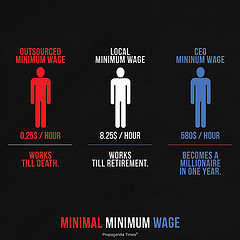
The US federal minimum wage has been a hot topic in 2013, starting with President Obama’s proposal in February to increase the federal minimum wage to $9/hour. Then, over the summer, McDonald’s was the source for national ridicule after releasing a financial planning document for its workforce that suggested employees would need to work two full-time entry level jobs in order to pay for basic monthly expenses. Most recently, thousands of fast food workers from across the nation went on strike to increase the federal minimum wage to $15/hour. Is living on a minimum wage income really that tough? And if it is, why is it so difficult to simply increase it?
In most cases, living off a minimum wage income is simply not feasible, especially for single parents.
- Kathryn Edin and Laura Lein, 1997. Making ends Meet: How Single Mothers Survive Welfare and Low-Wage Work. New York:Russell Sage Foundation.
Much of the reluctance to increase the minimum wage stems from the fear that higher wages would force companies to raise prices and hire fewer employees. However, these anxieties are largely unfounded.
- Lawrence F. Katz and Alan B. Kreuger, 1992. “The effect of minimum wage on the fast food industry”