social institutions

Sociology Twitter lit up after the US Women’s National Team’s World Cup win with the revelation that many of their players were sociology majors in college. It is an inspiration to see the team succeed at the highest levels and call for social change while doing so.

https://twitter.com/nedasoc/status/1148237568481398784

This news also raised an interesting question: do student athletes major in sociology because it is a compelling field (yay, us!) or because they are tracked into the major by academic advisors who see it as an “easy” choice to balance with sports?

According to data from the NCAA, the most common majors for both student athletes and the wider student body at Division 1 schools are business, STEM, and social sciences. Trend data show the biggest difference is in the choice between business and STEM; both groups seem to pick up social science majors at similar rates.
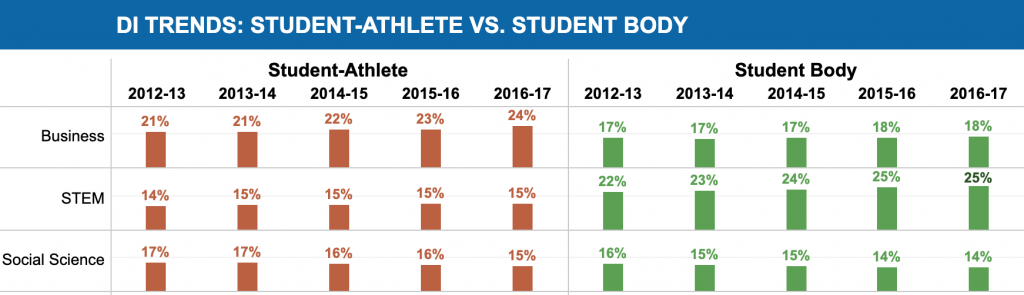
Source: NCAA D1 Diploma Dashboard

While the rate of majors is not that different, there is something special that sociology can do for these students. Student athlete lives are heavily administered. Between practice, conditioning, scheduled events, meals, and classes, many barely have a few hours to complete a full load of course work. In grad school, I tutored many student athletes who were sociology majors, and I watched them juggle their work with the demands of heavy travel schedules and intense workouts, all under the watchful eye of an army of advisors, coaches, mentors, and doctors. The experience is very close to what Erving Goffman called a “total institution” in Asylums:

“A total institution may be defined as a place of residence and work where a large number of like-situated individuals, cut off from the wider society for an appreciable period of time, together lead an enclosed, formally administered round of life. (1961, p. xiii)”

We usually associate total institutions with prisons and punishment, but this definition highlights the intense management that defines the college experience for many student athletes. When I tutored athletes in sociology, we spent a lot of time comparing their readings to the world around them. Sociological thinking about institutions, bureaucracy, and work gave them a language to think about and talk about their experiences in context.

Athletic programs can be complicated for colleges and universities, and there is ongoing debate about how the “student” status in student athlete shapes their obligation to pay for all this work. As debates about college athletics continue, it is important for players, fans, and administrators to think sociologically about their industry to see how it can better serve players as both students and athletes.

Evan Stewart is an assistant professor of sociology at University of Massachusetts Boston. You can follow his work at his website, or on BlueSky.
Read more at There’s Research on That (here and here)

The U.S. midterm elections are upon us this week, and everyone is trying to get out the vote. This is important, since voter turnout in this country is relatively low, but we also have to remember that there are institutional reasons why turnout is low in some areas that have nothing to do with voters’ motivation. Commentators often talk about gerrymandering and voter suppression policies, but what do these look like in practice, and what kind of impact do they have? Social science research can show us.

Gerrymandering occurs when legislators redraw voting districts in order to concentrate their electoral dominance. Political sociologists have shown that full voting rights are not as guaranteed in the United States as in many other major democracies, especially for low-income voters and communities of color in the electoral process. For example, partisan gerrymandering reduced access to communication between ward residents, local nonprofits, and their political representatives in Chicago. There is also evidence it changed voters’ choices in Georgia.

Bureaucratic policies can also enforce voter suppression by making it harder for people to register and to vote. After the 2010 midterm elections, there was a wave of laws that seemed to bolster voting requirements, such as new ID laws and proof of residence. And while strengthening voter requirements may seem benign at first, these rules restrict access to people who are less likely to have identification and proof of residence — people of color, the elderly, and the poor. In essence, such laws make it harder for only some people to vote. Research suggests that Republican leadership and legislatures are more likely to push for these laws.

Policies like these show why it is especially important to stay connected with the politics and to help others to vote where you can. Regardless of your personal preferences, we have a collective responsibility to defend the democratic process for everyone.

Amber Joy Powell is a PhD student in sociology at the University of Minnesota. Her current research interests include punishment, sexual violence and the intersections among race, gender, age, and sexuality. Her work examines how state institutions construct youth victimization.

Neeraj Rajasekar is a PhD candidate in sociology at the University of Minnesota interested in the intersections of “diversity” discourses, racial factors, and cultural ideologies.

Caity Curry is a PhD student in sociology at the University of Minnesota. Her research interests include the sociology of punishment and social control, especially the causes and consequences of mass incarceration and mass supervision.

Social institutions are powerful on their own, but they still need buy-in to work. When people don’t feel like they can trust institutions, they are more likely to find ways to opt out of participating in them. Low voting rates, religious disaffiliation, and other kinds of civic disengagement make it harder for people to have a voice in the organizations that influence their lives.

And, wow, have we seen some good reasons not to trust institutions over the past few decades. The latest political news only tops a list running from Watergate to Whitewater, Bush v. Gore, the 2008 financial crisis, clergy abuse scandals, and more.

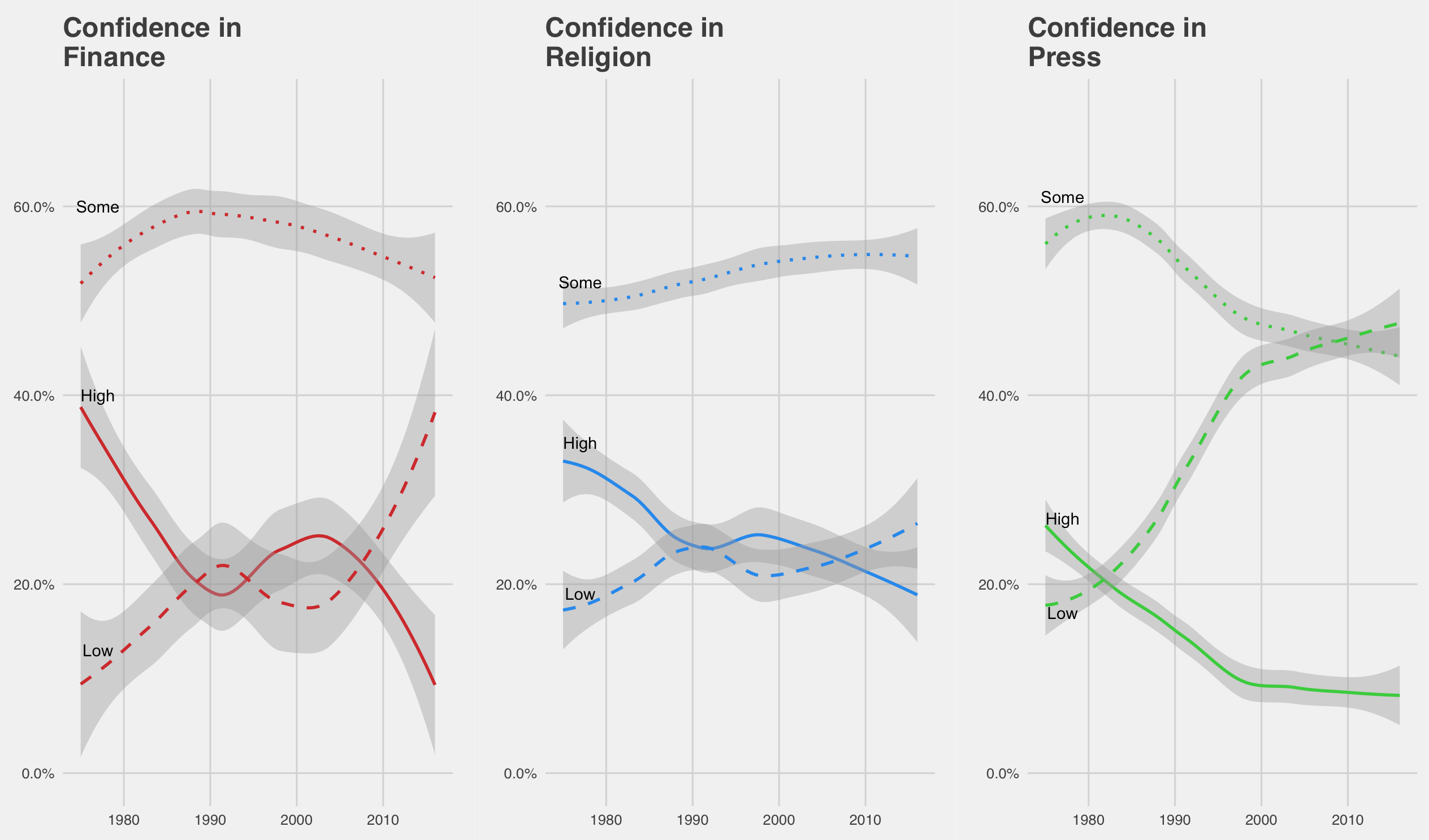
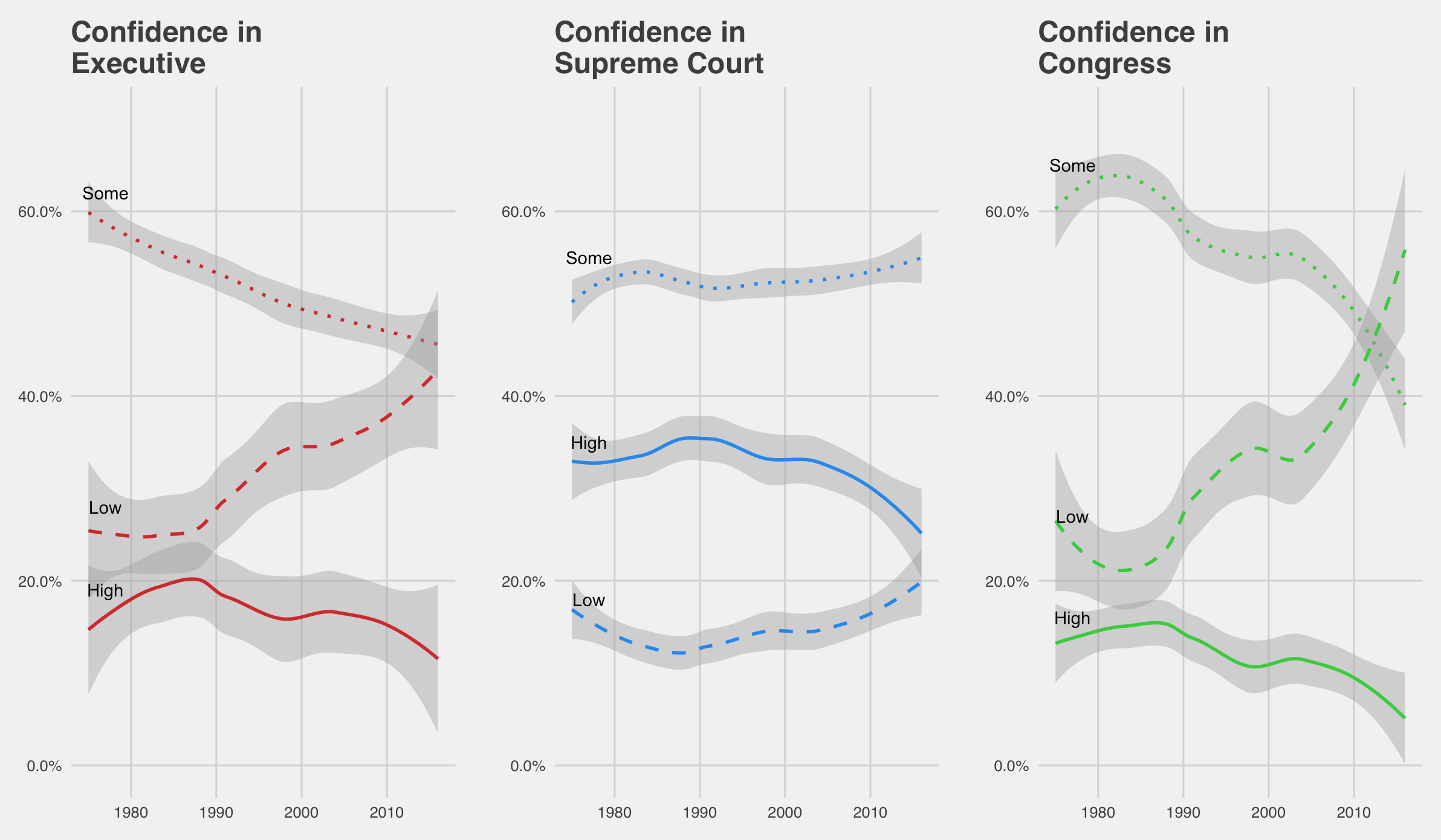
Using data from the General Social Survey, we can track how confidence in these institutions has changed over time. For example, recent controversy over the Kavanaugh confirmation is a blow to the Supreme Court’s image, but strong confidence in the Supreme Court has been on the decline since 2000. Now, attitudes about the Court are starting to look similar to the way Americans see the other branches of government.

(Click to Enlarge)
Source: General Social Survey Cumulative File
LOESS-Smoothed trend lines follow weighted proportion estimates for each response option.

Over time, you can see trust in the executive and legislative branches drop as the proportion of respondents who say they have a great deal of confidence in each declines. The Supreme Court has enjoyed higher confidence than the other two branches, but even this has started to look more uncertain.

For context, we can also compare these trends to other social institutions like the market, the media, and organized religion. Confidence in these groups has been changing as well.

(Click to Enlarge)
Source: General Social Survey Cumulative File

It is interesting to watch the high and low trend lines switch over time, but we should also pay attention to who sits on the fence by choosing some confidence on these items. More people are taking a side on the press, for example, but the middle is holding steady for organized religion and the Supreme Court.

These charts raise an important question about the nature of social change: are the people who lose trust in institutions moderate supporters who are driven away by extreme changes, or “true believers” who feel betrayed by scandals? When political parties argue about capturing the middle or motivating the base, or the church worries about recruiting new members, these kinds of trends are central to the conversation.

Inspired by demographic facts you should know cold, “What’s Trending?” is a post series at Sociological Images featuring quick looks at what’s up, what’s down, and what sociologists have to say about it.Evan Stewart is an assistant professor of sociology at University of Massachusetts Boston. You can follow his work at his website, or on BlueSky.
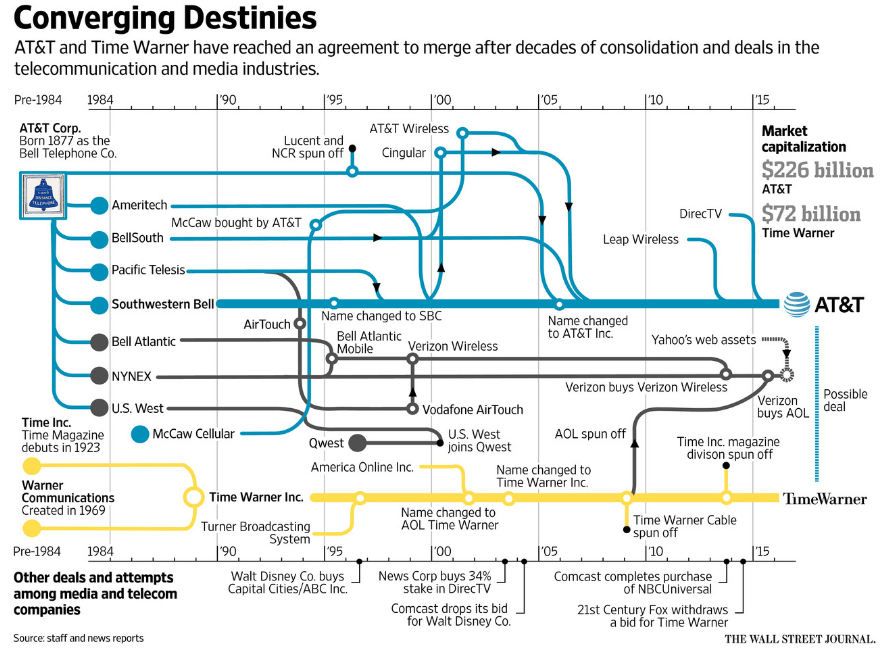
Last month one media behemoth, AT&T, stated it would purchase another, Time Warner, for $85.4 million. AT&T provides a telecommunications service, while Time Warner provides content. The merger represents just one more step in decades of media consolidation, the placing of control over media and media provision into fewer and fewer hands. This graphic, from the Wall Street Journal, illustrates the history of mergers for the latest companies to propose a merger:

4

The purchase raises several issues regarding consumer protections – particularly over privacy, competition, price hikes, and monopoly power in certain markets – and one of these is related to race.

A third of the American population identifies as Latino, African American, Asian American, and Native American, yet members of these groups own only 5% of television stations and 7% of radio stations. Large-scale mergers like the proposed one between AT&T and Time Warner exacerbate this exclusion. Minority-owned media companies tend to be smaller and mergers make it even harder to compete with larger and larger media conglomerates. As a result, minority-owned companies close or are sold and the barriers to entry get raised as well. The research is clear: media consolidation is bad for media diversity.

After the #OscarsSoWhite controversy, the Academy of Motion Picture Arts and Sciences committed to increasing diversity on screen and technology companies have vowed to increase their workforce diversity, but such commitments have done relatively little to improve representation. Such “gentlemen’s agreements” are largely voluntary and are mostly false promises for communities of color.

Advocacy groups and federal authorities should not rely on Memorandum of Understandings to advance inclusion goals. When the AT&T/Time Warner deal gets to the Federal Communications Commission, scrutiny in the name of “public interest” should include the issue of minorities’ inclusion in both the media and technology industries. As a diverse nation struggling with ongoing racial injustices, leaving underrepresented communities out of media merger debates is a disservice not only to those communities, but to us all.

Jason A. Smith is a PhD candidate in the Public Sociology program at George Mason University. His research focuses on race and the media. He recently co-edited the book Race and Contention in Twenty-first Century U.S. Media (Routledge, 2016). He tweets occasionally.