

podcasts

Photo courtesy Letta Page

Despite, well, everything, we are trying to get back into the classroom as much as we can at the start of a new academic year. I am scheduled to teach Introduction to Sociology for the first time this coming spring and planning the course this fall.

Whether in person or remote, I will be ecstatic to introduce our field to a new batch of students — to show them what sociologists do, how we work, and how we think about the world. Thinking about those foundations, the start of an academic year is a great time to come back and ask “what, exactly, are we doing?”

I have been thinking a lot about that question in our current chaotic moment and in the context of sociology’s changing role in higher eduction. This chart made by Philip Cohen keeps coming to mind:
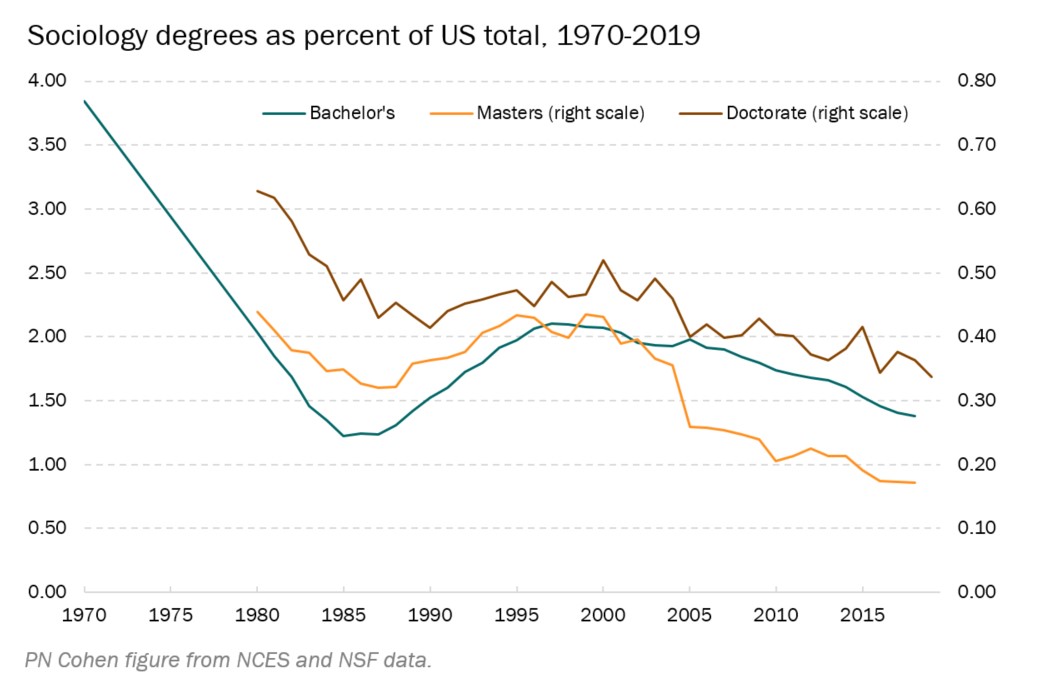
Source: Philip Cohen – original post at Family Inequality

There are a lot of reasons for the decline in sociology majors, and reflections on our purpose as a field are not new at all (examples hereherehere, and on the social sciences in general here). We all bring different ideas about our common methods and missions, and our field has plenty of room for many different sociologies. I like big-tent approaches like the one here at The Society Pages.

For newcomers, though, that range makes it hard to grasp what sociologists actually do, and that makes it tough to do right by our students. At some point, someone is going to ask a new sociology major the dreaded question: “what do you do with that?” I think we have a responsibility to model ways to answer that question clearly and directly, even if we don’t want to lock students into narrow careerist ambitions. A wonky answer about ~society~ doesn’t necessarily help them.

That’s why I love these recent podcast episodes with Zeynep Tufekci. In each case, the hosts ask her how she got so much right about COVID-19 so early in the pandemic. In both, her answers explicitly show us how insights about relationships, organizations, and stigma helped to guide her thinking. These interviews are a model for showing us what sociological thinking actually can do to address pressing issues.

Far too often, our institutions miss out on the benefits of thinking about social systems and relationships in this way. Sources like these help to sell sociology to our students, and they will be a big part of my upcoming intro course. In the coming weeks, we’ll be running more posts that focus on going back to basics for newcomers in sociology, including updates to our “What’s Trending?” series and more content for the intro classroom. Stay tuned, and share how you sell sociology to your students!

Evan Stewart is an assistant professor of sociology at University of Massachusetts Boston. You can follow his work at his website, or on BlueSky.
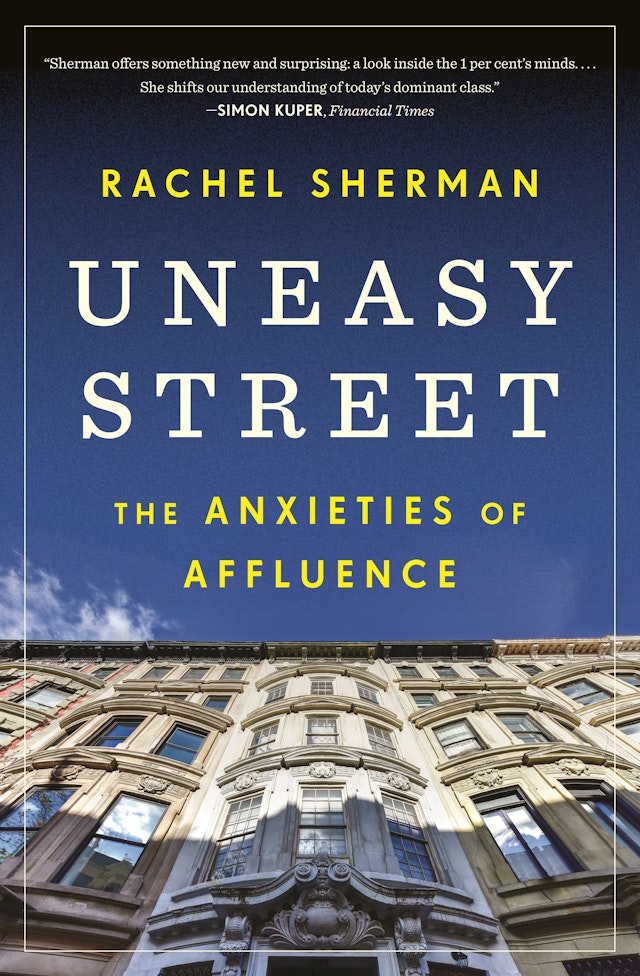

I love this podcast conversation with Rachel Sherman and Anne Helen Petersen about Sherman’s recent book, Uneasy Street: The Anxieties of Affluence. It is a great source for introduction to sociology courses looking to open up a conversation about differences in social class, especially because it draws attention to the fact that people do a lot of work to hide that social class position.

When we think about wealth, it is tempting to focus on flaunting riches through conspicuous consumption of flashy clothes, large homes, and other reality TV fodder. Sherman’s work makes an important point: phrases like “middle class” actually do a lot to hide our economic positions in society, and wealthy people often work to manage others’ perceptions of their wealth.

The podcast pairs well with a recent Twitter thread from John Holbein tracing research from around the world on how people’s perceptions of their economic position line up with their actual income and wealth. In case after case, many people report a social class that doesn’t line up with what they actually have.

This is a point I always try to make with my students: our social relationships are as much about the things we hide and avoid talking about as the things we openly share with each other. One of the most powerful points sociologists can make is to show these hidden patterns in the way we interact. The goal is not to call people out or to accuse them of lying, but rather to ask ourselves what it is about our economic lives that makes us want to work so hard to manage others’ perceptions in this way.

Evan Stewart is an assistant professor of sociology at University of Massachusetts Boston. You can follow his work at his website, or on BlueSky.

Photo via Oli (Flickr CC)

Whether you’re taking a long flight, taking some time on the treadmill, or just taking a break over the holidays, ’tis the season to catch up on podcasts. Between long-running hits and some strong newcomers this year, there has never been a better time to dive into the world of social science podcasts. While we bring the sociological images, do your ears a favor and check these out.

Also, this list is far from comprehensive. If you have tips for podcasts I missed, drop a note in the comments!

New in 2017

If you’re new to sociology, or want a more “SOC 101” flavor, The Social Breakdown is perfect for you. Hosts Penn, Ellen, and Omar take a core sociological concept in each episode and break it down, offering great examples both old and new (and plenty of sass). Check out “Buddha Heads and Crosses” for a primer on cultural appropriation from Bourdieu to Notorious B.I.G.

Want to dive deeper? The Annex is at the cutting edge of sociology podcasting. Professors Joseph Cohen, Leslie Hinkson, and Gabriel Rossman banter about the news of the day and bring you interviews and commentary on big ideas in sociology. Check out the episode on Conspiracy Theories and Dover’s Greek Homosexuality for—I kid you not—a really entertaining look at research methods.

Favorite Shows Still Going Strong

In The Society Pages’ network, Office Hours brings you interviews with leading sociologists on new books and groundbreaking research. Check out their favorite episode of 2017: Lisa Wade on American Hookup!

Felling wonky? The Scholars Strategy Network’s No Jargon podcast is a must-listen for the latest public policy talk…without jargon. Check out recent episodes on the political rumor mill and who college affirmative action policies really serve.

I was a latecomer to The Measure of Everyday Life this year, finding it from a tip on No Jargon, but I’m looking forward to catching up on their wide range of fascinating topics. So far, conversations with Kieran Healy on what we should do with nuance and the resurrection of typewriters have been wonderful listens.

And, of course, we can’t forget NPR’s Hidden Brain. Tucked away in their latest episode on fame is a deep dive into inconspicuous consumption and the new, subtle ways of wealth in America.Evan Stewart is an assistant professor of sociology at University of Massachusetts Boston. You can follow his work at his website, or on BlueSky.