gender: work

Merinda B. sent in an interesting example of the use of gendered discourses in airline marketing. Last fall British Airways released “To Fly. To Serve,” a commercial touting the bravery and adventurousness of BA pilots. These pilots, who heroically pushed into the frontiers of air travel and now ensure the safety and comfort of their travelers, are presented as exclusively male:

Transcript:
Those first young men, the pioneers, the aviators. Building superhighways in an unknown sky. Leaving wives and children in their snug homes with just a kiss and a promise to return. Roaring into the clouds to battle wind and stars. Their safety system built of brain and heart. They landed where there were no lights. Transforming strange names from tall tales into pictures on postcards home. And those next young men, travelling further, faster, higher then any in history, are the ones that followed them. Who skimmed the edge of space, the edge of heaven, the edge of dreams. And we follow them up there, to live by an unbreakable promise. The same four words stitched into every uniform of every Captain that takes their command: To fly. To serve.
As Merinda pointed out, while the British Airways of 1920 presumably had all-male pilots, that’s certainly no longer true in 2011. BA hired its first female pilot in 1987; indeed, she flew the first flight to land at Heathrow airport’s recently-added Terminal 5 in 2008. As of 2008, BA had about 175 female pilots on staff. Yet the ad reserves the heroic pilot role only for men. Women appear in the role of worried wife, waiting at home while her brave husband is off to do “battle” (similar to imagery of wives waiting on the homefront while soldiers go off to war) or as passengers, safe in the hands of their trusty male pilots; even in the modern scenes, this romanticized pilot-as-soldier role is imagined as male-only.

In another example of gendered marketing, German airline Lufthansa recently mailed ads to male customers, encouraging them to sign up for a new credit card. Nothing particularly out of the ordinary there, but the ad campaign, sent to us by Katrin, drew a lot of attention — and criticism — because the credit card in question wasn’t for the men themselves, but for their female partners. The Women’s Special card was offered as an add-on to male frequent fliers who have a Lufthansa Miles-and-More account:
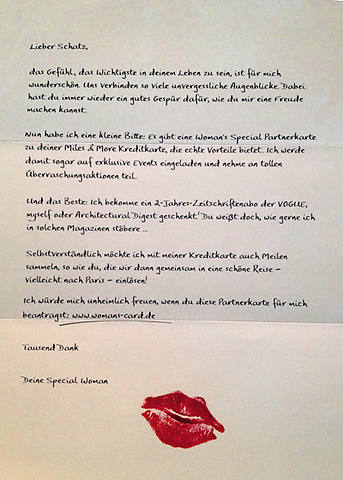
Written as a letter from a woman to her male partner, many felt the ad reinforced stereotypes of female dependence and consumerism. Katrin provided a translation:

Dear Honey,
The feeling that I am the most important thing in your life is wonderful for me. We are bound together by so many unforgettable moments. During which you again and again had a great feel for how to make me happy. Now I have a small plea: There is a Woman’s Special partner card to your Miles & More credit card which offers real benefits. With it I will even be invited to exclusive events and will take part in great surprise activities. And the best part: I’ll get a 2-year-subscription to VOGUE magazine, Myself  or to the Architectural Digest as a gift. You know how much I like browsing these kind of magazines… Of course I also want to collect miles with my credit card, just like you, which we can then redeem for a nice trip together- maybe to Paris! It would make me very happy if you could apply for this partner card for me: www.womans-card.de
Thousand times thank you,
 Your Special Woman
Part of the criticism sprang from the explicitly gendered program; the card, after all, isn’t called the Partner’s Special, or Spouse’s Special, but specifically the Woman’s Special. As The Local, a German English-language news site, reported, one German businesswoman, Anke Domscheit-Berg, Tweeted, “Will I be getting a letter from my sweetheart asking if he can have a partner credit card to go shopping with?” Presumably not — there is no equivalently-named (or even gender-neutral) option targeting the male partners of account holders.

On this day in 1963 the U.S. Congress passed the Equal Pay Act, a law designed to end wage discrimination against women.

How to get the word out? Advertising of course!

Thanks to Sean D. for the link!

Lisa Wade, PhD is an Associate Professor at Tulane University. She is the author of American Hookup, a book about college sexual culture; a textbook about gender; and a forthcoming introductory text: Terrible Magnificent Sociology. You can follow her on Twitter and Instagram.

Cross-posted at Family Inequality.

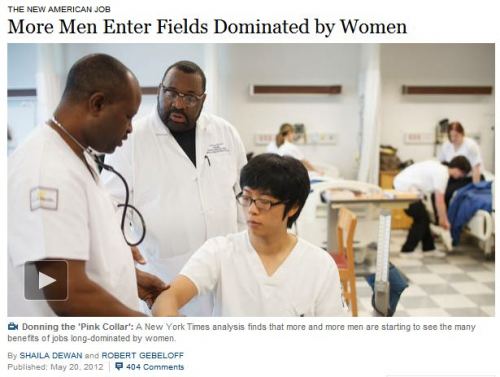
Lots of buzz over a New York Times article about men moving into female-dominated occupations, which reported that “more and more men are starting to see the many benefits of jobs long-dominated by women.”

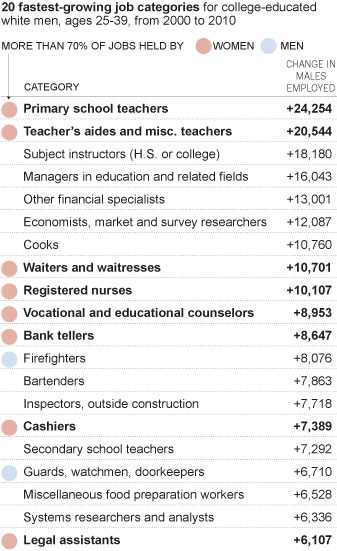
The Times produced this table, which shows the fastest growing occupations for (for some reason) college-educated White men, ages 25-39:

The ones with the pink dots are 70% female or more. The increase of young college educated White men in these occupations over 10 years appears striking, but the numbers are small. For example, compare that increase of (round numbers) 10,000 young White male registered nurses to the 1,900,000 full-time year-round nurses there were in 2010.

Moreover, consider that increase of 10,000 nurses in light of the overall growth of registered nurses from 2000 to 2010: about 500,000. Overall, the representation of men among full-time year-round registered nurses increased from 9.4% to 10.3% during the decade.

The Times article attempts to describe a broad trend of men moving into “pink-collar” jobs:

The trend began well before the crash, and appears to be driven by a variety of factors, including financial concerns, quality-of-life issues and a gradual erosion of gender stereotypes. An analysis of census data by The New York Times shows that from 2000 to 2010, occupations that are more than 70 percent female accounted for almost a third of all job growth for men, double the share of the previous decade.

Bold claims. But check the next sentence: “That does not mean that men are displacing women — those same occupations accounted for almost two-thirds of women’s job growth.” So, lots more men are in these jobs, but even more women are? How does that reflect an “erosion of gender stereotypes”? It seems like it reflects an increase in the size of female-dominated occupations.

In fact, as I reported briefly before, occupational gender segregation dropped barely a hair in the 2000s, from 51 to 50 on a scale of 0 to 100, compared with drops of 5 or 6 points in the decades before 1990. That is a lost decade for integration.

And if you look specifically at the category the Times chose — occupations that are 70% female or more — the percentage of men in those occupations increased, but only from 5.0% to 6.1%. And nurses? In 2010, 0.4% of all full-time year-round working men were nurses, up from 0.3% in 2000. Women are still 11-times more likely to be nurses than men.

Now that’s what you call a “gradual erosion of gender stereotypes.”

Sources: U.S. Census tables for 2000 and 2010 (table B24121).

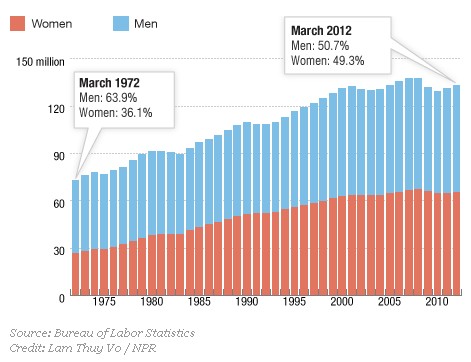
NPR’s Planet Money asks an interesting question.  If there are more women in the workforce now than there were forty years ago (and there are), where did all the additional jobs come from?

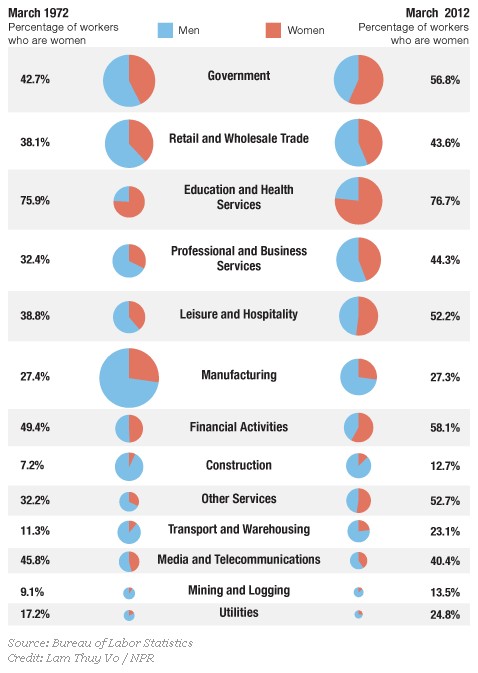
The pie charts below tell some of the story.  On the left are charts representing the percentage of women in various occupations in 1972.  The size of the circle corresponds to the size of the sector: larger is equivalent to more total jobs; on the right are the same charts for 2012.

Notice two trends: first,  in almost all categories today women are a larger percentage of the workers than they were in 1972 and, second, many of the occupational sectors that have high percentages of women have grown (e.g., education and health), whereas many in which men dominate have shrunk (e.g., manufacturing, media/telecommunications).

So, as women have joined the workforce, they’ve contributed to the overall growth of the American workforce and, specifically, filled the demand for employees in growing occupations.

Lisa Wade, PhD is an Associate Professor at Tulane University. She is the author of American Hookup, a book about college sexual culture; a textbook about gender; and a forthcoming introductory text: Terrible Magnificent Sociology. You can follow her on Twitter and Instagram.

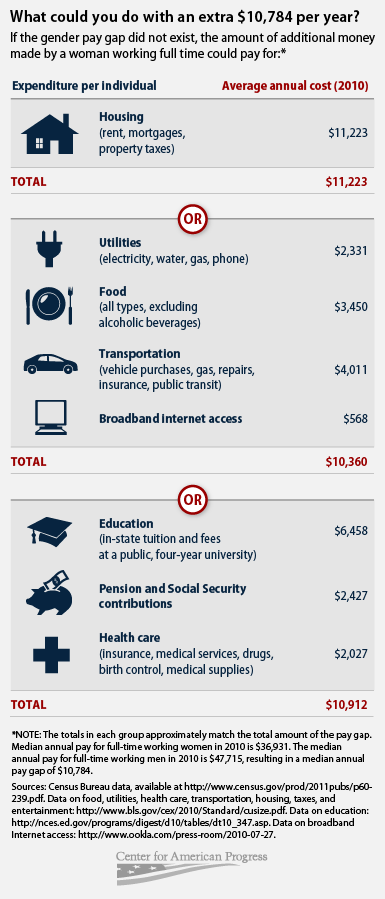
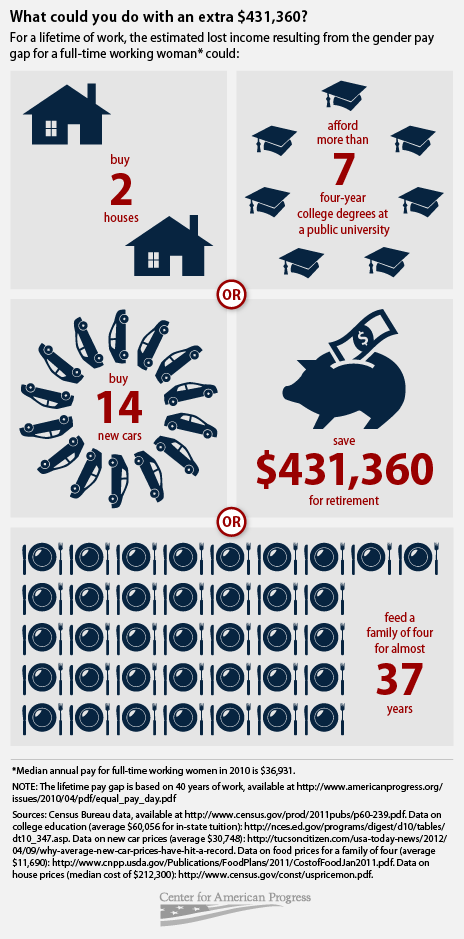
While income inequality between the sexes has decreased in recent decades, women still only make seventy-seven cents for every dollar a man is paid. Matt Separa from the Center for American Progress illustrated what could be bought with those lost wages to help us conceptualize how wide the wage gap is.

His first chart shows how the $10,784 in underpaid wages would almost cover annual housing costs or could pay the combined costs of a year’s worth of utilities, food, transportation, and internet access with a few hundred dollars to spare. The lost wages could also almost pay all the expenses for annual in-state tuition at a public university, twelve months of contributions to Social Security, and basic medical care for a year:

His second chart illustrates how across a lifetime, the lost wages ($431,360) could buy two houses, seven degrees from public universities, fourteen cars, or pay for a family of four to eat for thirty-seven years.   Many of Spera’s examples, including real estate, tuition and retirement savings, are especially powerful because they show how the lost wages could be turned into capital and wealth that would pay even more dividends on top of the lost income:

Overall, the graphs do a nice job of making the implications of the gender wage gap concrete.

—————

Jason Eastman is an Assistant Professor of Sociology at Coastal Carolina University who researches how culture and identity influence social inequalities.

Sociologists have observed that employment in the U.S. is largely structured around an assumption that the worker has no family responsibilities.  The ideas that an employee should be able to work during non-school hours, stay late when needed, take off time for their own illness but never anyone else’s, for example, all presume that the workers have either no children or someone else taking care of children for them.

Most jobs, then, are not designed to be compatible with family responsibilities.  Since most people doing primary child care are women, this hurts mothers disproportionately.  Mothers have a more difficult time being the “perfect employee” and also face discrimination from employers.  This translates into some telling numbers.  Women make about 69% of what men make (not controlling for type of occupation), but most of this disadvantage is related to parental status, not sex. Women without children make 90% of what men make, while mothers make 66%.  Ann Crittenden’s book, The Price of Motherhood, lays out these numbers starkly.

These issues are at the heart of this well-crafted Ampersand cartoon by B. Deutsch, which prompted this post in anticipation of Mother’s Day in the U.S.

Lisa Wade, PhD is an Associate Professor at Tulane University. She is the author of American Hookup, a book about college sexual culture; a textbook about gender; and a forthcoming introductory text: Terrible Magnificent Sociology. You can follow her on Twitter and Instagram.

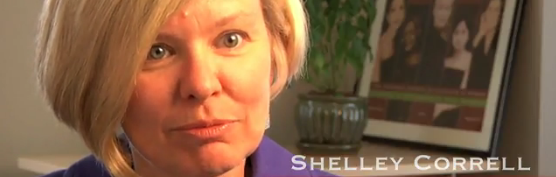
In this three-minute clip, sociologist Shelley Correll discusses her research on the “motherhood penalty.”  The phrase refers to the finding that being a mom specifically, not just being female or being a parent, leads to lower income. Scholars have begun to realize just how significant this is. As Correll explains, the pay gap between women with and without children is larger than that between women and men:

For more, see the full text of Correll’s paper titled “Getting a Job: Is There a Motherhood Penalty.”

Lisa Wade, PhD is an Associate Professor at Tulane University. She is the author of American Hookup, a book about college sexual culture; a textbook about gender; and a forthcoming introductory text: Terrible Magnificent Sociology. You can follow her on Twitter and Instagram.

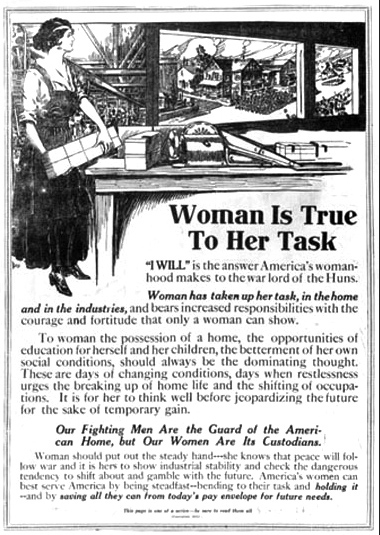
Yesterday, in honor of May Day, Anna North at Buzzfeed Shift posted a set of photos on the history of women in the (mostly U.S.-based) labor movement. One that I found particularly interesting was this 1918 poster urging women to be both thrifty and productive industrial workers as they play their role in winning World War I:

Note how patriotism is clearly connected to the idea of women having more opportunities:

To woman, the possession of a home, the opportunities of education for herself and her children, the betterment of her own social conditions, should always be the dominating thought.

But the poster simultaneously warns them against using their freedom for their own pleasure at the expense of the nation:

…restlessness urges the breaking up of home life and the shifting of occupations. It is for her to think well before jeopardizing the future for the sake of temporary gain…it is hers to show industrial stability and check the dangerous tendency to shift about and gamble with the future. America’s women can best serve American by being steadfast — bending to their task and holding it — and by saving all they can from today’s pay envelope for future needs.

So women are encouraged to think of themselves as empowered workers, with increased opportunities available to them, but only to the degree that this makes them reliable, productive workers and thrifty citizens, drawing on ideas of women’s special role in the home. Just as women are the “custodians” of their homes, they must also ensure “industrial stability” by sticking with their jobs for the good of the nation — a choice which might, of course, conflict with a woman’s efforts to improve her own or her family’s social conditions by, say, taking a job that pays more or has better working conditions. The poster encourages women to consider their opportunities, but ties those opportunities tightly to the common good of the nation and the family, ultimately warning women against too much pursuit of individual self-interest.