Search results for The

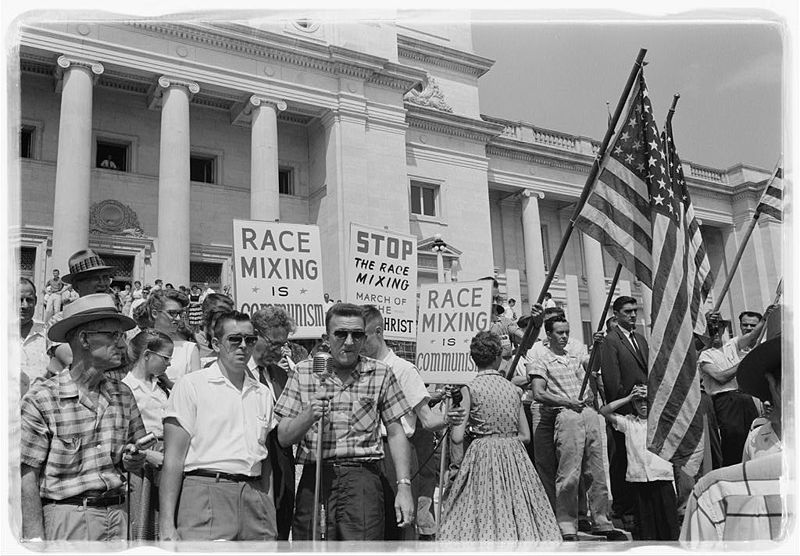
Protesters in Little Rock, Arkansas, (1959) declared that “race mixing” (or school integration) was “communism”:
800px-Little_Rock_integration_protest

A reader at Andrew Sullivan’s The Daily Dish argues that accusations of communism then, and socialism now, are not only about the redistribution of wealth.  They are about the redistribution of privilege of all kinds, including white privilege.

Read it here.

Thanks to Dmitriy T.M. for the link.

—————————

Lisa Wade is a professor of sociology at Occidental College. You can follow her on Twitter and Facebook.
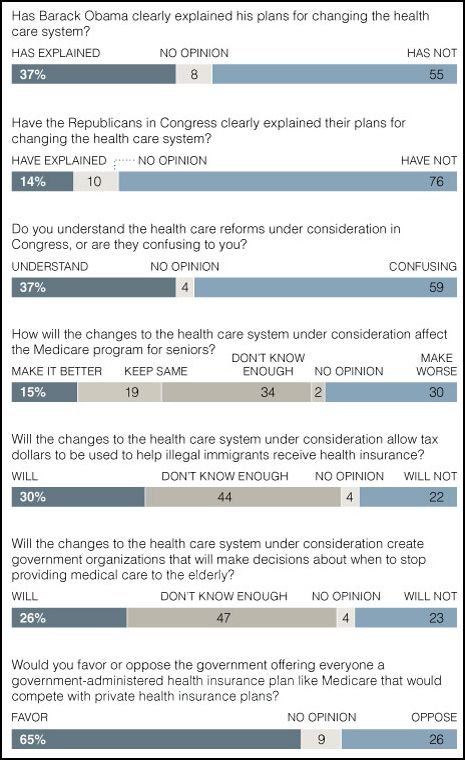
This interesting data from the New York Times suggests that Americans are largely confused about what the hell politicians are trying to do with health care, but they really do want a public option:

Capture

Despite the fact that 65% of Americans support a public option, the New York Timesheadline said that the public was “wary” of Obama on health care.

—————————

Lisa Wade is a professor of sociology at Occidental College. You can follow her on Twitter and Facebook.

I love beer. I also love wine and liquor, but beer’s what I come back to. Beer is plain ol’ delicious: every brand has a distinct flavor and it goes well with food or alone. It’s just intoxicating enough: if I don’t feel like getting wasted, one or two will do me, but steady drinking will get the job done fine if I’m in a partying mood.

My fella and I get tired of the same old, same old beer selection at our local Kroger, so when we travel out of state, we often pick up a lot of regional beers – up to 12 six packs when we have the cash! The beer boxes are my second favorite part of buying the beer after drinking it. Beer packaging is colorful and diverse, and often beautiful*:


The boxes serve as a runner around our walls. They’re a fascinating and unique decorative element of which I’m quite proud and which get a lot of comments from our friends. It’s a good record of our travels and our life together. They are not meant and usually are not read as endorsements of every beer we drink, but are in the context of over a hundred other examples of packaging. Pedestrian PBR is next to regional Yuengling, and obscure Backfin is next to a sampler pack. Every box that we (or occasionally a friend who works at a beer store) consume goes up on our wall, regardless of aesthetic or political merit: they are meant to provoke critique and examination of the relative merits and values in different packages of different beer.

Since I’m surrounded by the boxes all day, I begin to pick up on elements of their design. Namely, that males and whiteness are constantly normalized within the design of the boxes**:


Excepting the daguerreotype-esque Southern Ale, all of the men above are shown enjoying the beer, usually while engaging in their daily duties or in making the beer. The cottonwood man is not actively engaged, but he is holding the wheat that will make the beer, thus conferring involvement in the beer on him. The Highlands man is somewhat othered by the bagpipes, and I’m not sure how the man in the Rogue ale is constructed, but both are drinking and enjoying the beer they’re intended to represent. They are active and involved – not passive, not just drinking the beer, not just there. They are constructed as dynamic and effectual as they drink the beer. And they are all white: men of color are erased in beer packaging as far as I’ve seen.

Now, let’s look at the women that show up on the wall:

Women love to drink. Women love beer. But you would never know it from their scarce representation in beer packaging.

In the beer packages I’ve got up, women are not engaged in the act of drinking the beer that they represent. In fact, they’re not engaged in anything. Except opening their mouths, or, um, being on fire. They’re… objects. More specifically, sexual objects that have in most cases been disembodied. They’re floating heads, with their mouths open.

It gets worse when you look at how, specifically, the women of color are constructed. Look at the “Bad Penny” packaging above, and this one that I recently saw at a music festival:

The black women are constructed as reductive, exotic others, black women whose sexuality exists for the inebriated male gaze. It is not a coincidence that both have afros. Natural hair beautiful and laudatory, but there is only one kind of natural hair here: the style that is often problematized as dangerous and exotic, as another element that makes them an exotic experience for the male drinker.

Their sexuality is especially lacking in agency: the naked woman in the sexual chocolate ads is literally presented as an offering to the male gaze. She’s not engaged with the viewer by drinking, or by making eye contact. She is passive, and coded as naked: she is wearing a tube top, but it’s obscured by lettering of the same color as the top. A cartoon figure, she is not active; she is just there, waiting to be debased.

The “Bad Penny” character is making eye contact, but her eyes are heavily lidded, unlike the white women above. I took the “bad” in the name of the beer to be capitalization on blaxploitation by an alcohol company that aligns itself with kyriarchical forces: it’s the “Big Boss”. If the producer of this beer is the boss, where does that leave the women who hawk it?

Speaking of othering, let’s look at another one I found online:

Note again the heavily lidded eyes, the more explicit nudity. Though she is at least shown to be holding liquid, she’s not drinking it or enjoying it; she’s pandering to the male gaze with an oh-so-subtle finger in her mouth.

This is supposed to construct Aztec culture (which I am not well-versed in discussing). Please note the feathers, the background, and the jewelry as elements of othering and exoticization that I can’t fully articulate. Also not that this is not in a stein, as with most males shown with beer, but in some kind of “primitive”-looking stone goblet.

Women in the marketing of beer is a grim, grim field. Beer is a man’s drink, and women are excluded from independent enjoyment of it. They are not the drinkers of beer; they’re the sex that sells the beer, the static objects of intoxicated lust.

To end on a less grim note, I did come across one ad that struck me as positive:

This woman is not being objectified, or reduced to an othered sexual object. She is normalized by her whiteness, but also by her active enjoyment of beer. She’s drinking, which is what women do with beer.

ETA: meloukhia pointed out this label, which I’d seen before:

While the legs are somewhat sexual, and her eyes are closed, this woman is engaged and active – she is enjoying the beer, and life. Check out the comments for more beer packaging and discussion.

*It should be noted that while I appreciate the aesthetics of this example of packaging, this is an example of how voodoo is problematized and othered – especially when paired with a loaded word like “Dixie”.

**Many, though not all, of these packages repeat the imagery shown here in packaging of other varieties of beer.

—————————–

Rachel McCarthy James is a writer and tutor living in Virginia. She writes about feminism and stuff at Deeply Problematic.

If you would like to write a post for Sociological Images, please see our Guidelines for Guest Bloggers.

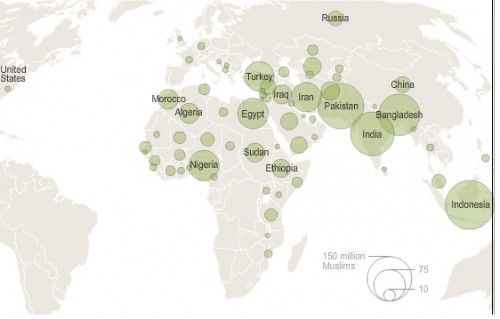
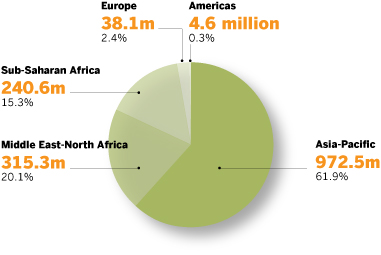
The Pew Forum on Religion & Public Life just released the results of a global study of Muslims. The interactive map lets you hover over a country and see what percent of its population is Muslim, and what percent of all Muslims reside there. It will be a surprise to many people to see what a small proportion of Muslims live in Arab countries.

Muslims

This map weights each country by population size (larger version here):

world-distribution-weighted

By region:

Pie-chart

Full report here.

Wonderful Pistachios has a new video featuring Levi Johnston, the guy famous only for nearly becoming Sarah Palin’s son-in-law when he and Bristol got pregnant. Here’s the video:

Hah! Because teen pregnancy and stuff = hilarious! If you’re the dad, anyway. I’m trying to imagine this video being made with a teen mom instead. Also, the silent Black man as an accessory to the White star is a great touch.

This just seems to be in terribly bad taste to me. Also, it’s an awfully long way to go to get to make a “do it” joke, and I’m not sure most people would get that the “protection” is the pistachio shell. I had to watch it about 3 times before I figured it out.

UPDATE: Apparently I didn’t actually figure it out. Reader DC says,

I think the “protection” they’re talking about is the black guy that’s supposed to be a bodyguard of some kind. The “does it” part is about cracking open the shell.

Duh. That makes sense. I mean, it makes sense that’s the “protection” they’re talking about. The video is still dumb.

And Ella says,

The guy is his real life body guard “Tank”. This may sound entirely unnecessary, but out of perverse curiosity I read the GQ feature about Mr. Johnston and the story is actually quite sad. It does delve into why he has Tank in his life.

The company really likes to say “do it,” apparently, as they do on this page letting you know there’s an app for your iPhone. An app where you crack pistachios.

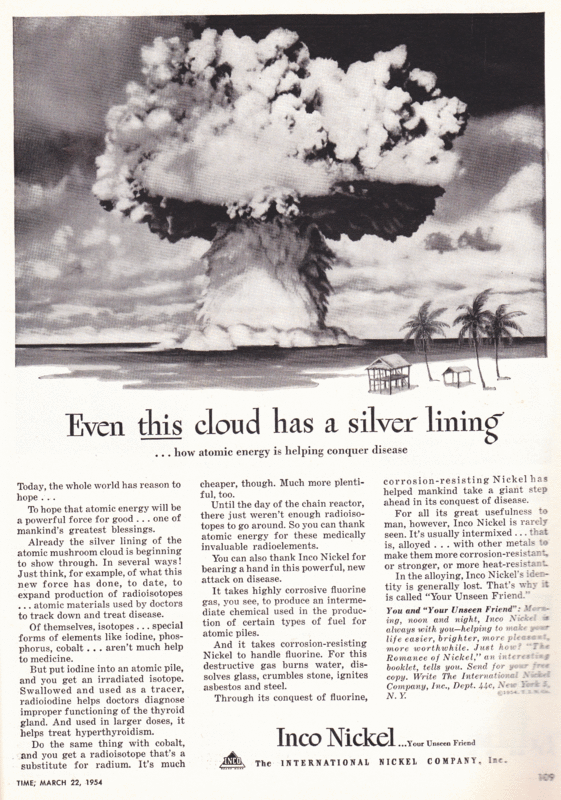
This ad’s unabashed assertion that a mushroom cloud can have  a “silver lining” reminds me of our posts on the evolution of the word “atomic” and Miss Atomic Bomb (1957).

IMG_0007

Via Vintage Ads.

—————————

Lisa Wade is a professor of sociology at Occidental College. You can follow her on Twitter and Facebook.


Dmitriy T.M. sent a link to a Cracked list of misguided products. Among them, was a discussion of a doll I remember from when I was a kid: the Cabbage Patch Kid Preemie.  Cabbage Patch Kids were all the rage.  The preemie version, a supposedly prematurely born “kid,” was a sort of spin off.

Cracked points out one of the ironies here:

So What’s the Problem?

You know what’s not all that cuddly? A one and a half-pound infant fighting for its fragile life in a coffin-shaped incubator with more tubes and machines attached to it than Weapon X. Don’t forget the bandages that keep the light out of its underdeveloped eyes, or the little heating beds it has to lay in because it can’t maintain its body heat. Toss in some weeping parents and a couple of nurses probing and prodding its frail little body and you’ve got the must-have toy of the season.

Given this deserved critique of the product, what exactly is it about the idea of a premature baby that would make Coleco think it would appeal to children and their parents?  I think this commercial gives us a clue:

The Cabbage Patch slogan, “You can give them all of your love,” is an excellent example of what this doll is really about: socializing young girls to be nurturers focused (apparently exclusively) on children.

In this case, what could possibly require more nurturing than an infant?  A premature infant!

The Cabbage Patch Kids website, where you can still buy preemies in addition to kids and babies, says that this premature version of the doll “will require extra attention and lots of Tender Loving Care. Be sure to spend lots of time with these tiny ones once you adopt.”  As Grandma reminds the girl, “Preemies need extra special care.”  And the girl responds in a way that implies that a baby that needs “extra special care” is even more rewarding than a baby that simply needs special care. The more self-sacrifice is required, the happier a girl will be.

Some deep and disturbing socialization indeed.

Oh and also, I couldn’t help but also share this doozy with you, from the description of the Preemie doll:

These small babies have no hair, but come with a choice of eye colors in blue, green, brown, and Asian.

—————————

Lisa Wade is a professor of sociology at Occidental College. You can follow her on Twitter and Facebook.

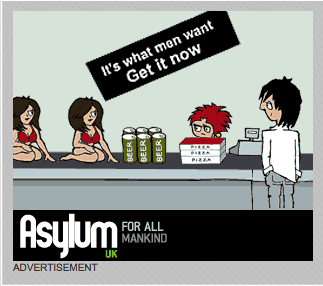
U.K. men’s magazine Asylum promotes itself, women’s objectification:

asylum_uk

Thanks to Giorgos S. for sending along the screen shots!

Other examples in which women are products here, here, here, here, here, and here.

—————————

Lisa Wade is a professor of sociology at Occidental College. You can follow her on Twitter and Facebook.