In the aftermath of Dylann Roof’s racist murder, some cities in the South are reconsidering their relationship to the Confederate Flag. Should it fly? Be in a museum? Burn? The discussion raises larger questions of how to move forward from ugly histories without simultaneously whitewashing a city’s past. And, as well, how do we know when something is truly in our past?

I was thinking about just these questions a couple weeks ago when a friend of mine walked me by the monument to the Crescent City White League in New Orleans. The conical stone was erected to commemorate the return of white supremacist government two years after a lethal insurrection against the Reconstruction state government in 1874. In that insurrection, thousands of former Confederate soldiers attacked the city police and state military. They killed 11 members of the NOPD and held city government buildings for three days before federal troops arrived and they fled.

Two years later, the white supremacist politicians were back in power and they placed the monument in a prominent place where Canal St. meets the Mississippi. The monument, to be clear, is in honor of cop-killing white supremacists.

Here it is in 1906 (source, photographer unknown):14

So, what to do with the thing?

In 1974 — one hundred years after the insurrection and 98 years after its erection — the city added a marker nearby distancing itself from the message of white supremacy. It read:

Although the “battle of Liberty Place” and this monument are important parts of the New Orleans history, the sentiments in favor of white supremacy expressed thereon are contrary to the philosophy and beliefs of present-day New Orleans.

In 1993, some of the original inscriptions were removed and replaced with this slightly more politically correct comment:

In honor of those Americans on both sides who died in the Battle of Liberty Place. … A conflict of the past that should teach us lessons for the future.

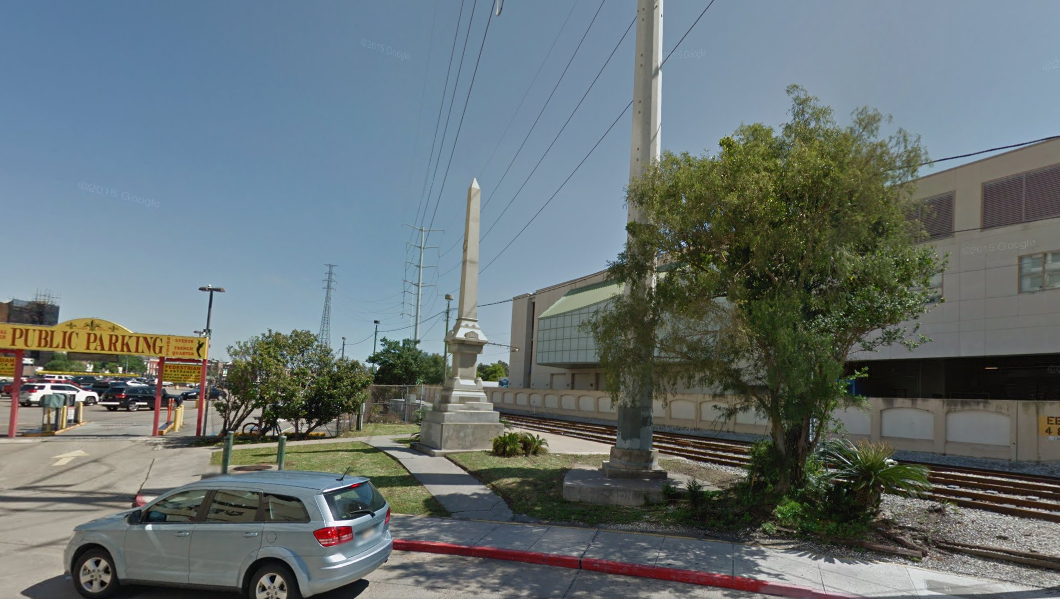
It was also moved to a new location. Today it sits between a flood wall, a parking lot, and an electrical substation. If you wanted to give a monument the finger, this is one way to do it. Here’s how it looks on Google Maps streetview:
3 4

So, the question is: What to do with these things?

I’ll admit that seeing the monument tucked into an unpleasant corner of New Orleans was somehow satisfying. But I was also uneasy about its displacement. Is this an example of New Orleans trying to repress knowledge of its racist history? (And present?) Or is it a sign that the city actively rejects the values represented by the monument? Conversely, if the city had left the monument at the foot of Canal St. would this be a sign that it took history seriously? And, thus, responsibility for its past? Or a sign that it didn’t take an anti-racist stance seriously enough?

This seems like an obviously difficult call to make, but I’m glad that we’re using the horror of Roof’s massacre to begin a discussion about how to handle symbols like these and, maybe, truly make them a part of our past.

Lisa Wade, PhD is an Associate Professor at Tulane University. She is the author of American Hookup, a book about college sexual culture; a textbook about gender; and a forthcoming introductory text: Terrible Magnificent Sociology. You can follow her on Twitter and Instagram.
One of the important conversations that has began in the wake of Dylann Roof’s racist murder in South Carolina has to do with racism among members of the Millennial generation. We’ve placed a lot of faith in this generation to pull us out of our racist path, but Roof’s actions may help remind us that racism will not go away simply by the passing of time.

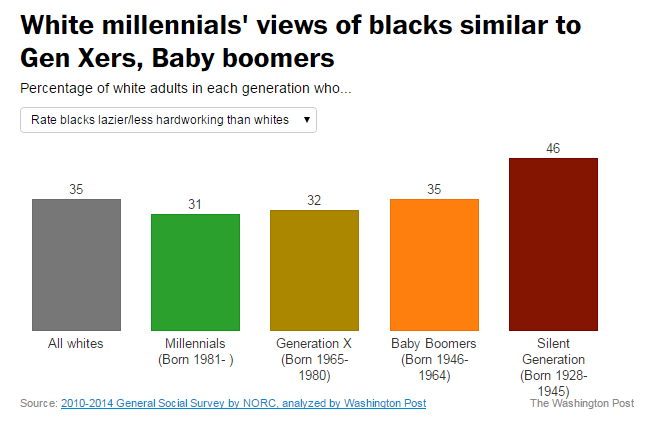
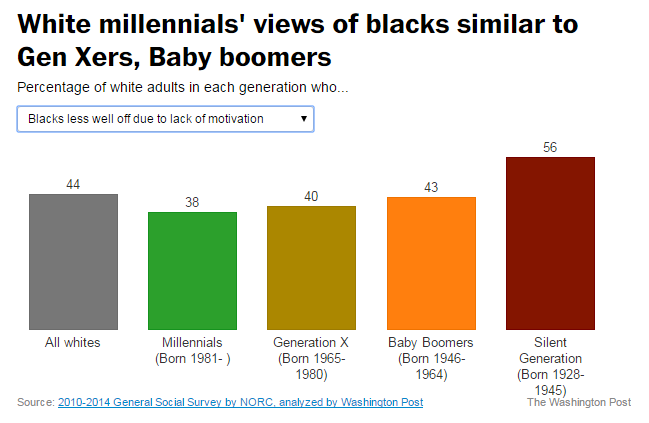
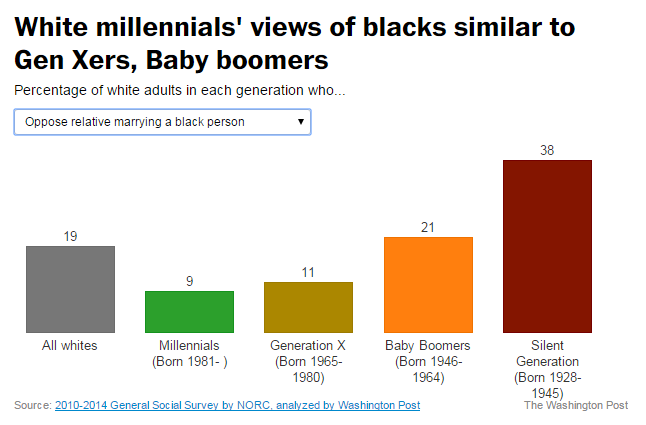
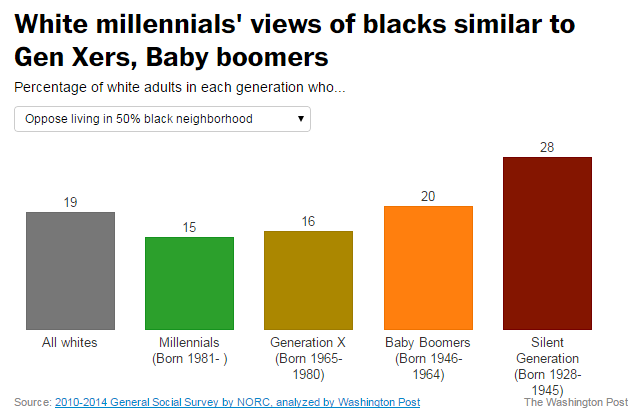
In fact, data from the General Social Survey — one of the most trusted social science data sets — suggests that Millennials are failing to make dramatic strides toward a non-racist utopia. Scott Clement, at the Washington Post, shows us the data. Attitudes among white millennials (in green below) are statistically identical to whites in Generation X (yellow) and hardly different from Baby Boomers on most measures (orange). Whites are about as likely as Generation X:

  • to think that blacks are lazier or less hardworking than whites
  • to think that blacks have less motivation than whites to do well
  • to oppose living in a neighborhood that is 50% or more black
  • to object if a relative marries a black person

And they’re slightly more likely than white members of Generation X to think that blacks are less intelligent than whites. So much for a Millennial rescue from racism.

4 5 6 7 8

All in all, white millennial attitudes are much more similar to those of older whites than they are to those of their peers of color.

***

At PBS, Mychal Denzel Smith argues that we are reaping the colorblindness lessons that we’ve sowed. Millennials today may think of themselves as “post-racial,” but they’ve learned none of the skills that would allow them to get there. Smith writes:

Millennials are fluent in colorblindness and diversity, while remaining illiterate in the language of anti-racism.

They know how to claim that they’re not racist, but they don’t know how to recognize when they are and they’re clueless as to how to actually change our society for the better.

So, thanks to the colorblindness discourse, white Millennials are quick to see racism as race-neutral. In one study, for example, 58% of white millennials said they thought that “reverse racism” was as big a problem as racism.

Smith summarizes the problem:

For Millennials, racism is a relic of the past, but what vestiges may still exist are only obstacles if the people affected decide they are. Everyone is equal, they’ve been taught, and therefore everyone has equal opportunity for success. This is the deficiency found in the language of diversity. … Armed with this impotent analysis, Millennials perpetuate false equivalencies, such as affirmative action as a form of discrimination on par with with Jim Crow segregation. And they can do so while not believing themselves racist or supportive of racism.

Lisa Wade, PhD is an Associate Professor at Tulane University. She is the author of American Hookup, a book about college sexual culture; a textbook about gender; and a forthcoming introductory text: Terrible Magnificent Sociology. You can follow her on Twitter and Instagram.

Comic by Wiley Miller. H/t to Larry Stern.

Lisa Wade, PhD is an Associate Professor at Tulane University. She is the author of American Hookup, a book about college sexual culture; a textbook about gender; and a forthcoming introductory text: Terrible Magnificent Sociology. You can follow her on Twitter and Instagram.
Flashback Friday.

Toban B. sent in some photographs and a discussion of how energy drinks are gendered.

Energy drinks are already gendered to begin with in a couple of different ways at least: (1) they are marketed as hydration for athletes and sports is a masculine arena and (2) women aren’t usually encouraged to consume “extra” calories. But, in addition to being seen as somehow for men, Toban shows how a particularly violent and aggressive kind of masculinity is reproduced in the marketing, even across different companies.

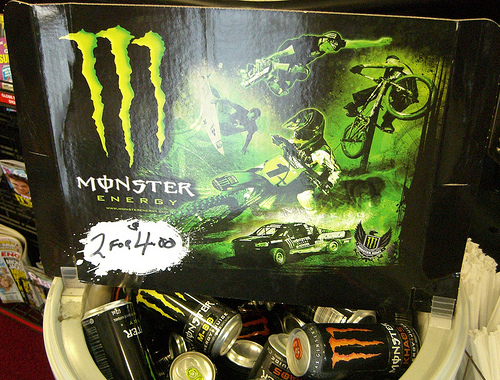
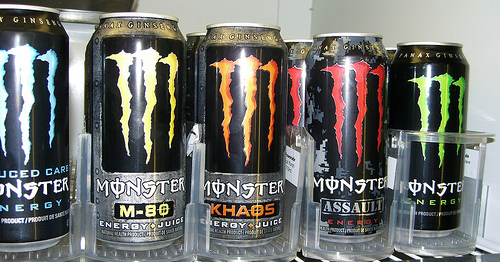
Monster energy drinks include slashes on the packaging that look like a vicious scratch and what appears to be a crosshair and bullet holes (bad aim?):

3740305675_f58d206a43

Notice that the “flavor” in the picture above is “Sniper.”  Toban notes that “Assault” and “M-80” are also flavors:

3714225276_711923c78f

The can for the Assault-flavored drink also features a camouflage design, invoking militarism.

They call their “shooters” “Hitman”:

3726673850_bedfee4d5a

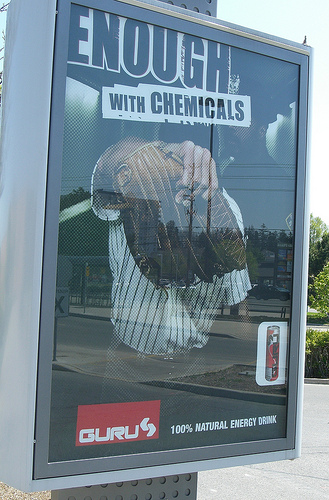
Both Monster and Guru link their product directly to (extreme) sports:

3729780513_781ebc3386

3531396720_d4452cfd26

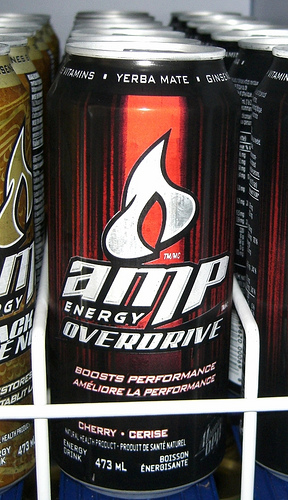
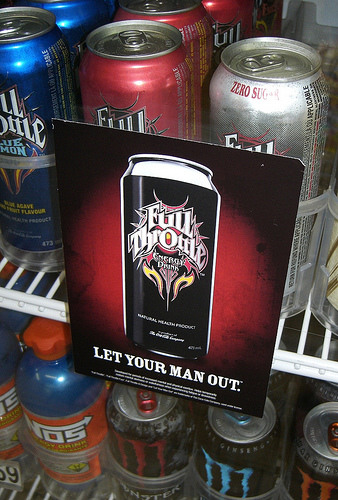
Full Throttle and Amp (“Overdrive”) go for a connection to aggressive driving:

3710431945_decf2af00a

3710397865_ae43b1d527xx

Full Throttle energy drinks make it explicit with the tagline, “Let Your Man Out.”

Toban notes that it’s ironic that a lot of these products are marketed as health drinks when, in fact, internalizing an aggressive form of masculinity is associated with taking health risks (e.g., refusing to wear seat belts or hard hats, drinking hard). “In any case,” Toban concludes, “this marketing normalizes and makes light of a lot of aggression and danger that we should be opposing.” And which, I will add, isn’t good for men or women.

See also our post with hilarious fake commercials making fun of energy drinks and hypermasculinity.

Originally posted in 2009.

Lisa Wade, PhD is an Associate Professor at Tulane University. She is the author of American Hookup, a book about college sexual culture; a textbook about gender; and a forthcoming introductory text: Terrible Magnificent Sociology. You can follow her on Twitter and Instagram.
Many important things will be said in the next few weeks about the murder of nine people holding a prayer meeting at a predominantly African American church yesterday. Assuming that Dylann Roof is the murderer and that he made the proclamation being quoted in the media, I want to say: “I am a white woman. No more murder in my name.”

Before gunning down a room full of black worshippers, Roof reportedly said:

I have to do it. You rape our women and you’re taking over our country. And you have to go.

For my two cents, I want to suggest that Roof’s alleged act was motivated by racism, first and foremost, but also sexism. In particular, a phenomenon called benevolent sexism.

Sociologists use the term to describe the attribution of positive traits to women that, nonetheless, justify their subordination to men. For example, women may be described as good with people, but this is believed to make them perform poorly in competitive arenas like work, sports, or politics. Better that they leave that to the men. Women are wonderful with children, they say, but this is used to suggest that they should take primary responsibility for unpaid, undervalued domestic work. Better that they let men support them.

And, the one that Roof used to rationalize his racist act was: Women are beautiful, but their grace makes them fragile. Better that they stand back and let men defend them. This argument is hundreds of years old, of course. It’s most clearly articulated in the history of lynching in which black men were routinely violently murdered by white mobs using the excuse that they raped a white woman.

I stand with Jessie Daniel Ames and her “revolt against chivalry” in the 1920s and ’30s. Ames was one of the first white women to speak out against lynching, arguing that its rationale was sexist as well as racist. Roof is the modern equivalent of this white mob. He believes that he and other white men own me and women like me — “you rape our women,” he said possessively — and so he justified gunning down innocent black people on my behalf. You are vulnerable, he’s whispering to me, let me protect you.

All oppression is interconnected. The matrix of domination must come down. I am a white woman. No more murder in my name.

This essay was expanded for The Conversation and cross-posted at the Washington Post.

Lisa Wade, PhD is an Associate Professor at Tulane University. She is the author of American Hookup, a book about college sexual culture; a textbook about gender; and a forthcoming introductory text: Terrible Magnificent Sociology. You can follow her on Twitter and Instagram.
Overviews of white, male violence

On white men’s anger and sense of persecution

“Benevolent sexism”: Protecting white women as an excuse for white, male violence

The invisibility of (white) men in the problem of male violence

Teaching (white) men to embrace a violent masculinity

Lisa Wade, PhD is an Associate Professor at Tulane University. She is the author of American Hookup, a book about college sexual culture; a textbook about gender; and a forthcoming introductory text: Terrible Magnificent Sociology. You can follow her on Twitter and Instagram.

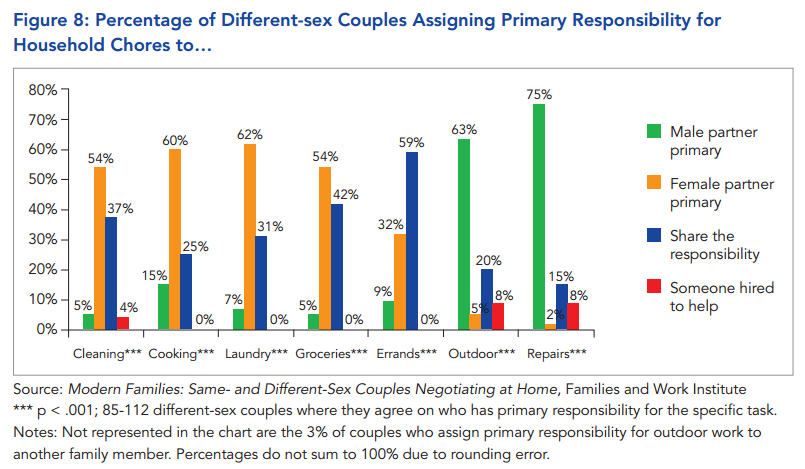
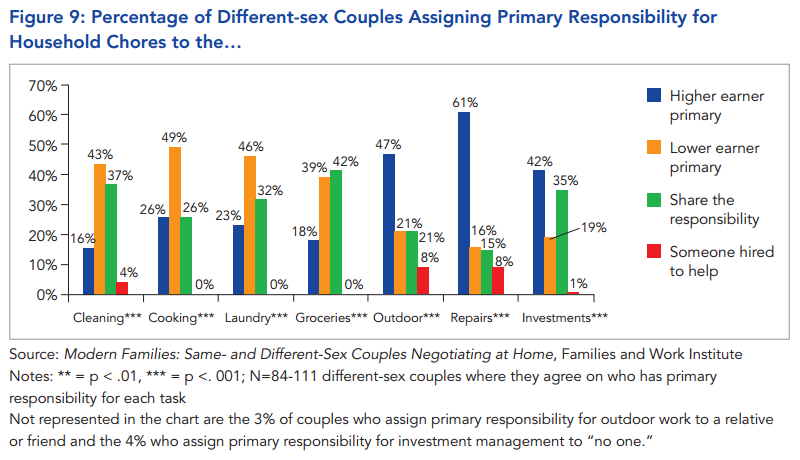
A new study from the Families and Work Institute compared household divisions of labor in 225 other-sex couples and same-sex couples in which both partners worked. The researchers found that same-sex couples are more likely than different-sex couples to share responsibility for chores. Eyeball the two graphs below and look for the green; that’s the bar that indicates that both people in the couple share responsibility. The first is different-sex couples and the second is same-sex.

45Same-sex couples, though, are no sharing utopia in which everyone does exactly 50% of everything. They are still more likely to divide up household labor than share it — that is, the blue and yellow bars indicating the higher or lower earner, respectively, still dominate the graph. And, interestingly, the gendered nature of the labor is still present in that the lower earner in same-sex couples tends to do the same labor as the female in different-sex couples.

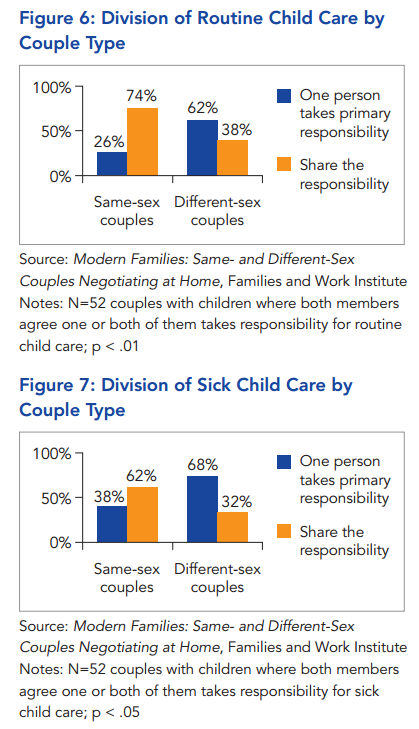
The data is more dramatic, though, when we look at parenting. Same-sex couples are more likely to share the responsibility for routine child care (74%) than leave it primarily up to one person. The same goes for sick child care (62%). Among different sex couples, the opposite is true. One parent generally takes primary responsibility for routine (62%) and sick (68%) child care.

6

There is no secret recipe, of course, to how a couple should divide their household chores and childcare. There is a take home lesson from the study, though, and that’s to talk about it if you want to. Generally speaking, members of couples who talked about it before moving in together (blue) were more satisfied with their division of labor than members of couples who wanted to have a conversation, but didn’t (yellow).

3

The authors of the study found that women in relationships with men were the most likely of all to say that they wanted to have a conversation, but didn’t (20%). Men in either same- (11%) or different-sex couples (11%) and women in same-sex couples (15%) were less likely to have held their tongue.

The author of the report concludes that it may not be how we divide up labor that matters that drives satisfaction, or even whether we talk about it, but whether we fail to have a conversation that we want.

Lisa Wade, PhD is an Associate Professor at Tulane University. She is the author of American Hookup, a book about college sexual culture; a textbook about gender; and a forthcoming introductory text: Terrible Magnificent Sociology. You can follow her on Twitter and Instagram.
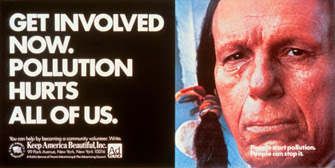
Most people middle aged or older remember the “Crying Indian” campaign for Keep America Beautiful:2

Most of them, by now, also know that Iron Eyes Cody was no Native American. Born to Sicilian Immigrants in southwestern Louisiana in 1904, Espera Oscar de Corti became an actor in his youth, and found that he could “pass” as a Native American in Hollywood.

de Corti, changing his name to “Cody,” claimed to have Cherokee-Cree heritage. He played native roles in dozens of westerns, with John Wayne and other stars of the mid-20th century. His chanting was featured in the Joni Michtell song “Lakota.” And, of course, he was the Noble Savage face of Keep America Beautiful. All while sharing more heritage with Christopher Columbus than with the people who got the shit end of the Columbian Exchange.

By all accounts Iron Eyes Cody tried to honour his assumed ancestry. He became an activist for Native American causes, and did lecture tours preaching against the harm of alcohol. He married a Seneca archaeologist, Bertha Parker, and they adopted two adopted two Dakota and/or Maricopa children. He even wrote a book about native sign language.

He also invented a backstory, quoted by Glendale News Press from  a 1951 local newspaper article:

Iron Eyes learned much of his Indian lore in the days when, as a youth, he toured the country with his father, Thomas Long Plume, in a wild west show. During his travels, he taught himself the sign language of other tribes of Indians…

The article said that the television star and his wife would appear at a Glendale Historical Society event to tell the story of the “Indian Sign Language in Pictures” and would demonstrate Indian arts and customs. Plus, the couple would bring along their 3-month-old “papoose” Robin (Robert Timothy). All were to be attired in Indian regalia.

In 1996, three years before his death, Iron Eyes Cody was outed as European by his half-sister, May Abshire, who offered proof of the actor’s Sicilian parentage to the Times-Picayune. Cody denied the allegations.

Today, such a shocking exposé, proving that an upstanding member of an ethnic community was really an outsider, would be all over social media. Just like Rachel Dolezal.

I’m having a hard time digging up any initial reactions to Iron Eyes Cody’s outing from indigenous people in the United States or Canada. How is he remembered? Did he help make native issues more visible, or did he obnoxiously appropriate a culture of suffering that didn’t belong to him?

Cross-posted at The Ethical Adman.

Tom Megginson is a Creative Director at Acart Communications, a Canadian Social Issues Marketing agency. He is a specialist in social marketing, cause marketing, and corporate social responsibility. You can follow Tom at Osocio and The Ethical Adman.