Who believes that the climate is changing? Researchers at Yale’s Project on Climate Change Communication asked 13,000 people and they found some pretty interesting stuff. First, they found that there was a great deal of disagreement, identifying six types:

  • The Alarmed (18%) – believe climate change is happening, have already changed their behavior, and are ready to get out there and try to save the world
  • The Concerned (33%) – believe it’s happening, but think it’s far off or isn’t going to affect them personally
  • The Cautious (19%) – aren’t sure if it’s happening or not and are also unsure whether it’s human caused
  • The Disengaged (12%) –  have heard the phrase “climate change,” but couldn’t tell you the first thing about it
  • The Doubtful (11%) – are skeptical that it’s happening and, if it is, they don’t think it’s a problem and don’t think it’s human caused
  • The Dismissive (7%) – do not believe in it, think it’s a hoax

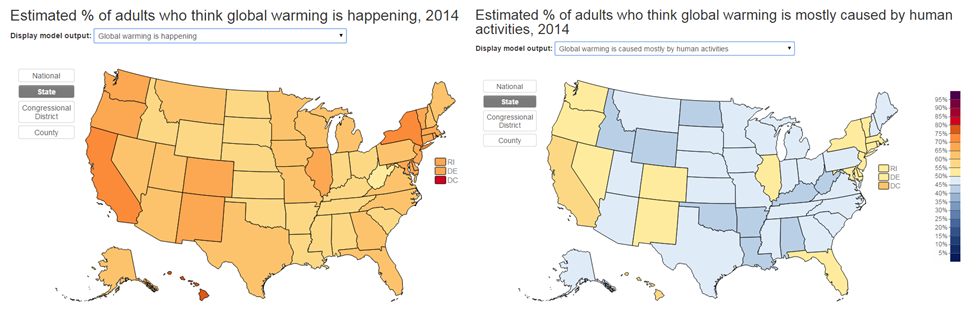
As you might imagine, attitudes about climate change vary significantly by state and county. You can see all the data at their interactive map. Here are some of the findings I thought were interesting.

More Americans think that climate change is happening (left) than think it’s human caused (right); bluer = more skeptical, redder = more believing:

2

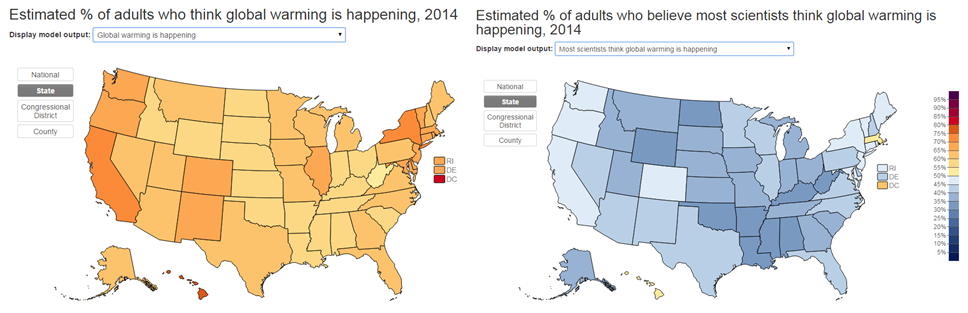
Even among people who say that they personally believe in climate change (left, same as above), there are many who think that there is no scientific consensus (right) suggesting that the campaign to misrepresent scientific opinion by covering “both sides” was successful:

10

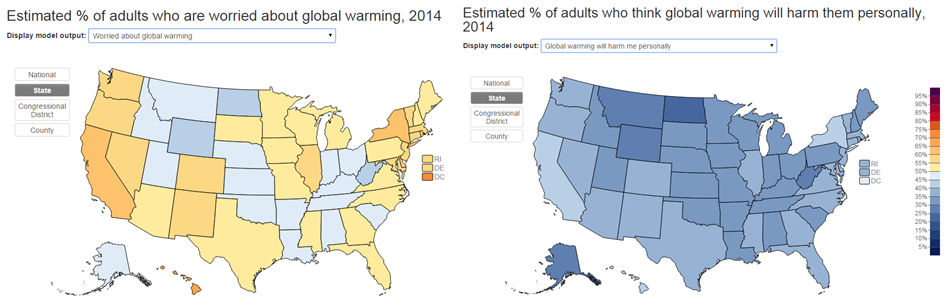
People are somewhat worried about climate change (left), but very, very few think that it’s going to harm them personally (right):

11

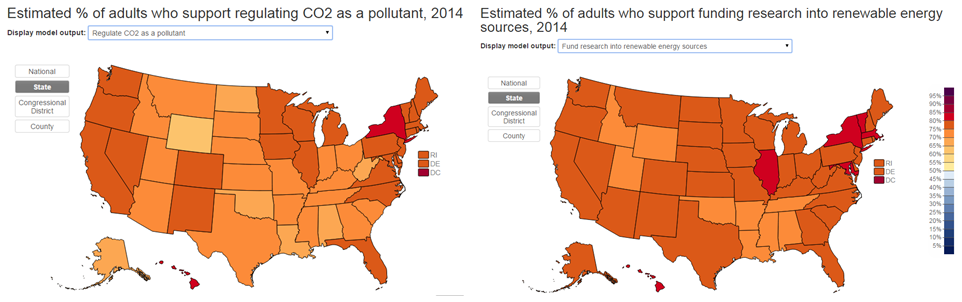
Even though people are lukewarm on whether it’s happening, whether it’s human-caused, and whether it’s going to do any harm, there’s a lot of support for doing something about it. Support for regulating CO2 (left) and support for funding research on renewable energy (right):

12

Take a closer look yourself and explore more questions at the map or read more at the Scholars Strategy Network. And thanks to the people at Yale funding and doing this important work.

Lisa Wade, PhD is an Associate Professor at Tulane University. She is the author of American Hookup, a book about college sexual culture; a textbook about gender; and a forthcoming introductory text: Terrible Magnificent Sociology. You can follow her on Twitter and Instagram.

Is there really a clean-cut difference between work and sex work? Is sex work really or always sexual? Are all the other jobs asexual? Where do we draw the line? Can we draw a line? Should we?

These were some of the questions that we discussed in my power and sexuality class this past semester and, like magic, an article appeared asking whether “bikini-clad baristas” at sexy-themed coffee shops are sex workers. Well, are they?

These coffee shops require women to wear bikinis or lingerie. At The Atlantic, Leah Sottile writes that “bikini” is an overstatement. On that day, a Wednesday, the employee slinging coffee wears lacy underwear. It’s their slow day, she explains, because on Tuesdays and Thursdays she wears only a thong and pasties.

“It’s like a really friendly drive-through peep show,” writes Sottile.

School administrators have re-routed buses.

—————

There are some interesting players in this debate, people who sociologists would call stakeholders.

Mike Fagan is one. He’s a politician and some would say that he’s responsible for making sure that city rules match the values of his constituents. He’s pro-regulation, explaining:

In my mind we’re talking adult entertainment. We don’t want to shut down the stands. We want to say, “Look, you either put the bikinis back on, or you move your business to an appropriately zoned area.”

Business owners — at least the ones that own sexy coffee shops — are generally anti-regulation. They’re not interested in relocating their businesses to an “appropriately zoned area,” the sad, skeezy corners of the city where we find strip clubs. One explains that she’s “just selling coffee” and if her girls want to wear a bikini when they do, who’s to say they shouldn’t?

Sex worker advocates are also involved. Savannah Sly, a representative of the Seattle Sex Workers Outreach Project, argues that bikini baristas are sex workers:

…because their work involves using sexual appeal… Because they may be stigmatized or their place of employment scrutinized due to the erotic nature of the work, I deem it worthy of the label of sex work.

Right or wrong, this is a convenient conclusion for Sly. If more workers are classified as sex workers, than sex workers become more powerful as a group, enabling them to better advocate for better working conditions, more protection, and rights.

The bikini baristas themselves surely have a variety of opinions. The one interviewed by Sottile points out that models often wear as little or less clothing, but no one’s debating whether they’re sex workers.

It’s a fair point. And it gets back to our question — and the question for the cities of Spokane, WA; Clovis, CA; Forest Grove, OR; Aurora, CO and more — where do you draw the line between sex work and not sex work?

Honestly, I don’t think it’s possible.

Sex is a part of lots of jobs. It’s not a binary, it’s a spectrum. Sex is a part of modeling, dancing, and acting. The bartender, the waitress, and the hostess all sometimes deploy their sex appeal. How much does sex play into how lawyers are viewed in courtrooms or personal trainers are evaluated? Is sex a part of pro sports? The therapist’s relationship with their client? Selling pharmaceuticals to physicians? Heck, even college professors are evaluated with chili peppers.

Maybe the difference is the contact or the penetration? But there are other jobs that centrally involve bodies and some involve kinds of penetration. What about the dentist climbing in your mouth? The phlebotomist drawing your blood? The surgeon opening up your chest? All these things are invasive and risky, but we manage them.

If not the penetration, maybe it’s the stigma? But there are other jobs that are stigmatized, too: undertakers, sewage plant employees, slaughterhouse workers, abortion providers, politicians (only sort of kidding), and many more.

The truth is that the things involved with sex work — emotional vulnerability, intimacy, emotional manipulation, physical contact, health risks, and moral opprobrium — all characterize at least some other jobs, too. So, the only thing that separates work from sex work is sex.

And, this might sound weird but, I don’t really think that sex is a thing that lines can be drawn around.

Is penile-vaginal intercourse sex? Is oral sex? Is manual stimulation of the genitals? Is making out? Is kissing? Is thinking about kissing? Would you offer different answers if I asked if those things were sexual? Would you answer differently if the question wasn’t about what counted as sex, but what counted as abstinence?

Is the penis a sexual body part? The clitoris? The anus? Breasts? The inner thigh? The back of one’s knee? The back of one’s neck? How do you decide? Who gets to?

So when is work sex work? I can’t conceive of an answer that would satisfy me.

So, what should be done about bikini baristas? A strong minimum wage. Unions. Protection from harassment. Sick days. A nice vacation. Penalties for wage theft. Predictable schedules. A nice benefits package. I want all those things for bikini baristas. I want them for all the other “sex workers,” too. I want those things for all workers because the important word in the phrase “sex work” isn’t sex, it’s work.

Cross-posted at Pacific Standard.

Lisa Wade, PhD is an Associate Professor at Tulane University. She is the author of American Hookup, a book about college sexual culture; a textbook about gender; and a forthcoming introductory text: Terrible Magnificent Sociology. You can follow her on Twitter and Instagram.
Medical professionals often have the final say in deciding what counts as a “defect.” Often, their decisions exceed the bounds of medicine, addressing bodies that may deviate from “normal” or “average,” but do not actually cause medical problems.

An alternative might be to allow the patient to decide if his or her body is acceptable, but in doing so they risk allowing people’s deeply subjective and often dysmorphic perceptions of their own bodies determine whether they undergo a risky procedure.

Is there another way?

Pediatric surgeon Norma Ruppen-Greeff and hers colleagues thought so. Pediatric physicians often correct hypospadias: a condition in which the meatus, or opening of the urethra, doesn’t quite make it to the top of the penis during fetal development, such that the urethra exits the penis somewhere along the shaft. This is generally corrected surgically, but physicians found that some men returned to them as adults with concerns that their penis still appeared abnormal.

Instead of dismissing men’s concerns or jumping with a knife, they decided to ask women if they noticed. They had 105 women fill out a questionnaire and rate which aspects of penile appearance were important to them. And, lo and behold, the shape and placement of the meatus was the least important. No need for surgery, plus they can reassure the guys that they’re okay. (Someone should follow up and ask gay and bisexual men; anyone for an awesome senior thesis?)

This is a great way to measure the sociocultural value of a surgery. Whereas we’re used to thinking about surgical issues as psychological (someone wants it) or medical (someone needs it), these physicians asked a distinctly sociological question. They measured how penises are widely perceived and which parts are socially constructed as important. That’s a pretty neat way to incorporate sociological realities into surgical practice.

Cross-posted at Pacific Standard.

Lisa Wade, PhD is an Associate Professor at Tulane University. She is the author of American Hookup, a book about college sexual culture; a textbook about gender; and a forthcoming introductory text: Terrible Magnificent Sociology. You can follow her on Twitter and Instagram.
Flashback Friday.

In the contemporary U.S., individuals choose who to marry based on personal preference, but there is a specific script by which those choices become a wedding day. Not everyone follows the script, but everyone knows it: the man decides to ask the woman to marry him, he buys a ring, he arranges a “special” event, he proposes, and she agrees. Many of us grow up dreaming of a day like this.

But this isn’t the only possible way to decide to marry. A reverse script might involve female choice. We can imagine a world in which, instead of hoping to be chosen, women decide to propose and men can only marry if they get asked. Another alternative script might involve no proposal at all, one in which two people discuss marriage and come to a decision together without the pop question and uncertain answer.

Of course, many couples essentially decide to marry through months or years of discussion, but these couples frequently act out the script anyway because, well, it’s so romantic and wonderful.

Or is it?

Andre M. sent in a clip of John Preator, a finalist on a previous season of American Idol. In the clip, he proposes to his girlfriend Erica on Main Street at a Disneyland Resort. The clip exaggerates the patriarchal underpinnings of both marriage and the marriage proposal. It may or may not be real, but it doesn’t really matter for our purposes.

Here it is:

First, Andre says, the spectacle is a shining testament to our commitment to the idea of marriage as an ideal state. Everyone loves marriage! As Andre writes:

A whole rainbow of characters come out of the shadows to push her towards yes, from the smiling Asian janitor, to the African American guy knighted by our hero and his plastic phallus, to the disabled woman who wishes to trade her fate with the bride-to-be.

We are supposed to think: “How wonderful! How sweet! How perfect!” What is made invisible is the fact that, in addition to a potential site of wedded bliss, marriage is the site of the reproduction of patriarchal privilege (especially through women’s disproportionate responsibility for housework and childcare) and heterosexist (still excluding same sex couples). But the audience knows that they are supposed to feel elated for the couple and privileged to witness their special moment (whether they feel these things or not).

Second, the public nature of the proposal put a lot of pressure on her to say “yes.” The audience is asked to participate in urging her to agree to marry him (“come on folks, how about a little encouragement?!”). And the performers, as well as the performance itself, create conditions that look a lot like coercion. Could she have said “no” if she wanted to? As if breaking his heart wouldn’t have been deterrent enough, saying “no” would have disappointed the onlookers and ruined the performance. He put so much work into scripting the proposal and it was very clear what her line was. How many women, with less pressure, have nonetheless felt it difficult or impossible to say “no”?

Okay, so let’s assume that Erica did want to marry John and that they will live happily ever after. And let’s also assume that most marriage proposals in the U.S. do not come with this degree of pressure. The clip is still a nice reminder of (1) just how taken-for-granted marriage is as an ideal state (can you imagine her saying, “I love you more than life itself and I want to be with you forever, but marriage, no thanks!”) and (2) the way that the proposal script puts men in the position of getting to choose and women in the position of having to agree or go off script.

Originally posted in 2010.

Lisa Wade, PhD is an Associate Professor at Tulane University. She is the author of American Hookup, a book about college sexual culture; a textbook about gender; and a forthcoming introductory text: Terrible Magnificent Sociology. You can follow her on Twitter and Instagram.
The Americans with Disabilities Act turned 25 years old last month. It was enacted by U.S. Congress with the goal of ensuring that people with disabilities had access to “reasonable accommodations” so that they could participate wholly in public life.

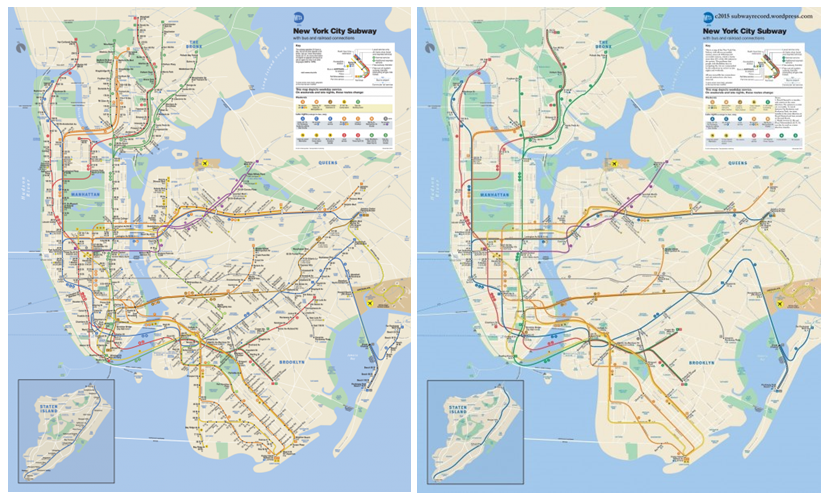
Did it work? Consider the New York City subway. SupraStructure featured these two maps. The one on the left is the NYC subway map of the 490 stations in the system; on the right is the accessible subway map, including only the 100 or so accessible stops:

15

“Essentially the NYC subway system is useless if you use a wheelchair,” writes Bad Cripple about the map. He continues:

Access to mass transportation for a person such as myself that uses a wheelchair is routinely difficult in the extreme. … Wheelchair lifts on buses are somehow broken or the drivers refuse to use the lift often claiming ignorance. Accessible taxis are as rare as diamonds in many cities. Subways in the vast majority of cities are grossly inaccessible. Rental car companies often do not have the car with hand controls rented weeks or days in advance. Shuttle buses at airports are not always accessible. Hotel shuttle buses are also typically not accessible.

He adds that discount travel is “pure folly” and that newer options like AirBnB and Uber seem to have no interest in accommodating people with disabilities. Not to mention the many places he travels that have broken lifts, elevators, and strangely non-accessible “accessible” accommodations.

As with much civil rights legislation, passing the ADA was just the first step in gaining equality. People have often had to sue piecemeal to get accessibility. A person identifies a restaurant without accessible bathrooms, for example, and begins legal proceedings to force the business to comply.  Slowly, little by little — thanks to lawsuits, building codes, and other means — the world is becoming more accessible, though not nearly as quickly as people with disabilities need it to.

Lisa Wade, PhD is an Associate Professor at Tulane University. She is the author of American Hookup, a book about college sexual culture; a textbook about gender; and a forthcoming introductory text: Terrible Magnificent Sociology. You can follow her on Twitter and Instagram.
“Asshole is a wonderful word,” said Mike Pesca in his podcast, The Gist. His former colleagues at NPR had wanted to call someone an asshole, and even though it was for a podcast, not broadcast, and even though the person in question was a certified asshole, the NPR censor said no. Pesca disagreed.

Pesca is from Long Island and, except for his college years in Atlanta, he has spent most of his time in the Northeast. Had he hailed from Atlanta – or Denver or Houston or even San Francisco – “asshole” might not have sprung so readily to his mind as le mot juste, even to denote Donald Trump. The choice of swear words is regional.

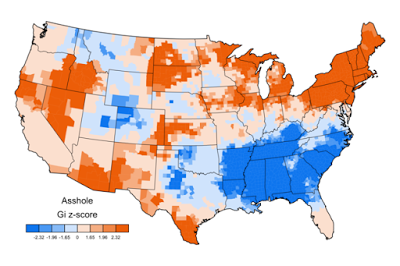
Linguist Jack Grieve has been analyzing tweets – billions of words – and recently he posted maps showing the relative popularity of different expletives. For example, every county in the Northeast tweets “asshole” at a rate at least two standard deviations above the national mean.

17
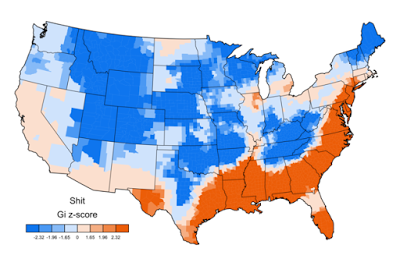
To my knowledge, Grieve has offered no explanation for this distribution, and I don’t have much to add. I assume that as with regional accents, historical factors are more important than the literal meanings of the words. It’s not that tweeters in the Northeast are generally more willing to use foul language, nor is this about anal imagery since the Northeast looks nearly prudish compared to other regions when it comes to “shit.”
18

Less surprising are the maps of toned-down expletives. People in the heartland are just so gosh darned polite in their speech. When Donald Trump spoke at the Family Leadership Summit in Iowa, what got all the attention was his dissing of John McCain (“He’s not a war hero. … He is a war hero because he was captured. I like people who weren’t captured.”) But there was also this paragraph in the New York Times’s coverage:

Mr. Trump raised eyebrows with language rarely heard before an evangelical audience — saying “damn” and “hell” when discussing education and the economy.

“Well, I was turned off at the very start because I didn’t like his language,” Becky Kruse, of Lovilia, Iowa, said…  Noting Mr. Trump’s comment about not seeking God’s forgiveness. “He sounds like he isn’t really a born-again Christian.”

Aside from the insight about Trump’s religious views, Ms. Kruse reflects the linguistic preferences of her region, where “damn” gets softened to “darn.”

journal.pone.0128832.g001 (1)

Unfortunately, Grieves did not post a map for “heck.” (I remember when “damn” and “hell” were off limits on television, though a newspaper columnist, usually in the sports section, might dare to write something like “It was a helluva fight.”) You can find maps for all your favorite words at Grieve’s website, where you can also find out what words are trending (as we now say) on Twitter. (“Unbothered” is spreading from the South and “fuckboy” is rising). Other words are on the way down (untrending?).  If you’re holding  “YOLO” futures, sell them now before it’s too late.

Originally posted at Montclair SocioBlog.

Jay Livingston is the chair of the Sociology Department at Montclair State University. You can follow him at Montclair SocioBlog or on Twitter.

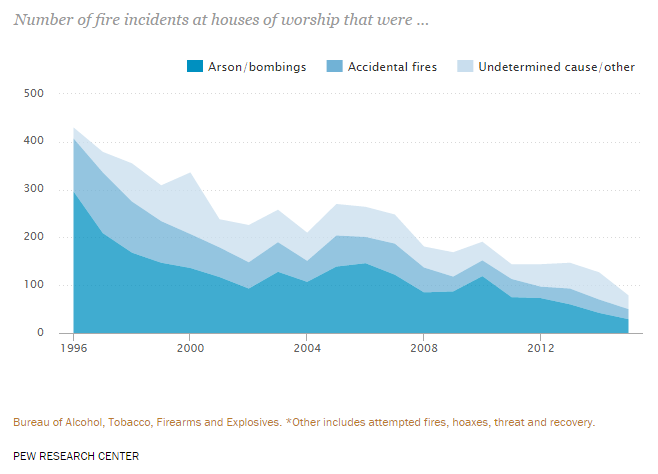
According to data presented by Pew Research Center, 51% of the last 20 years of fires at houses of worship were ruled “intentional.” In contrast, 10% of non-residential fires and 5% of residential fires are believed to be arson.

Overall, all types of fire incidents at churches and other houses of worship have been declining, but the proportion that are ruled intentional has been stable. In 1996, a House Judiciary Committee report found that arson attacks disproportionately targeted black churches in the South.

This is your image of the week:5

Play with the interactive data here.

Lisa Wade, PhD is an Associate Professor at Tulane University. She is the author of American Hookup, a book about college sexual culture; a textbook about gender; and a forthcoming introductory text: Terrible Magnificent Sociology. You can follow her on Twitter and Instagram.
Flashback Friday.

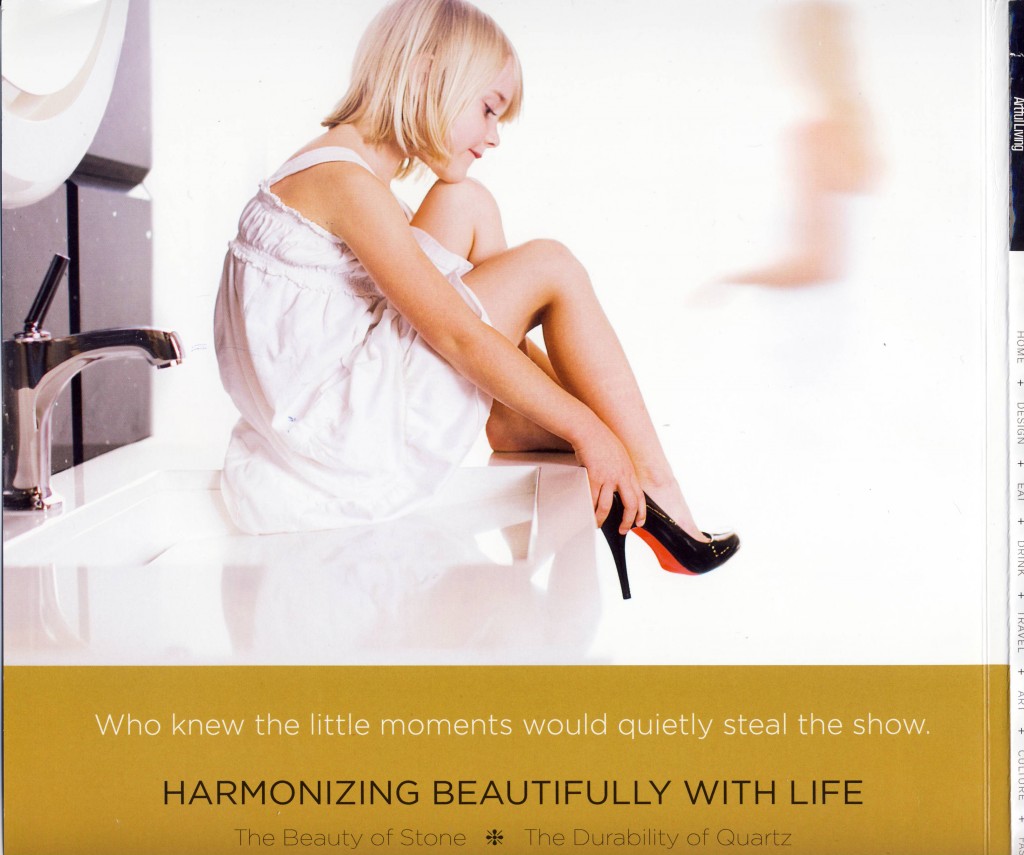
I just have to say “wow” to this ad for Quartz counter tops, sent it by Lisa Ray of Parents for Ethical Marketing and Corporate Babysitter:

The ad depicts a little girl fantasizing about growing up, but growing up means (extremely) high patent leather pumps; growing up means sexualizing herself.

And the ad does sexualize the little girl who, from the top-scanning-down, looks like a sweet girl trying on mommy’s shoes, but from the bottom-scanning-up, looks like an adult woman who suddenly transforms into a child. The white cotton dress implies innocence and purity, but it’s a costume we regularly see adult women wear when we want to both sexualize and infantilize them. In other words, this ad nicely plays into the mythology endorsed by pedophiles that even little girls want to feel sexy, even little girls want men’s attention, even little girls want sex.

And, yet, we are supposed to think this is sweet. The text, “Harmonizing Beautifully with Life” is, of course, ostensibly about the counter tops. But aligned with the image, it naturalizes both the girl’s fantasy and the conflation of female sex with the performance of sexualized femininity (it’s just “life”; as if there’s a gene for Christian Louboutin shoes that activates in the presence of double X chromosomes). More than simply naturalizing the girl’s fantasy of self-objectification, it endorses it (it’s beautiful harmony).

Notice also the class story in the ad. Who exactly is class privileged enough to have the freedom to allow “the quiet moments” to “steal the show”? Well, apparently people who are rich enough to wear Louboutin shoes. Louboutin began putting red soles on all his shoes as a not-so-subtle way to advertise that the shoe was Louboutin and, therefore, a very expensive shoe. It worked.  Fashion writers started pointing out the red soles with glee, as in this story about Angeline Jolie on a red carpet. The fact that the sole of this shoe is red is no accident, it’s meant to add class to the counter tops, in both senses of the word.

A final word on race: That the girl in the ad is white is no accident. And it’s not only because marketers expect the majority of their customers to be white, but because of what whiteness represents. Her white skin symbolizes the same thing that the white counter tops and white dress symbolize: purity, cleanliness, even innocence. It is only because all those symbolic elements are there that we can put a black patent leather heel with a red sole on her and still think “sweet.”  Imagine the same ad with a black child. In the U.S., black women are often stereotyped as sexually loose, morally corrupt, irresponsible teen mothers on welfare. With that symbolic baggage, this ad would be a morality lesson on the hypersexuality of black girls and their propensity to “grow up too fast.” It wouldn’t look sweet, it’d look dangerous.

“Harmonizing beautifully,” indeed.

Originally posted in 2010.

Lisa Wade, PhD is an Associate Professor at Tulane University. She is the author of American Hookup, a book about college sexual culture; a textbook about gender; and a forthcoming introductory text: Terrible Magnificent Sociology. You can follow her on Twitter and Instagram.