I just saw a story about this image on “Countdown with Keith Olbermann” (image found here):
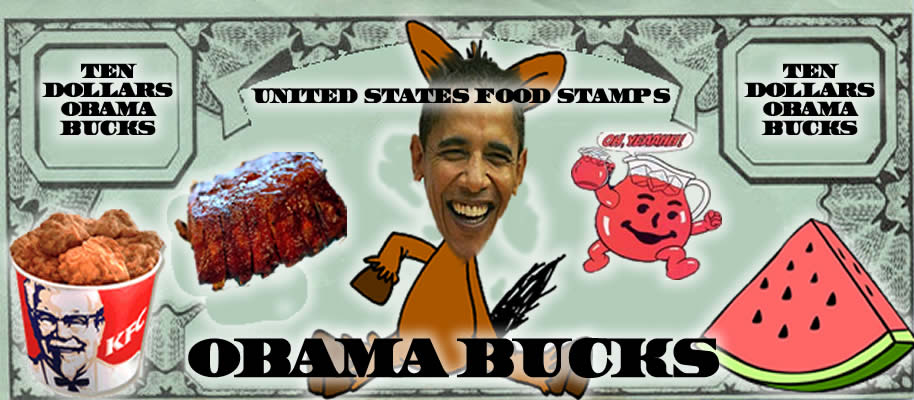
It is a “joke” included in the “October newsletter by the Chaffey Community Republican Women, Federated” (I read more about it here; the group is from San Bernardino, CA), in which they claim that if Obama wins, his face will be on food stamps, not dollar bills. From a story in The Press-Enterprise:
Fedele [the group’s president] said she got the illustration in a number of chain e-mails and decided to reprint it for her members in the Trumpeter newsletter because she was offended that Obama would draw attention to his own race. She declined to say who sent her the e-mails with the illustration. She said she doesn’t think in racist terms, pointing out she once supported Republican Alan Keyes, an African-American who previously ran for president. “I didn’t see it the way that it’s being taken. I never connected,” she said. “It was just food to me. It didn’t mean anything else.”
Uh huh. Right. Who could possibly have known that African Americans were historically portrayed in racist carictures eating fried chicken, ribs, and/or watermelon, or that there’s a long-standing political tradition of trying to connect Blacks and welfare in the public mind?
Honestly, it’s been awhile since an image of Obama actually made me gasp, but that one did.
UPDATE: Larry, from the L.A. Times‘ Daily Mirror blog, sent in a link to this post at the blog Please God No, in which the author claims to be the creator of the Obama bucks cartoon and says,
It was a satirical look at some of the Fox News watching right-wingers out there that are afraid of a government that sponsors welfare type programs. It was intended to poke fun at the unrealistic fears and agenda of racism that a fringe element of Republicans strongly embrace.
The author continues,
This “cartoon” (as described in the media), was meant to empower African Americans to stand up for and defend themselves against racial intolerance. This “cartoon” was prescribed to showcase the racial hatred and intolerance towards the “left” and it’s liberal “welfare” economic plan. Guess what? The radical right picked up this fumble and ran with it right into the opponents goal line. The fact that a website like this exists is not evidence of racial hatred or divide, but the fact that an image taken from this website was used in a legitimate publication to promote the Conservative agenda must be proof of either existing racism or utter stupidity.
I thought the author’s response might be interesting for a discussion of political parody and humor and the limits of satire. What makes political humor effective and what makes it, as in this case, actually appeal to the group the humorist claimed to be mocking? If people miss the satire, is that because they’re dumb or because the satire isn’t that good? If someone says they’re being satirical, does that automatically shield them from any accusations of sexism, racism, etc.? I really find the issue of humor to be fascinating–what we find funny, what happens when some groups don’t recognize what another group claims was an attempt to be humorous, and how claims of being satirical or “just joking” can be used to avoid responsibility for the content of statements or images. This seems like a particularly good example of some of those issues.
Dara G. sent in a link to this billboard in West Plains, Missouri, featuring a caricature of Obama in a turban meant to imply he’s an Arab/Muslim (found here):
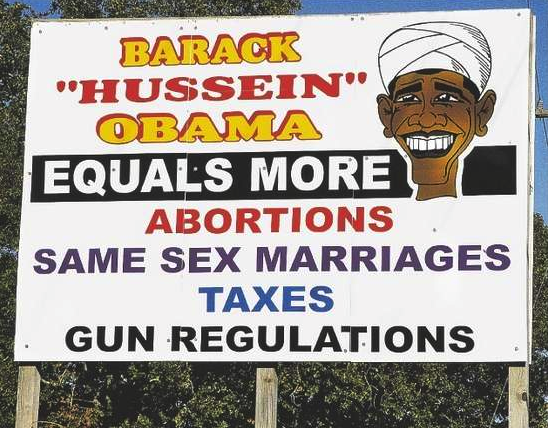
NEW! Here’s another (found here):
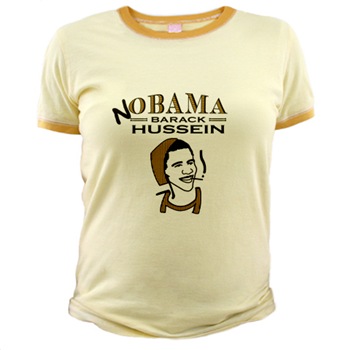
For other examples of accusations that Obama is Arab/Muslim (and that that is bad), see here, here, here, and here. For a non-racist caricature of Obama (showing it can, indeed, be done), see this post.
Thanks, Dara!
And I just saw on Rachel Maddow’s show that this image showed up briefly on the Sacramento County Republican Party’s website (image found here):
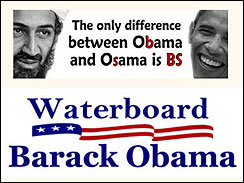
There’s more!
This image is from a recent rally (found here):
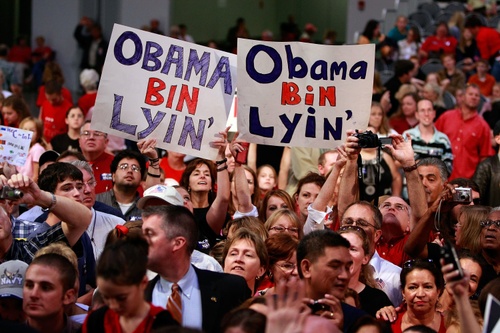
And, if you haven’t seen it yet, here is the by-now-classic video of supporters of a McCain rally yelling that Obama is a “terrorist” bound on spreading “terror” (found here):
I presume you can figure out for yourself how these might be used in classes. Negative messages about Arabs/Muslims, attempts to use fear of the connection between Arabs and terrorism, joking about torture, racist imagery, etc. etc….You don’t need me for this one.
To be fair, McCain, in at least one instance, has been attempting to temper this fervor. But, as Gwen mentioned in a previous post, those who stir up hatred often have a difficult time controlling it. I’d love to have some social psychologists weigh in on the phenomenon.
NEW! Man in Ohio hangs Obama from a tree in his front yard and boldly claims racist motivation (found here):