I was recently at the grocery store with my boyfriend when he noticed that Tropicana orange juice (owned by Pepsi) had a new look. Here’s an image of the new carton, found at the NYT:

23adcol600

Burk hated the new design. Loathed. Expressed his horror at length. He thought it was ugly and looked like a generic orange juice brand. I agreed that it looked a little generic but didn’t have a lot of other thoughts about it. It didn’t have any impact on our shopping patterns regardless, since neither of us drink orange juice (but give me some Tang and I’m a happy, happy girl; my great-grandma used to make a simple powdered-sugar frosting and added Tang mix to it so it was Tang-flavored, so I have very happy memories of Tang. Excellent on yellow or lemon cake. Pink lemonade mix works too.).

Anyway, it turns out lots of people shared Burk’s reaction–they absolutely hated the new carton. And they cared enough to actually contact the company and complain. As a result of all the complaints, Tropicana will be going back to the original design:

23adcol2190

What struck me about this was two things: First, the power of consumers. When we think about the food system (or clothing, or whatever), clearly meatpackers, grocery stores, big-box retailers like Wal-Mart, etc., have tremendous power, and consumers often feel powerless to affect a system that may not bring them the type or quality of food products they prefer to feed their families. And yet moments like this indicate that consumers can force companies to change. We saw something similar in the late 1990s: when lots of people got on the South Beach and Atkins diet, many restaurants started adding low-carb options to their menus to avoid losing customers (Subway particularly jumped on this bandwagon). If enough consumers make it clear that they will stop purchasing a company’s products, they can make those companies change. We aren’t powerful individually–Tropicana wouldn’t have cared if just I wrote in about a concern–but we can be powerful collectively.

The second thing that struck me, though, is what we get upset enough about to actually contact companies and demand change. Out of all the problems with our modern food system–the health of the food we buy, environmental impacts of production practices, conditions of agricultural workers, food contamination, etc.–most of the time we really don’t demand that companies do anything about it (unless there’s a crisis like the peanut butter contamination issue*). As a foodie, it’s a little depressing to think that people in general may be more concerned about the design of their orange juice carton than in thinking about what’s inside the carton.

* For you “Battlestar Galactica” fans: last night I had a very involved dream in which I realized that the peanut butter contamination problem had been a cylon plot to kill us.
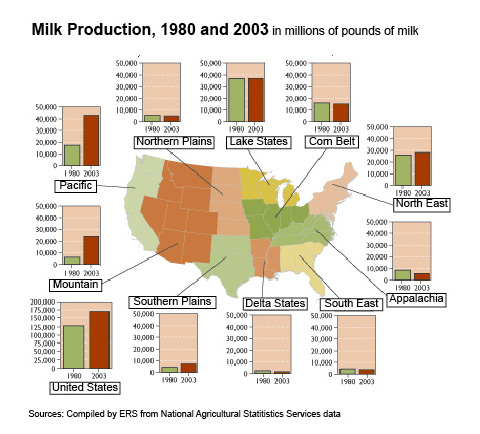
Fellow Contexts blogger Flaneuse over at Graphic Sociology posted this map showing increases in milk production by region:

milk_production_us

As we see, overall production has been more or less stable in most regions but has increased dramatically in the Pacific and Mountain regions.

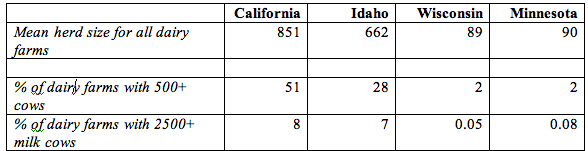
This data hides another pattern, however: changes in average dairy herd size. Dairy operations in the West and Pacific regions tend to be significantly larger than dairy farms in the more traditional dairy states in the Great Lakes region and the Northeast. I went to the 2007 Census of Agriculture site and grabbed some data to do a few quick calculations. I chose two states in the western U.S. and two in the traditional Dairy Belt, just for illustrative purposes:

picture-18

All calculations use data available in Table 17 in the Census reports for the total U.S. and each individual state, which you can easily access at the link above if you want to check my numbers. I rounded everything off to the next highest whole number except for the two percentages in the lower right-hand cells, where doing so would greatly over-represent the percent of farms of that size.

In general, dairy farms with more than 500 milking cows are considered very large in the industry. Those with over 2500 cows are really extremely large, though there are dairies with more than 10,000 milking cows (including the Vander Eyk dairy, which supplies organic milk to be sold under the Horizon brand, as well as conventional, non-organic milk to other companies). But I digress.

Anyway, clearly we see that farms in California and Idaho (and the other Pacific/Mountain states) are larger, on average, than dairy farms in the traditional dairy states. The increase in milk production in the western U.S. is due predominantly to increases in the number (and herd sizes) of very large industrial dairies.

The growth of these large dairies depends on very cheap rates for water used to irrigate agricultural land. Those dairies have to grow lots of alfalfa and other feed crops to feed so many cows, since they certainly can’t afford enough land to have thousands of cows on pasture. And big dairies produce enormous amounts of manure that have to be carted off somewhere each day, meaning they often have big manure lagoons where they store it (as well as spraying as much as possible on fields). The lagoons are lovely, if you haven’t ever been really close to one, or perhaps nearly fallen into one while conducting research for your thesis. Not that I know anyone who has had such an experience. Point being, the competitive success of large western dairies is dependent on favorable political conditions (such as decisions to keep agricultural water rates lower than other water usage rates), and they have significant environmental consequences when we consider the use of water for irrigation in states that are often relatively arid and potential pollution from manure runoff.

I have some issues with Flaneuse’s implication that the growth of western dairies is a fairly natural result of population growth because milk is a localized commodity. I don’t know that you can really call milk a localized product these days–California milk is for sale in every state, and CA has aggressively marketed the state’s dairy industry with their “Happy cows” campaign. I can also buy milk from dairies in Minnesota here in Vegas, if I look a bit. So while I’m sure population growth has a role, I think it’s important to look at the political factors–particularly environmental laws as they apply to agriculture and local opposition to large dairies–that encourage the growth of huge industrial dairies in some regions more than others.

Also keep in mind, the production of milk when measured in pounds doesn’t just indicate there are more dairies or more dairy cows…it can also be the result of getting more pounds of milk per year per cow through the use of technologies such as bovine growth hormone (rBGH). I’m not up on rates of use of rBGH by region right at the moment, but I do know its use is nearly universal in industrial dairies; if smaller dairies in the midwest are less likely to use rBGH for various reasons (including concerns about customer opposition), that would also have an impact on where milk production is increasing most rapidly.

That was a lot of rambling to have just added one little image to what was in the original post at Graphic Sociology, but soc of ag is my specialty area and I geek out about it sometimes. You have no idea how much I reined myself in to tell you just this much about the dairy industry!

[Note: If you’re really super interested in this and don’t mind reading academic articles, I suggest an article by Jess Gilbert and Raymond Akor (1988) “Increasing Structural Divergence in U.S. Dairying: California and Wisconsin since 1950,” Rural Sociology 53(1): 56-72. They lay out some of the effects of politics, water subsidies, technological change, etc., and how they’ve favored a particular type of dairy system in the West. Also check out the Program on Agricultural Technology Studies at the University of Wisconsin, which has links to lots of easy-to-understand reports about trends in the dairy industry.]

Browsing the Apple iTunes Application store the other day, I came across an application where guys can track their girlfriend’s menstruation cycle– and most importantly, their PMS symptoms– so that they can avoid the women in their lives who are going to be irrational, crazy, lunatics for a few days every month.

Take PMSTracker, for example, which tracks your “wife/girlfriend/sister/mom” so that you can avoid unexpectedly having your head bit off (or, in the example below, by your secretary).

pms

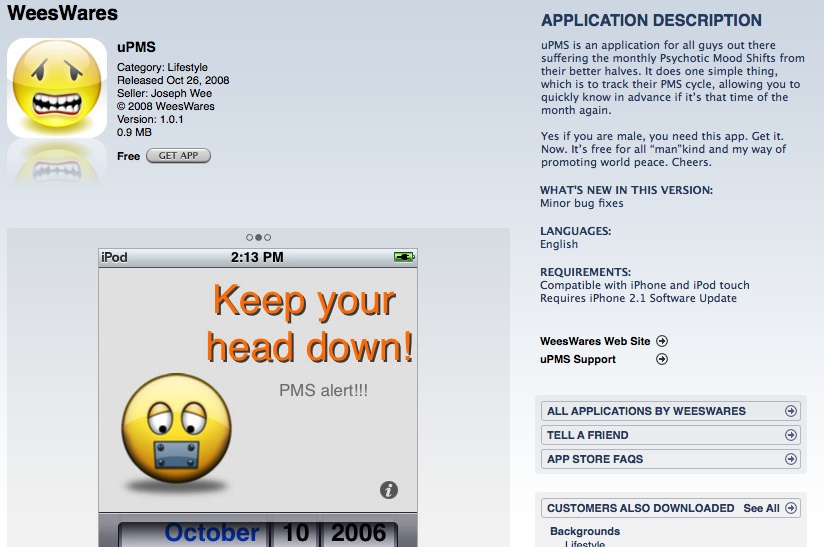
And then there’s an application called “uPMS” which aims to help “all guys out there suffering the monthly Psychotic Mood Shifts” by warning them when to “keep their head down.”

upms

My favorite is an app called “I am a Man” which advertisers itself as a better “lady tracking” application by making it easy to track several woman. And, according to the description, it will even somehow help you save money!

iammanladytimeAnd here’s the calendar tracking several girls at once. Importantly, the application is password protected, and if one girl checks out the program she’ll only see herself list (and not various other girls that this guy must be hiding from her):

ladytime3

There are a few useful iPhone and iPod Touch apps geared toward women and couples for keeping track of their menstrual cycles, fertility cycles etc. I’m not an expert on social constructions of menstruation (maybe someone who is can add more to this!) but what’s interesting to me about these particular apps is that they (1) perpetuate the assumption that PMS turns women into complete, irrational lunatics. Yes, some women experience serious and real psychological PMS symptoms, but the degrees to which they do varies greatly. (2) They apps trivializes real PMS symptoms by making it a joke that women into lunatics once a month. Not every woman’s cycle is actual 28 days, and often isn’t predictable like clockwork. And (3) what about the physical symptoms of PMS that are often much more uncomfortable and debillitating for women?


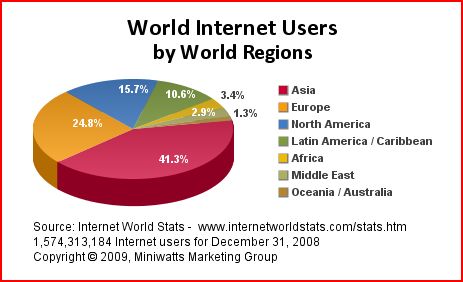
Percent of internet users by region (from internetworldstats):

capture51

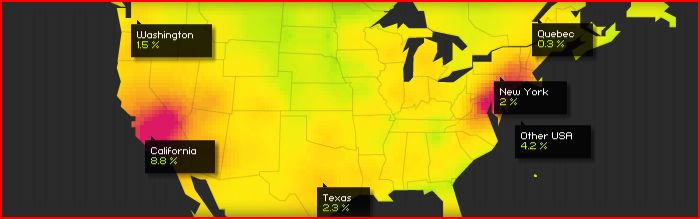
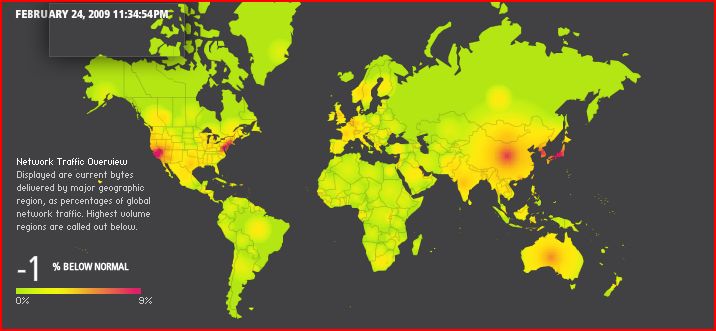
Akamai offers moment-to-moment data on internet use.  This is a screenshot from 11:34:55pm Pacific Standard Time:

capture31

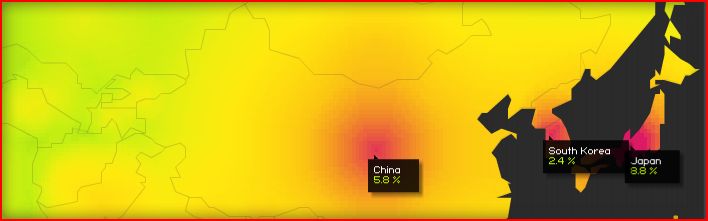
You can choose any region to highlight.  Here are the United States and China, South Korea, and Japan:

capture10

capture22

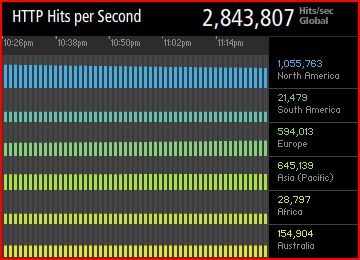
Hits per second by region:

capture41

Via Graphic Sociology.

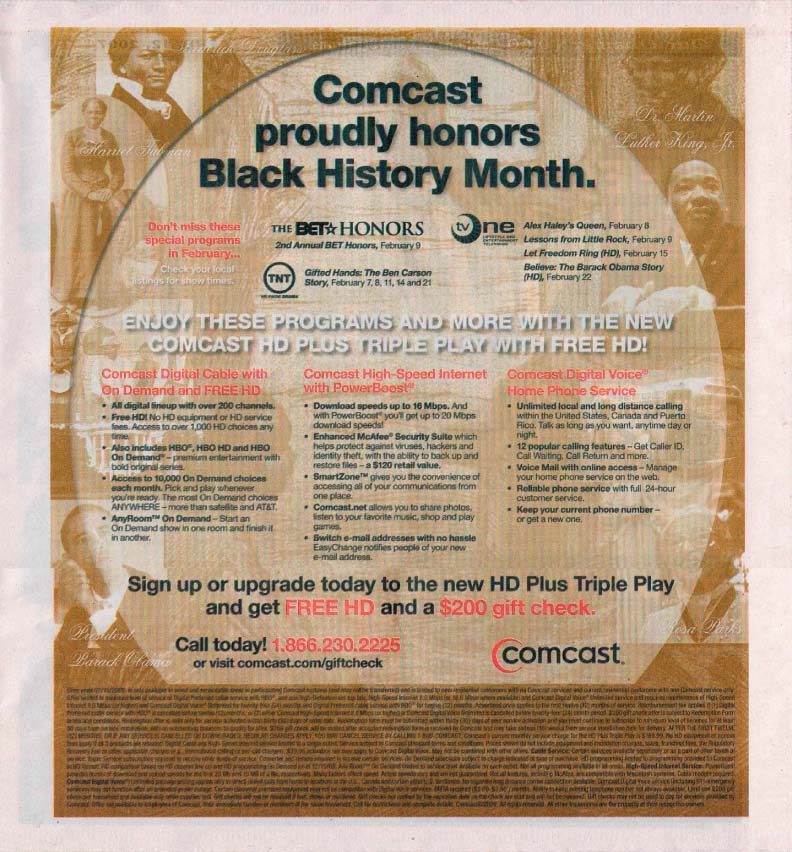
February is Black History Month, the month in which companies tout their support for the Black community.  MultiCultClassics, a blog that focuses on company outreach to people of color as employees and consumers, has been asking some interesting questions about this phenomenon.  Cynically, perhaps, it is suggested that it is all a big marketing scheme aimed at a good 13 percent of the American population.   Hmmmm.  For example:

bhm_comcast

This message was appearing on the screens at a grocery store…

bhm_dominicks

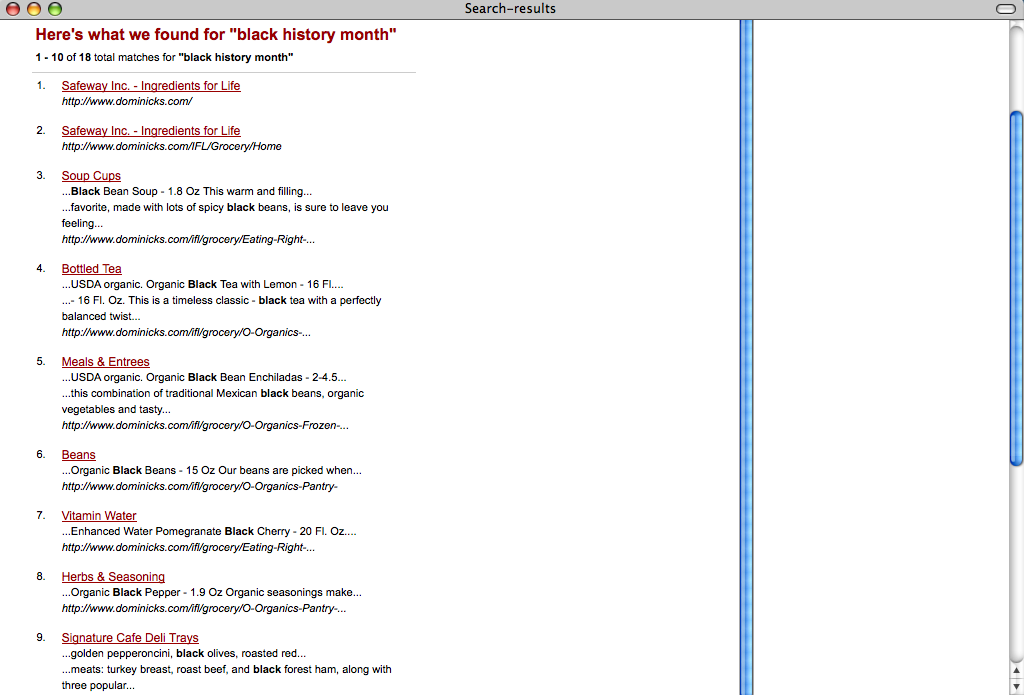
…and HighJive decided to test the theory.  The blogger went to the grocery store website, searched for information regarding “Black History Month,”  and found only this:

bhm_dominicks_21
(Post here.)

Way back in 1703, French settlers in Mobile, Alabama – at the time, the capital of French Louisiana and not much more than a tiny settlement attached to Fort Louis de la Mobile – decided to celebrate Shrove Tuesday with a feast and a party. Over the next few years, the celebrations grew more elaborate, with the first known parade taking place in 1711: the Boeuf Gras (“fatted ox”) society put together a large papier mache cow’s head and rolled it through town on a cart, which I’m sure made a lot of sense at the time.

(It is at this point that native Mobilians, like myself, like to point out that New Orleans wasn’t even founded until 1718, and that New Orleans’ oldest continually-parading organization, the Mistick Krewe of Comus, was founded by six guys from Mobile. Ahem.)

And so today we celebrate Fat Tuesday – the last hurrah before Lent – by dressing up in funny clothes, drinking to excess, dancing in the streets, and hurling moonpies at each other. To celebrate, I thought I’d share an interesting symbol and recommend an excellent documentary film on Mobile Mardi Gras, director Margaret Brown’s The Order of Myths.

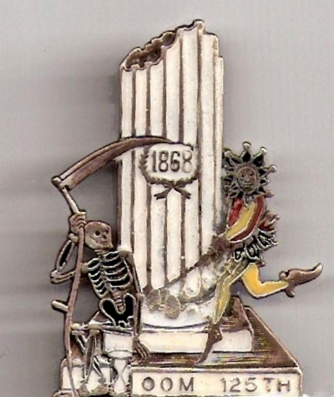
oom

What we have here is Folly chasing Death around a broken Ionic column, while whacking Death with gilded pig bladders; seeing as how during Mardi Gras the normal social order is overturned, why not the natural order as well? Here’s a similar image from a float:

2318194724_3ac36be568

To me, these images sum up a lot of what’s great about Mardi Gras: it’s a finger in the eye of mortality and a celebration of a kind of genial lunacy. But what about that Ionic column? Well, the decoding gets a little stickier there.

I’ve heard a couple of different explanations: one is that the column represents time, the other that it represents the Confederacy or the Old South more generally. It gets a little more complicated when you look at it in context: this particular image is the emblem float of the Order of Myths, and is pulled by donkeys mules and lit by gaslight lamps – which are carried by young African-American men – in the same manner it has been since the founding of the organization shortly after the Civil War. Mobile’s mystic societies, you see, remain firmly segregated, which brings me to Margaret Brown’s excellent film.

Brown – whose first full-length documentary, Be Here To Love Me, is an excellent if crushingly depressing film about Texas songwriter Townes Van Zandt – is a fellow Mobile expat, and her film examines the complexities of race, class, and collective memory in Mobile as embodied in the 2007 Mardi Gras season. She focuses primarily on the two parallel Mardi Gras courts and documents some tentative steps toward integrating the two. I won’t say much more, for fear of spoiling the film for you, except to remark that the past is very much present in the film, in ways that both William Faulkner and Pierre Bourdieu would appreciate. And I’d also add that Brown eschews a heavy-handed or didactic approach in favor of laying the situation out for the viewer and letting them draw their own conclusions, with a few subtle editorial decisions and one late-in-the-game revelation that throws much of the previous hour and a half into a new and intriguing light. Here’s a trailer for the film:

My only real criticism of The Order of Myths is that Brown focuses primarily on the Mardi Gras elite – a little of Joe Cain Day (held the Sunday before Fat Tuesday and known as “the People’s Parade” because pretty much anybody can be in it if they can get a slot) would have gone a long way: class in Mobile is not quite coterminous with race, after all. There’s a lot more to Mobile Mardi Gras than the royal courts, and we don’t really get to see much of that. Similarly, the school featured in the film is more integrated than you’d think, as are the crowds along the parade routes, given what’s shown in the film.

But these are relatively minor points – by and large, Brown tackles the subject with a keen and incisive eye, and I’d highly recommend it to anyone teaching a class on race in the United States.

———————-

For the record, the title of the post translates as “time flies, remember you are mortal, party on.”

Cynthia Enloe draws attention to how mobilizing a nation at war requires drawing on not just the notion of the heroic masculine protector, but also the vulnerable women and children who must be protected.  To draw attention to the way in which this binary (protector/protected) has functioned, she wrote “women and children” as “womenandchildren.”   Speaking very generally, women and children, and perhaps especially womeandchildren, are sympathetic characters in society in a way that men simply are not.  Likewise, women and children often seem more deserving of assistance and charity than men, who are expected to buck up and take care of themselves.

Stephen W. found himself confronted with this solicitation when making an internet purchase:

women27s20heart20disease1

Stephen wondered why he would want to “wipe out heart disease in women,” as opposed to “wipe out heart disease”? 

Why indeed?

Perhaps the appeal to save a group we often understand to be vulnerable and deserving of assistance makes (or is believed to make) this a more effective solicitation.

NEW (Jan ’10)!  Anna K.-B. sent in another instance of this women-need-extra-care-and-protection thing.  In this case, it’s a walk to end women’s cancers only:

top

The Active Life Movement has produced these ads as part of their campaign against childhood obesity:

activelifesuperhero

activelifebarbie

 activelifepirates

What irks me about this ad campaign is the negative message (i.e., the implicit “don’t”).  The message is: Don’t look like this.  And, maybe secondarily: Don’t eat a lot, watch TV, use your computer, or have conversations (?).   It’s ultimately restrictive and shaming.

The message could be a positive one (i.e., an implicit “do”): Do go outside, play, learn to dance, enjoy nature!  All of those would (presumably) accomplish the goals of the Active Life Movement without shaming people who don’t look like Barbie, Superman, or Legos (?) and who like to eat food, watch TV, be on the computer, and sit down sometimes.

Ultimately, then, instead of promoting the behaviors the organization likes, the advertisers resorted to reinforcing fat phobia/hatred and the stereotype that fat people just sit around and eat.

[I just realized I’m sitting in my bed, with a cat, having tossed off my shoes, I’m on my computer… and I am eating a SNACK!!!! Oh no!!!!!]

(Ad Freak via Shapely Prose.)