It’s always fun for me to have my own gastronomical assumptions revealed. Earlier we posted a cross-cultural example (soup for breakfast in South Korea) and historical examples (mmm aspic, 7-Up with milk, and prunes are for kids!).  On Shakesville, Deeky posted this photograph of ice cucumber-flavored Pepsi being sold in Japan:

pepsicucumber

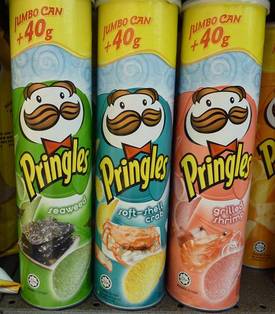
UPDATE (June ’10)! In another flavor-shake-up, BoingBoing posted these Pringles from Singapore in Seaweed, Soft-Shell Crab, and Grilled Shrimp:

—————————

Lisa Wade is a professor of sociology at Occidental College. You can follow her on Twitter and Facebook.

I found these ads for Matchbox via Copyranter.  In them, war toys are sold by situating small boys in realistic, not at all playful, conditions.   The blurring of the lines between pretend and real war is really interesting.  Whereas pretend war could be fun, real war is certainly not so.  And, oddly, the facial expressions and postures of the children in the ads do not suggest that they are having fun at all.  The ads seem to reveal, more than most, how play is also socialization.

MatchboxSingapore2

MatchboxSingapore1

matchbox_Chopper

—————————

Lisa Wade is a professor of sociology at Occidental College. You can follow her on Twitter and Facebook.

Miz Belle sent us a set of photos from the September issue (#106) of Numéro, a fashion magazine. The fashion spread, titled “Best Friends” (I found at least one post online saying the two models are, in fact, good friends) features a White woman in at least enough clothing to cover her lady bits posed next to a Black woman whose breasts are on display as she is either entirely or partially naked.

These aren’t even vaguely safe for work.

more...

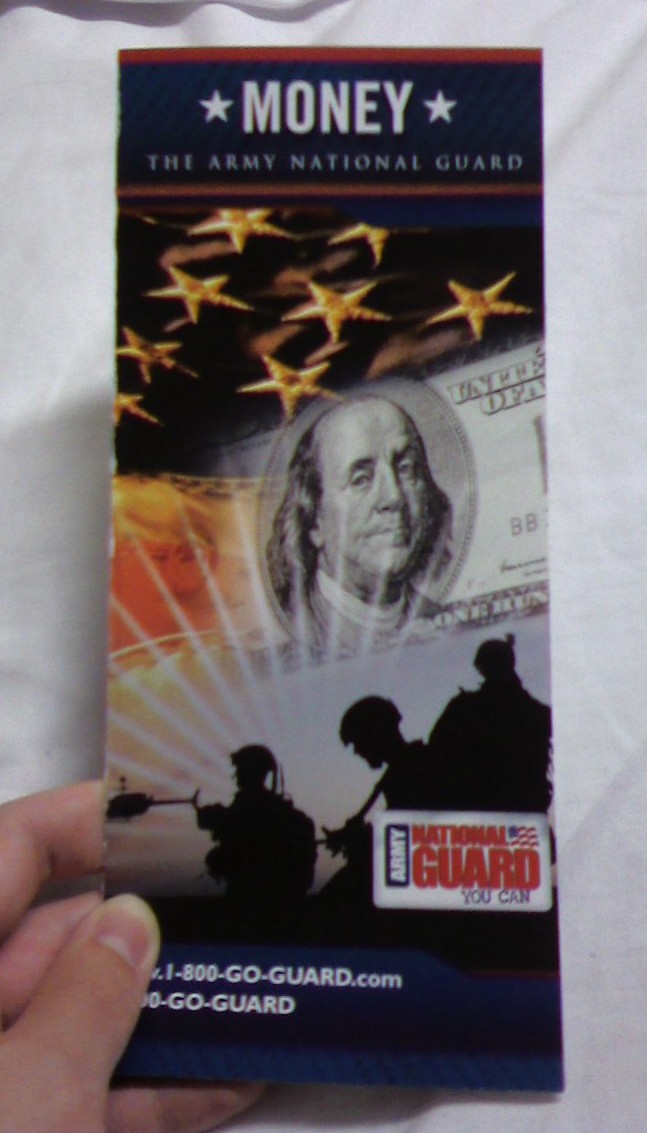
At one time in history (vague, I know), elite sons would make their mark on the world, first, in battle.  Increasingly, however, in the U.S., elites use their privilege to avoid military service.  The most recent wars have been fought, disproportionately, by men and women from the working class.

The military knows this, as illustrated by this Army National Guard recruitment pamphlet sent in by Leafan R., who found it on the Rutgers University campus:

0829091115

—————————

Lisa Wade is a professor of sociology at Occidental College. You can follow her on Twitter and Facebook.

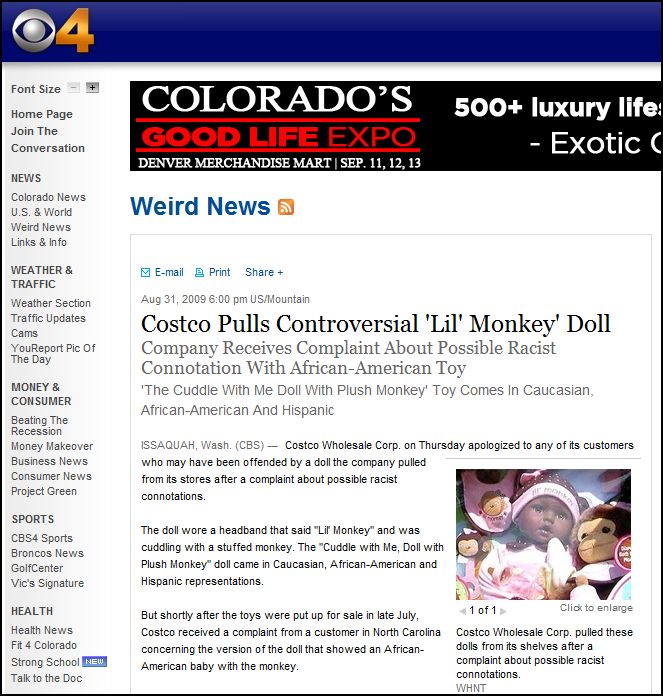
We recently posted about a baby doll pulled from Costco shelves after concerns that it was racist.  Early news stories reported on a black doll called “Lil’ Monkey” and a white doll called “Pretty Panda.”  As the story developed, it became clear that both dolls came in white, black, and Hispanic versions.  It made for an interesting discussion:  (1) Given the history of associating black people with primates, would it have been racist had the doll only came in black monkey and white panda versions?  And (2) given the history of associating black people with primates, was it racist, regardless, to make a black “Lil’ Monkey” doll that potentially triggered and/or effectively ignored this history?

The CBS affiliate in Denver linked to our post and discussion in their story about the controversy…

…which was published under “weird news.”

Screenshot:

Capture2

I am trying to keep my cool here.

Justification for African slavery was built on an association of black people with primates designed to deny black humanity.  Institutional, social psychological, and symbolic racism is ongoing in the U.S. and profoundly inhibits the life chances of black and brown people.

And yet when people say “hey, this makes me uncomfortable,” they are ridiculed and slotted into “weird news.”

It doesn’t even matter whether the intent or effect of the doll is racist.  Let me say that again: For this discussion, it doesn’t matter whether the intent or effect of the doll is racist.

Concerns about racism are trivialized when raising the question is defined as simply “weird.”  Even more, it is yet another way to deny the humanity of people of color.  When they and their allies raise their voices to weigh in on what representations of blackness are acceptable, they are dismissed like petty children or lunatics.  It is nothing less than a stunning lack of empathy.

If you needed evidence that we are not post-racial… well, there you have it.

—————————

Lisa Wade is a professor of sociology at Occidental College. You can follow her on Twitter and Facebook.

Since George W. Bush became president, a common criticism of him and his presidency has been that of nepotism: that he only rose to prominence because he is a member of a distinguished, wealthy family that has been involved in politics for generations. In the 2000 election, both candidates were the sons of men who held high political office. When Hillary Clinton became a serious contender for the Democratic nomination, many people (including me) thought there might be something a little disturbing in the fact that we might be flip-flopping between two families for as much as 28 years (if she won two terms). It seemed like evidence that American politics is becoming increasingly exclusive, with family connections playing a huge role in who ends up in positions of power.

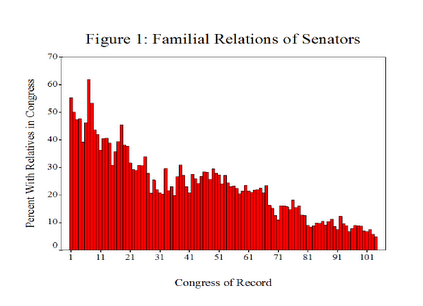
It is certainly true that family connections can have a lot of influence in U.S. politics. But Tom Schaller at FiveThirtyEight shows that, at least in the Senate, it’s becoming less common to have family members who also served in the Senate. Here’s a graph showing the percent of Senators in each Congress who had relatives who had served in Congress (at the same time or in the past):

Picture 1

The trend was clearly downward regardless, but Schaller points out that starting with Senators elected to the 64th Congress (in session 1915-1917), Senators were popularly elected rather than appointed. (Only 1/3 of Senators go up for re-election each time, so it wasn’t until the 66th Congress (1919-1921) that all serving Senators had been elected.)

So what we see is that in at least one part of the federal government, this particular type of family tie has decreased over time. Of course, there are many other ways family connections might help a person get elected to the Senate, and there are many other political offices that might be more or less influenced by a person’s family ties. If we looked at the percent of all Cabinet members, say, or Representatives, who had family members who had served in any major federal political position, we might see a much more obvious trend. But at the very least, the picture seems more complicated than arguments that our political system is dominated by a few family dynasties suggest.

The other thing that interests me is the fact that even Schaller seems to automatically equate having a family member previously (or currently) serve in the Senate with nepotism. I agree with a lot of his points about nepotism in general and the ways in which people often oppose “affirmative action” while never noticing the many, many ways they have themselves gotten an advantage from policies or personal connections that are, for all intents and purposes, forms of affirmative action. That said, nepotism as it is generally understood refers to people getting positions based on family connections regardless of whether they are qualified for or deserve them. I think Schaller is using the word in the looser sense of “getting a position based on family connections” without necessarily implying a lack of qualification. But I think for a lot of people, the fact that someone had a relative who previously served in high political office would be automatic evidence of nepotism (in the more derogatory sense) at play. And while I’m sure it often is, and that many people who get a job through family ties aren’t even vaguely qualified for them, I don’t know that showing that an official had a family member who previously held political office is prima facie evidence of nepotism. Presumably at least some people follow a family member into office and are completely and totally deserving of it, and thus might fit the less negative definition of nepotism I believe Schaller is using but not nepotism in the sense of “unqualified person who gets a job just because of Daddy.”

In 2000, at the University of Wisconsin – Madison (UW), Diallo Shabazz was my student.  He was a senior.  At the very beginning of his Frosh year, someone snapped this picture:

Picture5

From that point forward, Diallo was featured in UW promotional materials again and again.  He became accustomed to seeing that smile everywhere.  Because diversity has become such a popular, even trendy thing for a college to have, many students of color find themselves used as representatives of their colleges disproportionately.

But Shabazz’s story takes a fascinating turn.  At the end of his senior year he paged through the next year’s application and didn’t see himself.  Hmmm.  Then, someone asked if he saw himself on the cover.  And he looked and didn’t see it and then he did.  Do you?
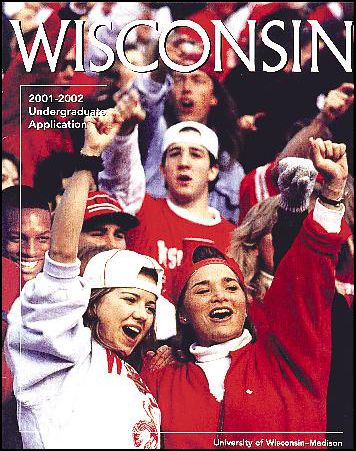
Capture1

That’s Diallo behind the excited girl on the left.  Except Diallo had never been to a UW football game.  You might recognize his face, transposed, from the original picture.  Indeed, someone at UW had photoshopped Diallo into the image below in order to give the impression that attendance at the game was more diverse than it was.  No Diallo:

Capture2

In that year 100,000 admission booklets went out with his face.  More insidiously, 100,000 admission booklets went out using his face to give the illusion of diversity at the University of Wisconsin – Madison.

Diallo sued.  He didn’t ask for a settlement.  He said that he wanted a “budgetary apology.”  He asked that, in compensation, the University put aside money for actual recruitment of minority students.  He won.  Ten million dollars was earmarked for diversity initiatives across the UW system.  The irony in the whole thing is that UW requested photos of Shabazz shaking administrators’ hands in reconciliation (i.e., photographic proof that everything was just fine).  Oh, and also, the Governor vetoed part of the earmark and many initiatives wore off with turnover.

What does this teach us?

First, notice that we have a commodification of diversity.  It is considered useful for selling an institution.

Second, if real diversity isn’t possible, cosmetic diversity will do.

Third, Shabazz himself was dismissed even as his image was used over and over.  Not only did they own the rights to his image and include him in many materials without the requirement that they ask or inform him, they literally took his image, cut it up, and used it to create a false picture.  When Shabazz complained, they first tried to blow him off.  So he wasn’t important to them, even as what he represented clearly was.

This suggests, fourth, that there was a real lack of a substantive dialog about and investment in race and diversity on the campus.  Talk: difficult.  Recruitment of minorities to a mostly white campus: tricky.  Addressing the systematic educational underinvestment in minorities prior to arriving at UW: expensive.  Retaining minorities in that environment: challenging.  Photoshop: easy.

Macon D., at Stuff White People Do, featured a similar situation in which Toronto’s Fun Guide (badly) photoshopped a black man onto their cover because their “goal was to depict the diversity of Toronto and its residents” (story here) (images also sent in by fds and Michael G.):

FUNphotoshop2

Original photo:

FUNphotoshop1

All of this puts into some perspective the recent Microsoft scandal that Jon S. and Dmitriy T. M. asked us to blog about.  If you were in the U.S. you would see the first image on the Microsoft webpage (with, as far as we know, real minorities) and, if you were in Poland, you would have seen the second image (with the black man replaced by a white man):

msft_sux_engadget

NEW! (Nov ’09):

Arturo Garcia pointed out that U.S. advertising for Couples Retreat included a black couple, but the advertising in the U.K. did not.

U.S. poster:

4113140933_210b27e6b6

U.K. poster:

4113141007_5a64763a21

The willingness to play with the presence of minorities–both by photoshopping them in and out–suggests that companies are making strategic, not ethical, decisions about what kind of public face (forgive the pun) to put on.  All of this avoids any real engagement with diversity itself.  This is probably largely because diversity is a minefield.  It’s incredibly difficult to even figure out how to define it, let alone how to build it, or how to manage it once you have it (something that my current institution struggles with).  And yet, these are the things that we must do.  Otherwise all of these strategic moves, both towards and away from minorities, are suspect.

NEW! In our comments, Jackie and Jasmine drew our attention to another example.  This is from the University of Texas, Arlington:

utarlington

See also our series on how people of color are included in advertising aimed primarily at white people, starting here.

If you’re really interested in these ideas, you might want to read MultiCultClassics, a blog specializing in how companies try to recruit minorities and present themselves as diverse institutions.

—————————

Lisa Wade is a professor of sociology at Occidental College. You can follow her on Twitter and Facebook.

Lisa Wade, PhD is an Associate Professor at Tulane University. She is the author of American Hookup, a book about college sexual culture; a textbook about gender; and a forthcoming introductory text: Terrible Magnificent Sociology. You can follow her on Twitter and Instagram.

Adam W., at Zoophobia, wrote a post calling out the Gotmilk.com website.  The website features six characters.  Here’s the front page:

Capture

Clicking on each character takes you to a page where you can play a game related to a benefit of drinking milk.  As Adam explains, through the characters the website reproduces the idea that “men do things with their bodies and women have things done to theirs; men produce things, women have things produced for them.”  He explains:

Slav, Igor and Sergie work their muscles to solve a puzzle.

Capture3

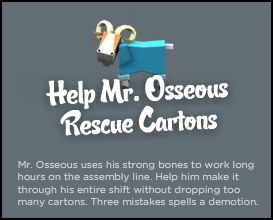
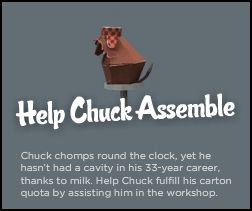
Mr. Osseous works the assembly line saving a valuable product, and Chuck assembles cartons for shipment.

Capture6

Capture7

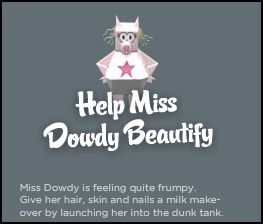
On the other hand, Miss Dowdy needs to be *given* a makeover by blasting from a cannon into a pool of milk filled by the truck driver and Mother Hen needs your help because she is “tense and irritable” from her PMS.

Capture

Capture1

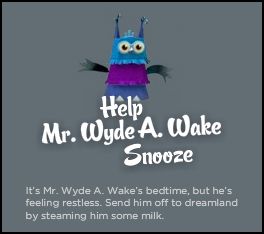
Also, Mr. Wyde A. Wake wants to be sleepy:

Capture5

In sum:

While the male animals are productive laborers, the female animals are either ditsy blonds or cruel old hens not worthy of the same honor, but still customers who need milk.

That is, men produce and consume the milk, while women only consume it.  Which is, of course, where the real craziness comes in.  Adam again:

While the male animals perform all the labor in the games, the literal labor of female cows giving birth in order to begin lactating as well as the exploitation of their bodies’ labor in producing all of the milk is completely absent. It is as Joan Dunayer writes in Animal Equality: within the dairy industry, “Milking is done to her rather than by her.”

Thus the game doesn’t just erase female labor in an ideological sense (as a reproduction of gendered stereotypes), it also erases the literal labor of female animals, without with there would be no milk to get.

—————————

Lisa Wade is a professor of sociology at Occidental College. You can follow her on Twitter and Facebook.