In a previous post I discussed data showing the growing income inequality in the U.S.: the middle class is shrinking, the poor are getting poorer, and the rich are getting richer. It turns out that corporations understand what is happening and they are responding. In brief, they are letting go of the middle class as a market and restructuring their offerings to appeal to the top and bottom of the income distribution.
Below the jump (warning, it automatically starts playing with sound) is an enlightening five minute discussion of this new business strategy on Daily Ticker video:
American Public Media’s Marketplace posted a short animated video summing up the potential problems with health care as an economic development strategy. Many cities are building large, fancy medical facilities with the hopes of drawing “medical tourists,” patients from other areas who would travel to receive care at state-of-the-art facilities, thus creating jobs and injecting money into the surrounding community. Given that we hear that the need for health care providers will grow greatly in the future, this seems like a risk-free plan. But as the video shows, these development strategies can lead to over-supply of services and increased overall cost of health care, without the promised benefits to local economies:
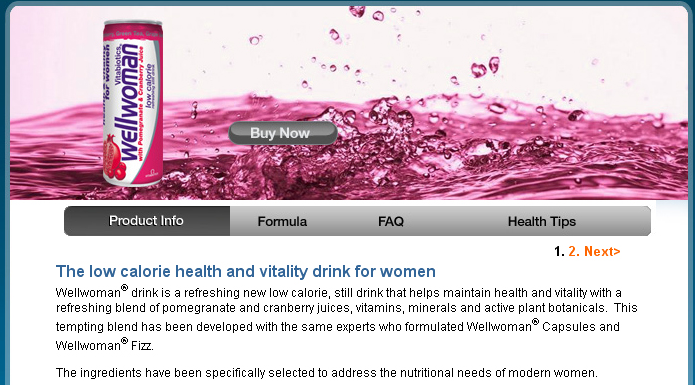
Indeed. Katrin, Greta P., and Sophie J. sent in a nice, succinct example of the divergent expectations for men’s and women’s bodies around today. We know, if we’re well-socialized, that women are supposed to be thin and men are supposed to be athletic. And, here, in this ad posted in the London Underground for Wellwoman and Wellman “sports” drinks, the message comes through loud and clear.
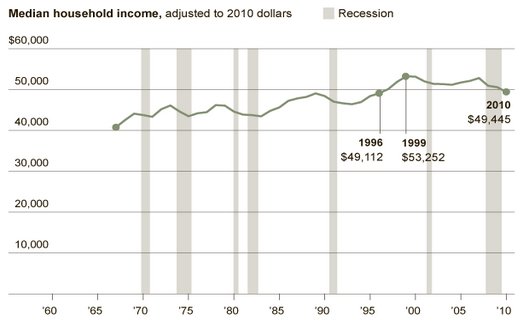
The Census Bureau just published new data revealing trends in living standards as of 2010. The trends are troubling to say the least. Median household income (adjusted for inflation) fell to $49,445. That means that the median household now earns less than it did a decade ago. This marks the first decade since the Great Depression without an increase in real median income.
According to Lawrence Katz, a labor expert and Harvard economist:
This is truly a lost decade. We think of America as a place where every generation is doing better, but we’re looking at a period when the median family is in worse shape than it was in the late 1990s.
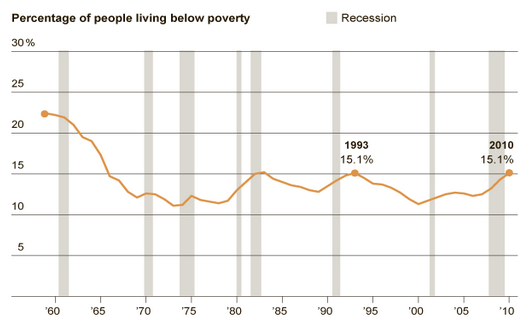
The percentage of Americans living in poverty hit 15.1 percent, the highest percentage since 1993. There are now 46.2 million people living below the poverty line, the greatest number ever recorded by the Census Bureau. Child poverty stood at 22 percent.
Things are unlikely to get better this year. State and local governments are slashing employment and programs and the federal government is now moving into cutting mode itself.
This depressing situation is not simply a recession phenomenon. As the New York Timesreports, the expansion period of 2001 to 2007 “was the first… on record where the level of poverty was deeper, and median income of working-age people was lower, at the end than at the beginning.”
Of course, while the great majority of people are struggling, a small minority have been doing very well. One consequence, as the chart below highlights, is a strong growth in inequality (as measured by the Gini coefficient with higher numbers reflecting greater inequality). As I noted in a previous post, over the years 2002 to 2007, the top 1% of households captured 58% of all the income generated.
In brief, there is a small minority that is doing very well and a great majority that is struggling, with a significant number in free fall.
Media depictions of trans people (almost entirely produced by non-trans individuals) tend to be fascinated by bodies. Since the (presumed) inappropriately gendered body is automatically monstrous, weird — or at the very least, available to be gawked at — the accessibility of trans bodies becomes a feature of their depiction.
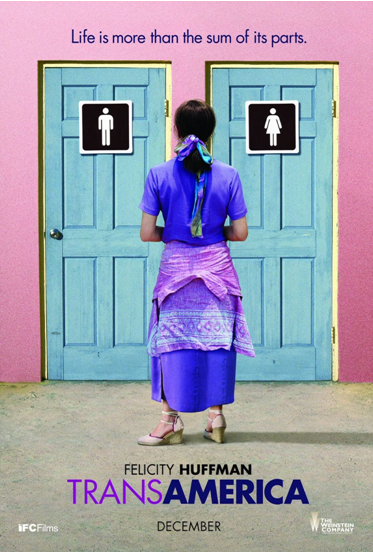
A big thread that runs through most visual media depictions is a fixation on stripping trans people naked, implying the naked body as “true.” The Crying Game’s big reveal comes when Del undresses, while the penultimate moment of self-fulfillment for Bree in Transamerica is represented by her naked in the tub, touching her vagina. Pre-op Bree’s “parts” trap her in-between, as the movie poster so helpfully informs prospective audiences—without surgery, she’s “really” just a man in a dress.
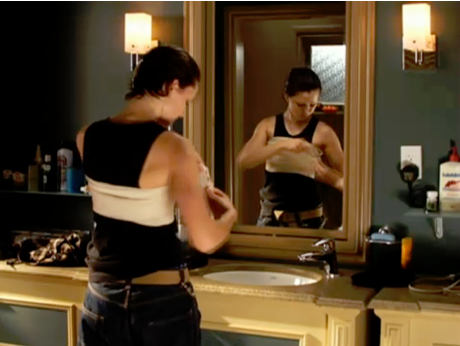
Chest surgery fills much the same function for images of trans men. The body-centrism was so prevalent in the recently released Becoming Chaz, the documentary following Chaz Bono’s transition, one critic titled his review: “About a Boy or About a Body?” We see a similar interest in trans-bodies in Boys Don’t Cry and the teen soap Degrassi:
(Still shot from film Boys Don’t Cry. Courtesy of Fox Searchlight Films)
(Still shot from Degrassi. Courtesy of Alliance Atlantis)
In all of these cases, the trans person’s emotional and social existence is tied to the state of their body. Bree can’t possibly be fulfilled until she’s had surgery and can strip naked in front of an audience. Bono can “really” be a man only after top surgery and he can go shirtless. Most importantly, trans people appear to have no life outside of their body, and their transition sometimes forms a narrative arc of beginning (bad body), middle (fixing the body), and end (good body). They are allowed to be a part of the story only as a person transitioning, their trans-status overwhelming everything about them that makes them unique individuals with complex personal stories.
——————————
Avery Dame is currently a master’s candidate in American Studies at the University of Kansas, where he studies media depictions of trans folks and trans vloggers on YouTube. He also blogs at the improbably named Ping Your Spaceman.
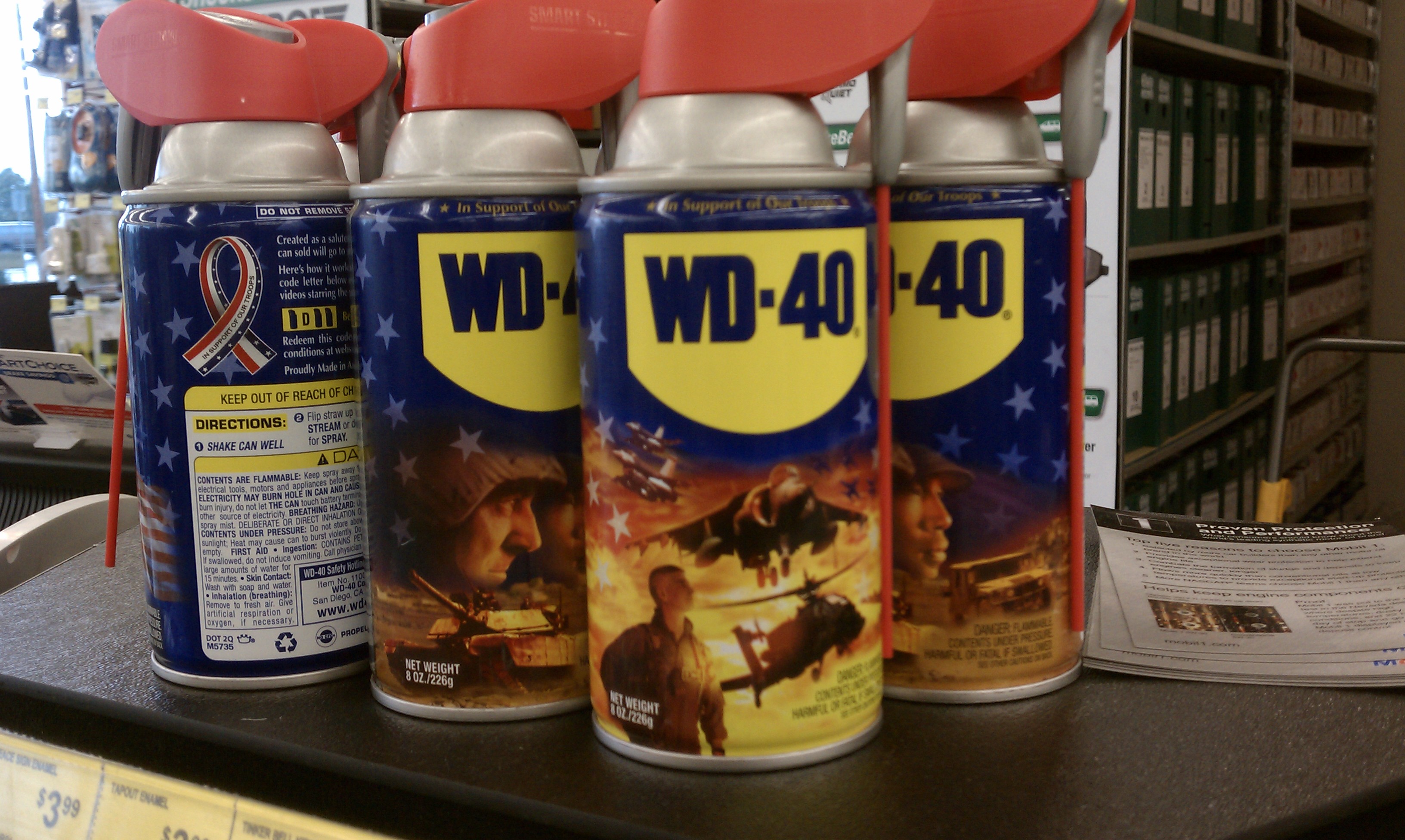
Recently, Raz sent in this image of cans of WD-40, part of their Collectible Military Series, for sale at an auto parts store:
The types of war-related advertising we see can give us insights about how average Americans are connected to, and affected by, different wars. During many U.S. wars, contributing to the war effort was the duty of every citizen; this is particularly apparent with World War II. The draft, the deployment of some 16 million Americans, and public calls to purchase war bonds and ration food meant that war was nearly everyone’s concern. In contrast, the current War on Terrorism mostly only impacts those connected directly to it—military families. There are no widespread calls to ration, buy war bonds, or otherwise support the war effort through employment, growing vegetables, saving scrap metal, or other changes to our daily lives. My own research shows that members of military families feel the war is ignored and forgotten by most Americans. They feel isolated in their daily anxieties and their efforts to support their loved ones.
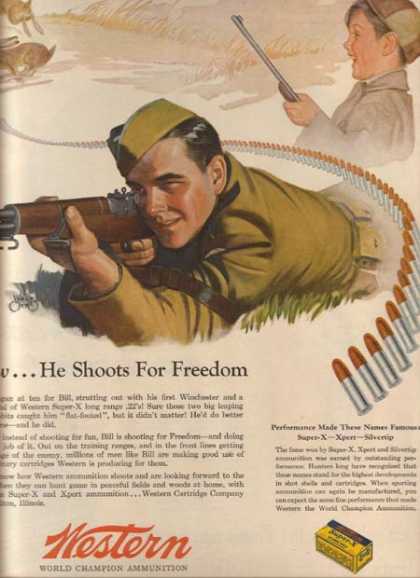
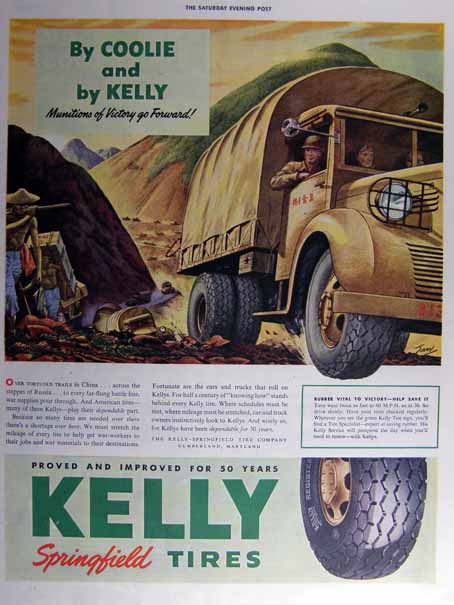
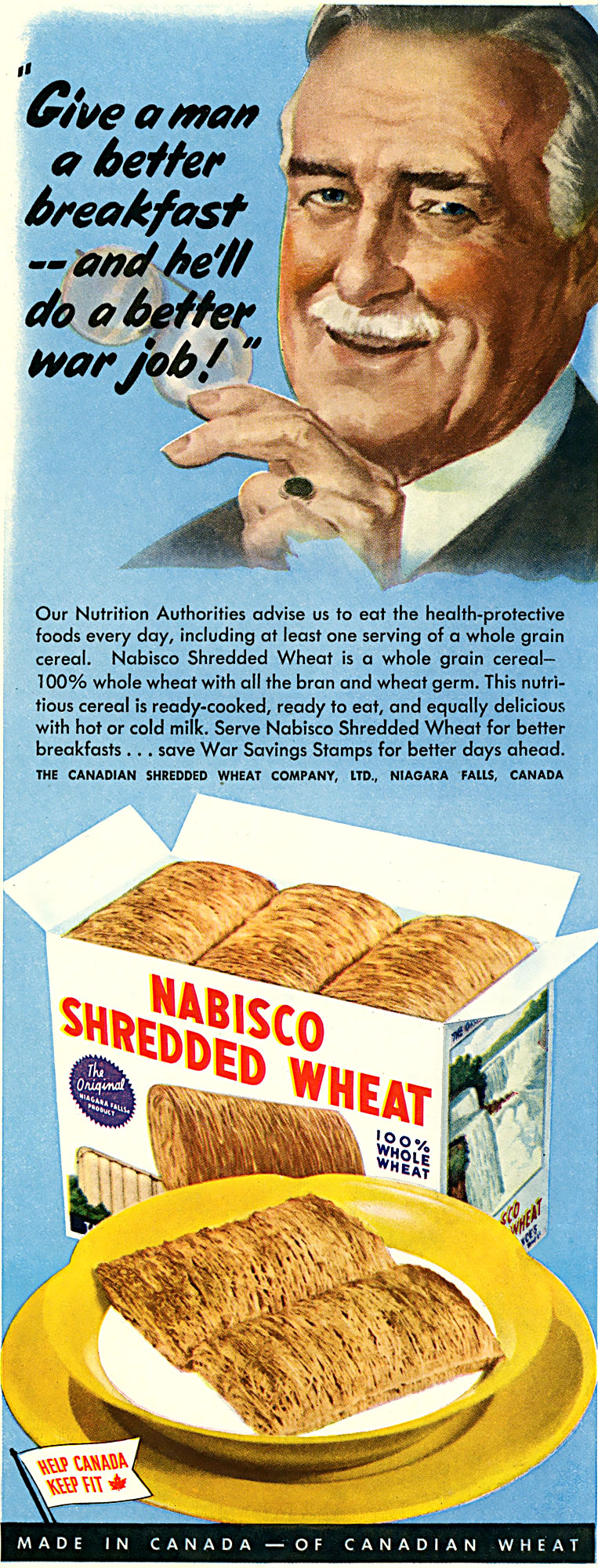
Products like the WD-40 Collectible Military Series were more common during WWII than they are now. During WWII advertising used the war cause and feelings of patriotism to sell a wide range of products that, ads argued, would help the U.S. win. Some were clearly connected to the war effort:
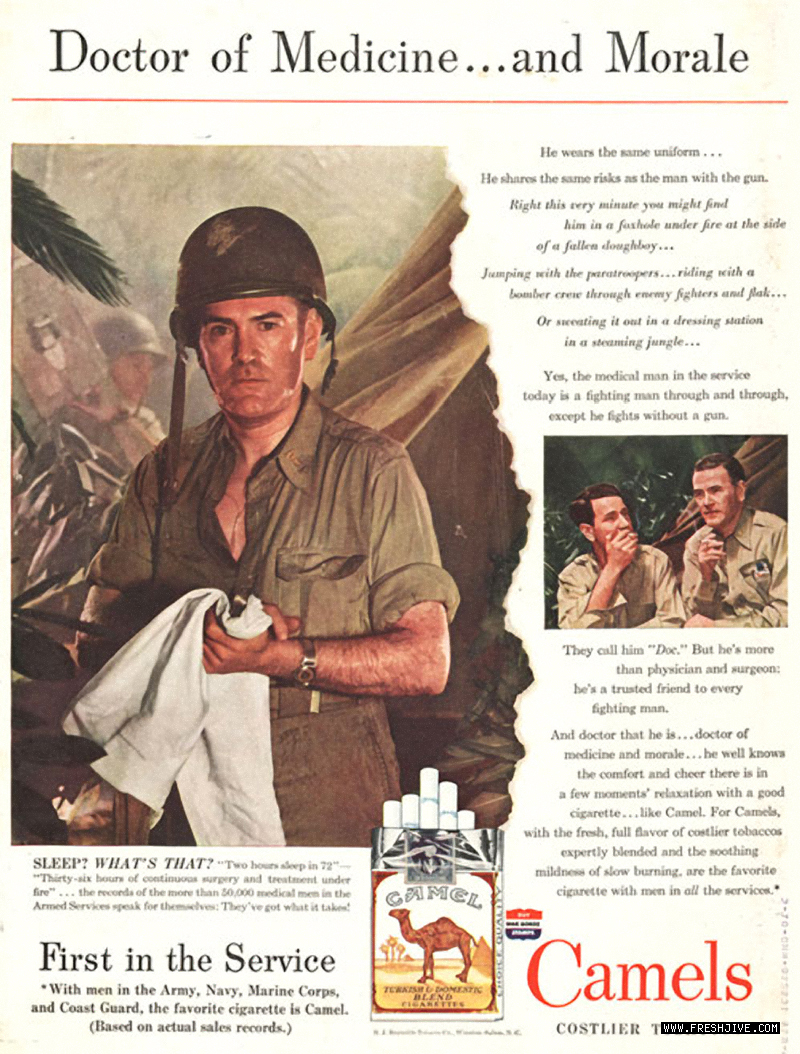
With others, the connection was much less obvious or direct:
Both Shlitz and Camel donated to the war effort. Similarly, with their “Drop and Give Me 40” campaign, WD-40 is donating part of their profits to charities that support service members and their families:
For each can purchased from March 2011 through May 2011, WD-40 Company donated 10 cents to three charities that help active-duty military, wounded warriors, retired veterans and their families. On Memorial Day, WD-40 Company presented $100,000 checks to each of the following military charities: Armed Services YMCA, Wounded Warrior Project, and the Veterans Medical Research Foundation.
Although military-themed products (aside from “support the troops” t-shirts, stickers and pins that are widely available) are not as common as they were during WWII, some companies have come out with patriotic advertising.
Goodyear has “support the troops” tires, sold and marketed at NASCAR races:
An Anheuser-Busch commercial shows ordinary Americans stopping their everyday lives to thank the troops. There is no mention of the company until the very end, and nothing at all about beer:
American Airlines has a similar advertisement depicting various Americans being supportive the troops before and during their flight:
The messages in these recent ads are markedly different than the WWII messages of everyone taking part and working toward victory, reflecting changing relationships between war efforts and the average citizen. No reminder of the war was necessary in the 1940s—war was a part of everyday Americans’ lives. Current ads, like the WD-40 series, often serve less as a call to specific action than as a reminder that the war exists, as a reminder to thank the troops and support service members. It’s a different type of message for a different type of war, one that only involves a small fraction of Americans and is often largely invisible to everyone else.
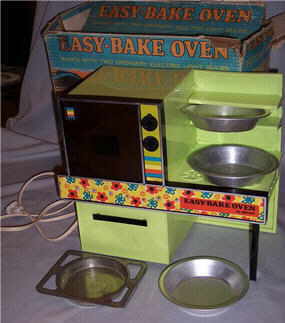
Yesterday Hasbro announced a new model of the Easy Bake Oven designed in response to the growing efficiency of light bulbs. This sounded to me like a perfect opportunity to bring back our post on the evolution of the toy. You’ll see the new model at the end.
—————————
My niece got an Easy Bake Oven for Christmas this year and I was shocked. Shocked!
No, not because of gendered gift giving, socialization, blah blah blah… (I don’t know where you would get that idea). Instead, I was shocked by what cooking apparently looks like in 2009. But let me start at the beginning…
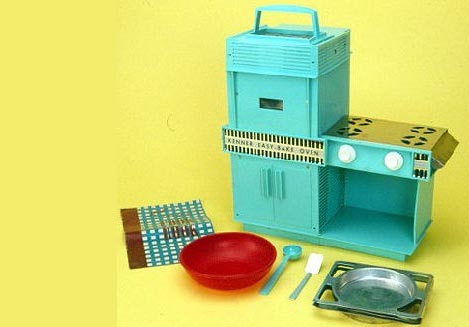
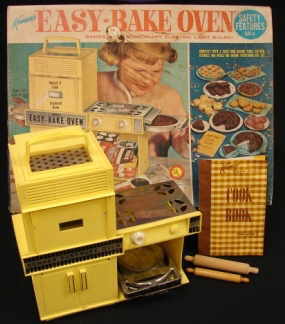
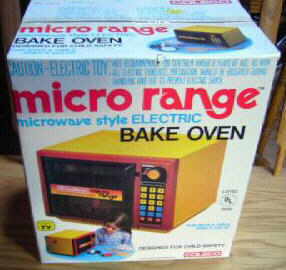
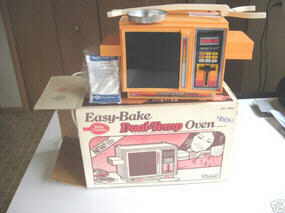
Presumably, between 1963 and 1978, what cooking looked like changed dramatically and the evolution of the Easy Bake Oven reflected that. This is what surprised me when I saw my niece’s oven.
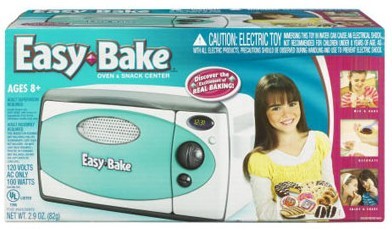
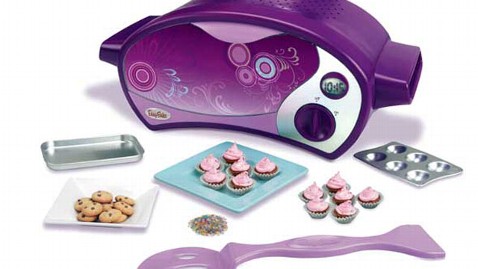
Ironically, this year’s Oven is painted in the original turquoise, as a nod to 1963, but it is still clearly a microwave:
2011: Commercially available light bulbs are no longer inefficient enough to bake goodies. This year’s model, then, is actually a real oven, reaching temperatures up to 375 degrees:
So that’s technological and socioeconomic change as signified by the Easy Bake Oven.
Sociological Images encourages people to exercise and develop their sociological imaginations with discussions of compelling visuals that span the breadth of sociological inquiry. Read more…

 In a previous post I discussed data showing the growing income inequality in the U.S.: the middle class is shrinking, the poor are getting poorer, and the rich are getting richer. It turns out that corporations understand what is happening and they are responding. In brief, they are letting go of the middle class as a market and restructuring their offerings to appeal to the top and bottom of the income distribution.