Cross-posted at The Hipster Effect.

I know, I know – you hate hipsters. Maybe somebody called you one once, but they were clearly mixing you up with the real hipsters. You know the ones.

Hipsters have beards. Or mustaches. Or neither. They wear skinny jeans. Or maybe they don’t. They’ve got thick-rimmed glasses. Or sometimes not. You may not be able to describe one offhand, but you know one when you see one. Right?

As elusive as a unicorn yet as common as an ant, the hipster seems to be everywhere and nowhere at once. The only definite thing about a hipster is that nobody wants to be called one (yet pretty much all of us are guilty of having called other people hipsters). It’s become one of the worst insults you can bestow upon somebody (yet it’s also among the most common). If you want to completely discount a person and everything that they stand for, just break out the H-word and watch their credibility to go down the drain. Once you’ve been dubbed a hipster, you yourself become meaningless in that context.  You become one of those people and we all know what those people are like.

Or do we?

The definition of a “hipster” is at best a collection of vague cultural artifacts that we associate with a certain set of personality traits, very few of which actually exist in tandem. The prototypical hipster is a trust-fund baby who spends his days talking about art projects that he never gets around to starting. He drinks the cheapest beer available even though he can afford better. He does this ironically, and he wears his clothes in the same way. He judges you, the non-hipster, based solely on your appearance, quickly dismissing you as a non-member of the hip elite. He listens to bands you’ve never heard of and thinks it’s sad that you can’t keep up with his cooler-than-cool musical tastes. In short, the prototypical hipster is an asshole – but for the most part, he doesn’t even exist.

In a way, we’ve vilified the hipster archetype as a way of dealing with our own insecurities. Being cool was something most people never worried about once they graduated high school. Our internet-fueled society has since changed that, bringing the hunt for the newest and most interesting things into our day-to-day lives. There is a burden to be cool that now follows you into your 20s and 30s and beyond, whereas before these things were safely relegated to lunchtime cafeterias and high school auditoriums. And with the internet now spitting out a different concept of cool with each and every day that goes by, it’s almost impossible to keep up. Eventually we throw up our hands in exasperation and, whenever we see somebody who looks like they’re trying harder than us, we spit out the word: hipster.

—————————

Sophy Bot is the author of the forthcoming book, The Hipster Effect: How the Rising Tide of Individuality is Changing Everything We Know about Life, Work and the Pursuit of Happiness.  Bot also runs The Hipster Effect blog, examining how identity, society and work have metamorphosed in the age of perpetual connectivity.

Cross-posted at Family Inequality.

Things that make you say… “peer review”?

This is the time of year when I expect to read inflated or distorted claims about the benefits of marriage and religion from the National Marriage Project. So I was happy to see the new State of Our Unions report put out by W. Bradford Wilcox’s outfit. My first reading led to a few questions.

First: When they do the “Survey of Marital Generosity” — the privately funded, self-described nationally-representative sample of 18-46-year old Americans, which is the source of this and several other reports, none of them published in any peer-reviewed source I can find — do they introduce themselves to the respondents by saying, “Hello, I’m calling from the Survey of Marital Generosity, and I’d like to ask you a few questions about…” If this were the kind of thing subject to peer review, and I were a reviewer, I would wonder if the respondents were told the name of the survey.

Second: When you see oddly repetitive numbers in a figure showing regression results, don’t you just wonder what’s going on?

Here’s what jumped out at me:

If a student came to my office with these results and said, “Wow, look at the big effect of joint religious practice on marital success,” I’d say, “Those numbers are probably wrong.” I can’t swear they didn’t get exactly the same values for everyone except those couples who both attend religious services regularly — 50 50 50, 13 13 13 , 50 50 50, 21 21 21 — in a regression that adjusts for age, education, income, and race/ethnicity, but that’s only because I don’t swear.*

Of course, the results are beside the point in this report, since the conclusions are so far from the data anyway. From this figure, for example, they conclude:

In all likelihood,  the experience of sharing regular religious attendance — that  is, of enjoying shared rituals that endow one’s marriage with transcendent significance and the support of a community  of family and friends who take one’s marriage seriously— is a solidifying force for marriage in a world in which family life is  increasingly fragile.

OK.

Anyway, whatever presumed error led to that figure seems to reoccur in the next one, at least for happiness:

Just to be clear with the grad student example, I wouldn’t assume the grad student was deliberately cooking the data to get a favorable result, because I like to assume the best about people. Also, people who cook data tend to produce a little more random-looking variation. Also, I would expect the student not to just publish the result online before anyone with a little more expertise had a look at it.

Evidence of a pattern of error is also found in this figure, which also shows predicted percentages that are “very happy,” when age, education, income and race/ethnicity are controlled.

Their point here is that people with lots of kids are happy (which they reasonably suggest may result from a selection effect). But my concern is that the predicted percentages are all between 13% and 26%, while the figures above show percentages that are all between 50% and 76%.

So, in addition to the previous figures probably being wrong, I don’t think this one can be right unless they are wrong. (And I would include “mislabeled” under the heading “wrong,” since the thing is already published and trumpeted to the credulous media.)

Publishing apparently-shoddy work like this without peer review is worse when it happens to support your obvious political agenda. One is tempted to believe that if the error-prone research assistant had produced figures that didn’t conform to the script, someone higher up might have sent the tables back for some error checking. I don’t want to believe that, though, because I like to assume the best about people.

* Just kidding. I do swear.

In an earlier post we reviewed research by epidemiologists Richard Wilkinson and Kate Pickett showing that income inequality contributes to a whole host of negative outcomes, including higher rates of mental illness, drug use, obesity, infant death, imprisonment, and interpersonal trust.

In the four-minute video below, Kate Pickett argues that once societies develop the capacity to enable status-based consumption (as opposed to survival-oriented consumption),  status-consciousness among humans exacerbates inequality.  Meanwhile, being status-conscious in a highly unequal society creates stress, and all kinds of other negative outcomes, among those who are judged less-than.

See Dr. Pickett, also, on why raising the average national income in developed countries doesn’t make people happier or enable them to live longer. And see more about income inequality and national well-being at Equality Trust.

Lisa Wade, PhD is an Associate Professor at Tulane University. She is the author of American Hookup, a book about college sexual culture; a textbook about gender; and a forthcoming introductory text: Terrible Magnificent Sociology. You can follow her on Twitter and Instagram.

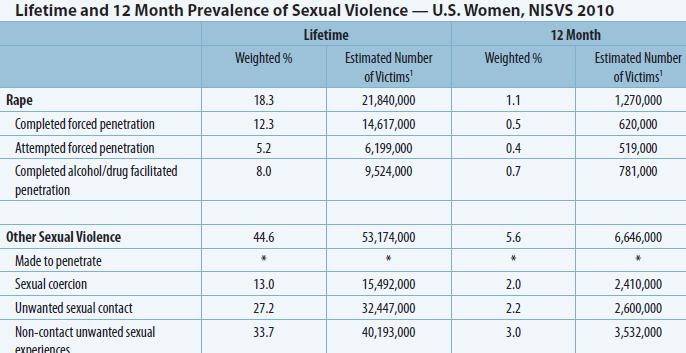
The Centers for Disease Control and Prevention’s National Center for Injury Prevention and Control recently released a report on domestic violence and sexual assault in the U.S. The National Intimate Partner and Sexual Violence Survey 2010 Summary Report presents the results of phone surveys (targeting both landlines and cells) of 18,049 randomly-selected adults conducted in 2010. The results are predictably depressing: 18.3% adult women have experienced rape (defined as attempted or completed forced penetration) in their lifetimes (for men, it’s 1.4%):

Undermining the stranger rapist myth, the report found that the vast majority of perpetrators were acquaintances or partners of their victims.

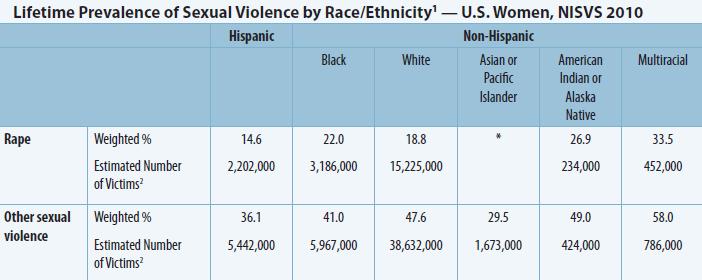
As has been found in other studies, Native American women are more at risk than other racial group for sexual assault; in this study, those identifying multiracial had the highest rates of all:

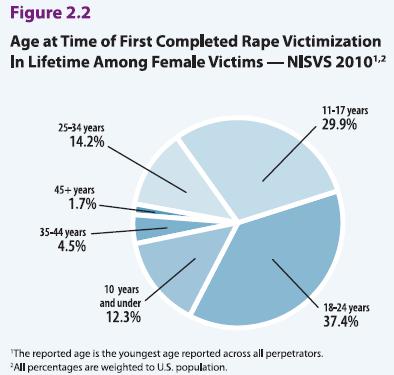
Almost a third of women who are raped are victimized before they’re 18, while over a third are young adults aged 18-24:

Risk of rape varies significantly by state, though in no state did fewer than 10% of women report being raped. Virginia had the lowest levels of victimization of women, at 11.4%; other states on the low end include Tennessee, Delaware, and Rhode Island. Worst was Alaska, at 29.2%, with Oregon not far behind at 27.2% and Nevada at 26.1%.

The report also include information on stalking and domestic violence; 16.2% of women and 5.2% of men report at least one incident, overwhelmingly from an intimate partner, while over 30% of women and 25% of men have been slapped, shoved, or pushed by a partner.

It is a singularly depressing read about the state of men’s and women’s intimate lives.

Cross-posted at Montclair SocioBlog.

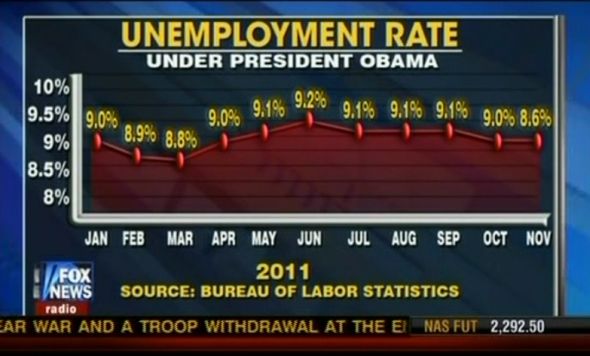
The best way to lie with statistics, says Andrew Gelman, is just lie.  This graph from Fox news is a visual version of that.  It’s published at Flowingdata.com via Media Matters.

The numbers are correct, but the Foxy graphmongers are making up the Y-axis as they go along.  The 8.6% of November is higher than than 8.8%, 8.9%, and maybe even the 9.0% of the first three months of the year.

Or maybe it’s an optical illusion.

[HT:  Max Livingston]

It’s been way too long since we’ve talked about one of my favorite foods-lost-to-history: vegetable flavored Jell-O.  I added some more examples to the end.  They’re truly awe-some.

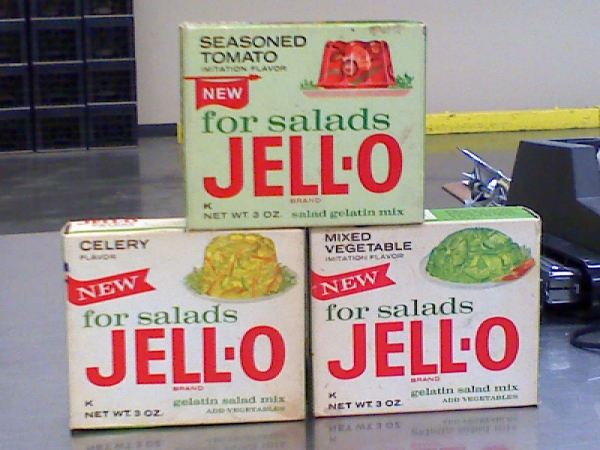
Another great example of how tastes are shaped by history: JELL-O in the flavor of celery, seasoned tomato, mixed vegetable, and italian:
jello

A box of various flavors:

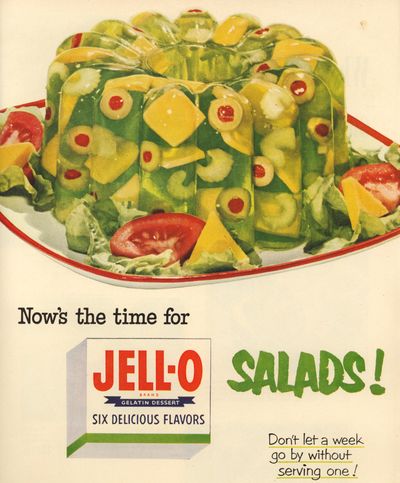
What do you do with it? Well, fill it with things like chopped celery, olives with pimento, and squares of… something:

3882147687_abb2c645d9_o

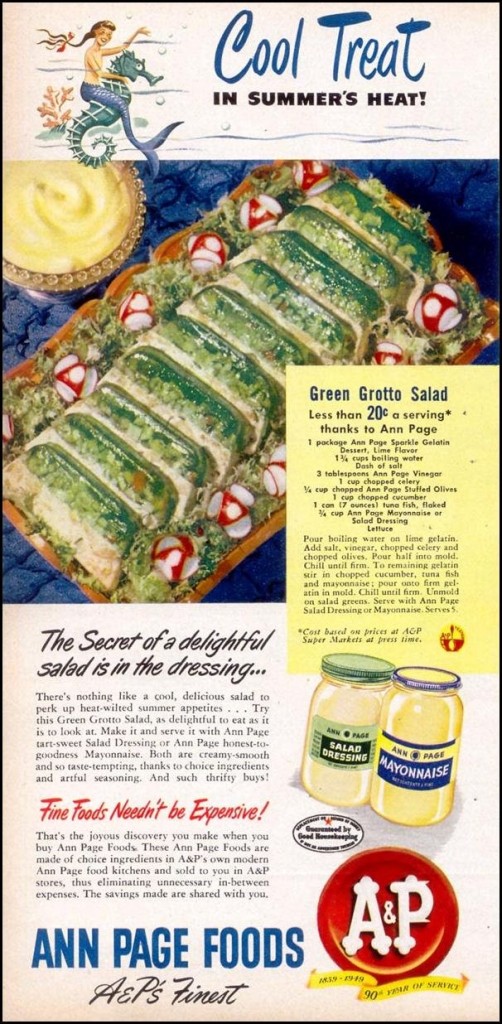
Or, um, tuna…

apday07011949022m32b1fd

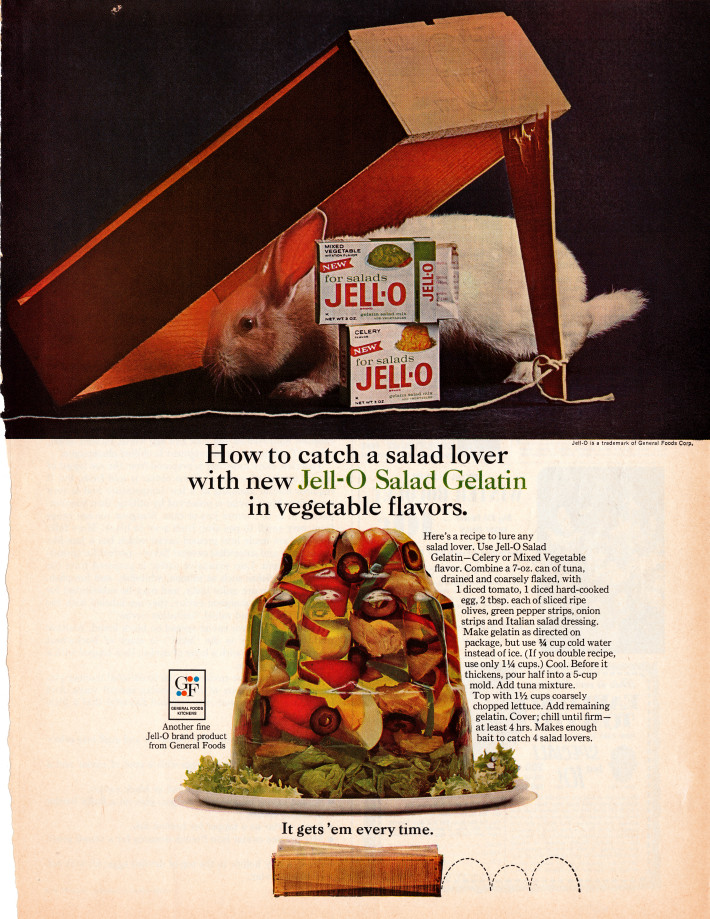
Don’t forget the hard-boiled eggs:

See also our post on aspic, meat-flavored gelatin foods.  And, for fun, here’s a history of JELL-O that includes a brief description of how you would have to make it if you had to make it from scratch, which will leave you wondering how we ever bothered to invent and make gelatin to begin with.

(Ads found at here, here, here, here, and here.)

Lisa Wade, PhD is an Associate Professor at Tulane University. She is the author of American Hookup, a book about college sexual culture; a textbook about gender; and a forthcoming introductory text: Terrible Magnificent Sociology. You can follow her on Twitter and Instagram.

Back in November, Conan O’Brien officiated at the wedding of two gay men on his show. This received a decent bit of media coverage, it being the first time a same-sex couple was married on TV. My friend John McQuiston pointed out a great video showing the intros of many stations’ coverage of the story. John says CBS Newspath released a tease with the phrase “pushing the envelope,” and the phrase stuck. The clip illustrates the way that, despite the many media outlets available to us, norms of news reporting (and, according to John, general laziness) mean that we often hear the same message or framing of issues repeated over and over, reinforcing a particular understanding of events to the exclusion of other interpretations:

As we enter the last frenzied days of Christmas shopping, Dmitriy T.M. thought it was worth looking at international comparisons in spending on the holiday. The Economist posted a graph based on Gallup polls and other data sources about how much individuals in various countries in Europe, plus the U.S. and South Africa, plan to spend on Christmas shopping this year, plotted against national GDP. Overall, Christmas spending correlates with national wealth, with the Netherlands being a noticeable outlier (spending less than we’d expect) and Luxembourg in a spending league of its own: