On January 1st, the minimum wage increased in Arizona, Colorado, Florida, Montana, Ohio, Oregon, Vermont and Washington. These eight states all have laws which require them to automatically increase their respective minimum wages by the rate of inflation. Nevada also indexes its minimum wage but its increase takes place in July.

The state of Washington has the highest state minimum hourly wage at $9.04.  Oregon has the second highest at $8.80.

Eighteen states plus the District of Columbia have minimum wages above the federal minimum wage which remains at $7.25 per hour.  A full-time worker making the federal minimum wage earns just $15,000 a year.

There are those who argue against state laws requiring an inflation adjustment to the minimum wage.  Their most common argument is that such government mandated increases are a threat to business profitability and the health of our capitalist, free-market economy.  This is an interesting argument.  At one time, the conventional wisdom was that capitalism was a means to an end, the end being a better standard of living.  Now it appears that capitalism has become the end itself, and to sustain a healthy capitalism workers will have to make sacrifices.     

Actually, those arguing against increasing the minimum wage are really arguing for the necessity of a declining real wage.  The minimum wage has not kept up with inflation. This is true even in states that currently index their minimum wage.  The reason is that indexing began after years of real wage decline. For example, Oregon’s January 2012 increase to $8.80 from $8.50 still leaves the real inflation-adjusted Oregon minimum wage below what it was in 1976.  In 2011 dollars, Oregon’s 1976 minimum wage was $9.09.

The federal government does not automatically index the federal minimum wage and the chart below highlights the extent of the decline in its real value. The blue line shows the actual or nominal dollar value of the federal minimum wage; increases are the result of a vote by Congress.  The red line shows the real value of the minimum wage in 2010 dollars.  In real terms the federal minimum wage remains considerably below its value in the 1970s.

wage-trend.png

A second common argument against inflation adjusted increases in the minimum wage is that it is just a training wage for young teens and therefore not important to family survival.  This argument misses the mark for several reasons, the most important being that, as the chart below shows, 80% of minimum wage workers in the eight states with mandated increases are over the age of 20, and more than 75% work more than 20 hours per week (just over half work full-time). In fact, according to an Economic Policy Institute study of national data, families with a minimum-wage worker rely on their earnings for nearly half the family income.

table-on-increase.png

Appearances and Publications:

After I posted about the Jimmy Kimmel prank in which he encouraged parents to film their kids getting “bad” presents, I had the opportunity to inform a New York Times article about the subject.  I discussed the social rules of the Christmas gift-giving (and the importance of teaching kids how to be the butt of a joke).  My first time in the NYT. w00t!

Also, I’m proud to report that a paper I co-wrote with Caroline Heldman has been published in a new book titled Sex For Life: From Virginity to Viagra, How Sexuality Changes Throughout Our Lives (edited by Laura Carpenter and John DeLamater, and published by NYU Press).  Our chapter is about first-year college students experiences with hook up culture.  You can get a sneak peak here.

Pinterest!

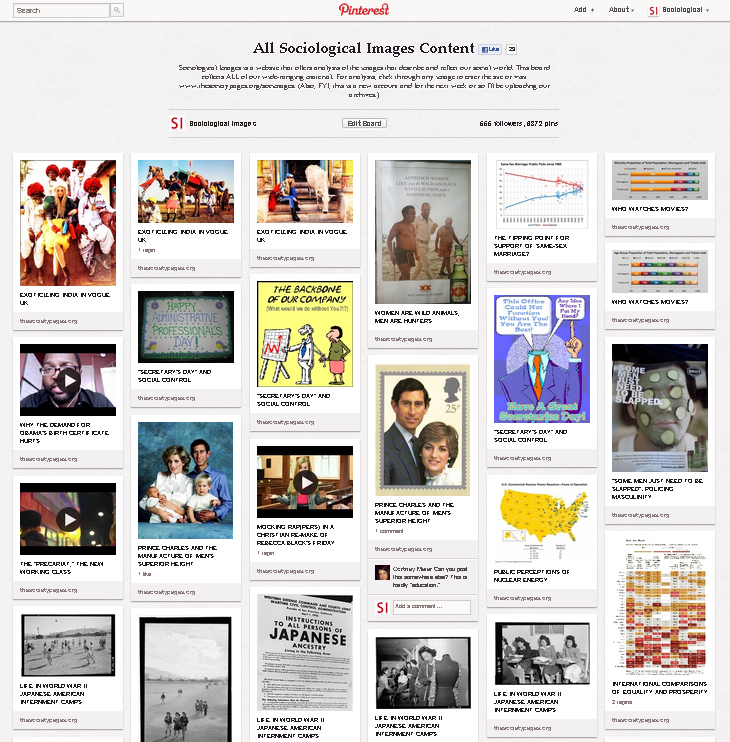
Over the holiday I went sort of bonkers and decided to start up a Pinterest site for SocImages.  Pinterest is a virtual “pin board” where people can collect images from around the web.  I uploaded our entire archive to the site: 4,002 posts and 8,040 images.  It will let you peruse our images much more quickly. If anything inspires, you can click through to the blog to read the analysis.  These are the “boards” we have so far:

They look like this (then you scroll down):
 Best of December:


Meanwhile, our fabulous intern, Norma Morella, collected the stuff ya’ll liked best from this month.  Here’s what she found:

Best of 2011:

Gwen and I ran our favorite posts from 2011 over the last five days.  Just in case you missed them, here’s a list:

Over at his blog, Family Inequality, SocImages Contributor Philip Cohen made a list of his best liked posts from 2011 too.  Check them out here.

Social Media ‘n’ Stuff:

Finally, this is your monthly reminder that SocImages is on TwitterFacebook and, now, Pinterest.  Gwen and I and most of the team are also on twitter:
For the last week of December, we’re re-posting some of our favorite posts from 2011.

————————

Enjoying a show last year at The Magic Castle, I was struck by the magician/assistant distinction.  The magician would make a dove disappear, and his assistant would suddenly reveal it in her possession.  “Who was doing magic,” I wondered? It looked like a team effort to me.

I was reminded of this distinction while watching an NPR short on artist Liu Bolin.  Bolin, we are told, “has a habit of painting himself” so as to disappear into his surroundings.  The idea is to illustrate the way in which humans are increasingly “merged” with their environment.

So how does he do it?  Well, it turns out that he doesn’t.  Instead, “assistants” spend hours painting him.  And someone else photographs him.  He just stands there.  Watch how the process is described in this one minute clip:

So what makes an artist?

One might argue that it was Bolin who had the idea to illustrate the contemporary human condition in this way. That the “art” in this work is really in his inspiration, while the “work” in this art is what is being done by the assistants. Yet clearly there is “art” in their work, too, given that they are to be credited for creating the eerie illusions with paint. Yet it is Bolin who is named as the artist; his assistants aren’t named at all.  What is it about the art world — or our world more generally — that makes this asymmetrical attribution go unnoticed so much of the time?

See also Hennessey Youngman on “How to make An Art.”

Lisa Wade, PhD is an Associate Professor at Tulane University. She is the author of American Hookup, a book about college sexual culture; a textbook about gender; and a forthcoming introductory text: Terrible Magnificent Sociology. You can follow her on Twitter and Instagram.

For the last week of December, we’re re-posting some of our favorite posts from 2011.

————————

Flickr creative commons by Sakurako Kitsa, Roberto De Vido, and Stella Hwang.

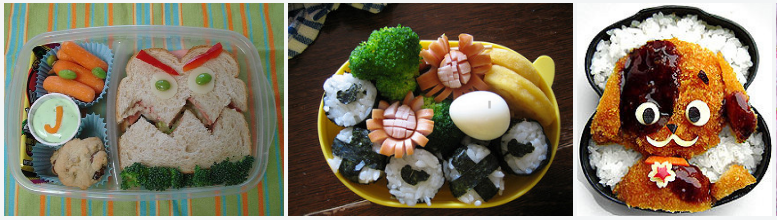
In her article “Japanese Mothers and Obentos: The Lunch-Box as Ideological State Apparatus,” Anne Allison discussed the meaning of obentos. The Japanese educational system is highly centralized, with the national Ministry of Education determining the curriculum and approving textbooks. Nursery school, though overseen by the Ministry, is generally private and isn’t compulsory, though attendance is high. According to Allison, it functions much like kindergarten in the U.S., focusing less on content than on how to be a student. Of particular importance are the ability to transition from home life to the public sphere of a bureaucratic state institution and socialization into norms of group life, including cooperation and emphasis on the collective rather than the individual.

The obento was seen as an important element of this process. It was a token of home, and more specifically, of mom. The willingness to make elaborate, creative obentos was used as a measure of a woman’s commitment to the mothering role. The lunches, as you can imagine from the photos, could be very time- and labor-intensive to make. During her time in Japan, Allison says she and the mothers she talked to spent 20-45 minutes each morning on a single obento, in addition to the time spent planning and shopping for ingredients. Tips for making obentos were a frequent topic of conversation among moms, and whole magazines were devoted to the topic. Stores sell a range of obento items, including containers, decorations, molds and stamps to cut foods into various shapes, and, increasingly, pre-made food:

Nursery schools carefully oversaw lunch. The entire obento must be eaten, and everyone had to wait until every child had finished — an important lesson in the importance of the group over the individual. Thus, part of the mother’s job was to make the food appealing and easy to consume, in an effort to encourage her child to eat and avoid the embarrassment of holding up the rest of the class from after-lunch recess. Making food brightly-colored, in various shapes, and in small portions helped with this process. If a child failed to eat the entire lunch, or ate slowly, both the child and mother were held accountable. More than just a lunch, then, Allison argues that obentos served as a form of socialization into ideas of what it meant to be Japanese, particularly the emphasis on the collective and the importance of meeting expectations. Indeed, her son’s teacher viewed him as successfully assimilating to Japan not when he learned the language or made friends, but when he began routinely finishing his obento.

Talking to Japanese mothers — and making obentos for her own young son — Allison found that designing obentos was often viewed as a creative outlet, a way to express themselves and their love for their child. The small group she spoke with generally described it as a fulfilling part of motherhood. But the stakes were also high, since making a sub-par or merely utilitarian obento could stigmatize them as bad mothers. The quality of a mother’s obento became a symbol of the quality of her mothering and her commitment to her child’s educational success.

Of course, this served to institutionalize a form of intensive mothering that is difficult to balance with work life or outside interests. The women she spoke to generally could not hold even part-time jobs and fulfill the expectations placed upon them; those who did often tried to keep it secret to avoid negative judgment from their child’s teacher. In fact, a 2007 Japan Today article said that 70% of Japanese women leave the paid labor force when they have a child.

Allison’s article was published in 1991. I’d love to hear from readers with more recent experiences with expectations surrounding obentos in Japan.

UPDATE: As I had hoped, some of our readers have some great insights about obentos, including questioning whether the really elaborate obentos are most common among wealthier families while most make do with less intricate versions that don’t require as much commitment to intensive mothering. Be sure and check out the comments!

[Full cite: Anne Allison. 1991. “Japanese Mothers and Obentos: The Lunch-Box as Ideological State Apparatus.” Anthropological Quarterly 64(4): 195-208.]

Gwen Sharp is an associate professor of sociology at Nevada State College. You can follow her on Twitter at @gwensharpnv.

For the last week of December, we’re re-posting some of our favorite posts from 2011.

————————

You often hear that everything is sexualized nowadays, and not just women but men too. In the September 2011 issue of Sexuality & Culture, we examine this idea in an analysis of Rolling Stone magazine covers.  Specifically, we wanted to know if men and women are equally sexualized, and if they have become either more frequently or more intensely sexualized over time.  To do this, we analyzed every cover from the first issue of Rolling Stone in November 1967 through 2009, minus a few (such as those that featured cartoons rather than people, etc.). You can read more about our methods in the article here.

In order to analyze these 1000+ images of men and women, we developed a “scale of sexualization.”   This scale was composed of 11 different variables to measure different aspects of sexualization.  For instance, a cover model was given “points” for being sexualized if their lips were parted, if they were scantily clad (more points if they were naked), if the text describing them used explicitly sexual language, or if they were lying down on a bed or otherwise posed in a sexually suggestive way.  Images could score anywhere from 0 points (and 176 did) to 23 points (though 20 was our highest score).

Once all of the images on all 43 years of Rolling Stone were scored, we divided the images into three groups:  those images that were generally not sexualized, those images that were sexualized, and those images that were so sexualized that we dubbed them “hypersexualized.”

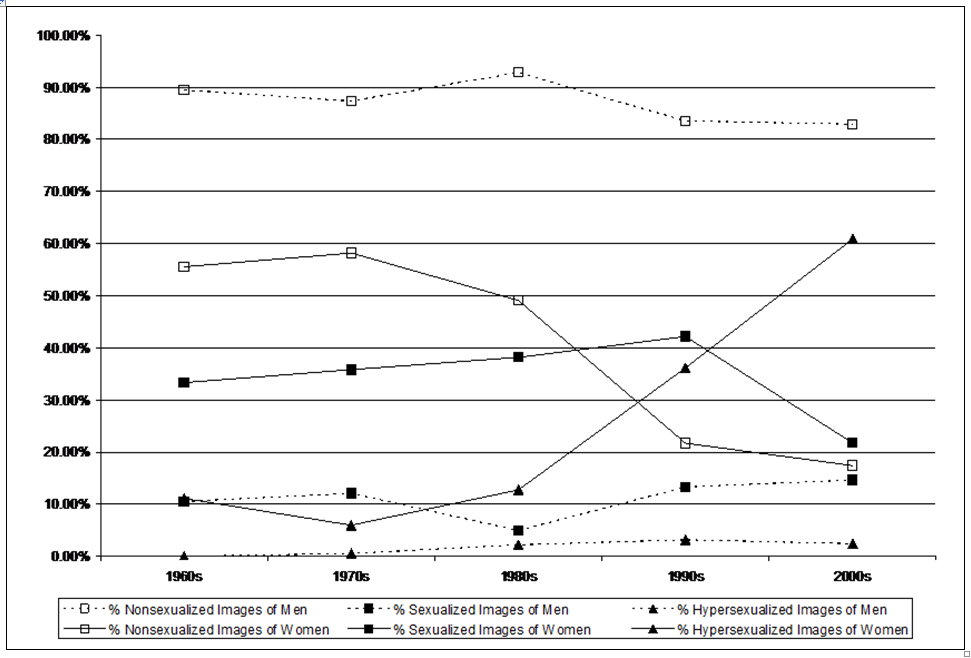
The graph below shows our findings:

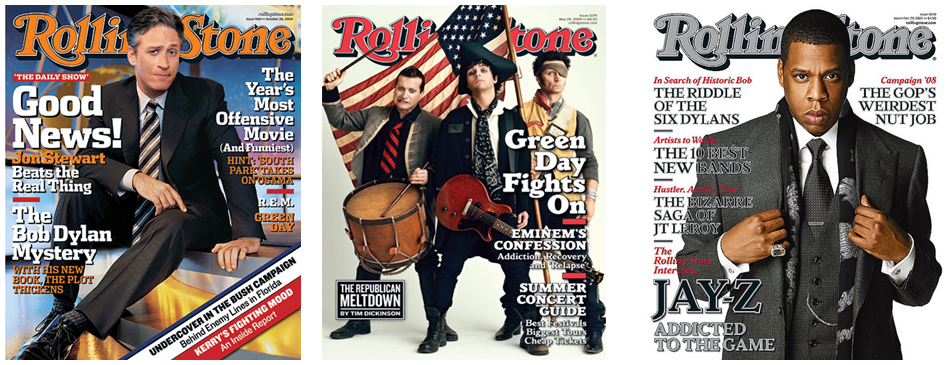
Looking first at images of men (represented by dotted lines), we see that the majority of them– from 89% in the 1960s to 83% in the 2000s — were nonsexualized.  Men are sometimes shown in a sexualized manner (about 15% in the 2000s), but they are rarely hypersexualized (just 2% in the 2000s). In fact, only 2% of the images of men across the entire dataset — all 43 years — are hypersexualized.

But, again, the vast majority of men — some 83% in recent years — were not sexualized at all.  So, if you were to pick up a copy of Rolling Stone in the 2000s, you would most likely see men portrayed in a non-sexualized manner, such as in these images:

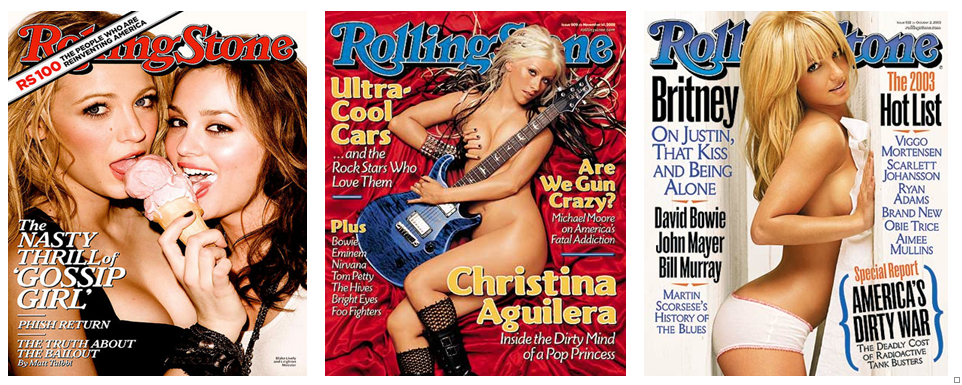
In contrast, women, especially recently, are almost always sexualized to some degree.  In fact, by the 2000s, 61% of women were hypersexualized, and another 22% were sexualized.  This means that, in the 2000s, women were 3 1/2 times more likely to be hypersexualized than nonsexualized, and nearly five times more likely to be sexualized to any degree (sexualized or hypersexualized) than nonsexualized.

So, in the last decade, if you were to pick up a copy of Rolling Stone that featured a woman on its cover, you would most likely see her portrayed in a sexualized manner, since fully 83% of women were either sexualized or hypersexualized in the 2000s. Here are a few examples of hypersexualized images:

In our article, we argue that the dramatic increase in hypersexualized images of women — along with the corresponding decline in nonsexualized images of them — indicates a decisive narrowing or homogenization of media representations of women.  In Female Chauvinist Pigs: Women and the Rise of Raunch Culture, journalist Ariel Levy (2005:5) describes this trend in this way:  “A tawdry, tarty, cartoonlike version of female sexuality has become so ubiquitous, it no longer seems particular.  What we once regarded as a kind of sexual expression,” Levy writes, “we now view as sexuality” (emphases in original).  In this article, we offer empirical evidence for this claim.

So what explains this trend towards women’s hypersexualization?  We don’t think it’s just the idea that “sex sells.” If that were true, we’d see many more images of women on Rolling Stone’s covers (only 30% of covers feature images of women) and we’d also see more sexualized and hypersexualized images of men.  We’d love to hear your thoughts in the comments.

Mary Nell Trautner and Erin Hatton are Assistant Professors of Sociology at SUNY Buffalo. Trautner is the author of many articles on the relationship between law, culture, organizational practices, and social inequality (and has written a fantastic Soc Images Course Guide for Sociology of Gender courses).  Hatton, a sociologist of work, is the author of The Temp Economy: From Kelly Girls to Permatemps in Postwar America.

For the last week of December, we’re re-posting some of our favorite posts from 2011.

————————

Last week Lisa posted about the racist “Asians in the Library” video from UCLA student Alexandra Wallace, and how the responses to it have often drawn on very sexist, demeaning language, as though the only way we know to combat one type of stereotyping or prejudice is to use another. Yuki T. send in a video response by slam poet Beau Sia that, as Yuki says, “stands out as a real examination of the white privilege and fear that underlies the racism that Alexandra Wallace displays,” rather than just trying to degrade or mock Alexandra in whatever way possible:

UPDATE: I found a transcript at dandelionchild, via Common Pitfalls of the Amateur Poet, though it appears the first place the transcript was posted was Madame Thursday. It’s after the jump. Thanks for reminding me, WellWheeled!

more...

For the last week of December, we’re re-posting some of our favorite posts from 2011. Originally cross-posted at Jezebel and Owni.

————————

A few years ago my mom took a short-term nursing job at a hospital in the Sacramento area. This was a huge deal for her. She had never been to California, hadn’t lived outside of our rural area of Oklahoma since she divorced my dad when I was a baby, and had never worked at a “big city” hospital. She feared she wouldn’t be able to make it, that her rural hospital experience just wouldn’t translate.  There were a lot of firsts for her, but it went well and the hospital administration told her they’d be happy to have her back. She was incredibly proud of herself, both for doing a good job and for being able to survive in California, a location trumped in the Big Scary Places sweepstakes only by New York City. It was an enormous confidence builder: she could leave her small town and she could make friends and keep a job.

And then, a few days before she was set to leave, she called me. Some of the staff had a little informal going-away party for her, and she was baffled by the card they’d all signed for her. It featured Jeff Foxworthy, the comic who made a name with his “You might be a redneck if…” schtick in the ’90s. The joke on the card was something about being a redneck if you used Hefty trash bags for luggage. But why, my mom asked hesitantly, would they give that to her? She’d never told them she liked Jeff Foxworthy; what made them think she’d want a card with him on it? And finally, in a plaintive voice that still just breaks my heart when I remember it, she asked me if it was possible they were implying she is a redneck, and that the people she thought were her friends were laughing at her.

Of course they did, and were. That doesn’t mean they didn’t genuinely like her or didn’t think she’s an excellent nurse, or that they meant to be hurtful; they probably assumed she’d get the joke, what with her accent, unusual colloquialisms, and openly-expressed awe and  complete lack of irony or cynicism. But in fact, the idea that her new friends might view her as a redneck or a hick was a shock. She didn’t know what she might have done that would make other people think she’s a redneck. And I could tell she was terrified — afraid that instead of “making it” in California, she was actually a joke, and too clueless to know it.

I lied to her. I said I was sure it wasn’t anything specific to her, but was just because she was from Oklahoma, and Jeff Foxworthy is from the South, so they probably just thought everybody in the South or South-adjacent region likes him. I knew it would break her heart and totally destroy her new-found confidence to think that to a lot of people, she represented stereotypes of backward rednecks, not the hard-working medical professional she’d been working so hard to portray herself as.

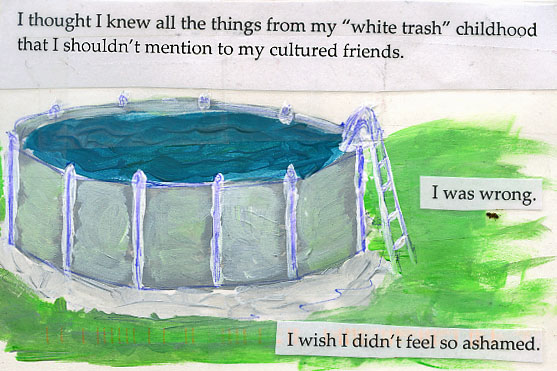
I thought of that experience when I saw this postcard from Post Secret:

I’ve built up a lot more cultural capital than my mom, going to grad school and being socialized into the norms of academia. I mostly eradicated my accent when I was an undergrad, I figured out that Velveeta cheese was not an acceptable addition to a cheese plate at an upper-middle-class dinner party, and I learned that most people don’t view skunks, squirrels, opossums, or raccoons as animals you might potentially turn into pets, if you’re brave and really dedicated.

I don’t feel ashamed of my background any more, because I’ve achieved enough proof of upper-middle-class success — a Ph.D., a tenure-track job, the knowledge that Brie is fancy cheese and not, as my grandma thought upon seeing it for the first time, fish bait — and some useful theories, like the idea of cultural capital, to help me make sense of what’s going on.

But I recognize the sentiment expressed in the postcard — the ever-present possibility that you’ll un-self-consciously mention something from your childhood and be met with gleefully horrified looks and giggles, and not know what’s so funny about shrugging and off-handedly saying, “I don’t know if I really need to see a movie about it, I’ve watched my relatives do it tons of times” when someone suggests watching the documentary Okie Noodling. It’s an extra little mental effort you have to expend as you navigate social encounters, trying to imagine whether something as small as honestly answering a simple question like what was your favorite food when you were a kid might open you up to ridicule. It’s not really the laughing itself, which is often good-natured and comes from people who do honestly like you, that’s so bothersome; it’s the realization that you still don’t know the cultural rules, and thus can’t necessarily protect yourself from being laughed at even if you wanted to — or in my mom’s case, that you don’t know what it is you’re doing that makes you a redneck in other people’s eyes.

For the last week of December, we’re re-posting some of our favorite posts from 2011.

————————

A good mockery can go a long way towards exposing cultural trends.  And this faux “Trailer for Every Oscar-Winning Movie Ever,” sent along by Ben N., does a fabulous job of revealing just how damn formulaic American movies can be.  It’s a treat:

See also: mocking tampon commercials.

Lisa Wade, PhD is an Associate Professor at Tulane University. She is the author of American Hookup, a book about college sexual culture; a textbook about gender; and a forthcoming introductory text: Terrible Magnificent Sociology. You can follow her on Twitter and Instagram.