How does a scientist measure your unconscious mind?  It turns out, it can be done.  With a technique called the Implicit Association Test, psychologists can measure your unconscious beliefs about anything: whether, deep down, you associate Black men with weapons, Asians with foreigners, fat people with laziness, men with science, and more.  You can test yourself on all manner of implicit beliefs here.

It works by putting a pair of words on each side of a computer screen. Sometimes the pair matches your unconscious mind; like (for most of us, unfortunately) young and good.  Sometimes the pair challenges your unconscious mind; like (for most of us, unfortunately) old and good.  You’re asked to do a timed test focusing on just one of the pair; we’re all quicker when the terms match than when they don’t.  For more, read up about it here.

In any case, it turns out the phenomenon has a name — the Stroop effect — and the best illustration of it I’ve ever seen was featured on BoingBoing.  It involves colors and color names. For a lifetime, we’ve been taught to associate certain colors with certain names. Accordingly, our brain fires faster and more confidently when we see the name in the color, compared to when we see the name in an opposing color.  See for yourself: can you read both lists of colors equally comfortably, un-self-consciously, and quickly?Probably not.  So, for better or worse, scientists see this same effect when they try to get our brains to process paired words like Asian/American and men/science.  The results of these experiments are depressing (both abstractly and often personally when we take the tests ourselves), but it’s pretty amazing that we’re able to delve that deeply into the mind with such a simple task.

Lisa Wade, PhD is an Associate Professor at Tulane University. She is the author of American Hookup, a book about college sexual culture; a textbook about gender; and a forthcoming introductory text: Terrible Magnificent Sociology. You can follow her on Twitter and Instagram.

A couple of years ago I posted a segment from the PBS series Faces of America focusing on the legal efforts by Syrian immigrants in the late 1800s and early 1900s to be officially recognized as White (and thus eligible for naturalized citizenship). It nicely illustrates the social construction of race and ethnicity, and the way  power struggles are embedded in the categories we recognize and who is assigned to each one.

In Not Quite White: Arabs, Slavs, and the Contours of Contested Whiteness, directors Jamil Khoury and Stephen Combs integrated scenes from Khoury’s play WASP: White Arab Slovak Pole and interviews with scholars from the Arab American and Polish American communities to “reflect upon contested and probationary categories of whiteness and the use of anti-Black racism as a ‘whitening’ dye.”

Thanks to Katrin for the link!

Flickr Creative Commons, Lau

Stephanie Medley-Rath sent in a new example of urinals shaped like women’s mouths (source).

Liz B. sent in a slide show of “innovative” urinals that included this example.

Urinals at the Rosenmeer restaurant in Moenchengladbach, Germany, are shaped like women’s bodies (source).

Others are shaped like nuns urinals (more nun or maybe the Virgin Mary urinals here).


Emma B. sent in this image of sinks:

fail-owned-sink-design-fail

Gwen Sharp is an associate professor of sociology at Nevada State College. You can follow her on Twitter at @gwensharpnv.

Previous posts related to St. Patrick’s Day:

See also, Gingerism.

Lisa Wade, PhD is an Associate Professor at Tulane University. She is the author of American Hookup, a book about college sexual culture; a textbook about gender; and a forthcoming introductory text: Terrible Magnificent Sociology. You can follow her on Twitter and Instagram.

In honor of St. Patrick’s Day tomorrow, I thought I’d re-post this one from 2010…

Some recent ads making fun of redheads has brought gingerism — or hateful attitudes and behavior towards people with red hair, light skin, and freckles — into the news lately.

It appears to be an ongoing form of discrimination, especially in Britain.  Men and boys appear to be more frequent targets than women and girls, who at least are sometimes seen as uniquely beautiful.  A recent series of verbal and physical attacks  is nicely documented at Wikipedia.  They include a stabbing, a family who has had to move twice after their children were bullied, a woman who won a sexual harassment suit after being targeted for her red hair, and a boy who committed suicide after being teased relentlessly.

The prejudice may be related to the long-standing antagonism between Britain and Ireland; discrimination against the Irish by the British crossed the Atlantic with early Americans.  As late as the 1800s the Irish were demeaned, negatively stereotyped, and compared with apes in the United States.

Katrin brought our attention to this ad for Tesco. Tesco voluntarily withdrew their ad after complaints. And an ad for npower generated a handful of complaints to the Advertising Standards Authority.  The Authority declared that the humor was unlikely to cause widespread offense (BBC).

Katrin also sent in M.I.A.’s video for the song “Born Free.” It was pulled from YouTube for excessive violence and inappropriate content. Among other themes, it shows red-headed, freckled adolescents being rounded up by the police (this becomes clear at about 2:45), taken out to a deserted area, shot at or bombed, and physically attacked. The video is supposed to highlight ethnic cleansing, though a number of critics argue the gratuitous violence overshadows any political point. It’s about 10 minutes long, but you don’t have to watch the whole thing to get the idea:

M.I.A, Born Free from ROMAIN-GAVRAS on Vimeo.

Lisa Wade, PhD is an Associate Professor at Tulane University. She is the author of American Hookup, a book about college sexual culture; a textbook about gender; and a forthcoming introductory text: Terrible Magnificent Sociology. You can follow her on Twitter and Instagram.

Cross-posted at Montclair SocioBlog.

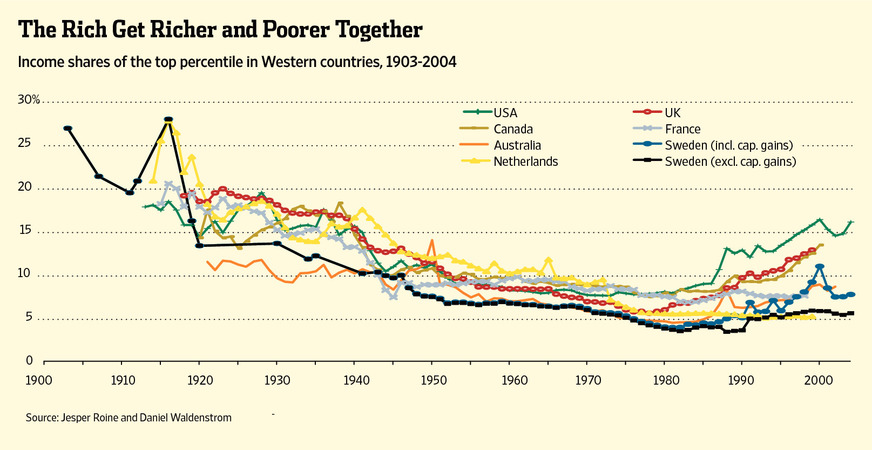
This graph tracks the share of income going to the top 1% in seven countries.  It’s from a paper by two Swedish economists, Jesper Roine and Daniel Waldenström (pdf).”’

The trend was towards greater equality up to 1980 — the share of the 1% was shrinking.    Since then, the 1% have increased their share of the income pie in all seven countries.  But the graph seems to show important differences, especially in recent decades.  Here is a  cropped version of the graph showing the 1980-2004 years.  I have added straight lines connecting those two points for Sweden and for the U.S.
Both changes are increases, but are they the same or are they different?  The answer is crucial.  The U.S. and Sweden have different economic policies.  If the changes are no different between countries, then inequality is just one of those inevitable things that’s happening no matter what governments do.  But if the growth of inequality in the US is much greater than in Sweden, maybe government policy can in fact mitigate the trend towards inequality.
The Swedish 1% share went from a little under 5% to about 7.5%.  In the U.S., the 1% share increased from about 7% to 16%.* You might see those increases as very similar.
In fact, Allan Meltzer in the Wall Street Journal takes precisely that view.  He stretches out the graph to de-emphasize the vertical differences, and adds a title implying that all countries are “together” in this shift of income to the top 1%.
He adds this explanation:
As the . . . chart . . . shows, the share of income for the top 1% in these seven countries generally follows the same trend line. That means domestic policy can’t be the principal reason for the current spread between high earners and others. Since the 1980s, that spread has increased in nearly all seven countries. The U.S. and Sweden, countries with very different systems of redistribution, along with the U.K. and Canada show the largest increase in the share of income for the top 1%. [emphasis added]
If your pay went from $5 an hour to $7.50 an hour while your co-worker’s went from $7 to $16, you might think that your co-worker had gotten a substantially heftier raise.  But if so, that’s because you’re not the Wall Street Journal.
Meltzer’s main point in the article is that we should not raise taxes on the very wealthy.  However, as Bruce Barlett points out (here), if the rich are getting just as rich in high-tax countries like Sweden and the Netherlands as they are in low-tax countries like the U.S., we may as well raise taxes on them. They’ll be doing just as well, like their Swedish and Dutch counterparts, and the nation will have more revenue to put towards Medicare, education, deficit-reduction, etc.But Meltzer is wrong.  Sweden and the Netherlands are very different from the U.S.  As the graph shows, the income share of the 1% in the U.S. is twice that of the 1% in Sweden and 3 times that of the 1% in the Netherlands.  And it has risen more rapidly.  Yet Meltzer claims that inequality trends are similar everywhere.

So who are you going to believe – the Wall Street Journal or your lying eyes?

Many people look at Asian-Americans’ relatively high incomes, compared to other racial/ethnic groups, and assume this minority group has achieved the American Dream.  In fact, Census data reveal Asians have higher average incomes and are less likely to live in poverty than whites (DeNavas, Proctor, & Smith, 2011).  Numbers like this lead many to conclude Asians are free from discrimination and are a “model minority” for others to emulate.

However, these numbers regarding Asian-American economic success are misleading.  For example, after controlling for factors such as education, number of workers in a household, and regional costs of living,, Asian-Americans’ economic advantages disappear (Kim & Mar, 2007).  Like other racial minorities, because of racial discrimination Asians must work harder to get the same economic returns as whites.

But the model minority stereotype is so distracting that many completely overlook overtly racist statements about Asians.  A Saturday Night Live clip about the “Linsanity” surrounding NBA player Jeremy Lin illustrates how the racial discourse is regulated quite differently for Asian Americans in comparison to African Americans, drawing on several actual incidents and comments that appeared in coverage of Lin. In this clip, the sportscasters celebrate a headline describing Jeremy Lin as “Amasian,” laugh at signs depicting him inside a fortune cookie, and make statements such as he’s “sweet not sour” and “turned Kobe [Bryant] into Kobe beef.”   They also talk about “loving [Lin] long time,” “wax on, wax off Mr. Miyagi,” and “domo arigato, Mr. Lin-boto” as they bow while grinning widely, bang gongs, and mimic martial arts moves.  The double standard is revealed as the sportscasters criticize and then fire their peer for saying similar things about Black basketball players, including  “Kobe ordered fried chicken,”  “Amar’e Stoudemire was dancing like Maury Povich just told him he’s not the father,” and “my homey Carmelo [Anthony] rolls in late”.

In fact, Chou and Feagin argue the “model minority” stereotype makes Asians more vulnerable to racism than other racial groups because over-exaggerated notions of success lead many to dismiss prejudice against this group as innocent or harmless.  They write, “This distinctive, supposedly positive stereotyping distracts people from seeing the discrimination Asian Americans face every day” (Chou & Feagin, 2008, p. 30). The SNL clip drives home the way this played out with the Jeremy Lin case.

Relevant Reading:

Chou, R. S., & Feagin, J. R. (2008). The Myth of the Model Minority: Asian Americans Facing Racism. Boulder: Paradigm Publishers.

DeNavas, C., Proctor, B. D., & Smith, J. C. (2011). Income, Poverty, and Health Insurance Coverage in the United States: 2010. U.S. Census Bureau.

Kim, M., & Mar, D. (2007). The Economic Status of Asian Americans. In M. Kim (Ed.), Race and Economic Opportunity in the Twenty-First Century (pp. 148-279). New York, SC: Routledge.

Potter, J., & Wetherell, M. (1987). Discourse and Social Psychology. Sage.

—————

Jason Eastman is an Assistant Professor of Sociology at Coastal Carolina University who researches how culture and identity influence social inequalities.

Hennessy Youngman is one of things-on-the-internetz that validates the entire enterprise. In the fast and fascinating 10 minute clip here, Youngman traces the history of performance art, linking it to Occupy and our contemporary engagement with the internet. Oh, and totally worth watching to the end.

(Hennessy, if you’re reading, I was the one that tweeted at you to do a video about The Levitated Mass.  Nobody could do it quite like you! PS – whisky is my drink too.)

Also from Hennessy Youngman:

Lisa Wade, PhD is an Associate Professor at Tulane University. She is the author of American Hookup, a book about college sexual culture; a textbook about gender; and a forthcoming introductory text: Terrible Magnificent Sociology. You can follow her on Twitter and Instagram.