Elizabeth sent in a link to a long and judicious New York Times article about biologically-male, gender-variant children, written by Ruth Padawer.  It’s well done, laying out the struggles even liberal-minded parents go through, including the mixed messages they get from “experts.”  It also briefly addresses the hormonal and genetic research, but acknowledges that the measures of femininity and masculinity used in these studies — and in daily life — are socially constructed.  That is, what is considered masculine or feminine is different across cultures and changes over time.

The picture of three boys at a camp for gender-variant children, waiting for their turn in a fashion show, was particularly interesting (photo by Lindsay Morris). I was struck by not just the emphasis on the dress/skirt, but the nail polish, jewelry, and high heels (on at least two of the children).  Their poses are also striking, for their portrayal of not just femininity, but sexualized femininity. It’s hard to say, but these boys look pretty young to me, and yet their (or their camp counselors?) idea of what it means to be a girl seems very specific to an adult hyperfemininity.  (After all, even most biological girls don’t dress/act this way most of the time and lots of girls explicitly reject femininity; Padawer comments that 77% of women in Generation X say they were tomboys as kids.)

In contrast, girls, when they enact a tomboy role — and now I’m off into speculation-land — don’t seem to go so far into the weeds.  We don’t see girls dressing up like lumberjacks or business men in suits and ties.  They don’t do tomman, they do tomboy.  There’s something more woman about how some of these boys perform femininity.

Some research on tomboys shows that girls who adopt it are sometimes, in part, trying to put off the sexual attention that comes with growing up.  So perhaps tomboyism is a way of rejecting one’s maturing body.  In contrast, perhaps femininity appeals to some boys because we adultify and sexualize young girls; it’s a form of grown up play as well as gender deviance?

Who knows.  The truth is — and the article does a good job of communicating this — we have no idea what’s going on here.

Lisa Wade, PhD is an Associate Professor at Tulane University. She is the author of American Hookup, a book about college sexual culture; a textbook about gender; and a forthcoming introductory text: Terrible Magnificent Sociology. You can follow her on Twitter and Instagram.

Cross-posted at Corporate Governance.

Sociologists Richard Zweigenhaft and G. William Domhoff began studying ascendance to the top corporate office 20 years ago and, while the population of CEOs is far from diverse, they report that they have been surprised to see as many women and minorities as they have.  Today there are 80 white women, African Americans, Latinos, and Asian Americans at the head of Fortune 500 companies.

In a discussion about their book, The New CEOs, at The Society Pages, they ask whether the rise of non-white/non-male CEOs is really a disruption in the distribution of power.  Despite protestations to the contrary — “all CEOs, it seems, worked their way up from the bottom,” they say with tongue in cheek — almost all come from wealthy backgrounds.  The rising diversity, in other words, doesn’t include class diversity.

With one exception: African Americans.  Most African American CEOs, they show, did not grow up in wealthy families.  “Many,” they write, “grew up with parents who were factory workers, postmen, custodians, day-care workers, or house cleaners.”  They refrain from speculating as to why they see this difference.

So, what’s next?  Zweigenhaft and Domhoff make some guesses as to the near future. The people positioned to be our next Fortune 500 CEOs will have graduated from college, got an MBA or law degree, will be currently earning more than $250,000 a year, and now hold a senior executive position.  Given these parameters, they conclude that:

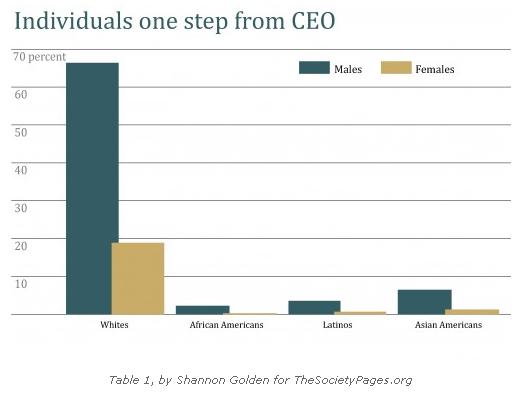
…about two-thirds of those a step from the CEO office were white men, about 19% were white women, slightly fewer than 3% were African Americans, about 4% were Latinos, and about 8% were Asian Americans.

As the graph shows, compared to minority men, white women are far more likely to be rising into CEO positions in the near future.  Women of color, as they say, “almost disappear” in the data.  They explain that this likely has to do with their double minority status.  When hiring and promoting, people tend to look for ways of connecting with the potential employee.  A white man (usually doing the hiring) will see at least one thing in common with a white woman or a man of color.   As an example, they cite a study of executives with MBAs from Harvard:

…female Jewish executives all agreed that being female was more of an impediment to their careers than being a Jew, but many quickly emphasized that being Jewish, or different in any other way, was not irrelevant. As one put it, “It’s the whole package. I heard secondhand from someone as to how I would be perceived as a pushy, Jewish broad who went and got an MBA. Both elements, being Jewish and being a woman, together with having the MBA, were combined to create a stereotype I had to work against from the first day.” Another woman explained, “It’s part of the question of whether you fit the mold. Are you like me or not? If too much doesn’t fit, it impacts you negatively.”

These dynamics affect your entire career trajectory, of course, but Zweigenhaft and Domhoff believe they become even more intense as people approach the top office.  They conclude:

Culture (in the form of cultural capital), education, and class are all still in play. While gender and color remain the best predictors of who will make it into the upper echelons of the corporate world, beyond that, it’s intersectionality [of different identities together] wherever we look.

Lisa Wade, PhD is an Associate Professor at Tulane University. She is the author of American Hookup, a book about college sexual culture; a textbook about gender; and a forthcoming introductory text: Terrible Magnificent Sociology. You can follow her on Twitter and Instagram.

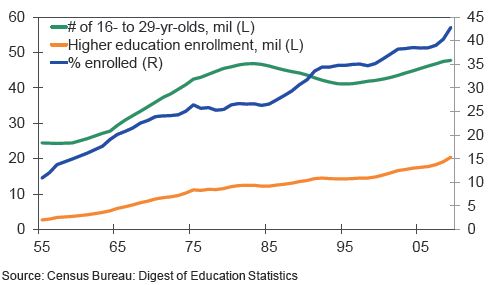
Earlier this summer, Lisa posted about total student loan debt in the U.S., which has increased overall as more people go to college. “Student Lending’s Failing Grade,” a report from Moody’s Analytics  provides more information about student loan debt. Demand for student loans continues to increase as the number of high school graduates who go on to college rises. Over 40% now attend (blue line; the right axis shows percents):

Enrollment at for-profit institutions such as University of Phoenix is still a small minority of all those going to college, but it’s growing rapidly:

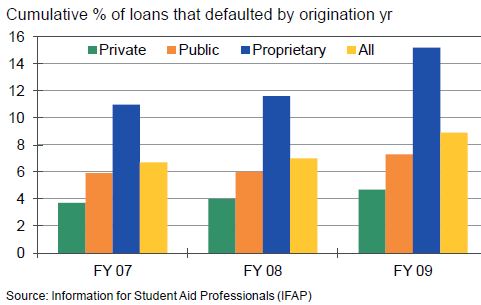
This is significant for student loan debt because students at for-profit (or proprietary) institutions have much higher default rates than students at private or public colleges:

However, the report points out that default and delinquency rates on student loans are quite low compared to other forms of debt. This is partially due to the consequences of defaulting, but also because it’s easier to defer student loan repayment and thus avoid being labeled as “defaulting” than it is for most other loans.

Overall, the report argues that projections of future student loan debt are worrisome. Loans taken out more recently have higher default rates than in the past, and students may have unrealistic expectations of how much they will make after graduation, and so overestimate how much they’ll be able to pay in student loan debt each month. From my experience watching students, I would add that it’s not even that they overestimate how much they’ll be able to afford; many don’t have a clear sense of how much their monthly payment will be, especially since they take out loans on a semester-by-semester basis and may not really think about the cumulative debt they’re taking on. Many are then shocked to discover that their monthly bill isn’t the insignificant sum they’d assumed it would be.

Cross-posted at Montclair SocioBlog.

Isabella was the second most popular name for baby girls last year.  She had been number one for two years but was edged out by Sohpia.  Twenty-five years ago Isabella was not in the top thousand.

How does popularity happen?  Gabriel Rossman’s new book Climbing the Charts: What Radio Airplay Tells Us about the Diffusion of Innovation offers two models.*   People’s decisions — what to name the baby, what songs to put on your station’s playlist (if you’re a programmer), what movie to go see, what style of pants to buy —  can be affected by others in the same position.  Popularity can spread seemingly on its own, affected only by the consumers themselves communicating with one another person-to-person by word of mouth.  But our decisions can also be influenced by people outside those consumer networks – the corporations or people produce and promote the stuff they want us to pay attention to.

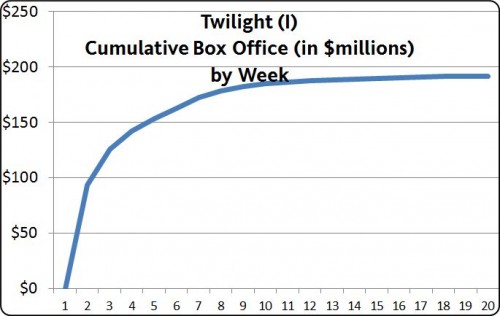
These outside “exogenous” forces tend to exert themselves suddenly, as when a movie studio releases its big movie on a specified date, often after a big advertising campaign.  The film does huge business in its opening week or two but adds much smaller amounts to its total box office receipts in the following weeks.   The graph of this kind of popularity is a concave curve.  Here, for example, is the first  “Twilight” movie.
Most movies are like that, but not all.  A few build their popularity by word of mouth.  The studio may do some advertising, but only after the film shows signs of having legs (“The surprise hit of the year!”).  The flow of information about the film is mostly from viewer to viewer, not from the outside.

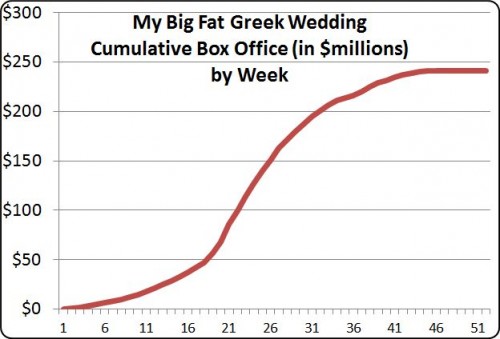
This diffusion path is “endogenous”; it branches out among the people who are making the choices.  The rise in popularity starts slowly – person #1 tells a few friends, then each of those people tells a few friends.  As a proportion of the entire population, each person has a relatively small number of friends.  But at some point, the growth can accelerate rapidly.  Suppose each person has five friends.  At the first stage, only six people are involved (1 + 5); stage two adds another 25, and stage three another 125, and so on.  The movie “catches on.”

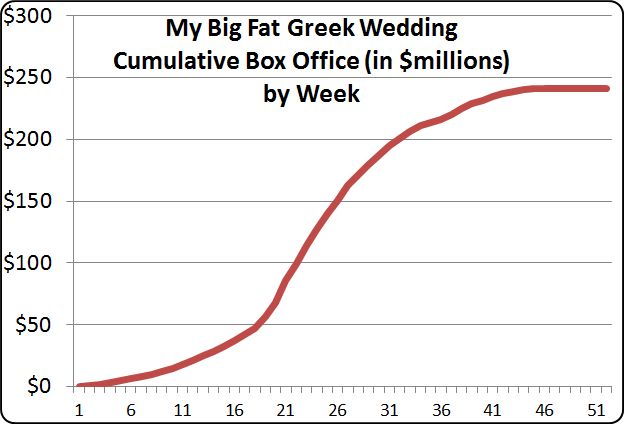
The endogenous process is like contagion, which is why the term “viral” is so appropriate for what can happen on the Internet with videos or viruses.   The graph of endogenous popularity growth has a different shape, an S-curve, like this one for “My Big Fat Greek Wedding.”
By looking at the shape of a curve, tracing how rapidly an idea or behavior spreads, you can make a much better guess as to whether you’re seeing exogenous or endogenous forces.  (I’ve thought that the title of Gabriel’s book might equally be Charting the Climb: What Graphs of Diffusion Tell Us About Who’s Picking the Hits.)

But what about names, names like Isabella?  With consumer items  – movies, songs, clothing, etc. – the manufacturers and sellers, for reasons of self-interest, try hard to exert their exogenous influence on our decisions.  Nobody makes money from baby names, but even those can be subject to exogenous effects, though the outside influence is usually unintentional and brings no economic benefit.  For example, from 1931 to 1933, the first name Roosevelt jumped more than 100 places in rank.

When the Census Bureau announced that the top names for 2011 were Jacob and Isabella, some people suspected the influence of an exogenous factor — “Twilight.”

I’ve made the same assumption in saying (here) that the popularity of Madison as a girl’s name — almost unknown till the mid-1980s but in the top ten for the last 15 years — has a similar cause: the movie “Splash” (an idea first suggested to me by my brother).  I speculated that the teenage girls who saw the film in 1985 remembered Madison a few years later when they started having babies.

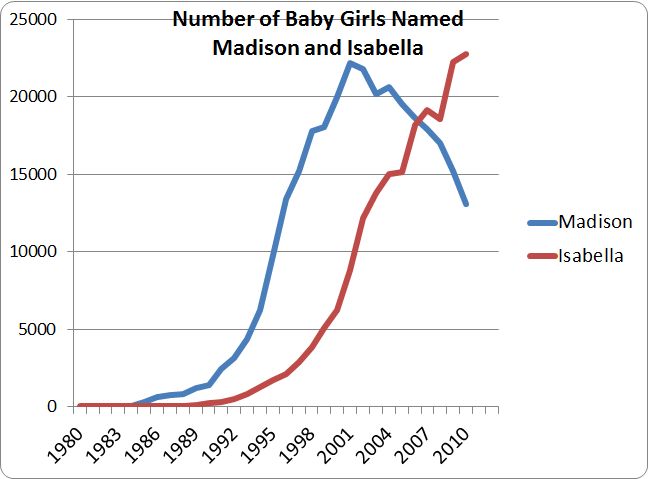
Are these estimates of movie influence correct? We can make a better guess at the impact of the movies (and, in the case of Twilight, books) by looking at the shape of the graphs for the names.
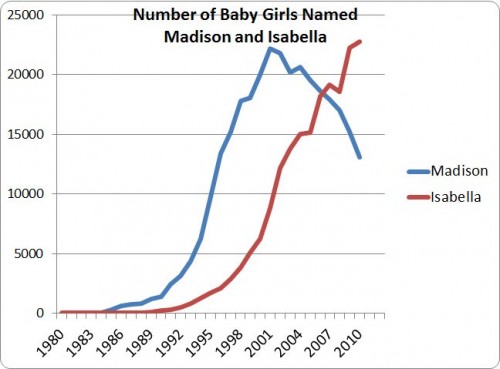
Isabella was on the rise well before Twilight, and the gradual slope of the curve certainly suggests an endogenous contagion.  It’s possible that Isabella’s popularity was about to level off  but then got a boost in 2005 with the first book.  And it’s possible the same thing happened in 2008 with the first movie. I doubt it, but there is no way to tell.

The curve for Madison seems a bit steeper, and it does begin just after “Splash,” which opened in 1984.   Because of the scale of the graph, it’s hard to see the proportionately large changes in the early years.  There were zero Madisons in 1983, fewer than 50 the next year, but nearly 300 in 1985.  And more than double that the next year.  Still, the curve is not concave.  So it seems that while an exogenous force was responsible for Madison first emerging from the depths, her popularity then followed the endogenous pattern.  More and more people heard the name and thought it was cool.  Even so, her rise is slightly steeper than Isabella’s, as you can see in this graph with Madison moved by six years so as to match up with Isabella.
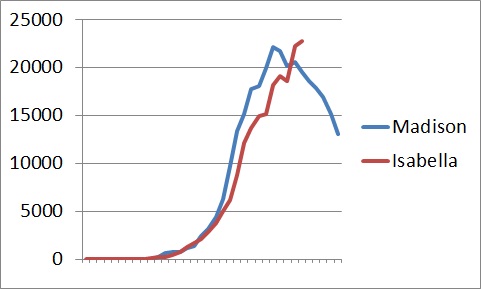
Maybe the droplets of “Splash” were touching new parents even years after the movie had left the theaters.

————————

* Gabriel posted a short version about these processes when he pinch hit for Megan McCardle at the Atlantic (here).

The mass media often enjoys stoking the fires of the “nature/nurture debate,” an argument between those who believe that human behavior is largely inborn (nature) and those who believe it is largely learned (nurture).  In fact, most scholars reject this forced choice in favor of the idea that nature and nurture are forces that shape each other.

In this view, biology is both an independent and a dependent variable.  That is, it acts on us in ways that shape our interactions with others (such that behavior is dependent on biology) and our interactions with others shape our biology (such that our biology is dependent on our behavior).  I’ve published professionally on this topic and we’ve previously posted examples involving the socio-genetic causation of psychopathythe response of testosterone levels to political victories, and the historical shift in the average age of menstruation.

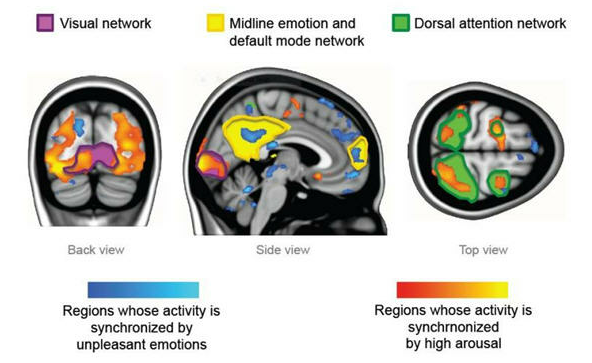
Today’s example comes from an fMRI study of emotion.  They discovered that, when we watch others experience emotions, our brains sync up with theirs.  Our bodies, in other words, strongly react to environmental stimuli.  This, argues one of the researchers, “…facilitates understanding others’ intentions and actions… [as well as] social interaction and group processes.”

It may seem obvious that our neural activity would respond to our environments, but I think it bears emphasizing.  It is too easy for us, in a society that seems eager for a biological explanation for everything, to ignore the ways in which the body is a dependent variable as well as an independent one.  In many ways it makes sense to think of our biologies as the matter through which social interaction occurs.  In other words, while we often think of society as the medium for the transmission of genes, I also like to think of biology as the medium for the transmission of society.

Lisa Wade, PhD is an Associate Professor at Tulane University. She is the author of American Hookup, a book about college sexual culture; a textbook about gender; and a forthcoming introductory text: Terrible Magnificent Sociology. You can follow her on Twitter and Instagram.

Last month the president of fast-food chain Chik-fil-A publicly stated that the company opposed same-sex marriage. The restaurant then became a flash point in the struggle around who has the right to get married. Supporters of marriage equality called for boycotts, but opponents of same-sex marriage participated in Chik-fil-A, organized by Republican former governor of Arkansas (and Fox News commentator) Mike Huckabee. Huge numbers of people turned out to patronize the store last Wednesday, leading to enormous lines and long waits at some locations, and intense media coverage of the event.

So Chik-fil-A became clearly associated with the anti-same-sex marriage camp, and more generally with the conservative movement. But what about other restaurants?

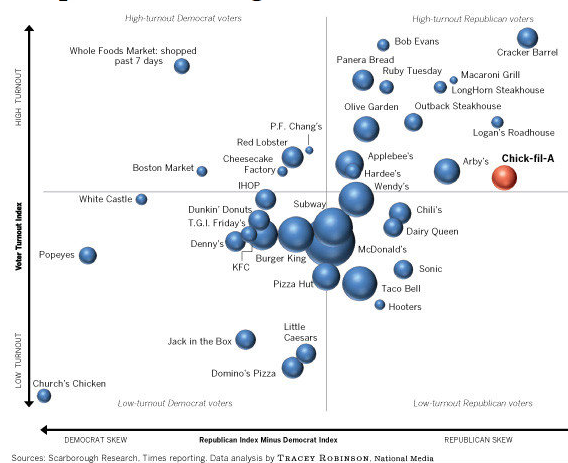
Reader Peter N., of Pitzer College, sent in an image posted by the Los Angeles Times showing the politics and political engagement of patrons of a number of restaurants, as well as Whole Foods. A market research firm’s survey asked respondents if they had gone to any of these restaurants in the past 30 days (7 for Whole Foods), political leanings, and likelihood of voting. In this graph, the larger the bubble, the more respondents said they had gone to the restaurant. Those left of the center line had a disproportionate number of Democratic customers, while those to the right attracted Republicans. The higher the bubble on the graph, the more likely its customers were to vote:

Aside from the political patterns, notice the differences in likelihood of voting. Generally, customers at sit-down restaurants like P.F. Chang’s and Macaroni Grill were more likely to vote than those at fast-food places, though there are a few exceptions (Denny’s, Hooters). This probably reflects class differences in voting: the restaurants in the upper half of the graph are generally more expensive than the fast-food places or chains like Denny’s, and they require more leisure time for a meal compared to getting a pre-made, or quickly-made, combo at the drive-through. Those with the money and time to spend on such restaurants are the same groups who are more likely to vote in general.

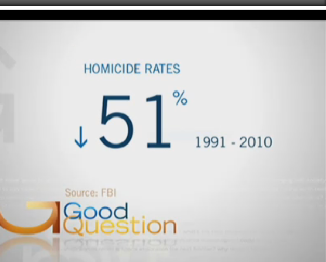
In the wake of the Aurora theater shooting and the shooting of a Sikh temple in Wisconsin, Minneapolis CBS affiliate WCCO asked, “Are we more violent than ever before?” They interviewed The Society Pages’ own Chris Uggen about historical changes in crime. Given the way local news often covers crime and violence, this is a surprisingly nuanced segment:

Tanita S. sent along a link to an interesting observation made over at Whatever.  John Scalzi, preparing to make lunch, noticed that he had two bags of an identical food product, except one was named “tortillas” and one was named “wraps.”

John did some sleuthing and discovered that the bag of wraps cost 26¢ more than the tortillas.  Moreover, since there were only 6 wraps in the package of wraps, but 8 tortillas in the package of tortillas, each wrap cost 19¢ more than each tortilla.

So, there is an interesting marketing story here.   Mission has figured out that they can sell their product for a higher price if they name it “wraps” (or, at least, they think they can). Let’s crowd source this.  After all, Mission is counting on our collective network of ideas (and a failure to notice the count difference) to push us towards the wraps instead of the tortillas.  What does “wraps” make you think of?  What else is that word linked to that might make a person prefer it?  Would you feel different bringing home a package of wraps?  In other words, what ideas, lying just beneath the surface, are they tapping into with this marketing strategy?

Lisa Wade, PhD is an Associate Professor at Tulane University. She is the author of American Hookup, a book about college sexual culture; a textbook about gender; and a forthcoming introductory text: Terrible Magnificent Sociology. You can follow her on Twitter and Instagram.