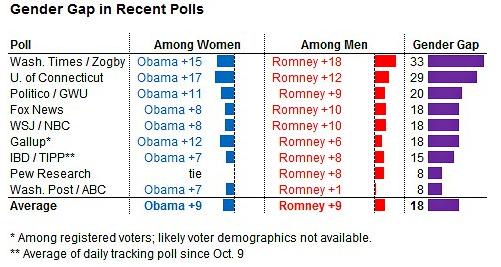
Nate Silver, the statistics guru behind FiveThirtyEight, is predicting that the gender gap in tomorrow’s election will be “near historic highs.” According to Silver’s averaging of recent poll data, Obama has a 9-point lead among women, Romney has the same size lead among men.
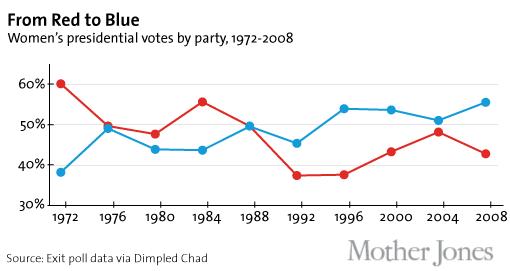
Women haven’t always leaned Democratic. The trend started in the 1990s, as data at Mother Jones reveals:
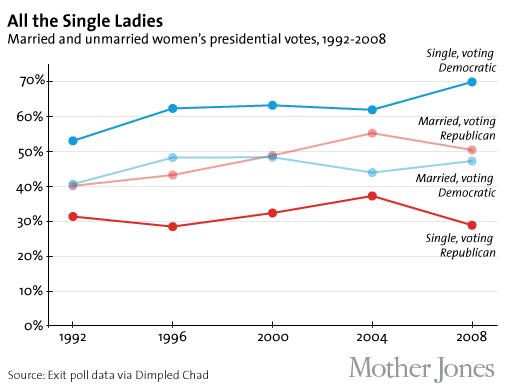
Single women are especially likely to vote Democratic. Seventy percent voted for Obama in 2008:
A concern for reproductive rights, especially in light of recent Republicancomments, are likely a big driver of women’s retreat from the political right. Their concerns very well may swing the election. In a poll of swing states, Gallup found that abortion topped the list of concerns for women; it didn’t make men’s top five:
It will be interesting to see how long the Republicans will hold onto positions unfriendly to women’s reproductive options.
For whatever reason, there has been a real slump in the number of people typing “obama gun” (will he take our guns away?), “obama muslim” (the idea used to run at about 20%), “obama socialist” (the republic “hangs in the balance“), and “obama citizen” (thank you, Snopes) into the Google search box since the 2008 election.
We don’t know how much these fears, versus other concerns, will affect votes against him this year, although there have been some good efforts to track the effects of anti-Black racism on his vote tally.
Naturally, not everyone who Googles these things believes the underlying stories or myths. But it seems likely they either believe them, are considering them, heard someone repeat them, or are arguing with someone who believes them, etc. So I’m guessing – just guessing – that these trends track those beliefs.
But maybe four years of Obama as an actual president has softened up the hard-line hatred in some quarters. What do you think?
Philip N. Cohen is a professor of sociology at the University of Maryland, College Park, and writes the blog Family Inequality. You can follow him on Twitter or Facebook.
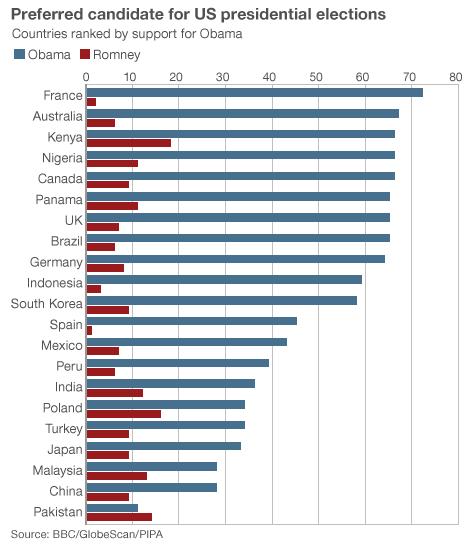
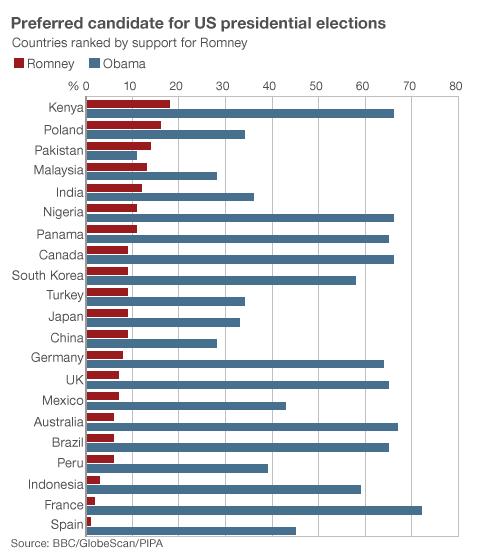
A BBC poll of almost 22,000 people in 21 countries found that, on average, they preferred Obama to Romney more than five to one. Only one country, Pakistan, would elect Romney.
Results ranked by support for Obama:
Results ranked by support for Romney:
What does it mean that this is such a close race here?
In this 6 1/2 minute video, CGP Gray explains how the mathematics of a one person/one vote system inevitably leads to a two-party system that pleases almost no one.
At the GOP convention in August, Mitt Romney’s cavalier dismissal of global warming got the intended laughs. Today, it seems less funny and the Democrats are capitalizing on the turn of events:
Here’s the transcript:
President Obama promised to begin to slow the rise of the
oceans and to heal the planet. My promise is to help you and your family.
In two short sentences, Romney gives us the broader context for the denial of global warming: the denial of society itself. He echoes Margaret Thatcher’s famous dictum
There is no such thing as society. There are individual men and women, and there are families.
This doesn’t mean that there are no groups beyond the family. But those larger groups are valid only because individuals, consciously and voluntarily, chose to create them. This way of thinking about the relation between individuals and groups has long been an underlying principle of American thought. Claude Fischer, in Made in America calls it “voluntarism” – the idea that the only legitimate groups are the ones that people voluntarily form or join.* The individual has a strong obligation to those groups and their members, but he has little or no obligation towards groups and people he did not choose.
That is a moral position. It tells us what is morally O.K., and what is not. If I did not choose to join a group, I make no claims on others, and it is wrong for others – whether as individuals or as an organized group, even a government – to make any claim upon me.
That moral position also shapes the conservative view of reality, particularly about our connectedness to other people and to the environment. Ideas about what is right determine ideas about what is true. The conservative rejects non-voluntary connections as illegitimate, but he also denies that they exist. If what I do affects someone else, that person has some claim upon me; but unless I voluntarily enter into that relationship, that claim is morally wrong. So in order to remain free of that claim, I must believe that what I do does not affect others, at least not in any harmful way.
It’s easy to maintain that belief when the thing being affected is not an individual or family but a large and vague entity like “society” or “the environment.” If I willingly join with many other people, then I will see how our small individual acts – one vote, one small donation, one act of charity, etc. – add up to a large effect. That effect is what we intended. But if we separately, individually, drive a lot in our SUVs, use mega-amounts of electricity, and so on, we deny that these acts can add up to any unintended effect on the planet.
As Fischer says, voluntarism is characteristically American. So is the denial of global warming. At a recent Romney rally (video here), when a protester yelled out the question, “What about climate?” Romney stands there, grinning but silent, and the crowd starts chanting, “USA, USA.” The message is clear: we don’t talk about climate change; we’re Americans.
At the Washington Post, John Cohen and Rosalind Helderman report:
The 2012 election is shaping up to be more polarized along racial lines than any presidential contest since 1988, with President Obama experiencing a steep drop
in support among white voters from four years ago.
They compare data from a recent poll with exit interviews from 2004 and 2008. The results show that, while Obama is overwhelmingly the favorite among non-whites, he trails him among whites by 23 percentage points.
Cohen and Helderman say that Obama has lost support among whites even just recently. Meanwhile, a whopping 91% of Romney supporters are believed to be white. We are, truly, a deeply divided nation.
For every major topic, the overwhelming majority of front-page articles were written by non-Hispanic Whites, while racial/ethnic minorities were underrepresented compared to the overall U.S. population:
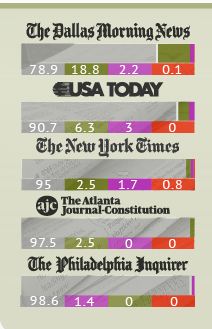
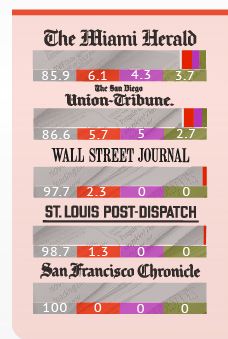
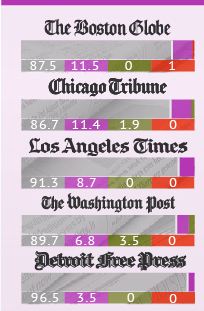
Major newspapers varied in the diversity of those writing their feature articles. The Dallas Morning News was the most diverse, with a particularly large percentage (18.8) of front-page stories written by African American reporters. The San Francisco Chronicle had the least diversity; 100% of its feature political stories were written by White non-Hispanics:
Overall, 93% of the feature articles analyzed in the database were written by White non-Hispanics, 4% by Asian Americans, about 2% by African Americans, and less than 1% by Hispanics. Compare that with each group’s proportion of the overall U.S. population:
These numbers clearly matter in terms of career opportunities and exposure for minorities within the industry. But they also should concern us readers. What does the lack of diversity mean in terms of the issues covered, the political contacts and average-Joe-voters spoken to, the topics seen as important enough to cover?
Gwen Sharp is an associate professor of sociology at Nevada State College. You can follow her on Twitter at @gwensharpnv.
About Sociological Images
Sociological Images encourages people to exercise and develop their sociological imaginations with discussions of compelling visuals that span the breadth of sociological inquiry. Read more…