Cross-posted at Pacific Standard.

Last week the U.S. Supreme Court struck down the part of the Voting Rights Act of 1965 that required states with a documenting history of discrimination to get federal approval before changing their voting laws.  When the law was passed in 1965, one of its main targets were “literacy tests.”

Ostensibly designed to ensure that everyone who voted could read and write, they were actually tools with which to disenfranchise African Americans and sometimes Latinos and American Indians.  Minority voters were disproportionately required to take these tests and, when they did, the election official at the polling place had 100% jurisdiction to decide which answers were correct and score the test as he liked.  The point was to intimidate and turn them away from the polls.  If this sounds bad, you should see the range of disturbing and terrifying things the White elite tried to keep minorities from voting.

The tactics to manipulate election outcomes by controlling who votes is still part and parcel of our electoral politics.  In fact, since most voters are not “swing” voters, some would argue that “turnout” is a primary ground on which elections are fought.  This is not just about mobilizing or suppressing Democrats or Republicans, it’s about mobilizing or suppressing the turnout of groups likely to vote Democrat or Republican.  Since most minority groups lean Democrat, Republicans have a perverse incentive to suppress their turn out. In other words, this isn’t a partisan issue; I’d be watching Democrats closely if the tables were turned.

Indeed, states have already moved to implement changes to voting laws that had been previously identified as discriminatory and ruled unconstitutional under the Voting Act.  According to the Associated Press:

After the high court announced its momentous ruling Tuesday, officials in Texas and Mississippi pledged to immediately implement laws requiring voters to show photo identification before getting a ballot. North Carolina Republicans promised they would quickly try to adopt a similar law. Florida now appears free to set its early voting hours however Gov. Rick Scott and the GOP Legislature please. And Georgia’s most populous county likely will use county commission districts that Republican state legislators drew over the objections of local Democrats.

So, yeah, it appears that Chief Justice John Roberts’ justification that “our country has changed” was pretty much proven wrong within a matter of hours or days.  This is bad.  It will be much more difficult to undo discriminatory laws than it was to prevent them from being implemented and, even if they are challenged and overturned, they will do damage in the meantime.

In any case, here are two examples of literacy tests given to (mostly) minority voters in Louisiana circa 1964.  Pages from history (from Civil Right Movement Veterans):

Louisiana circa 1964a Louisiana circa 1964bThanks to @drcompton for the tip!

Lisa Wade, PhD is an Associate Professor at Tulane University. She is the author of American Hookup, a book about college sexual culture; a textbook about gender; and a forthcoming introductory text: Terrible Magnificent Sociology. You can follow her on Twitter and Instagram.

SocImages News:

I didn’t catch the moment, but suffice to say we reached 25,000 Facebook friends and counting.  Hello to all our friends out there and thanks so much!

Screenshot_1

New Logo!

Congratulations to Avery Wagner, Grace Wong, James Dunphy, Letta Page, and Laura Bertocci!  These were the five finalists in our logo contest!  Keep your eyes open for a new logo, currently being polished by Letta and Laura.

Elsewhere on the Net:

Gwen Sharp’s post featuring photographs of Victorian women stoicly breastfeeding their babies struck a nerve! It received over 6,500 likes here, was featured at Jezebel and the Daily Mail, and was cross-posted at the Huffington Post.

I did an unprecedented number of TV/webcast programs this month, appearing on National Geographic’s Taboo, in a Huffington Post Live debate about food stamps, and in a Bloomberg News short on sexual assault on college campuses.

Cross-post highlights!

Nathan Vanderford kindly featured me in his project tracing the career trajectories of people with PhDs. A neat idea offering great perspective!

Finally, I had the pleasure of contributing to stories at CNN, the LA Weekly, The Raw Story, and Opposing Views.  Some of this was ongoing interest in our advice that college students shouldn’t try to follow their dreams.

Upcoming Lectures and Appearances:

I am on sabbatical writing in earnest, but I’d love to use my flexible schedule to do lots of public speaking as well.  Visit my website if you’d be interested in having me.  I’ve already scheduled my first talks for next year: Westminster College in Utah and Macalester College in Minnesota.  Looking forward to it already!

Social Media ‘n’ Stuff:

Finally, this is your monthly reminder that SocImages is on TwitterFacebookGoogle+, and Pinterest.  Lisa is on Facebook and most of the team is on Twitter: @lisawade@gwensharpnv@familyunequal@carolineheldman, and @jaylivingston.

In Other News…

Here’s a picture I took of lava entering the ocean on the big island of Hawaii. I am lucky to have family there and the opportunity to hike out to the flow. It was extraordinary and felt as dangerous as it looks!

DSCN0793

Lisa Wade, PhD is an Associate Professor at Tulane University. She is the author of American Hookup, a book about college sexual culture; a textbook about gender; and a forthcoming introductory text: Terrible Magnificent Sociology. You can follow her on Twitter and Instagram.
1This four-minute BBC video documents a population of ethnic German-Americans. They are the descendants of Germans who immigrated to Texas 150 years ago.  Over the generations, the language evolved into a unique dialect.  Today linguist Hans Boas is trying to document the dialect before it dies out.  While it persisted for a very long time, World War II, and the ensuing stigma against anything German, brought an end to its transmission.  Today’s speakers are all 60 or older and will soon be gone.

Lisa Wade, PhD is an Associate Professor at Tulane University. She is the author of American Hookup, a book about college sexual culture; a textbook about gender; and a forthcoming introductory text: Terrible Magnificent Sociology. You can follow her on Twitter and Instagram.

The Stonewall Riots, widely described as the birth of the modern gay and transgender rights movement, occurred on this day in 1969.

Elana M. sent along a fascinating study revealing the gender binary in our brains.  The researchers, Homayoun Javadi and Natalie Wee, asked subjects to look at a series of gendered objects — either (a) or (b) — and then judge the masculinity or femininity of a series of androgynous faces.  Gender mattered, but not how you might think.

Condition 1:1
2

Condition 2:

2 2

The findings were counter-intuitive to me.  Subjects who saw the feminine objects judged the faces to be more masculine, and vice versa for subjects who saw the masculine objects.  The researchers interpret this as an “adaptation effect,” a neurological phenomenon in which “looking at something for a long time makes you more likely to see its opposite” (source).  For example if you look at a white screen after looking at a red one for a while, the white screen will appear green (red’s opposite).  Or, if you look at lines moving right for a while and then look at static lines, they will appear to move left.

Javadi and Wee’s findings suggest that our brains give gender to both objects and people and that we place masculinity and femininity in a binary.  We are “opposite sexes,” then, but only in our minds.

Lisa Wade, PhD is an Associate Professor at Tulane University. She is the author of American Hookup, a book about college sexual culture; a textbook about gender; and a forthcoming introductory text: Terrible Magnificent Sociology. You can follow her on Twitter and Instagram.

Cross-posted at Family Inequality.

The other day when the Pew report on mothers who are breadwinners came out, I complained about calling wives “breadwinners” if they earn $1 more than their husbands:

A wife who earns $1 more than her husband for one year is not the “breadwinner” of the family. That’s not what made “traditional” men the breadwinners of their families — that image is of a long-term pattern in which the husband/father earns all or almost all of the money, which implies a more entrenched economic domination.

To elaborate a little, there are two issues here. One is empirical: today’s female breadwinners are much less economically dominant than the classical male breadwinner — and even than the contemporary male breadwinner, as I will show. And second, conceptually breadwinner not a majority-share concept determined by a fixed percentage of income, but an ideologically specific construction of family provision.

Let’s go back to the Pew data setup: heterogamously married couples with children under age 18 in the year 2011 (from Census data provided by IPUMS). In 23% of those couples the wife’s personal income is greater than her husband’s — that’s the big news, since it’s an increase from 4% half a century ago. This, to the Pew authors and media everywhere, makes her the “primary breadwinner,” or, in shortened form (as in their title), “breadwinner moms.” (That’s completely reasonable with single mothers, by the way; I’m just working on the married-couple side of the issue — just a short chasm away.)

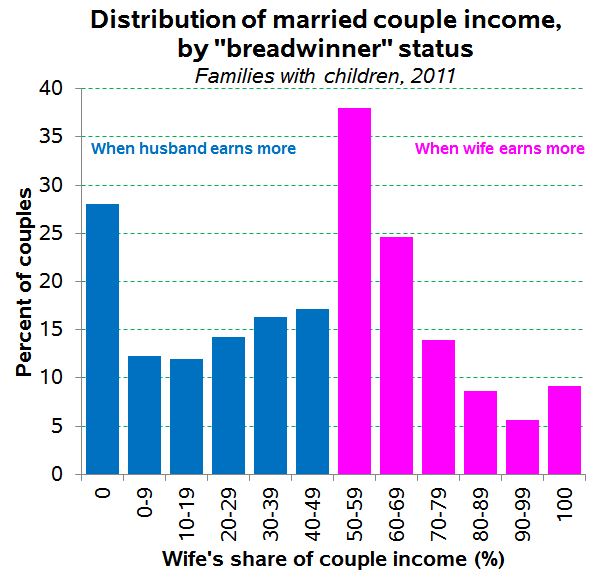
The 50%+1 standard conceals that these male “breadwinners” are winning a greater share of the bread than are their female counterparts. Specifically, the average father-earning-more-than-his-wife earns 81% of the couple’s income; the average mother-earning-more-than-her-husband earns 69% of the couple’s income. Here is the distribution in more detail:

1

This shows that by far the most common situation for a female “breadwinner” is to be earning between 50% and 60% of the couple’s income — the case for 38% of such women. For the father “breadwinners,” though, the most common situation — for 28% of them — is to be earning all of the income, a situation that is three-times more common than the reverse.

Collapsing data into categories is essential for understanding the world. But putting these two groups into the same category and speaking as if they are equal is misleading.

This is especially problematic, I think, because of the historical connotation of the term breadwinner. The term dates back to 1821, says the Oxford English Dictionary. That’s from the heyday of America’s separate spheres ideology, which elevated to reverential status the woman-home/man-work ideal. Breadwinners in that Industrial Revolution era were not defined by earning 1% more than their wives. They earned all of the money, ideally (meaning, if their earnings were sufficient) but, just as importantly, they were the only one permanently working for pay outside the home. (JSTOR has references going back to the 1860s which confirm this usage.)

Modifying “breadwinner” with “primary” is better than not, but that subtlety has been completely lost in the media coverage. Consider these headlines from a Google news search just now:

Further down there are some references to “primary breadwinners,” but that’s rare.

Maybe we should call those 100%ers breadwinners, and call the ones closer to 50% breadsharers.

Philip N. Cohen is a professor of sociology at the University of Maryland, College Park, and writes the blog Family Inequality. You can follow him on Twitter or Facebook.

Cross-posted at the Los Angeles Times, Huffington Post, and BlogHer.

In an Op-Ed article on hookup culture in college, Bob Laird links binge drinking and casual sex to sexually transmitted diseases, unwanted pregnancies, confusion, low self-esteem, unhappiness, vomiting, ethical retardation, low grades and emotional inadequacy. “How nice of The Times to include this leftover piece from 1957 today,” snarked a reader in the online comments.

Fair enough, but Laird is more than out of touch. He also fundamentally misunderstands hookup culture, the relationships that form within it and the real source of the problems arising from some sexual relationships.

Laird makes the common mistake of assuming that casual sex is rampant on college campuses. It’s true that more than 90% of students say that their campus is characterized by a hookup culture.  But in fact, no more than 20% of students hook up very often; one-third of them abstain from hooking up altogether, and the remainder are occasional participators.

If you do the math, this is what you get: The median number of college hookups for a graduating senior is seven. This includes instances in which there was intercourse, but also times when two people just made out with their clothes on. The typical student acquires only two new sexual partners during college. Half of all hookups are with someone the person has hooked up with before. A quarter of students will be virgins when they graduate.

In other words, there’s no bacchanalian orgy on college campuses, so we can stop wringing our hands about that.

Laird argues that students aren’t interested in and won’t form relationships if “they are simply focused on the next hookup.” Wrong. The majority of students — 70% of women and 73% of men —report that they’d like to have a committed relationship, and 95% of women and 77% of men prefer dating to hooking up. In fact, about three-quarters of students will enter a long-term monogamous relationship while in college.

And it’s by hooking up that many students form these monogamous relationships. Roughly, they go from a first hookup, to a “regular hookup,” to perhaps something that my students call “exclusive” — which means monogamous but not in a relationship — and then, finally, they have “the talk” and form a relationship.  As they get more serious, they become more sexually involved (source):

1

Come to think of it, this is how most relationships are formed — through a period of increasing intimacy that, at some point, ends in a conversation about commitment. Those crazy kids.

So, students are forming relationships in hookup culture; they’re just doing it in ways that Laird probably doesn’t like or recognize.

Finally, Laird assumes that relationships are emotionally safer than casual sex, especially for women.  Not necessarily. Hookup culture certainly exposes women to high rates of emotional trauma and physical assault, but relationships do not protect women from these things. Recall that relationships are the context for domestic violence, rape and spousal murder.

It’s not hooking up that makes women vulnerable, it’s patriarchy. Accordingly, studies of college students have found that, in many ways, hookups are safer than relationships. A bad hookup can be acutely bad; a bad relationship can mean entering a cycle of abuse that takes months to end, bringing with it wrecked friendships, depression, restraining orders, stalking, controlling behavior, physical and emotional abuse, jealousy and exhausting efforts to end or save the relationship.

Laird’s views seem to be driven by a hookup culture bogeyman. It might scare him at night, but it’s not real.  Actual research on hookup culture tells a very different story, one that makes college life look much more mundane.

Lisa Wade, PhD is an Associate Professor at Tulane University. She is the author of American Hookup, a book about college sexual culture; a textbook about gender; and a forthcoming introductory text: Terrible Magnificent Sociology. You can follow her on Twitter and Instagram.

An anonymous professor has started a tumblr humorously characterizing life as a college professor… with gifs!  Here are some of my favorites but, if you’re a professor or want to know what it’s like to be one, and you can handle a bit of snark, you should definitely go on over!

Arriving Late to My Friend’s Panel

1

When Academics Attend Conference Presentations

6

When Tenure Track Faculty Hear About a Course Release

2

Revise and Resubmit

3

Fourteenth Week of the Semester

4

At the Department Party, When My Chair “Asked” Me to Join the Assessment Committee

7

When Someone Says, “You only teach two classes? What do you do all day?”

5

Thanks to Ben C. for the tip!

Lisa Wade, PhD is an Associate Professor at Tulane University. She is the author of American Hookup, a book about college sexual culture; a textbook about gender; and a forthcoming introductory text: Terrible Magnificent Sociology. You can follow her on Twitter and Instagram.