
Nationalist white supremacy organizations, and their gentler counterparts in the U.S., sometimes argue that non-white women are having more children than white women.  The result is a shift in the national demographic (that they don’t like).

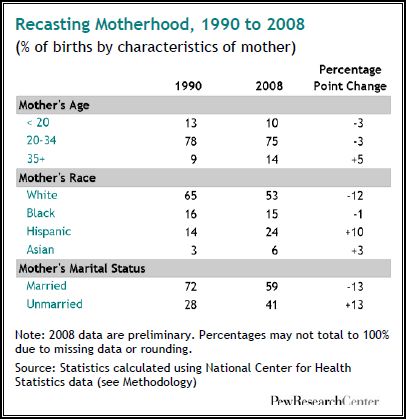
This month the Pew Research Center released a report on the changing demographics of American motherhood (discovered thanks to a tip by Michael Kimmel).  Under “Mother’s Race,” we see that there has been a 12 percentage point decrease in the share of births to white women between 1990 and 2008.  In contrast, births to Asian and, especially, Hispanic women have increased (a combined 13 percentage points):
The share of births to native versus foreign born women has also shifted, with a quarter of births now to women who have immigrated to the U.S.:

They summarize:

White women made up 53% of mothers of newborns in 2008, down from 65% in 1990. The share of births to Hispanic women has grown dramatically, to one-in-four.

So, whether you agree with the national white supremacists’ evaluation of the data or not (I assume you do not), they’re right about the data.

UPDATE: Sabrina, in the comments, rightly points out that my comments assume that the father’s race matches the mother’s.

Lisa Wade, PhD is an Associate Professor at Tulane University. She is the author of American Hookup, a book about college sexual culture; a textbook about gender; and a forthcoming introductory text: Terrible Magnificent Sociology. You can follow her on Twitter and Instagram.
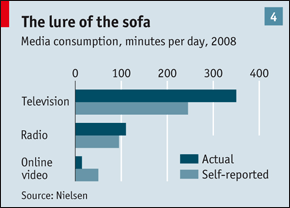
An article at The Economist summarizes the research of Sarah Pearson, who has spent almost 100,000 hours watching British people watch television. People underestimate how much time they spend watching television and listening to the radio (especially the first one), but they overestimate how much time they spend watching online videos.

Pearson found that they also underestimate how much time they spend watching shows as they are being broadcasted. Despite the many ways that shows can now be recorded and rebroadcast, most of our television watching is just like it was 50 years ago. “Even in British homes with a Sky+ box,” she finds, “…almost 85% of television shows are viewed at the time the broadcasters see fit to air them.”

Why? Because television is a social activity. People sit down to watch things together and then they “see what’s on.” And, even when people watch television alone, they like to watch shows at the same time as other people are watching it, or as soon as possible afterward.

Via BoingBoing.

Lisa Wade, PhD is an Associate Professor at Tulane University. She is the author of American Hookup, a book about college sexual culture; a textbook about gender; and a forthcoming introductory text: Terrible Magnificent Sociology. You can follow her on Twitter and Instagram.
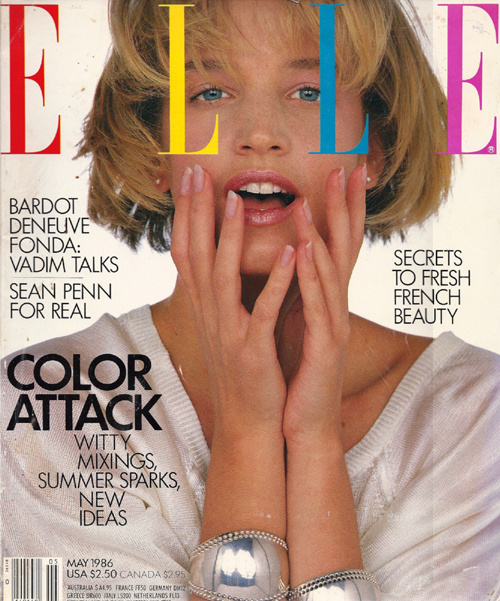
Dodai at Jezebel recently posted an Elle cover from May 1986. Like her, I was struck by how un-retouched the photo appeared to be. Dodai says that you can see freckles and moles on her face.

Dodai also argues that the fashion spreads in the 1986 issue look like they are happy and having fun and she compares them to the spreads in the May 2010 issue in which, she says, the models appear somber. See for yourself.

Lisa Wade, PhD is an Associate Professor at Tulane University. She is the author of American Hookup, a book about college sexual culture; a textbook about gender; and a forthcoming introductory text: Terrible Magnificent Sociology. You can follow her on Twitter and Instagram.
Michelle R. sent in a segment from CNN that asks children to associate positive or negative attributes with various skin tones, much like a famous 1940s experiment that asked children which doll they preferred. The original experiment, and recreations since then, have found that children of all races tend to view lighter-skinned dolls or images more positively (prettier, smarter, more desirable as a classmate) than darker-skinned ones, and to believe that adults do so as well (sorry for the ads before each segment).

Anderson Cooper then talks to some of the children about their answers:

It’s fascinating that kids pick up on competing cultural themes and use them in their answers — that is, skin color isn’t supposed to matter and you judge people as individuals, but people still do care about skin color. And they all agree that the “good” skin color (from their own perspective or what they think adults prefer) is lighter. And to hear a girl refer to her own skin color as “nasty”…heartbreaking.

NEW! (May ’10): Alex P., Dimitriy T.M., and Abeer K. sent in a final segment, in which a parent reacts to her child’s preferences:

Related posts: another recreation, and the original study.

Mr. Wray, AP Psychology teacher, sings the biases:

Sent in by Dmitriy T.M.

Lyrics after the jump:

more...

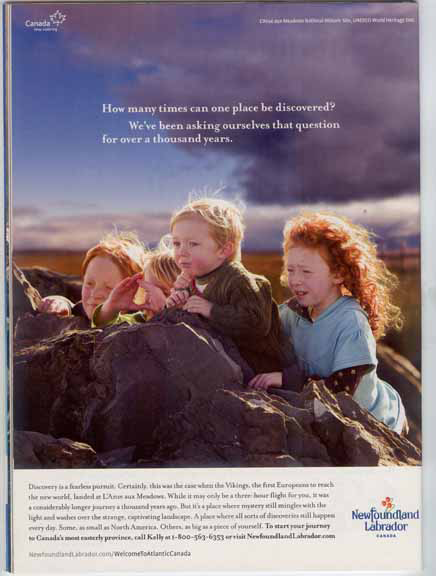
Thea Lim at Racialicious posted this travel advertisement for Newfoundland-Labrador, Canada:

Text:

How many times can one place be discovered?  We’ve been asking ourselves that question for over a thousand years.

Discovery is a fearless pursuit. Certainly, this was the case when the Vikings, the first Europeans to reach the new world, landed at L’Anse aux Meadows. While it may only be a three-hour flight for you, it was a considerably longer journey a thousand years ago. But it’s a place where mystery still mingles with the light and washes over the strange, captivating landscape. A place where all sorts of discoveries still happen every day. Some, as small as North America. Others, as big as a piece of yourself.

As the recent Vancouver Olympics reminded us relentlessly, Canada was home to many peoples when the Europeans arrived.  The ad sanitizes this history, turning it into “discovery.”   Lim points out that “discovery” has a certain ring to it that “genocide” or “colonization” simply does not.

She quotes Ronald Wright, author of Stolen Continents, who points out how ridiculous it is to use the term “discovery” to describe what happened when Europeans arrived in North America:

…I was told by Dehatkadons, a traditional chief of the Onondaga Iroquois, “You cannot discover an inhabited land.  Otherwise I could cross the Atlantic and ‘discover’ England.”  That such an obvious point has eluded European consciousness for five centuries reveals that the history we have been taught is really myth…  those vanquished by our civilization see that its myth of discovery has transformed historical crimes into glittering icons.

The use of the myth of discovery in advertising like this demonstrates just how deeply many of us have internalized it.

Lisa Wade, PhD is an Associate Professor at Tulane University. She is the author of American Hookup, a book about college sexual culture; a textbook about gender; and a forthcoming introductory text: Terrible Magnificent Sociology. You can follow her on Twitter and Instagram.
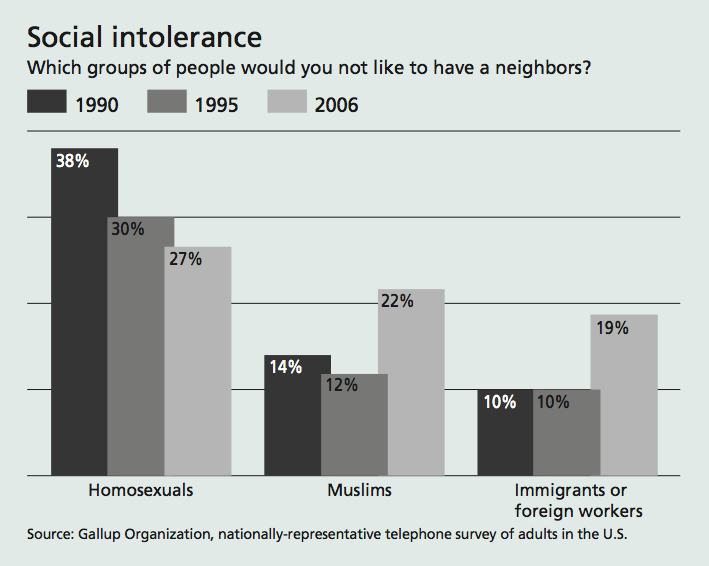
A recent study by Chelsea Schafer and Greg Shaw found that, as of 2006, over a quarter of Americans would still rather not live near homosexuals.  This percentage has been decreasing, however; in 1990 and 1995, 38% and 30% of people, respectively, wanted to keep their distance:

But tolerance for Muslims and immigrants has not increased alongside tolerance for gays and lesbians.  The data show that rather high levels of tolerance in the ’90s (with about 90% of people being happy to have these groups as neighbors) disappeared and, by 2006, 22% of people did not want to live near Muslims and 19% did not want to live near immigrants.

The data on tolerance for Muslims is likely due to the way the attacks on September 11th, 2001, have been spun to stoke hatred against Muslims.  What do you think about the increased intolerance for immigrants?  Have “foreigners” been collateral damage in the smear campaign against Muslims and Arabs?  If it were simply growing conservatism, wouldn’t we see the same pattern for homosexuals?  Other explanations?

Borrowed from Contexts Discoveries.

Lisa Wade, PhD is an Associate Professor at Tulane University. She is the author of American Hookup, a book about college sexual culture; a textbook about gender; and a forthcoming introductory text: Terrible Magnificent Sociology. You can follow her on Twitter and Instagram.
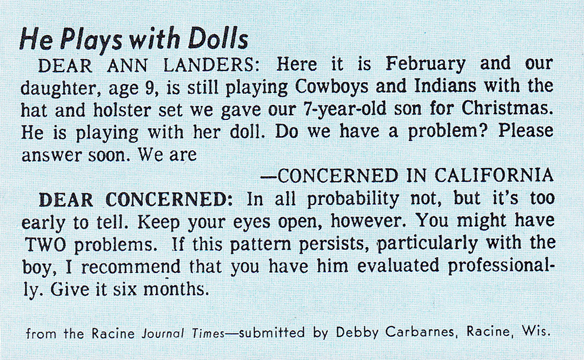
In the U.S. today we largely accept and encourage girls’ experimentation with boy-coded things, but we are still extremely ambivalent, if not downright condemnatory, of boys experimenting with girl-coded things.

This excerpt from an Ann Landers advice column from 1974 shows that Landers had the same asymmetrical concerns almost 40 years ago.

The parents ask about the sex-crossed play behavior of both their daughter and their son, but Landers fixates on the son, suggesting that if he continues such play he should get checked out.

From Ms.

Lisa Wade, PhD is an Associate Professor at Tulane University. She is the author of American Hookup, a book about college sexual culture; a textbook about gender; and a forthcoming introductory text: Terrible Magnificent Sociology. You can follow her on Twitter and Instagram.