Talking Points Memo posted an article about a study recently released by the Program on International Policy Attitudes at the University of Maryland. The study looks at misinformation about issues related to the 2010 election among the U.S. electorate. The survey sampled 616 individuals who reported that they voted in the November elections, and according to their methodology, was chosen to be representative of the overall U.S. population. After individuals were chosen to take part, they were asked to complete an online survey; those who didn’t have access to a computer were provided with a laptop and internet access. You can read more about this method of collecting data, which uses an online program called Knowledge Networks, here.

Of course, any study of misinformation brings up the tricky question of how to identify what is “true,” and how to do so in a way that isn’t itself political. The authors explain at length:

…we used as reference points the conclusions of key government agencies that are run by professional experts and have a strong reputation for being immune to partisan influences. These include the Congressional Budget Office, the Department of Commerce, and the National Academy of Sciences. We also noted efforts to survey elite opinion, such as the regular survey of economists conducted by the Wall Street Journal; however, we only used this as supporting evidence for what constitutes expert opinion. In most cases we inquired about respondents’ views of expert opinion, as well as the respondents’ own views…in designing this study we took the position that some respondents may have had correct information about prevailing expert opinion but nonetheless came to a contrary conclusion, and thus should not be regarded as ‘misinformed.’

On some issues, such as climate change, there is a vocal dissenting minority among experts. Thus questions were framed in terms of whether, among experts, more had one or another view, or views were evenly divided.

The researchers first asked if respondents believed they had seen or heard misleading or incorrect information during the fall campaign. Overall, a majority of voters said they had encountered misinformation during the election, and over half said there was more misinformation this time than usual.

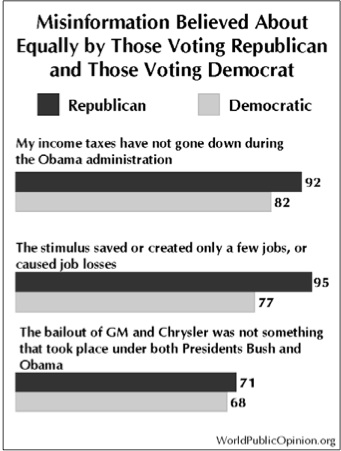
The results also indicated relatively high levels of misinformation on a number of questions. For instance, 40% thought the Trouble Assets Relief Program (TARP, or the bank bailout) was passed under President Obama, when it was actually passed under President Bush; 43% didn’t know that President Obama has increased the number of U.S. troops in Afghanistan. And overall, respondents seemed quite confused about financial policies, with overwhelming majorities of both Republicans and Democrats getting questions about taxes, the stimulus, and the auto maker bailout wrong:
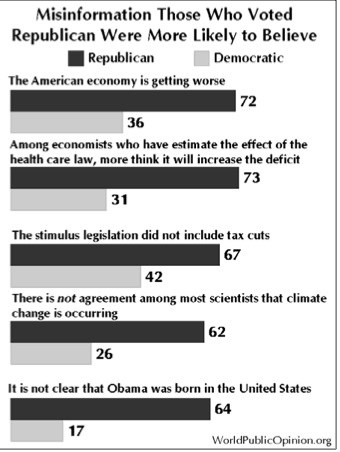
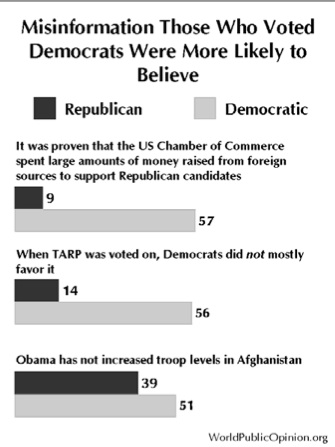
However, for most items, Democrats and Republicans tended to differ on which issues they were misinformed about, in fairly predictable ways:
Finally, the study found that source of information seemed to play a role. Those who said they watched Fox News were more misinformed than any other group, and the more they watched it, the more misinformed they were — whereas with most other news sources, the more news individuals consumed, the less misinformed they were. Viewers of Fox News were more likely to believe the following (incorrect) statements (from p. 20 of the report):

  • most economists estimate the stimulus caused job losses (12 points more likely)
  • most economists have estimated the health care law will worsen the deficit (31 points)
  • the economy is getting worse (26 points)
  • most scientists do not agree that climate change is occurring (30 points)
  • the stimulus legislation did not include any tax cuts (14 points)
  • their own income taxes have gone up (14 points)
  • the auto bailout only occurred under Obama (13 points)
  • when TARP came up for a vote most Republicans opposed it (12 points)
  • it is not clear that Obama was born in the United States (31 points)

This pattern persisted regardless of political affiliation — Democrats who reported watching more Fox News were more misinformed than other Democrats, though less so than Republicans who watch the same amount of Fox News.

This table shows the number of respondents who said most experts believe climate change either isn’t occurring or that the scientific community is evenly split, by source of news and how often they view that source (p. 21):
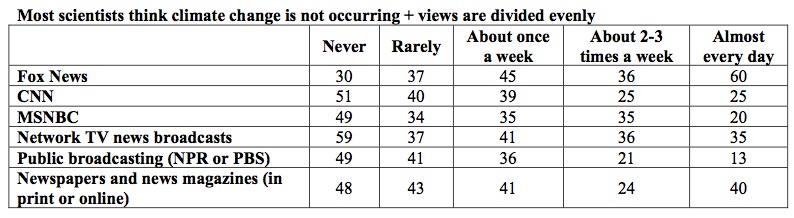
They have the same breakdown of data for each question. In general, the lowest levels of misinformation were found among those who reported high levels of consumption of news from MSNBC and/or PBS/NPR. However, as the study authors point out, for a number of questions (such as those about the effects of the stimulus program), all groups had quite high levels of misinformation.

Of course, this leaves a number of questions unanswered: are people more misinformed because they watch Fox News? Or are misinformed people more likely to watch Fox News at least in part because it is more likely to reinforce ideas they already have?

And how does the choice of these particular questions, out of all the potential questions we could ask to judge how well- or poorly-informed people are, affect the results? I suspect critics might say that many of these questions are ones liberals are more likely to get right simply by answering based on political ideology, regardless of actual knowledge — for instance, someone who is Democratic might be more likely to say the health care bill wouldn’t add to the deficit, and thus be “right,” but answer that way because health care reform was a Democratic-backed policy and thus something they supported, not because they have any concrete knowledge about it. As we see with the question about the Chamber of Commerce, when a question doesn’t fit so well with liberal-leaning views (the Chamber of Commerce tends to be more popular among conservatives), Democrats showed high levels of misinformation as well. If we asked more of those sorts of questions, would we find that Democrats (or, say, those who report PBS or NPR as their main source of information) were more misinformed than Fox viewers?

Thoughts?
Mark Grief wrote a fantastic analysis of the “hipster” in the New York Times.  Drawing on a book he edited,”What Was the Hipster?“, with Kathleen Ross and Dayna Tortorici, Grief offers an analysis based on the work of Pierre Bourdieu.

Bourdieu observed that the rich justified and naturalized their economic advantage over others not only by pointing to their bank accounts, but by being the arbiters of taste.  Bourdieu shows us that taste…

…is not stable and peaceful, but a means of strategy and competition. Those superior in wealth use it to pretend they are superior in spirit.

Style, in other words, is not just arbitrary; it is about establishing that you are better than other people.

Those below us economically, the reasoning goes, don’t appreciate what we do; similarly, they couldn’t fill our jobs, handle our wealth or survive our difficulties.

But the rich aren’t the only ones who attempt to use taste and style to gain and preserve status.  Indeed, hipsters may be the purest example of this phenomenon.

“Once you take the Bourdieuian view,” Grief explains, “you can see how hipster neighborhoods are crossroads where young people from different origins, all crammed together, jockey for social gain” by liking cool things first.

I will quote Grief liberally because he does such a fantastic job of describing the field:

One hipster subgroup’s strategy is to disparage others as “liberal arts college grads with too much time on their hands”; the attack is leveled at the children of the upper middle class who move to cities after college with hopes of working in the “creative professions.” These hipsters are instantly declassed, reservoired in abject internships and ignored in the urban hierarchy — but able to use college-taught skills of classification, collection and appreciation to generate a superior body of cultural “cool.”

They, in turn, may malign the “trust fund hipsters.” This challenges the philistine wealthy who, possessed of money but not the nose for culture, convert real capital into “cultural capital” (Bourdieu’s most famous coinage), acquiring subculture as if it were ready-to-wear. (Think of Paris Hilton in her trucker hat.)

Both groups, meanwhile, look down on the couch- surfing, old-clothes-wearing hipsters who seem most authentic but are also often the most socially precarious — the lower-middle-class young, moving up through style, but with no backstop of parental culture or family capital. They are the bartenders and boutique clerks who wait on their well-to-do peers and wealthy tourists. Only on the basis of their cool clothes can they be “superior”: hipster knowledge compensates for economic immobility.

All hipsters play at being the inventors or first adopters of novelties: pride comes from knowing, and deciding, what’s cool in advance of the rest of the world.

This, Grief concludes, is why everyone, especially hipsters, hates to be called a hipster.  The whole idea is to have authentically superior tastes.  Once you are revealed as someone who cares about having the right tastes, you are disqualified as a person who has good taste effortlessly.  Likewise, if you are suddenly one who has the same tastes as everyone else, you are just one of the masses.  Being a hipster, it turns out, is a perilous identity that must be constantly re-worked and re-authenticated.

Lisa Wade, PhD is an Associate Professor at Tulane University. She is the author of American Hookup, a book about college sexual culture; a textbook about gender; and a forthcoming introductory text: Terrible Magnificent Sociology. You can follow her on Twitter and Instagram.

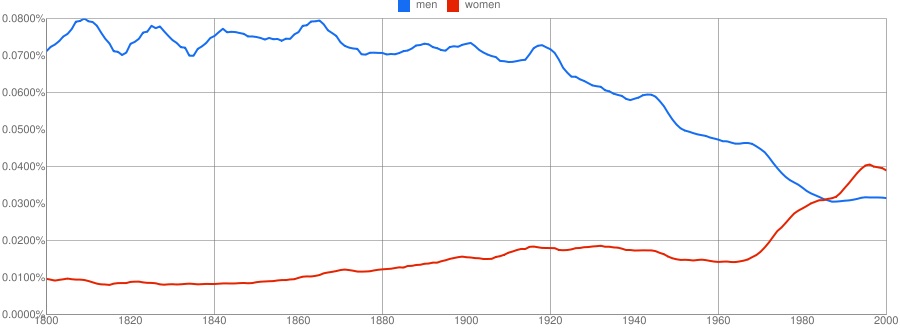
A  number of readers, including Mickey C., Lu Fong (writer and editor at The Good Men Project and Good Feed), Cheryl S., and Kelly V., let us know about Google Ngram. The program includes a database of a little over 5 million books and allows you to graph the frequency with which various words or phrases show up in books published in various languages over time (English can also be broken down into British or American English). Mickey and Lu each graphed the words “men” and “women” (see Lu’s discussion here):

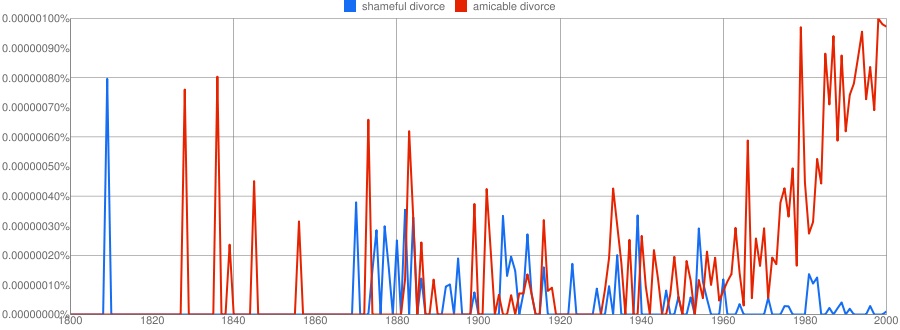
Cheryl S. tried “shameful divorce” vs. “amicable divorce”:

The plateaus are due to smoothing, which presents the data as 3-year averages to reduce huge spikes and valleys from individual data points to make overall trends more apparent. You can change the level of smoothing. Here’s the graph with no smoothing at all:

Overall, the tool provides a way to track changes in language as well as social trends. Google provides some info on their methodology, though not as much as I’d like. Some key points:

1. They “normalize” the results based on the number of books published each year, to account for the fact that many more books are published each year now than in, say, 1800, so 100 occurrences of a phrase today means less than 100 occurrences then — that’s why results are presented as percentages, not as raw numbers.

2. Phrases have to appear in at least 40 books total to be included in the database.

3. Keep in mind, the dataset is not based on all books published, but of a subset of books digitized by Google Books. The database includes about 4% of all published books, according to a journal article just published in Science.

I suspect it will be an amazing time-killer.


Stephen Colbert reports, and mocks, some pretty stunning product placement on Days of Our Lives:

Thanks to Dmitriy T.M. for the tip!

Lisa Wade, PhD is an Associate Professor at Tulane University. She is the author of American Hookup, a book about college sexual culture; a textbook about gender; and a forthcoming introductory text: Terrible Magnificent Sociology. You can follow her on Twitter and Instagram.

Abbotsford, Wisconsin’s Mark Prior posted a sign reading “NO NEGRO’S ALLOWED” sign [sic] at the entrance to his strip club.  From the story at NBC (via Racialicious):

“Our mistake is sometimes we look for logic in something that is just plain stupid,” says Dr. Selika Ducksworth-Lawton, an African American historian at the University of Wisconsin-Eau Claire.

Meanwhile, in Hayden, Idaho, Mark Eliseuson celebrated the first snow with a KKK snowman, complete with noose.  According to KTLA News, Eliseuson took down the snowman after being told that he could be charged with a “nuisance”:

(Thanks to Dmitriy T.M. for the tip off.)

See also our post on race-themed parties at colleges and universities and our post on The Compton Cookout.

Lisa Wade, PhD is an Associate Professor at Tulane University. She is the author of American Hookup, a book about college sexual culture; a textbook about gender; and a forthcoming introductory text: Terrible Magnificent Sociology. You can follow her on Twitter and Instagram.

To commemorate the last weekend before Christmas, when many will be out trying desperately to complete holiday shopping, I thought I’d post this image, designed and sent in by Joseph Moriarty in response to the craziness of all the holiday-season shopping frenzies (including the now-predictable tramplings):

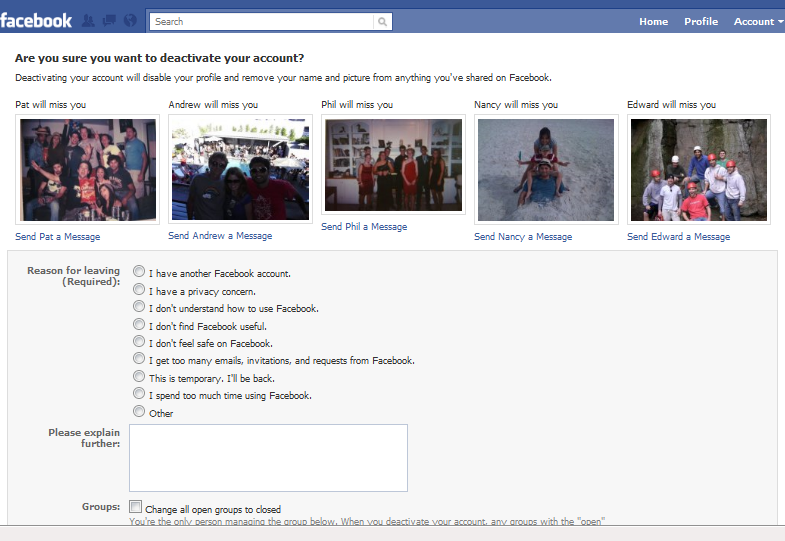
Genesis C. smartly decided to deactivate her Facebook account, and thus its distractions, during her final exams. “It felt as if Facebook was doing all it could to convince me to stay.”  First Genesis sought to delete her account altogether, but finding a delete button took quite a bit of digging (and some googling).  She set about to delete, but the site insists on a 14 day waiting period.  A deleted account in two weeks wasn’t going to help her study now, so she decided to deactivate instead.  She continues:

After I selected the “deactivate” button under “account settings” Facebook asked me “Are you sure you want to deactivate your account?” and under that it displayed pictures of a few friends, captioned with the lines “[Friend’s name here] will miss you.”

The images they included weren’t profile pictures, but pictures in which Genesis had been tagged, so Facebook deliberately included people that she knew personally.


Genesis concludes:

I just thought it was very interesting to find out how manipulative a social network like Facebook can be by trying their best to make you feel that you really need Facebook in your life. First of all by making it very hard to finalize your deletion request and by making you feel that by deleting/deactivating your account you lose connection with your closest friends, as if it were the only form of communicating with these people.

See also an ABC News story on deleting/deactivating your Facebook account.

Lisa Wade, PhD is an Associate Professor at Tulane University. She is the author of American Hookup, a book about college sexual culture; a textbook about gender; and a forthcoming introductory text: Terrible Magnificent Sociology. You can follow her on Twitter and Instagram.


Andi M. sent in a video created by J.C. Penney called “The Doghouse.” The ad tells the story of men sent to the doghouse by their wives for various bad behaviors, but mostly for giving bad Christmas gifts. A bad gift is a non-romantic gift, or a gift that is related to housework, or that implies a woman needs to lose weight or change her appearance:

As Andi points out, the ad portrays men as idiots or even actively mean-spirited. But I’m also interested in the way we define what are appropriate gifts for women. We often see “practical” gifts as perfectly acceptable to give to men. But increasingly, gifts for women are supposed to be essentially romantic, a symbol of love, not usefulness, a cultural trend the jewelry industry, in particular, has encouraged and benefited from.

In this ad, we have several “bad” gifts — more computer memory, a vacuum cleaner, facial hair remover, and a work-out accessory. All are presented as equally idiotic choices for men to make. So getting a woman something that might significantly improve her computer is just the same as giving her something to work out with, while actively mocking her body and eating habits. Any non-romantic gift is risky, even if accompanied by an attempt to be sweet (see the poor computer memory guy).

I’ve discussed before research on low-income women who complain when they feel that men waste money on romantic but non-essential gifts rather than stuff they actually need. On the other hand, I asked one of my classes about what they would consider an acceptable gifts, and I was (probably stupidly) surprised that many of the women in the class were adamant that useful or helpful items were nice to get, but only in addition to a romantic gift, never as the “main” gift itself. A couple said they’d feel bad if their female friends were showing off jewelry they got for Valentine’s Day or Christmas and they didn’t have anything to show, because their friends would assume their boyfriends/husbands weren’t romantic or didn’t love them very much. So it was less about whether they wanted jewelry than that they knew other women did, and thus feared their friends would judge their relationships if they didn’t get the right gift to “prove” they had good partners.

I think ads like this both reflect and reinforce this social pressure to buy the “right” kind of gifts for women. J.C. Penney tapped into an existing cultural norm about what kinds of gifts women want, and then reinforces it by presenting jewelry as the only means available to men to get out of the doghouse, and shows all women as being in complete agreement about what an acceptable gift is.

UPDATE: Reader Josh Leo pointed out that the ad also portrays the doghouse as a place men are tortured by having to do feminine things:

…all they are fed in “the doghouse” is Quiche and Chai Latte’s. This is clearly a statement that these foods are feminine an almost a form of torture for “Real Men.”