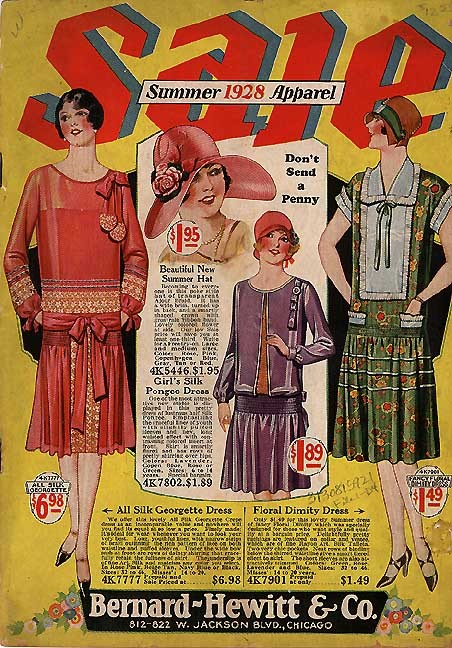
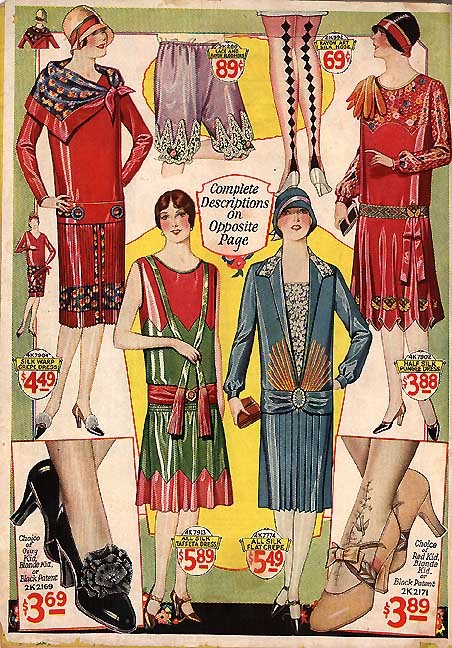
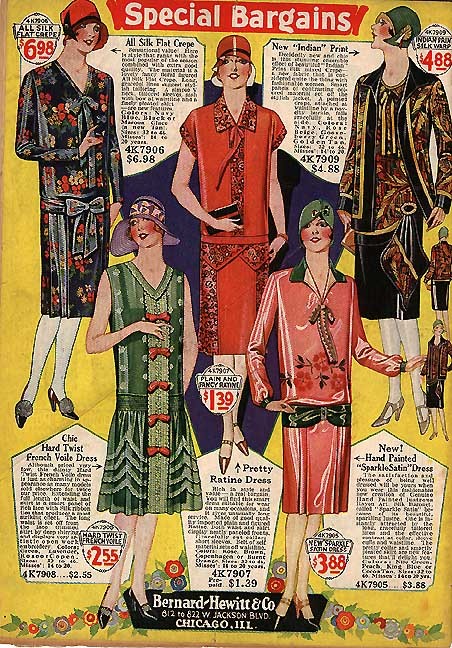
These clothing ads from 1928, featured on Jezebel, portray an ideal female form that is wildly different than the one we have today.  Note the straight lines (no hips or boobs) and very short hair cuts:

summer1928

1928shoesundies

specialbargains

I also like how the first image reads “Summer 1928 Apparel.”   Seasonal fashion, it appears, is nothing new.

Chicho sent in a link to an interesting ad campaign from the Agency for Healthcare Research and Quality and the Ad Council. The campaign’s tagline is Real Men Wear Gowns:

picture-13

According to the website, “Real Men Know the Facts” about heart disease.”

As Chicho points out, it’s one of those rare examples we see of ads trying to undermine stereotypical masculinity rather than play it up: there’s still the idea of being a “real man,” but instead of associating that with rugged individualism or risk-taking (or eating high-fat bacon burgers while drinking a beer as you sit in your Dodge truck), here being a real man means taking care of yourself, going to the doctor regularly, and taking care of your family by staying healthy.

Thanks, Chicho!

Gwen Sharp is an associate professor of sociology at Nevada State College. You can follow her on Twitter at @gwensharpnv.

In the Girl and Boy Scouts, merit badges represent the acquisition of skills and knowledge.  Artist Mary Yaeger tries to draw attention to the skills and knowledge that girls and women in America aquire, whether they be scouts or not, with her own set of embroidered merit badges. They feature things like tolerating menstrual cramps, shaving armpits, taking the birth control pill, suffering through gyn exams, using mascara and lipstick, learning how to walk in high heels, wearing sexy underwear, and more.

The project nicely reminds us that women have to work hard to appear properly feminine, as well as the unique things we experience as women.

Via Jezebel.

Lisa Wade, PhD is an Associate Professor at Tulane University. She is the author of American Hookup, a book about college sexual culture; a textbook about gender; and a forthcoming introductory text: Terrible Magnificent Sociology. You can follow her on Twitter and Instagram.

The Guardian is now making all of the data it uses in its stories available for free online. You can browse their data on subjects as wide ranging as imports and exports of plastic bags, reported amounts of exercise, and the best selling singles of 2008 at their Data Store. As one example, I’ve pasted in 20 government financial bail outs as a percentage of their GDP:


capture10

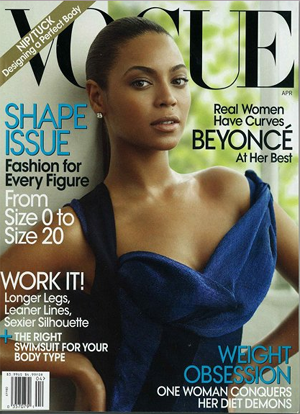
Women of color rarely grace the covers of fashion magazines like Vogue.  And yet, for the second time this year, the Vogue cover features a woman of color, Beyonce.  Unfortunately, in line with cultural stereotypes, the issue is the “Shape Issue,” contributing to the stereotype of Black women, and Latina women too, as especially “curvy.”  We document the fetishization of black women’s behinds here.

This month, Beyonce’s cover includes stories entitled:

Fashion for Every Figure: Size 0 to Size 20

Real Women Have Curves: Beyonce at Her Best

NIP/TUCK: Designing a Perfect Body

WORK IT! Longer Legs, Leaner Lines, Sexier Silhouette

THE RIGHT SWIMSUIT FOR YOUR BODY TYPE

WEIGHT OBSESSION: One Woman Conquers Her Diet Demons

beyoncecleancopy031309

The magazine sets up, essentially, an impossibility:  “Have curves, but by curves we mean something very specific: boobs and an ass.  You know, like Black women’ve got.  See Beyonce? She’s Black. So she’s got curves.  No matter that she’s extremely thin.  You should be extremely thin, too (‘WORK IT!’); eh em, we mean, ‘conquer your demons,’ we love you ‘from size zero to size 20.’  Just kidding!  We totally don’t.  Design ‘your perfect body’ with cosmetic surgery!  Then you’ll really love yourself… and we will find you acceptable… it’s win win!!!!”

Racism and sexism.  Nice work, Vogue.

(Via Jezebel.)

Singapore Airlines  is known for its “Singapore girls.” Here is a video that shows lots of images of how pretty Asian women, there to serve others, have been used in their advertising (the creator of the video claims to be a Singapore girl):

Apparently the Singapore Girl is such a phenomenon, she’s a figure at Madame Tussaud’s:

I had no idea that when most people think of Singapore, they think of this “pretty, smiling…girl.”

Anyway, I think it’s an interesting example of the way non-White women are often portrayed as exotic (the Singapore girls have become a symbol of Singapore itself) and also of what sociologists refer to as emotion work. The Singapore girls aren’t there just to bring us drinks and make sure we’re buckled in; there’s there to make us feel pampered and to warm our hearts–to do the type of emotion work (constantly smiling, being extremely attentive, being at the passengers’ service and making it seem like a joy) that makes customers feel cared-for and special…and thus willing to pay high prices for those business seats. And clearly these women are part of the decor–pretty, polite, accommodating women for passengers to enjoy while they fly.

Gwen Sharp is an associate professor of sociology at Nevada State College. You can follow her on Twitter at @gwensharpnv.

Will M. sent us this fascinating clip of Lil’ Wayne on Jimmy Kimmel Live. In the clip, Kimmel asks Wayne about losing his virginity at age 11. Wayne reveals that he did, indeed, lose his virginity at 11. He lost it to a 14-year-old girl who turned out the lights and surprised Wayne into participating, even as he had not intended doing so. What is fascinating is, were Wayne a white female, this narrative would have been considered molestation or rape. As a black male, doubly hypersexualized as a man (who always wants sex) and a black man (who really always wants sex), it’s just considered a joke. This is really nice evidence of the social construction of men, especially Black and Latino men, as hypersexual and, therefore, incapable of being sexually assaulted.

The discussion of his virginity loss begins at about 2:40.

Just one excerpt:

White guy: I didn’t know you could lose your viriginity at 11-years-old.

Other white guy: Well, we can’t, but he did.

Crazy Vet offers us this rather amazing commercial for BP as an example of “green-washing” or an effort to make a company appear environmentally friendly:

What I think is especially remarkable about this example is how entirely free of any content it manages to be.  The commercial combines pretty colors, animation, babies, cute music, and whistling gas pumps.  That alone, apparently, is effective in convincing us that BP is environmentally benign.  It is pure emotion, completely devoid of an argument.

—————————

Lisa Wade is a professor of sociology at Occidental College. You can follow her on Twitter and Facebook.