Cross-posted at Montclair SocioBlog.

It can take a while to find the right word.  But a mot juste may be crucial for framing a political issue. If you like the idea of men being able to marry men, and women women, what should you call the new laws that would allow that?

The trouble with “gay marriage” and even “same-sex marriage” is that these terms suggest – especially to conservatives – some kind of special treatment for the minority.  It’s as though gays are getting a marriage law just for them.

At last, the gay marriage forces seem to have come up with a term that invokes not special treatment but a widely-held American value that’s for everyone – equality.  A bill in  New Jersey has been in the news this week, mostly because Gov. Christie says he will veto it.  The bill is a “marriage equality” law.

The governor is in a bit of a squeeze.  As a Republican with ambitions beyond New Jersey’s borders, he can’t very well be for gay marriage.  But if his opponents can frame the matter their way, he now has to come out against equality.  Which is why the governor continues to refer to the issue as “same-sex marriage.”*

It’s like “abortion rights” or even “women’s rights.” A phrase like that might rally women to your cause, but if you want broader support, you need a flag that every American can salute.  I’m not familiar with the history of abortion rights so I don’t know how it happened, but those who want to keep abortion legal have managed to frame the issue as one of freedom to choose.   They have been so successful that the media routinely refer to their side as “pro-choice.”   To oppose them is to oppose both freedom and individual choice, principles which occupy a high place in the pantheon of American values.

It’s not clear that the “marriage equality” movement has been similarly successful, at least not yet.  I did a quick Lexis-Nexis search sampling the last week of the months January and July going back to 2007.  I looked for three terms: “same-sex marriage,” “gay marriage,” and “marriage equality.”

The general trend for all three is upwards as more legislatures consider bills, with big jumps when a vote becomes big news – that blip in July 2011 is the New York State vote.  But the graph can’t quite show how “marriage equality” has risen from obscurity.  That first data point, July 2007, is a 4.  Four mentions of “marriage equality” while the other terms had 25 and 50 times that many.  As of last week, “gay” and “same sex” still outnumber “equality,” but the score is not nearly so lopsided.

Here is a graph of the ratio of “equality” to each of the other two terms.  From nearly 1 : 20 (one “marriage equality” for every 20 “gay marriages”) the ratio has increased to 1 : 3 and even higher when the discussion gets active.

If the movement is successful, that upward trend should continue.  When you hear Fox News referring to “marriage equality laws,” you’ll know it’s game over.

———————————

* Christie is usually politically adept, but he’s stumbling on this one.  He referred to a gay legislator as “numb nuts” (literally, that might not necessarily be a liability for a politician caught in a squeeze).   Christie also said that he’s vetoing the bill so that the matter can be put on the ballot as a referendum – you know, like what should have happened with civil rights in the South.  

I think people would have been happy to have a referendum on civil rights rather than fighting and dying in the streets in the South.

Several critics, including Numb Nuts, responded that, yes, Southern whites would have been happy to have civil rights left up to the majority.  African Americans not so much.  (If you’re looking for an illustration of Tocqueville’s “tyranny of the majority,” the post-Reconstruction South might be a good place to start.)  The analogy is obvious – race : 1962 :: sexual orientation : 2012 – even if it was not the message the governor intended.
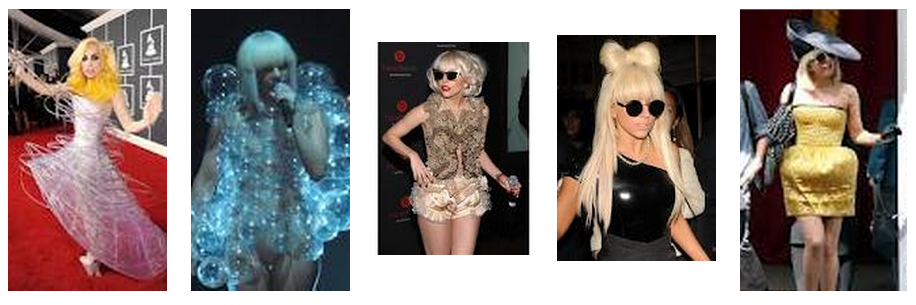
(source: Google Images)

Since the inception of the Gaga machine, her message has been to love yourself, flaunt your difference, be you in a conformist youth culture. As a 20-year-old struggling for an alternative sexual expression to “sexpot”, my interest was piqued. She was young and raw, full of a singular energy that demanded attention, with a decent set of pipes… so what was the catch? The catch was the patriarchal bargain.

A patriarchal bargain, as Lisa Wade wrote in a previous post, is:

…a decision to accept gender rules that disadvantage women in exchange for whatever power one can wrest from the system. It is an individual strategy designed to manipulate the system to one’s best advantage, but one that leaves the system itself intact… Don’t be too quick to judge; nearly 100% of women do this to some degree.

Even Lady Gaga.

Gaga, as weird and anti-Britney Spears sexy as she is, still exhibits sexiness that appeals to the male gaze. At times, it is positively pornographic. That is Lady Gaga’s patriarchal bargain. Despite bucking traditional rules of femininity with innovative fashion elements, she upholds contemporary standards of beauty and sex appeal. Her method is achieved through the use of palatable distractions: telephones as headwear, shamelessly poisoning ex-lovers, and dancing in flawless skeleton makeup. Give ‘em the old razzle dazzle and they won’t even notice that she’s a skinny white woman gyrating in underwear.

Bad Romance:

Telephone:

Throughout her body of work there is a thread of what we know all too well:  ass-shaking, barely-there nudity and conspicuous consumption, just in an offbeat fashion. Gaga is bonkers, but Gaga is sexy. Gaga is political and outspoken, Gaga is skinny and [often] blond.  Indeed, “Mother Monster” may uplift her fans because of her affinity for oddness, but lest we forget, she is a lady and must inhabit the flesh that adheres to gender norms and restrictions, she reminds us:

“I would rather die than have my fans see me without a pair of heels on. And that’s show business.”

If you want to ride the ride, you have to pay the price.  And that price is patriarchy.

—————————

Sonita Moss is a 2010 graduate of the University of Michigan with a B.A. degree in Sociology and French & Francophone Studies. Sonita hopes to receive her PhD in Sociology with a focus on the intersections of gender, race, and beauty. Whilst she prepares for the GRE, she occasionally updates her blog, Deconstructed Beauty.

If you would like to write a post for Sociological Images, please see our Guidelines for Guest Bloggers.

Cross-posted at Jezebel.

I am convinced that women could pee standing up, with the same accuracy as a man (which means, what, 90% accuracy?), if they practiced as often as men do.

There, I said it.

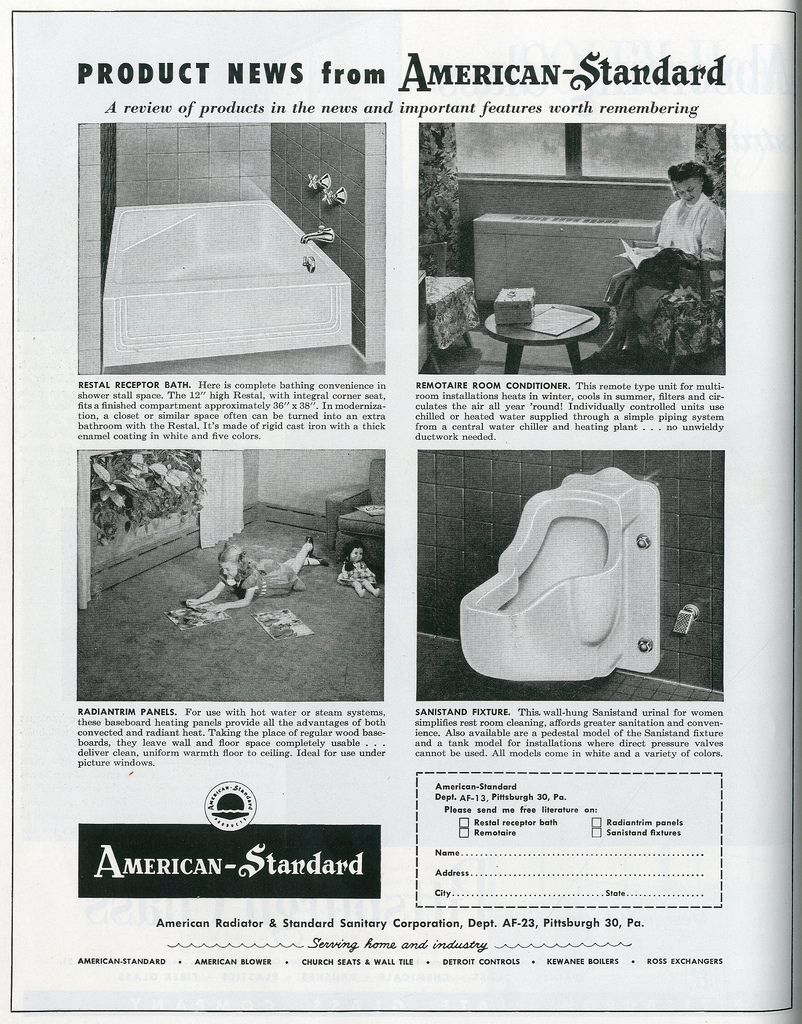
In any case, I’m not the only one and, in fact, in 1953 American Standard unveiled a urinal for women (via Vintage Ads):

Close up:

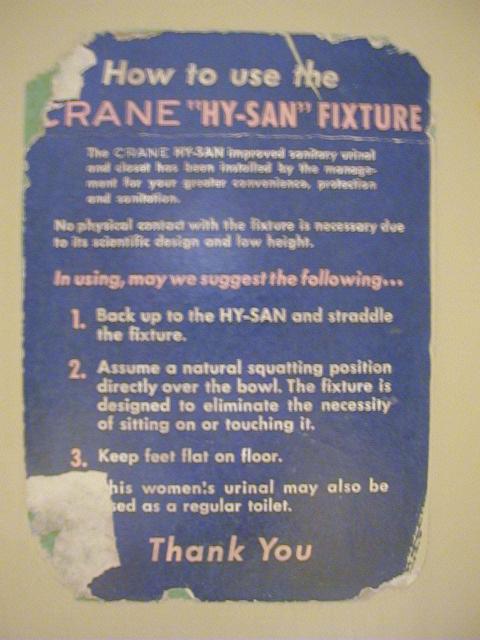
A commenter says she remembers seeing these in roadside rest areas for a time. But, obviously, they didn’t catch on. I suspect that they were made with women in skirts in mind, and involved squatting more so than standing and leaning back. This set of instructions for an another women’s urinal may or may not have applied to this one:

In any case, I like to imagine an alternative future in which women use urinals as easily and lightheartedly as men.  It makes me appreciate the historical contingency of our everyday lives.  Reminds me of the horizontal wall refrigerator.

Lisa Wade, PhD is an Associate Professor at Tulane University. She is the author of American Hookup, a book about college sexual culture; a textbook about gender; and a forthcoming introductory text: Terrible Magnificent Sociology. You can follow her on Twitter and Instagram.

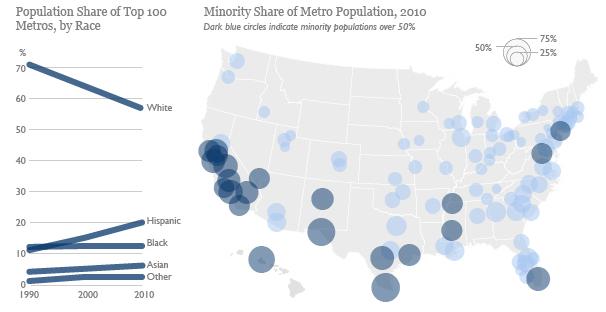
Sangyoub Park sent us a link to a post by the Brookings Institution about the changing racial/ethnic demographics of the 100 largest metro areas in the U.S. While White non-Hispanics still make up the majority in those areas (at 57% of the population), the minority population has grown rapidly in a number of cities; 22 of the top 100 metro areas are now majority-minority:

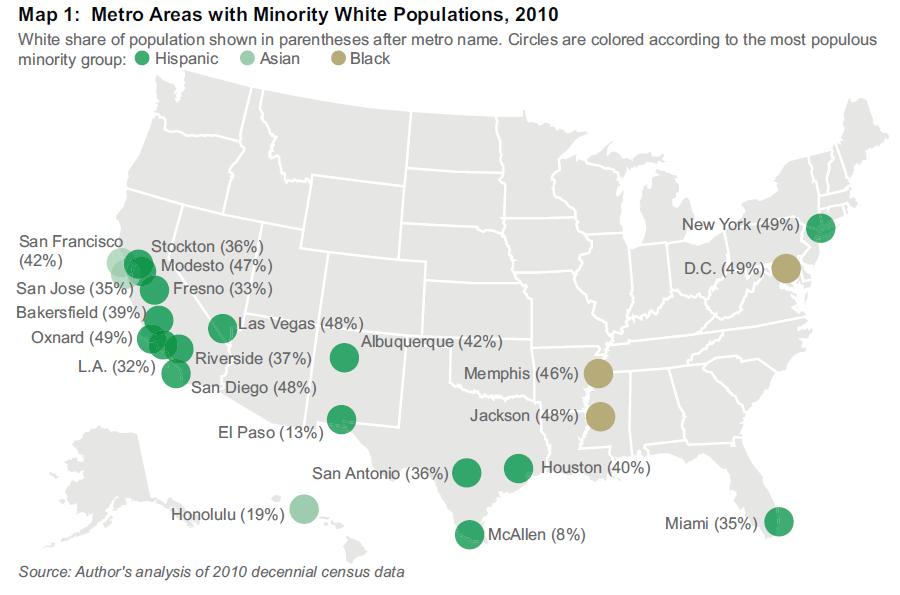
A detailed map of the majority-minority metro areas, with the largest racial/ethnic minority group in each (and the White non-Hispanic population in parentheses):

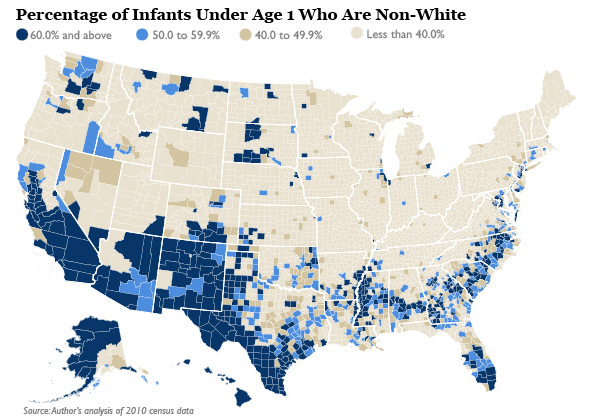
This demographic shift in metro areas should accelerate, given the racial/ethnic makeup of the population of children under age 1:

The Washington Post has an interactive map that lets you select an area and get detailed demographic information at the Census tract level (racial/ethnic makeup, household type, etc.) from 1990 to 2010.

Of course, as Sangyoub points out, being in the numerical majority doesn’t imply that a group no longer meets the definition of a minority group in a social sense. In many areas, racial/ethnic minorities continue to have less access to or control over economic resources, social prestige, and political power than do non-Hispanic Whites. Accumulated advantages do not get automatically redistributed when demographics change.

In an earlier post we reviewed research by epidemiologists Richard Wilkinson and Kate Pickett showing that income inequality contributes to a whole host of negative outcomes, including higher rates of mental illness, drug use, obesity, infant death, imprisonment, and interpersonal trust.

She summarizes these findings in this quick nine-minute talk at a Green Party conference:

See Dr. Pickett making similar arguments as to why raising the average national income in developed countries doesn’t make people happier or enable them to live longer, why unequal societies are more violent, and how status inequality increases stress.

And see more about income inequality and national well-being at Equality Trust.

Lisa Wade, PhD is an Associate Professor at Tulane University. She is the author of American Hookup, a book about college sexual culture; a textbook about gender; and a forthcoming introductory text: Terrible Magnificent Sociology. You can follow her on Twitter and Instagram.

We’ve posted in the past about awkward or puzzling attempts by companies to recognize Black History Month. The L.A. Clippers let underprivileged kids attend a game for free, though technically in the wrong month. The NBC cafeteria offered fried chicken and collard greens, as did a grocery store. Or maybe you prefer to celebrate Black History Month by buying hair straightener. And sometimes companies just sort of say they’re celebrating Black History Month, but without any specifics.

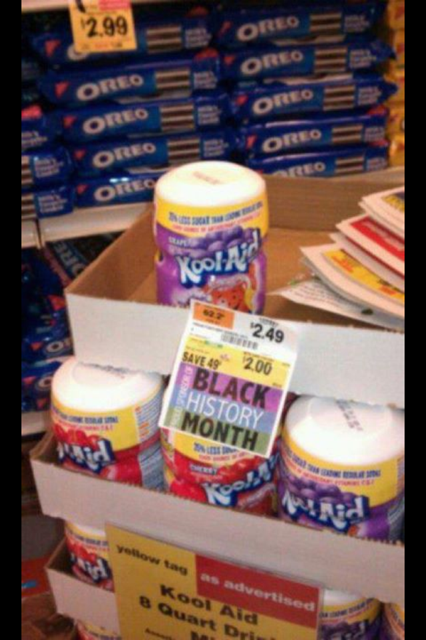
Emma A. sent in our newest example. Chad Ochocinco, of the New England Patriots, tweeted this pic of Black History Month being celebrated…with a sale on Kool-Aid:

Yep.

Today kicks off New York Fashion Week, an important time of year for models.

In these interviews, sociologist Ashley Mears talks about her research on modeling. Modeling, she explains, is a “winner take all” market; most live in very precarious economic circumstances. The value of her product — her body and her ability to use it — is something over which she has almost no control.

Accordingly, modeling requires an incredible amount of “emotion work,” the control of one’s feelings and presentation of emotions for the sake of an employer or customer.

For more from Dr. Mears, see our posts on the invisibility of labor in modeling, the ugly secret behind the model search, thinness in modeling (trigger warning), and contrasting aesthetics for high end and commercial models.

Lisa Wade, PhD is an Associate Professor at Tulane University. She is the author of American Hookup, a book about college sexual culture; a textbook about gender; and a forthcoming introductory text: Terrible Magnificent Sociology. You can follow her on Twitter and Instagram.

The phrase “Magical Negro” refers to the phenomenon in which a white character in a tv show or movie finds enlightenment through the wisdom of a Black character.  It is widely considered an offensive trope in which Black people — imbued with special spiritual, religious, or primitive powers of insight, often ostensibly due to some disadvantage like poverty — serve only to support a white person’s transformation.  The white person, and their ultimate redemption, remains the central story.

I couldn’t help but think of this when I watched the trailer for The Best Exotic Marigold Hotel, sent in by Katrin.  In this trailer, the Magical Negro isn’t a Black person; it’s not even a person.  It’s the entire country of India.

See if you see what I saw:

For examples of the Magical Negro, see our post on The Secret Life of Bees, the Magical Negro at Ikea, and the Magical Aboriginal Child in an Australian tourism ad.

Lisa Wade, PhD is an Associate Professor at Tulane University. She is the author of American Hookup, a book about college sexual culture; a textbook about gender; and a forthcoming introductory text: Terrible Magnificent Sociology. You can follow her on Twitter and Instagram.