Archive: Sep 2018

Many tennis clubs today uphold an all-white dress code. But does this homage to tradition come with the racism and sexism of the past? Wimbledon’s achromatic clothing policy hearkens back to the Victorian era, when donning colorless attire was regarded as a necessary measure to combat the indecency of sweat stains, particularly for women. Of course, back then, women customarily played tennis in full-length skirts and men in long cotton pants — also for propriety’s sake.  
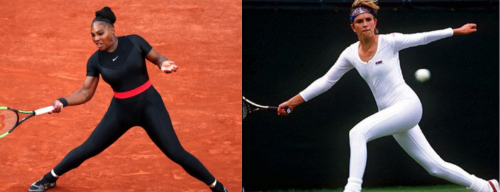
Serena Williams at the French Open, 2018 Anne White at Wimbledon, 1985

But today, not all tennis clubs insist on all-white.While Wimbledon is known for having the strictest dress standards (even Anne White’s catsuit pictured above got banned there in 1985), the other grand slams, including the French Open (along with the U.S. Open and the Australian Open), have recently become venues for athletes to showcase custom fashions in dramatic colors and patterns. Since the advent of color TV, athletes have used their clothing to express their personality and distinguish themselves from their competitors.

For instance, Serena Williams wore a black Nike catsuit to this year’s French Open. Her catsuit, a full-body compression garment, not only made her feel like a “superhero,” but also functioned to prevent blood clots, a health issue she’s dealt with frequently and which contributed to complications with the birth of her daughter. On Instagram, she dedicated it to “all the moms out there who had a tough recovery from pregnancy.”

Despite this supposed freedom, Williams’ catsuit drew the ire of the French Tennis Federation. Its president, Bernard Giudicelli, said in an interview with Tennis Magazine that “[Catsuits] will no longer be accepted.” The FTF will be asking designers to give them an advance look at designs for players and will “impose certain limits.” His rationale?I think that sometimes we’ve gone too far,” and “One must respect the game and the place.”

The new policy and the coded language Giudicelli used to justify it have been called out as both racist and sexist. By characterizing Williams’s catsuit as a failure to “respect the game,” the FTF echoes other professional sporting associations who have criticized Black football players kneeling during the anthem and Black or Latino baseball players’ celebrating home runs. Moreover, the criticism of Williams’ form-fitting clothing and the reactionary new dress code it spawned are merely the latest in a series of critiques of Williams’ physique.

Sociologist Pierre Bourdieu explains in his “Program for a Sociology of Sport” that practices like the policing of athletes’ apparel are a way for the tennis elite to separate themselves from other players and preserve a hierarchy of social status. This became necessary as the sport, derived from royal tennis and known as the “Sport of Kings,” experienced a huge increase in popularity since the 1960s. Bourdieu describes how this expansion resulted in a variety of ways to play tennis, some more distinctive than others:

…under the same name, one finds ways of playing that are as different as cross-country skiing, mountain touring, and downhill skiing are in their own domain. For example, the tennis of small municipal clubs, played in jeans and Adidas on hard surfaces, has very little in common with the tennis in white outfits and pleated skirts which was the rule some 20 years ago and still endures in select clubs. (One would also find a world of differences at the level of the style of the players, in their relation to competition and to training, etc.)

In reanimating the dress code, FTF officials are engaging in boundary work to preserve the status of a certain kind of tennis — and, by extension, a certain kind of tennis player — at the top of the hierarchy. In so doing, it is limiting the expression of a sports icon who redefines beauty and femininity and perhaps elite tennis itself.

Amy August is a doctoral candidate in Sociology at the University of Minnesota. Her research focuses on education, family, culture, and sport. Her dissertation work uses qualitative methods to compare the forms of social capital recognized and rewarded by teachers and coaches in school and sports. Amy holds a BA in English Literature from the University of Illinois at Chicago, a MA in Teaching from Dominican University, and a MA in Comparative Human Development from the University of Chicago.

Political sociologists often study how relationships and resources shape democratic institutions. Classic works like C. Wright Mills’ The Power Elite and G. William Domhoff’s Who Rules America? focused on the way wealth and status wield influence. More recent studies about think tanks and industry advocacy groups look at the current power of lobbying and thought leadership. When we talk about “big money” in politics, it is useful to understand exactly what that money is doing. 

One of the challenges for studying elite influence in politics, however, is that much of this influence happens behind closed doors or hidden in a complicated bureaucracy of regulation and reporting.

This is why I’m excited about a new project led by MIT Associate Professor In Song Kim called LobbyView. The team at LobbyView has pulled together a database of lobbying reports filed under the Lobbying Disclosure Act of 1995 and made it fully searchable and downloadable. Now, you can enter an organization and see exactly what kinds of policies they work on. The results might surprise you.

For example, here are the results from a quick search for the Family Research Council—a prominent lobbying group representing the religious right. When I talk about conservative Christian advocacy, most people immediately think about pro-life policy and same sex marriage. LobbyView’s text analysis of their reports shows a much wider range of issues in their legislative advocacy.

Top 10 two-word issues pulled from Family Research Council lobbying reports—LobbyView CC

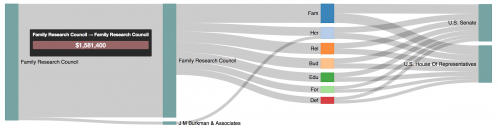
You can also see where the money is going. Over the full range of reports collected by LobbyView, FRC has spent about 1.6 million dollars. While much of that went to issues coded under family policy, healthcare, and religion (as we would expect), they also advocate on legislation in foreign policy and defense spending.

Family Research Council lobbying expenditures 1999-2018—LobbyView CC

Try it out for yourself and see what your industry is working for in Washington!

Evan Stewart is an assistant professor of sociology at University of Massachusetts Boston. You can follow his work at his website, or on BlueSky.

This week Hurricane Florence is making landfall in the southeastern United States. Sociologists know that the impact of natural disasters isn’t equally distributed and often follows other patterns of inequality. Some people cannot flee, and those who do often don’t go very far from their homes in the evacuation area, but moving back after a storm hits is often a multi-step process while people wait out repairs.

We often hear that climate change is making these problems worse, but it can be hard for people to grasp the size of the threat. When we study social change, it is useful to think about alternatives to the world that is—to view a different future and ask what social forces can make that future possible. Simulation studies are especially helpful for this, because they can give us a glimpse of how things may turn out under different conditions and make that thinking a little easier.

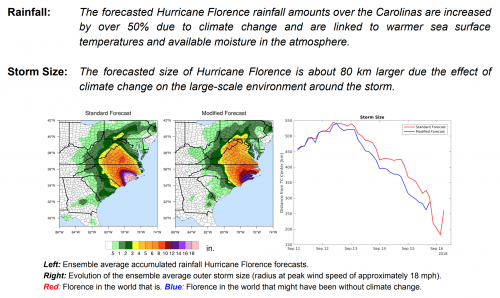
This is why I was struck by a map created by researchers in the Climate Extremes Modeling Group at Stony Brook University. In their report, the first of its kind, Kevin Reed, Alyssa Stansfield, Michael Wehner, and Colin Zarzycki mapped the forecast for Hurricane Florence and placed it side-by-side with a second forecast that adjusted air temperature, specific humidity, and sea surface temperature to conditions without the effects of human induced climate change. It’s still a hurricane, but the difference in the size and severity is striking:

Reports like this are an important reminder that the effects of climate change are here, not off in the future. It is also interesting to think about how reports like these could change the way we talk about all kinds of social issues. Sociologists know that narratives are powerful tools that can change minds, and projects like this show us where simulation can make for more powerful storytelling for advocacy and social change.

Evan Stewart is an assistant professor of sociology at University of Massachusetts Boston. You can follow his work at his website, or on BlueSky.

Originally Posted at TSP Discoveries

In a scene familiar to today’s teachers, several students in the classroom are glued to their screens: one is posting to social media, one is playing a computer game, and another is hacking their way past the school’s firewall with skills they perfected from years on the Internet. Are these students wasting class time or honing the skills that will make them a future tech millionaire?

Photo Credit: Ben+Sam, Flickr CC

Recent research in American Journal of Sociology from Matthew Rafalow finds that teachers answer that question differently based on the social class and race makeup of the school. Schools that serve primarily white, more privileged students see “digital play” such as video games, social media, and website or video production as building digital competencies that are central to success, while schools that serve larger Latino or Asian populations view digital play as irrelevant or a distraction from learning.

Based on observations of three technology-rich Bay Area middle schools, Rafalow examined whether the skills students develop through digital play are considered cultural capital — skills, habits, and dispositions that that can be traded for success in school and work. Although digital play can lead to skills like finding information online, communicating with others, and producing digital media, classed and raced stereotypes about educational needs and future work prospects affect whether teachers recognize those skills in their students. In other words, Rafalow examined whether teachers reward, ignore, or punish students for digital play in the classroom.

Rafalow found three distinct approaches across the schools. At the first school — a public middle school that largely serves middle-class Asian students — teachers viewed digital play as threatening to their traditional educational practices because it distracted students from “real” learning. Further, teachers believed students comfortable with digital skills could hack standardized tests that had been given electronically.

Photo Credit: US Department of Education, Flickr CC

At the second school — a public middle school that largely serves working-class Latino students — teachers discounted any skills that students brought into the classroom through their years of digital play. Instead, teachers thought introducing their students to website design and programming was a more important part of preparing them for 21st century working-class jobs.

In contrast, at the third school — a private, largely white middle school — teachers praised skills students developed through digital play as crucial to job success and built a curriculum that further encouraged expression and experimentation online.

The ways teachers in this study approached digital play provide a clear example of how raced and classed expectations for students’ futures determine the range of appropriate classroom behavior.

Jean Marie Maier is a graduate student in sociology at the University of Minnesota. She completed the Cultural Studies of Sport in Education MA program at the University of California, Berkeley, and looks forward to continuing research on the intersections of education, gender, and sport. Jean Marie has also worked as a Fulbright English Teaching Assistant in Gumi, South Korea and as a research intern at the American Association of University Women. She holds a BA in Political Science from Davidson College.