Archive: 2012

The New York Times recently ran an  interesting story on prison cemeteries in Texas.  For about $2,000, the state buries about 100 inmates a year. They die of lethal injection, old age, or illness, but they’re all dressed in dark pants, a white shirt, and tie, and are buried with a prayer from the prison chaplain.

When inmates die in custody, their bodies are sometimes unclaimed.  This may be because they have no family at all, or their family members don’t wish to claim the body.   Other times the inmate is cared for by family members who simply can’t afford to bury the person themselves.  So, occasionally the family members will decline to claim the body, but show up on the day of the burial to pay their respects.

Lisa Wade, PhD is an Associate Professor at Tulane University. She is the author of American Hookup, a book about college sexual culture; a textbook about gender; and a forthcoming introductory text: Terrible Magnificent Sociology. You can follow her on Twitter and Instagram.

Paula F. sent in a link to Babble.com’s list of the top 100 ‘mom blogs’ of 2011.  Mom blogs have become wildly popular in recent years as a way to document and comment on the experience of motherhood, and this particular list illustrates some interesting things about social privilege.  Paula was struck by the lack of racial diversity among the selected blogs and noted how women of color are vastly underrepresented.   For example, only 7 of the blogs are written by African-American moms, and 4 of those refer to the mother’s race in the title (although the same is not true for any of the blogs written by white women).

A quick review of the blogs reveals some other interesting issues related to social privilege and motherhood.  In addition to the lack of racial diversity, the blogs included in the list show very little variation in terms of class, sexuality, age, and marital status.   (The blogs were chosen by a panel of “experts” that took into consideration nominations from Babble readers, so it’s unclear how representative they are of mom blogs in general.)

While there is the more obvious privilege of the “digital divide,” or the disparate access that people have to technology and the internet, there is also privilege in having the spare time to devote to intensive writing/blogging and the connections necessarily to draw sponsorship and advertising.  Moreover, while some of the selected blogs do offer narratives that deviate from traditional ideas about mothering and motherhood (for example, several blogs discuss mental health issues, the struggles of parenting, and forming blended families), they nonetheless reproduce a narrow image of who mothers are, what they look like, and what they do.

 ————————

Christie Barcelos is a doctoral student, a mom, and a blogger, but not really a mom blogger.

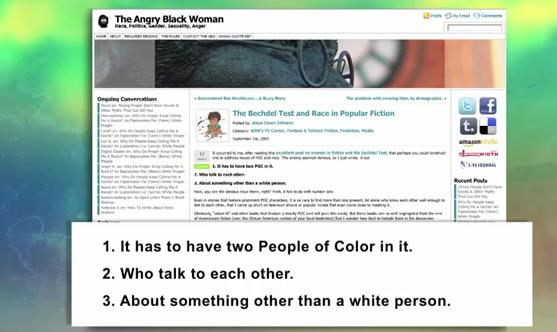
Yesterday I posted the results of an L.A. Times study on the demographics of the Academy voters who decide who receives Oscars. What about the movies they’ll be voting on this year? The always-awesome Anita Sarkeesian, of Feminist Frequency, produced a short video applying the Bechdel test — the simple measure of even minimal representation of women in film — to the 2012 Oscar nominees, as well as a racial version of the Bechdel test that looks at how non-Whites are included. The results are not encouraging:

The cartoon added below inspired me to revive this post from 2008.

Many believe that the U.S. is at the pinnacle of social and political evolution. One of the consequences of this belief is the tendency to define whatever holds in the U.S. as ideal and, insofar as other countries deviate from that, define them as problematic. For example, many believe that women in the U.S. are the most liberated in the world. Insofar as women in other societies live differently, they are assumed to be oppressed. Of course, women are oppressed elsewhere, but it is a mistake to assume that “they” are oppressed and “we” are liberated. This false binary makes invisible ways in which women elsewhere are not 100% subordinated and women here also suffer from gendered oppression.

(If you’re interested, I have a paper showing how Americans make these arguments called Defining Gendered Oppression in U.S. Newspapers: The Strategic Value of “Female Genital Mutilation.”)

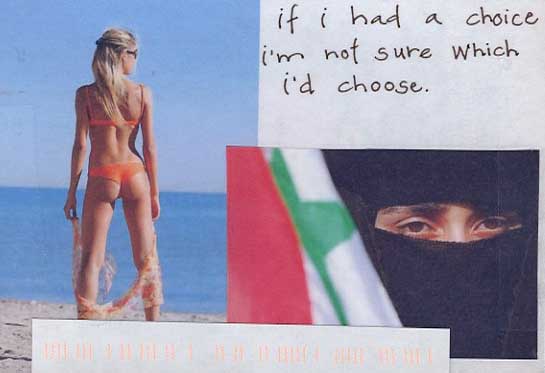
I offer these thoughts are a preface to a postcard from PostSecret.  The person who sent in the postcard suggests that she’s not sure which is worse: the rigid and extreme standard of beauty in the U.S. and the way that women’s bodies are exposed to scrutiny or the idea of living underneath a burka that disallows certain freedoms, but frees you from evaluative eyes and the consequences of their negative appraisals.

Cartoonist Malcolm Evans drew a similarly compelling illustration of this point, sent along by David B.

Lisa Wade, PhD is an Associate Professor at Tulane University. She is the author of American Hookup, a book about college sexual culture; a textbook about gender; and a forthcoming introductory text: Terrible Magnificent Sociology. You can follow her on Twitter and Instagram.

This Sunday is the 2012 Oscars ceremony. The Oscars are awarded based on the votes of nearly 6,000 members of the Academy of Motion Picture Arts and Sciences; however, the Academy keeps the identities of the voting members secret, so there’s little knowledge of who, exactly, determines the recipients of Oscars, prestigious awards within the industry that can increase interest in a film, increase job opportunities, and generally raise the profile of winners.

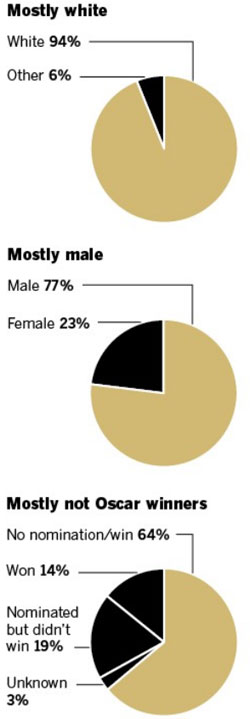
Sangyoub Park sent in a link to an article at the L.A. Times story about Academy voters. Times reporters were able to verify the identity of 89% of current voters, and the paper provided this breakdown of their demographics; as it turns out, those deciding who wins an Oscar are overwhelmingly White non-Hispanic and male:

Within some categories of voting members, Whites are even more dominant; they make up 98% of writers and executives. Voters are also disproportionately older; the median age is 62, and the Times reports that only 14% were under age 50.

As the Times story illustrates, many inside and outside of the film industry believe the make-up of Oscar voters influences which movies, actors, and directors have a serious chance of winning, with those that appeal to middle-aged White men inherently advantaged because of the lack of diversity among voters.


During the height of the Occupy Movement, thousands of individuals submitted pictures of themselves to the We are the 99 Percent tumblr blog.  They posed with letters and signs, telling individual stories of what it’s like to be in the 99%.

There’s been a solid critique of how whites, youth, and those with college access have a larger voice on this site, as well as dismissive responses from those on the right, but I’m struck by the rhetoric used. One word stands out to me as particularly jarring: Luck.

[Written for a child] “I am 3 years old and lucky to go to preschool, have a roof over my head and spaghetti-o’s in my belly. I am lucky to have Medicaid while my parents don’t qualify.”

“i am 22, living in a trailer in exchange for labor… We eat 69c mac’n’cheez or ramen; i drive a car illegal with disrepairs. And i’m lucky.”

“I am lucky my husband has a decent job because before I was on his health insurance my coverage  denied normal, annual GYN visits because ‘Being a woman is a pre existing condition.’ And we are the lucky ones!!”

“But I am one of the lucky ones. I was finally diagnosed with borderline personality disorder I am properly medicated”

“I’m one of the lucky ones. I enjoy my part-time job… yet… [have a] $65,000 [student] loan. 4 side jobs – not enough for rent. No health insurance. No children, so I don’t qualify for any aid, but I’m one of the lucky ones.”

“I am a lucky one. I have enough money to eat 3 of 4 weeks of the month…”

Luck is a word that comes up incredibly frequently among the 99 percenters, alongside words like debt, crisis, and unemployment. But what kind of luck is this? What does it mean to be “one of the lucky ones?”

In these posts, people struggling to hold multiple jobs call themselves “lucky” for having food most of the month, enough work to survive, or health care for part of their family — even as they report drowning in debt, losing work, and losing hope.

This isn’t our usual meaning for luck, and it only makes sense in comparison — to the “unlucky ones.” But if the “99 percent” is lucky, who exactly is unlucky? And how does this “luck” relate to the accompanying uncertainty, stalled careers, and failure to attain personal and collective dreams?

After sending in an early picture, I was startled to realize I’d also used the rhetoric of luck as a frame for my complaint. Of course I live in relative privilege to others, but why subsume my experience of uncertainty and dislocation beneath that privilege?

On the one hand, the rhetoric of luck acknowledges our relationships to other human beings, including those with greater struggles. To observant readers, it can also point to the structural and economic challenges that even “lucky” people face.

But I’d argue that the same rhetoric turns our lives into happenstance. It moves our stories harmlessly to the side, so that larger — and often deceptive — narratives about luck, hard work, and the American Dream can continue as planned. By prefacing our stories with an admission of luck, we displace our own voices and cast doubt on our experiences as something that just “happened to us.”

Yet the current economic and political situation didn’t just happen to either the “lucky” or the “unlucky” ones. As in other periods of U.S. economic history since the 1700s, the underemployment, debt, financial instability, and lack of affordable life-goods that Americans face are the result of deliberate policies designed to streamline and protect growth for investors, large corporations, and other profiteers — often at the expense of individual citizens, workers and business owners without large amounts of capital or political access.

So rather than slip into the rhetoric of luck, what other frames can we use to talk about our experiences? Framing our experiences in light of multiple takes on economic history may allow us to draw from previous generations in assessing our options for greater involvement in setting the guidelines for our society. Initiating discussion on the civic responsibility of every stakeholder may involve bringing to task those who have instituted policies beneficial only to a small minority of elite Americans. And collective effort from the left and the right could enable us to ensure that economic activity bears appropriate fruit for individuals, households, and families, and that the people actually have a voice in our towns, states, and nation at least equivalent to other sources of power.

 ————————

Celia Emmelhainz, M.A., is an economic anthropologist who conducts ongoing research on citizenship, economics, and religion in Central Asia. With a degree in anthropology from Texas A&M University, she currently works as an academic librarian in Kazakhstan.

Lisa Wade, PhD is an Associate Professor at Tulane University. She is the author of American Hookup, a book about college sexual culture; a textbook about gender; and a forthcoming introductory text: Terrible Magnificent Sociology. You can follow her on Twitter and Instagram.


Happy Fat Tuesday to all our friends in New Orleans! Don’t do anything we wouldn’t do!

If you’re not in the middle of the revelry, enjoy these Mardi Gras posts from previous years:

Lisa Wade, PhD is an Associate Professor at Tulane University. She is the author of American Hookup, a book about college sexual culture; a textbook about gender; and a forthcoming introductory text: Terrible Magnificent Sociology. You can follow her on Twitter and Instagram.

PBS has a gallery of images of oral contraceptives that provides a nice illustration of the way product design can be used as a form of behavior modification, while also needing to adapt to the way people actual use products — or forget to do so, the ever-present problem with the pill.

Initially , the pill came in bottles, like other prescriptions:

Notice the bottle contains 100 pills; there was no effort to package it into quantities for a single month. Women were supposed to take 20 pills in a row, then none during their period. It was up to them to keep track of everything and remember when it was time to start taking the pills again.

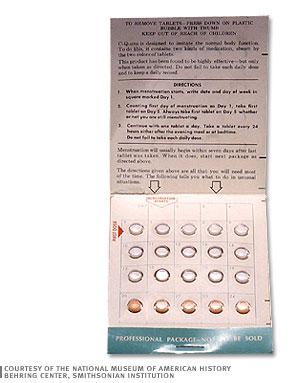
In 1962, an engineer created a prototype of a dispenser pack, designed to hold exactly a month’s worth of pills and help women remember to take them correctly:

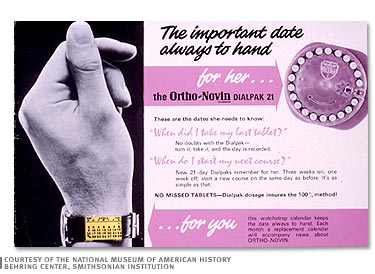
The first contraceptive in a pack of this type, Dialpak, appeared the next year; oral contraceptives packaging has been designed to help women remember to take them accurately ever since. This became a major selling point, with Dialpak 21 even offering a small calendar you could attach to a special watch band so you could more easily keep track of whether you’d taken the pill:

In 1965, Eli Lilly introduced a new packaging design, with differently-colored pills arranged in a sequence; however, it didn’t label the days of the week, so it didn’t help women figure out if they’d remembered to take their pill on any given day:

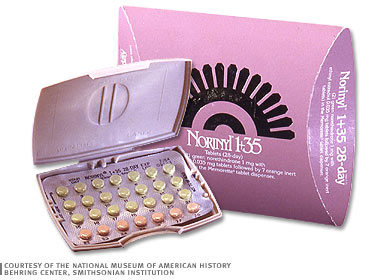
Norinyl came in a package that took the sequential design but added several features that enhanced compliance. An extra pill was added, so that pills with active ingredients were taken for 21 days, not 20. Then a row of placebo pills were added so that women took a pill every day of the month, so they were less likely to forget to start a new pack:

When we think about the emergence and success of the pill, we tend to focus on the product itself. But the packaging tells an interesting story on its own. The pharmacological effectiveness of oral contraceptives meant little if women forgot to take them reliably. The design of the packaging helped play a crucial role, increasing users’ ability to follow the prescribed schedule.

Today, there’s an entire trade organization, the Healthcare Compliance Packaging Council, dedicated to promoting attention to the design of packaging as an important element in all areas of healthcare. The pill was the first prescription drug sold in a so-called “compliance pack,” serving as an example of the potential effectiveness of packaging design as a way to encourage patients’ conformity to prescribed medication regimens.