Archive: Mar 2011

You know how sometimes you see something and you just cringe and wonder how, how, something made it into the public sphere? Paul Fidalgo, of Near Earth Object, took a photo of this display illustrating the career ladder at McDonald’s. The display provides a rather unintended commentary on race and corporate hierarchies in general:

I suppose I should be happy, as the sky appears to be the limit for White women like me on the Ladder of Whiteness.

I was doing some googling, looking for data on the racial diversity of McDonald’s employees, since the company has touted itself as a leader in providing career opportunities to women and underrepresented minorities. I’m always surprised how corporations that carefully guard their brand in other ways, and talk about diversity issues, often seem to drop the ball when it comes to thinking about the cultural politics of representations of race and ethnicity in their materials.

[UPDATE: A number of commenters argue that McDonald’s has a better record on promoting women and minorities than most corporations. I’m not trying to argue there that they don’t — I was trying to find some data on their employees because I’ve also heard they stand out, as far as corporate America goes. That’s why I found the display surprising, as opposed to perhaps predictable.]

So anyway, my online search led me to 365Black, the website McDonald’s set up to appeal to African Americans:

Ok…uh, sure. Just exactly like the baobab tree.

I’d seen 365Black before — readers have sent it in, and we just couldn’t think of much to say so we’ve never posted about it. But then my googling took me to MeEncanta, the McDonald’s page for the Latino community. They offer this sticker (i.e., instruct you to download the image and print it on sticky-backed paper) to show off your Latin pride:

Alrighty…

And finally I arrived at Myinspirasian, which targets Asian Americans. On the page about Asian Pacific American Heritage Month they include information about contributions by Asian Pacific Americans, such as this:

Multimedia creations inspired by Asian Pacific Americans are the latest rage among kids, teens and young adults of all ages. The multimedia creations offer a variety of the trendiest ways to receive news, information, entertainment and services using the worldwide web.

No specifics are given, so you’ll have to figure out what these mysterious “multimedia creations” are. Also, “they have become household names in a host of sporting activities,” though apparently not the type of household names where McDonald’s could actually name one. The entire section is similarly vapid, completely lacking in anything other than non-specific statements that Asian Pacific Americans have, like, done stuff, and things. It reminded me of some of the very superficial celebrations of Black History Month we’ve seen.

But if you want, you can take the Asian Phrases Challenge, where you can hear various phrases spoken in either Mandarin or Cantonese, Filipino/Taglish, Indian/Hinglish, or Korean:
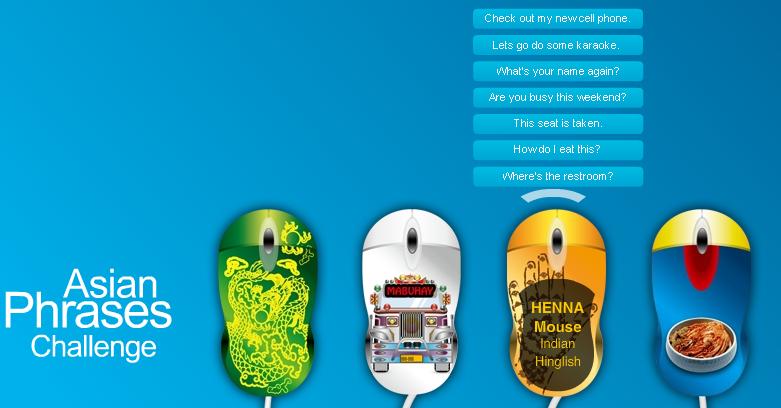
I’m not sure what the “challenge” aspect is, since it doesn’t do anything but play the phrases.

I just…I don’t know. You decide to make webpages entirely devoted to a particular demographic and this is the best you can do? And do these types of marketing projects actually work?

———————–

For more, see our previous post showing how people of color are subordinated visually in advertising materials.


On the February 21, 2011 edition of The Colbert Report, there was a humorous but still telling segment (watch) about former Congressional Senator and Representative Rick Santorum (R-PA). The segment detailed the effects of Dan Savage’s appeal to readers and followers to “Google bomb” then U.S. Senator Santorum in 2003 as a response to some of Santorum’s comments about homosexuality. In April of 2003, the Senator made several controversial statements that essentially compared homosexual acts to bestiality and incest, and stated he believed such acts to be a threat to society and the institution of the family (read excerpts from the interview). Savage, author of the sex advice column “Savage Love,” appealed to his readers to come up with a definition of “Santorum” to memorialize the Senator’s comments as an act of protest.

After settling on a definition, Savage created the website Santorum to promote the newly coined sexual neologism that meant a “frothy mixture of lube and fecal matter that is sometimes the byproduct of anal sex.” Over time, and many searches later, Savage’s website is to this day at the top of the results list when you Google “Santorum.” [In a nutshell, in order to Google bomb, or to inflate the ranking of a site under a particular query, you rely on people clicking on a specific link in the search results list and you rely upon other websites linking to a particular page using a specific anchor text. In this case, other websites linked to Savage’s site using the anchor text “Santorum” and many people clicked on his site when Googling the term.]


As funny as the story is, it raises important questions about the power over discourse given the new possibilities presented by the web. Much is to be said for a crowd-sourced means of discourse. In a very general way, it can be likened to subvertising (see AdBusters) where popular advertisements are parodied or spoofed to illustratively and critically question the meaning of the original advertisements and the discourses they are selling to the consumer. In a more specific way to Santorum’s case, using a Google bomb can be likened to muckraking. Not only did Savage make a successful attempt at a large-scale practical joke, he successfully drew attention to Santorum’s comments about homosexuality. Further, the result of the Google bomb would make it difficult for Santorum to promote his own website and the discourse he would wish to produce about himself on the web, especially should he consider running for the U.S. Presidency in 2012.

Yet, each of these strategies that combat dominant narratives are traditionally produced by the few and the privileged, and the same was true of the dominant narratives. Ultimately, what I wish to highlight with this post is that the web is fostering challenges to existing power relations over the production of discourse. The Google bomb presents an interesting case for the democratization of discourse production, and it provides evidence for possible strategies of altering what discourses become visible in the mainstream.

William Yagatich is a sociology graduate student at the University of Maryland.  His post originally appeared at Cyborgology.

NEWS:

The newest Sociological Images essay to be published in Contexts magazine, The Social Control of Mothers, is now available.  The essay, drawing heavily on Elizabeth Armstrong’s book Conceiving Risk, Bearing Responsibility, explores the imperfect relationship between pregnant women’s consumption of alcohol and fetal alcohol spectrum disorders and asks whether controlling women’s behavior is really the best way to reduce the rate of these disorders. You can check out our earlier post on the topic, download the (more carefully composed) essay from Contexts, or send us a note at socimages@thesocietypages.org to ask for a copy.

Don’t forget that Sociological Images welcomes guest posts from academics and graduate students.  Please read our Guest Post Guidelines for more.

Finally, this is your monthly reminder that we’re on Twitter and Facebook.  If we’re lucky, we may just reach 10,000 friends sometime this March.  Who will be the 10,000th!?

We’ve posted previously on the tendency of the U.S. media to ignore the rest of the world (in favor of Britney Spears), even changing the cover of magazines sold in the U.S., but not elsewhere, in ways that coddle our ethnocentrism.

Given this phenomenon, this four-minute clip from a Russia Today news program (in English) is particularly striking.  The reporter notes that the U.S. media is covering the ongoing foreign political protests more thoroughly, and with more positive enthusiasm, than it has the protests in Wisconsin.

Thanks to Abby Kinchy, fellow UW-Madison alum and Assistant Professor of Science and Technology Studies at Rensselaer Polytechnic Institute, for the tip.

Lisa Wade, PhD is an Associate Professor at Tulane University. She is the author of American Hookup, a book about college sexual culture; a textbook about gender; and a forthcoming introductory text: Terrible Magnificent Sociology. You can follow her on Twitter and Instagram.