Archive: 2010

Peggy R. sent in this great vintage ad for Cessna private planes.  Placed in 1941, it suggests that all families should have private planes after the war:
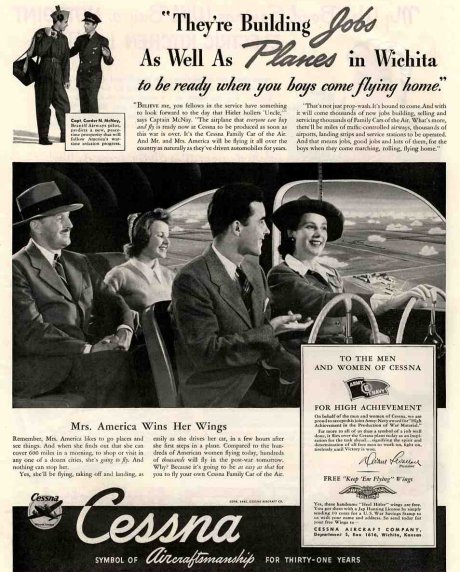
I spoke with my friend and Cessna expert, Stephen Wilson.  He explained that the G.I. Bill, which reimbursed veterans for educational expenses, applied to flying lessons.  Veterans, then, could be reimbursed for learning to fly and Cessna was trying to encourage all veterans and their families to take to the skies.

Lisa Wade, PhD is an Associate Professor at Tulane University. She is the author of American Hookup, a book about college sexual culture; a textbook about gender; and a forthcoming introductory text: Terrible Magnificent Sociology. You can follow her on Twitter and Instagram.

NEWS:

Lisa was quoted in an Associated Press article that, much to her chagrin, rather uncritically celebrated the recent rash of untouched photos released by celebrities.  You can read it here and compare it to her unfiltered thoughts about it at her own post.

We added a new example of an assignment drawing on Sociological Images that instructors can use.  This one asks students to think critically about the whole project and is, thus, very interesting.  See #7 of our Sample Assignments.

This is your monthly reminder!  You can follow us on Twitter or friend us on Facebook where we update with a featured post every day.  We are, by the way, having lots of fun watching reactions to our posts on Facebook.  Thanks to all of you who have friended us and contribute to the conversations and the “like”!

NEWLY ENRICHED POSTS (Look for what’s NEW! Apr. ’10):

Neat, Cute, Ew, and Cool

In a comments thread a Reader, ckilgore, linked to her grandma’s cabinet fridge from the ’50s.  We added it, along with another example of an ad, to our vintage ad for the same.

We added a picture of pair-bonded female albatrosses to our (adorable) post on gay animals.

Tom M. sent in a billboard for Penthouse features a very suggestive… eye.  We added it to our post featuring ads with not-at-all-subtle visual sexual innuendo (NSFW).

I added an image of the Korean peninsula at night, linked in a comments thread by Brendon, to our post comparing the a map of the lights of the world at night and population density.

Race-Related Updates

We added a representation of “users” from WordPress that represented people as coming in different skin colors to our post featuring default avatars.

Jessica S. and Lucia M.M. sent in links to companies selling pretend teepees.  We added it to our post on American Indian-themed toys for kids.

Skada sent in another example in which white people are just people but black people are b-l-a-c-k, this time on Netflix.

Gender-Related Updates

We added lollipops, identical deodorants, and disposable cameras to our post on pointlessly gendered products.  We also added a new “girl talk” version of Jenga to our post on gendered versions of classic board games.  The first two were found by Sunlight Snow and the latter by Kathe H.

We also added a “drama queen” sign for girls to our post on babies’ and kids’ items that reinforce the “girls as spoiled divas” stereotype.  Thanks to Coley for sending it in!

Alex N. sent in a Fruit Loops commercial that genders doctors and nurses (in the direction that you would expect) and we added it to a post on that topic.

We updated our post on scrapbooking sticker sets of words about boys and girls with wall decals for boys and girls. In case you didn’t know, boys like hip-hop derived terms, while girls like any and all abbreviations.

Lizz Q. sent us another example of an anatomical illustration that featured a man facing straight forward and a woman posing rather sexily.  We added it to our burgeoning collection.

We added another great example of hygiene products being marketed to men by arguing that it enhances, instead of detracts from, their manliness.  In this one, sent in by Lucia M.-M., truly manly body wash is contrasted with sissy manly body wash.

Sofia R. sent us another example of Twix commercials that depict men as immature idiots.

We added a third example of shirts being sold in “unisex” and “women’s,” sent in by Mindy J.

Dmitriy T.M., Beth W., Abby D., and Jillian Y. sent in links to a video game called RapeLay.  We added it to a previous post on rape-themed video games (TRIGGER WARNING).

Lisa Wade, PhD is an Associate Professor at Tulane University. She is the author of American Hookup, a book about college sexual culture; a textbook about gender; and a forthcoming introductory text: Terrible Magnificent Sociology. You can follow her on Twitter and Instagram.


How have adults and young people weathered the worldwide economic downturn? This two-minute 12-second video shows that young people have been harder hit by joblessness in almost all OECD countries:

From the OECD Factblog.

Lisa Wade, PhD is an Associate Professor at Tulane University. She is the author of American Hookup, a book about college sexual culture; a textbook about gender; and a forthcoming introductory text: Terrible Magnificent Sociology. You can follow her on Twitter and Instagram.

Asa D. sent in an animated 1958 Disney segment titled “Magic Highway USA.” The cartoon extols the virtues of the highway system of the future (the interstate highway system was authorized by President Eisenhower in 1956). Apparently it is farther into the future than 2010, as my windshield does not have a radar, and road construction around here doesn’t seem to be instantaneous:

The segment of course illustrates gender expectations of the time — dad goes off to work while mom and the kid(s) go shopping. But as Asa points out, this example of the “techno-utopianism” of the post-World War II era, with faith that modern technologies will lead to a happy future that increasingly frees us from unpleasant work, boredom, wasted time, and so on, is truly fascinating.

Providing a nice contrast to that earlier vision, Dmitriy T.M. let us know about the stop-motion short video Metropolis by Rob Carter. The entire video, which is 9 1/2 minutes long, gives an abridged history of Charlotte, North Carolina.

Here are the last 3 minutes (you can see the entire video here). In this segment, we see the unfolding of a large highway system and urban construction/destruction/reconstruction. At about a minute in, “the video continues the city development into an imagined hubristic future, of more and more skyscrapers and sports arenas and into a bleak environmental future” (quote found here):

Metropolis by Rob Carter – Last 3 minutes from Rob Carter on Vimeo.

NEW! (May ’10): Kris H. sent in another example of envisioning the future. The Futurama, an exhibit at the 1939 World’s Fair, promised a future in which interstate highways will allow people to bypass slums, relieving us of the work of fixing them (found at Neatorama):

Jose Marichal, who blogs at Thick Culture, forwarded us this compilation of Bob Barker’s infantilizing and harassing behavior on The Price is Right during the 1970s.  It’s pretty stunning:

I’d like to say that men don’t call women “girls” these days… but I’m watching Jaime Oliver’s Food Revolution.

Source: FourFour via The Daily Dish.  More examples of calling women girls, both vintage and contemporary.

Lisa Wade, PhD is an Associate Professor at Tulane University. She is the author of American Hookup, a book about college sexual culture; a textbook about gender; and a forthcoming introductory text: Terrible Magnificent Sociology. You can follow her on Twitter and Instagram.

PART ONE:

Drinking lowers your GPA. So do smoking, spending time on the computer, and probably other forms of moral dissolution. That’s the conclusion of a survey of 10,000 students in Minnesota.

Inside Higher Ed reported it, as did the Minnesota press with titles like “Bad Habits = Bad Grades.” Chris Uggen reprints graphs of some of the “more dramatic results” (that’s the report’s phrase, not Chris’s). Here’s a graph of the effects of the demon rum.

Pretty impressive . . . if you don’t look too closely. But note: the range of the y-axis is from 3.0 to 3.5.

I’ve blogged before about “gee whiz” graphs , and I guess I’ll keep doing so as long as people keep using them. Here are the same numbers, but the graph below scales them on the traditional GPA scale of 0 to 4.0.

The difference is real – the teetotalers have a B+ average, heaviest drinkers a B. But is it dramatic?

I also would like finer distinctions in the independent variable, but maybe that’s because my glass of wine with dinner each night, six or seven a week, puts me in the top category with the big boozers. I suspect that the big differences are not between the one-drink-a-day students and the teetotalers but between the really heavy drinkers – the ones who have six drinks or more in a sitting, not in a week– and everyone else.

—————————-

PART TWO:

Some time ago, the comments on a post here brought up the topic of the “gee whiz graph.” Recently, thanks to a lead from Andrew Gelman, I’ve found another good example in a recent paper.

The authors, Leif Nelson and Joseph Simmons, have been looking at the influence of initials. Their ideas seem silly at first glance (batters whose names begin with K are more likely to strike out), like those other name studies that claim people named Dennis are more likely to become dentists while those named Lawrence or Laura are more likely to become lawyers

But Nelson and Simmons have the data. Here’s their graph showing that students whose last names begin with C and D get lower grades than do students whose names begin with A and B.

The graph shows an impressive difference, certainly one that warrants Nelson and Simmon’s explanation:

Despite the pervasive desire to achieve high grades, students with the initial C or D, presumably because of a fondness for these letters, were slightly less successful at achieving their conscious academic goals than were students with other initials.

Notice that “slightly.” To find out how slight, you have to take a second look at the numbers on the axis of that gee-whiz graph. The Nelson-Simmons paper doesn’t give the actual means, but from the graph it looks as though he A students’ mean is not quite 3.37. The D students average between 3.34 and 3.35, closer to the latter. But even if the means were, respectively, 3.37 and 3.34, that’s a difference of a whopping 0.03 GPA points.

When you put the numbers on a GPA axis that goes from 0 to 4.0, the differences look like this.

According to Nelson and Simmons, the AB / CD difference was significant (F = 4.55, p < .001). But as I remind students, in the language of statistics, a significant difference is not the same as a meaningful difference.

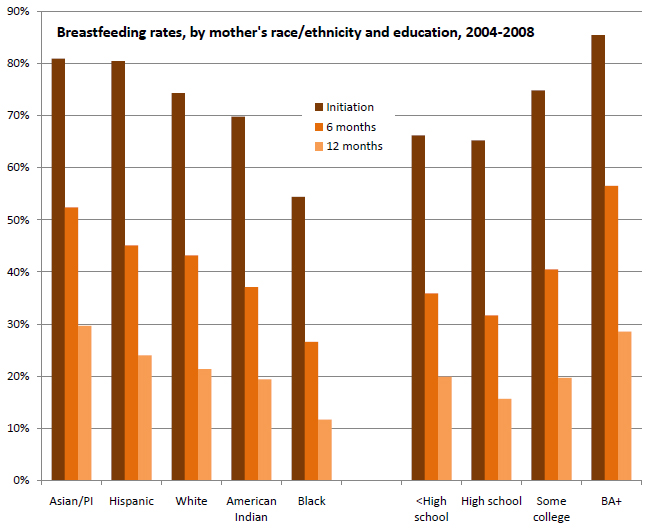
Breastfeeding is widely believed to carry significant health advantages for infants and the American Academy of Pediatrics (AAP) would like to see all mothers breastfeed their children for at least 12 months, with no supplemental food for the first six.

Breastfeeding, however, is a big job.  Even if a newborn takes to breastfeeding without any problems (some mothers struggle mightily with less-than-cooperative infants), mothers must feed their children around the clock (they now recommend every two hours, 24-hours a day for newborns).  If it takes a half hour to settle the baby down and fill it up, you’ve got an hour and a half before the next feeding time.

Mothers who have the privilege to stay home with their babies — for three, six, or even twelve months — then, are going to find it much easier to follow the AAP guidelines.  For mothers who return to work, those who work in flexible positions that award some degree of autonomy and respect will also be more likely to continue breastfeeding.   In other words, a lawyer with a private office and a work schedule under her own control can stop several times a day and express milk to bring home to her child; in contrast, a woman working the cash register at McDonald’s with a boss hovering over her doesn’t have the same autonomy or privacy and may be forced to give up breastfeeding.

It shouldn’t be surprising, then, that breastfeeding rates are higher among more educated women and White and Asian women.  Both of these variables tend to correlate with class privilege:

There are some interesting things, however, that don’t correlate with this class thesis.  First Hispanic women are more likely to breastfeed than White women and people with less than a high school education are more likely to breastfeed, especially at six and 12 months, than people with a high school education.

I can think of some reasons why… I’ll let you discuss it in the comments.

Borrowed from Philip Cohen’s Family Inequality Blog.  For more data on rates of breastfeeding, including U.S. state comparisons and changes in rates over time, see here.

Lisa Wade, PhD is an Associate Professor at Tulane University. She is the author of American Hookup, a book about college sexual culture; a textbook about gender; and a forthcoming introductory text: Terrible Magnificent Sociology. You can follow her on Twitter and Instagram.

Amanda brought our attention to a photo project by L. Weingarten called “A Series of Questions.” The ongoing project is designed to draw our attention to how the kinds of questions we ask transgender people makes them feel like inexplicable Others. From a description of the project:

The subjects, self-identified people of transgender, transsexual, genderqueer, gender-variant, or gender non-conforming experience, hold signs depicting questions that each has had posed to them personally — some by strangers, others by loved ones, friends, or colleagues. Presented on white wooden boards, the questions are turned on the viewer, shifting the dynamics under which they were originally asked, and prompting the viewer to cast a reflective, self-critical eye upon him or herself, revealing how invasive this frame of reference can be.

In other words, these questions get asked not only because transgender people break the rules, they get asked because the rest of us can be so inflexible, utterly confounded when other around us challenge our assumptions about the world.


Lisa Wade, PhD is an Associate Professor at Tulane University. She is the author of American Hookup, a book about college sexual culture; a textbook about gender; and a forthcoming introductory text: Terrible Magnificent Sociology. You can follow her on Twitter and Instagram.