gender studies

Recently, I had the pleasure of corresponding with sociologists Chloe Bird and Pat Rieker about their book Gender and Health: Constrained Choices and Social Policies (Cambridge University Press, 2008), credited as the “first book to examine how men’s and women’s lives and their physiology contribute to differences in their health.” I was curious how the authors see their research relating to some of the health topics that have made headlines in recent months. Gender And Health: The Effects Of Constrained Choices And Social Policies, Chloe E. Bird, Patricia P. Rieker, 0521682800

Nack: Starting off with the topic of mental, health, you’ve written about sex-based differences.  Reflecting on recent articles, like NYT’s In Anxious Times, Medical Help for the Mind as Well as the Body, how does your book add to our understanding of and concern for policies like the Mental Health Parity Act?


Rieker:  Our book provides concrete data for why the Mental Health Parity Act is such a strategic and critical addition to general health care policy.  We focus on gender differences in mental health, particularly depression and substance abuse disorders.  Although the overall rates of mental illness are similar between men and women, if you look at it by specific disease, then you see large gender differences.  Women’s depression and anxiety rates are double that of men’s; while men’s rates of substance abuse and impulse control disorders are double that of women’s. Available research shows that individuals with serious mental health problems also have more physical health issues, including a lower life span. Both social and medical interventions are needed to prevent and treat these socially and financially costly conditions which create enormous health burdens on individuals, who may become unable to perform work and other social roles, and their families, Employers and society, as a whole, bear additional costs. 


Bird:  Also, differences in men’s and women’s lives can affect their utilization of mental health care and the effectiveness of specific interventions. We need systematic assessments of the effectiveness of treatments/approaches for both men and women, which can ultimately lead to better physical and mental health outcomes. The US has fallen behind Canada and other countries which require this approach in federally-funded research. 


Nack: How are the differences between men’s and women’s mental health problems particularly relevant as we consider the impact of the economic downturn, in general, and, with regard to healthcare coverage, the rising numbers of uninsured and underinsured Americans?


Rieker:  In the current poor economic climate, many men and women are experiencing increased stress/anxiety when losing jobs which may have provided dependable incomes and health insurance. Constant worry, itself, leads to ill health and exacerbates existing underlying conditions (e.g., cardiovascular and respiratory conditions).  Our framework of constrained choice illustrates how social and economic policy can reduce or enhance the options and opportunities for individuals to engage in healthy behaviors such as not smoking, not drinking to excess, eating well, and exercising.  While some individuals respond to economic downturns by temporarily limiting costly habits of smoking or drinking, we argue that more could be done at different policy levels to encourage positive health behaviors and coping strategies that improve physical and mental health. more...

st1:*{behavior:url(#ieooui) }

/* Style Definitions */
table.MsoNormalTable
{mso-style-name:”Table Normal”;
mso-tstyle-rowband-size:0;
mso-tstyle-colband-size:0;
mso-style-noshow:yes;
mso-style-parent:””;
mso-padding-alt:0in 5.4pt 0in 5.4pt;
mso-para-margin:0in;
mso-para-margin-bottom:.0001pt;
mso-pagination:widow-orphan;
font-size:10.0pt;
font-family:”Times New Roman”;
mso-ansi-language:#0400;
mso-fareast-language:#0400;
mso-bidi-language:#0400;}

I am pleased to introduce Susan David Bernstein, “Beyond Pink & Blue’s” first guest columnist! Susan teaches literature and gender studies at the University of Wisconsin-Madison, and has published widely on contemporary feminist theory and the Victorian novel. She is currently working on a study of women writers and activists in the Reading Room of the British Museum, as well as a memoir titled Unlikely Loves.

Here’s Susan:

I discovered new realms of gender profiling before my child was born in August of 1992. Although the sex chromosomes of this eventual baby were recorded in my OB/GYN file, I was adamant that I did not want to know. “Don’t tell me!” I’d shield my eyes, when a nurse or doctor opened my file at an appointment. At that time, it was increasingly common for people to have this knowledge, and from what I witnessed, prenatal gendering took off with a vengeance. I’d hear comments like, “I know this little guy is going to be a quarterback! What a kicker already!” Baby showers became gendered affairs, and the first outfits for the ride home from the hospital were tooled to match that chromosomal information. I was happy instead to receive an array of baby clothes, some blue, some fuschia, one with a rodeo pattern, another with vegetables in reds, greens, and oranges.

So even back then, it was unusual to answer the “what kind of baby are you having?” question with, “I don’t know.” I had an elaborate birth plan which even included a provision about birthing room announcements: I asked my doctor not to say, “It’s a boy!” or “It’s a girl!” but simply, as he did, “Congratulations, you have a healthy baby!” My partner and I even joked about how we’d try not to know those gender-defining genital features of our baby (we’d have someone else do the diapering and bathing for the first month), so that our ingrained notions about gender would be kept at bay. And, we thought, so would those of the world we lived in. Not possible, I discovered, from day one.

I did of course learn I had a daughter within in minutes of her birth, and she was quickly swaddled in a pink blanket. A nurse held out a basket of caps for newborns, all knitted by a women’s league, and I chose a white one with lavender and blue stripes. But later that day my partner and I requested a different blanket, yellow perhaps, or green or white. We learned that the maternity unit only had blue and pink blankets.

This was Madison, Wisconsin, a university town with a history of progressive values; Tammy Baldwin is our congressional representative—the first open lesbian to be elected to the House. Today, in 2009, my daughter is taking a terrific women’s studies class in her high school (the same one Baldwin graduated from); all four public high schools in Madison offer such courses. But in 1992, there were only pink and blue blankets at the hospital. So I asked for a blue one. A nurse entered my room the next morning, glanced at the bassinet, and then asked me cheerily, “And how is your little boy today?” I responded, “I do not have a boy.” The woman peered in the basket, looked a bit alarmed, and hurried out of the room.

Within a few years, the hospital expanded its newborn wardrobe to include prints and other colors. Still, there remain many ways in which the straitjackets of gender identity flourish from before birth through high school. My daughter spent all four years of high school competing on the cross country team where the girls run 4K meets to the boys’ 5K races. And now she’s one of two girls on her high school team of forty wrestlers. She’s also in the gender minority in her advanced chemistry and physics classes. As a family, we’re still learning to navigate the updated variations of pink and blue that we first encountered in 1992.

There’s lots of cross-dressing buzz in the mainstream media and in the blogosphere.  Here’s a semi-biased sample for your consideration:

Oct. 17: CNN covers Morehouse College’s dress code which “cracks down on cross-dressing.”

Nov. 6: NYT article asks “Can a Boy Wear a Skirt to School?” and describes U.S. high schools whose dress codes range from enforcing ‘traditional’ norms to allowing for students to more freely express their sex, gender and sexuality through their appearance. Is this a case of those with social/political power being ‘out of touch’ with changing times?

Dress code conflicts often reflect a generational divide, with students coming of age in a culture that is more accepting of ambiguity and difference than that of the adults who make the rules.

Nov. 7: Sociologist Shari Dworkin’s post on the Sexuality & Society blog adds a more nuanced analysis of Morehouse’s policy and encourages a complex approach to understanding gender-based dress codes.

Nov. 18: My guest-post on the Sexuality & Society blog takes on some of the questions left unasked and unanswered in that Nov. 6 NYT article about high school dress codes and considers Dworkin’s arguments.

What are the overt and covert goals of school dress codes? Are these dress codes developed to ensure that students meet norms of professionalism, or do these serve as tools for schools to enforce heteronormativity and stigmatize transgenderism? Are schools citing safety concerns, warning parents about how to protect youth from harm, or do these intend to distract us from the ways in which dress codes serve to reinforce heterosexist norms? How well can we predict the unintended consequences of dress codes – both the more ‘traditional’ and more ‘progressive’ policies?

Today: I read a new NYT article online — in the Fashion & Style section — that asserts, “It’s All a Blur to Them” and goes on to describe today’s “urban” 20-somethings who,

are revising standard notions of gender-appropriate dressing, tweaking codes, upending conventions and making hash of ancient norms.

So, what are we to think? In early November, we read about a female high-school senior who was forbidden to wear a tux in her yearbook photo. A couple of weeks later, we read about the growing trend of unisex lines in the fashion world. Does this mix of media coverage reflect that the U.S. remains an ideologically conflicted patchwork of ‘blue’ and ‘red’ Americans? Or, if the generational-change argument holds true, then are we on our way to becoming a society that truly embraces ‘gender fluidity’?

Difficult Dialgoues

Get the latest on girls and girls studies this week at the National Women’s Studies Association annual conference in Atlanta, Georgia from November 12-15.  The conference theme is “Difficult Dialogues,” and we expect our largest event in recent history.  On tap: more than 1,600 feminist scholar-activists gathering to exchange ideas in more than 300 sessions.

You’ll hear analyses of girls’ lives and experiences, including sessions like “Girls of Color and Performance Ethnographies” and “Voices of Girls in Urban Schools.”

And if you can’t make it you can find updates on our Facebook page or after the conference on the NWSA site where we expect to make a podcast of the Angela Davis keynote address available.

Wimpy Kids

You can also hit the newsstand and pick up the latest issue of Ms. Magazine where you’ll find my contribution on Jeff Kinney’s Diary of a Wimpy Kid book series.  My daughter Maya is one of my expert sources along with Sharon Lamb, Lyn Mikel Brown and Mark Tappan, who’ve just released Packaging Boyhood: Saving Our Sons from Superheroes, Slackers, and Other Media Stereotypes.

On October 27, the World Economic Forum released its 2009 Global Gender Gap report, which ranks countries according to four categories: economic participation and opportunity, educational attainment, political empowerment, and health and survival. Who wins? Iceland, with the world’s smallest gender gap. Who loses? Yemen, coming in at 134th place. But lest we point fingers, the U.S. dropped four places, to 31st place, owing to minor drops in the participation of women in the economy and improvements in the scores of previously lower-ranking countries. (Though we’re top of the heap for educational attainment, we’re #61 for political empowerment. Ouch!)

The authors, Ricardo Hausmann of Harvard University, Laura D. Tyson of the University of California at Berkeley, and Saadia Zahidi of the World Economic Forum, have put together an accessible and informative report. Among many other issues, their report suggests how motherhood can, in a word, kill. Consider a few of the statistics surrounding maternal health in many parts of the world:

Annually, more than half a million women and girls die in pregnancy and childbirth and 3.7 million newborns die within their first 28 days. (Appendix E, “Maternal Health and Mortality”)

Approximately 80% of maternal deaths could be averted if women had access to essential maternity and basic healthcare services. (Appendix E, “Maternal Health and Mortality”)

The need for paying greater attention to maternal health has been underscored by Nicholas Kristof in his New York Times column and his recent book Half the Sky, co-authored with Sheryl WuDunn. And while plenty of criticism has been levied against Kristof’s book, succinctly and fairly voiced by Katha Pollitt in her review in The Nation (thanks to my colleague Amy Kesselman for bringing her review to my attention!), Kristof deserves kudos for bringing media attention to the health issues that needlessly affect mothers in many developing countries, such as obstetric fistula.

The Global Gender Gap report provides other glimpses into how the experience of motherhood varies from country to country. Consider what Ricardo Hausmann, Ina Ganguli, and Martina Viarengo have to say about the relationship between marriage and motherhood, and their impact on the labor force participation gap between men and women:

…while the education gap has been reversed in quite a few countries, the employment gap has not. This gap is related to the compatibility of marriage and motherhood with a lifestyle where women can work.

(Here, the U.S. has a dubious distinction: of those countries where the employment gap has been rising, it has seen the biggest increase.)

Overall, however, there are some signs of positive change when examining the “motherhood gap” within labor force participation globally:

Motherhood has not been a universal obstacle for female labour force participation. In almost half the countries we studied, women with three children work at least as much as women with no children. However, in other countries, especially in Latin America, the motherhood gap is very large, with Chile exhibiting the largest gap. But there is good news: the motherhood gap has been falling in almost two-thirds of the countries, with the biggest reductions shown again by Brazil and Greece, accompanied by Austria and Bolivia.

There isn’t room in this report to explore all the complexities of paid work and mothering–such as who cares for children when mothers work in countries that don’t support working mothers, the working conditions mothers face, and so on–not to mention the wide spectrum of how women experience motherhood according to identity (class, ethnicity, religion), educational background, and geographical location (whether mothers live in a village or an urban environment). Even so, the report provides some broad brushstrokes that help situate the many different kids of gendered gaps in the world.

st1:*{behavior:url(#ieooui) }

/* Style Definitions */
table.MsoNormalTable
{mso-style-name:”Table Normal”;
mso-tstyle-rowband-size:0;
mso-tstyle-colband-size:0;
mso-style-noshow:yes;
mso-style-parent:””;
mso-padding-alt:0in 5.4pt 0in 5.4pt;
mso-para-margin:0in;
mso-para-margin-bottom:.0001pt;
mso-pagination:widow-orphan;
font-size:10.0pt;
font-family:”Times New Roman”;
mso-ansi-language:#0400;
mso-fareast-language:#0400;
mso-bidi-language:#0400;}

Back in the 1970s, feminists took toy companies to task for their sexist marketing practices. They railed against the board game “Battleship” for depicting a father and son at play while an apron-clad mother and daughter washed dishes in the background. (One outraged mother even sent the cardboard game box to the editors of Ms. magazine to prove her point.) They questioned why pretend kitchens were fashioned out of pink plastic, when the majority of professional chefs were men. And they urged puzzle-makers to depict women piloting airplanes and fighting fires.

One of the youngest toy activists was a seven-year-old from New York City named Caroline Ranald. In 1972, the second-grader wrote a letter to the Lionel train company admonishing them for their boy-dominated ads. “Girls like trains too,” she explained. “I am a girl. I have seven locomotives. Your catalog only has boys. Don’t you like girls?” Caroline’s short letter made a big impression. Not only did the toy train makers feature girls in their subsequent catalogs, they also circulated a press release with endorsements touting the psychological and cognitive benefits of train play for girls.

Fast forward to 2009…and we have to ask: what happened to the gains feminists made in toyland? I literally did a double-take when I read that the Toy Association’s “Toy of the Year Awards” offer separate prize categories for “Best Boy Toy” and “Best Girl Toy.” Sure, they slot some contenders into gender-neutral categories like “Best Outdoor Toy” and “Best Educational Toy.” But they don’t even try to airbrush the fact that when it comes to selling toys, gender divisions—and gender stereotypes—still reign.

In case you’re wondering, the “Best Boy Toy” of 2009 went to the Bakugan Battle Brawlers Battle Pack Action Series. These intricately wrought orbs of plastic snap open into dragon- and vulcan-like shapes when they are hurled onto corresponding magnetized cards. Bakugan isn’t just a Manga-inspired action toy, it’s an entertainment brand, complete with a website, television show, and other paraphernalia. According to the Toy Association’s website, Bakugan beat out the Handy Manny 2-in-1 Transforming Tool Truck, the EyeClops Night Vision Infrared Stealth Goggles, and a few other trinkets for the top boy toy honors.

My own boys, ages 8 and 11, can’t seem to get enough Bakugan spheres, priced around ten dollars a pop. When I asked my younger son why he thinks girls aren’t into Bakugan, he replied that “they don’t like to fight and brawl the way boys do.” Maybe so, but when toy companies are so explicit about developing toys for gender-specific markets, we have to ask the proverbial chicken-and-egg question: do boys like Bakugan because it taps into some innate affinity for competitive, militaristic play—or because they are being socialized and culturally conditioned to prefer those forms of play?

For the record, the Best Girl Toy of 2009 was the Playmobil Horse Farm, a plastic play-set complete with stables, ponies, and equestrian figurines. (In 2007, the honor went to Hasbro’s FurReal Friends Butterscotch Pony—which raises the question of why a horse-related toys have become so feminized in recent years.) Runner-ups for Best Girl Toy include a Pedicure Salon activity kit, a Talking Dollhouse, and Hannah Montana’s Malibu Beach House—toys based on stereotypes of beauty and domesticity so blatant they speak for themselves.

Although most elementary-school boys probably wouldn’t beg for a kiddie pedicure set, children display more variation and boundary-crossing in their play than the toy industry might care to admit.  Decades after the heyday of second-wave feminism, few parents would bat an eye at a girl playing with StarWars action figures or a boy weaving a potholder on a loom.  But for the purveyors of playthings, pink and blue don’t make purple; they make green.  Toy makers have a vested interested in selling to a gender-bifurcated market, because they can make double the money selling twice as many toys.

In the spirit of feminist toy activism, perhaps it’s time, once again, to argue the point. If there are any little boys out there who have a thing for horses, maybe they can e-mail the folks at Playmobil and set them straight.

Not far into Nona Willis Aronowitz and Emma Bee Bernstein’s book, Girldrive: Criss-Crossing America, Redefining Feminism, the word drive takes on new definition. Friends since they were 11, the duo spent summers together at Camp Kinderland, (where they return to teach a gender awareness workshop at their journey’s end). Aronowitz describes their mutual upbringing as one in which they incubated within the same “bubble: the liberal Jewish one that inhabits New York’s Upper West Side and Greenwich Village.” Post-college, over Bloody Marys and brunch, they hatch a plan to drive across America to try to understand what feminism means to twentysomethings outside this shell. After planning and saving, they set off for an odyssey of exploration, crashing on couches, interviewing in living rooms as well as in bars, doing their best to catch the flavor of whatever city they’re in and to measure how the word “feminist” translates.

Through series of snapshots – both visual and written – they tease out from their interviewees whether or not they comfortably embrace the word “feminist” as part of their self-definition. The book feels like a gloss – in the best sense – Bernstein’s photos are vivid and edgy as is each page’s sleek design. Aronowitz is responsible for the bulk of the writing and through her capsule write-ups she imbues mutable definitions into the word “feminist.”

The two discover a “badass feminist posse in Baton Rouge,” are so taken with the “fascinating women in Nashville,” they say on an extra day, dress up as frumpy second-wavers for some Halloween partying on the Las Vegas strip. They interview members of Big Star Burlesque, a plus-size dance troupe in Austin, chat with graduate students in San Diego and parse the contributions and detriments of “academic feminism,” learn from a young single mother on welfare tending bar in Sioux Falls, and bring some of their “guy friends” directly into the discussion in Kansas City. They drop acid in Abiquiu, follow a text to an afterhours “noise show” in Portland, feel surprised by Seattle’s “crunchy clean,” spend much of their holidays in New York City zigzagging across the boroughs to capture the rich communities of writers, artists, and activists they find.

The effect is one of pastiche, weaving, or braiding, all good second-wave tropes, but with the conversation focused on third-wave concerns. Aronowitz and Bernstein are transparent about their process throughout – and frank about what surprised them. Working out and through the interconnective fibers that bind generations of women is their work. They encounter women who mightily resist the word “feminist” due to generational preconceptions, but still desperately want gender injustice to end. Some embrace the word “humanist” or just want to be called an activist, minus any labels. When some women were confused by what the word “feminist” even meant, the two asked, “What pisses you off about being a woman?” or “What keeps you up nights?” often to a flood of response. The collective narrative picks up friction when Aronowitz and Bernstein openly grapple with women who say they plan to have a “traditional” marriage or eschew premarital sex or are ardently anti-choice. These moments are compelling as Aronowitz and Bernstein gamely push up against these comments, and fairly include them.

Interviews with second wave feminists leaven the book as the two ask what legacy has been handed down, and what these women hope for their generation. The two sit down with Erica Jong, Katha Pollitt (and her daughter), Michele Wallace, poets Mei-Mei Berssenbrugge and Anne Waldman, Starhawk, (among others), pay homage to Kathleen Hanna, and close the book with an interview with feminist artist Susan Bee Bernstein, Emma’s mother.

If I could wish for one change, it would be less breadth. Surveying with a wide lens is the point of their project – to collage viewpoints and show the multiplicity of meanings that inhabit the word “feminist.” Yet at times the interviewees’ comments are so brief they don’t allow meaning to accrete. The richest part of the book is its sheer panoply of voices and images, but more interstitial reflection would help frame the montage.

It is impossible to not commend the two for the ambitious scope of this project, to admire their commitment, and the sense of passion present in their quest. Sadly, it’s also impossible to not think about the losses that accompany the book – especially the resonating silence that surrounds losing the voice of a young feminist from the collective conversation. But the echo left is one of fervid dialogue – richly diverse – engaged in trying to create what changes lie ahead.

Welcome to my first column exploring gender stereotypes and realities in children’s lives. Whether or not you’re a parent yourself, it’s impossible to miss the countless ways in which our culture divides kids along gender lines. Just walk into any toy store and notice how the playthings are segregated–with action figures, race cars, and dinosaurs for the boys, and Barbies, Bratz dolls, and craft kits for the girls.

For decades, debates have raged over the “nature vs. nurture” question: Are we neurologically “hard wired” to behave in stereotypically masculine or feminine ways—or is gendered behavior acquired through culture and socialization? The pendulum has swung back and forth over the past fifty years, with scientists, educators, and parents vacillating between two poles of thought. During the 1970s, second-wave feminists came down on the “nurture” side of the fence, and worked hard to raise a generation of kids free from the restrictive gender roles that permeated the postwar, Leave-it-to-Beaver era. (Think Free to Be, You and Me, Title IX, and the ubiquitous parenting refrain: “you can be ANYTHING you want to be…”) Recently, however, some experts have been touting the “nature” side of the equation, arguing that boys and girls are “biologically programmed” to behave and learn differently.

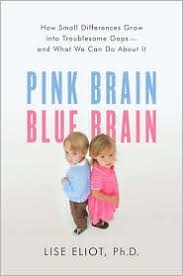
Today, in my opinion, the most sophisticated and sensible answer to the “nature vs. nurture” question is: “both.” In her new book Pink Brain, Blue Brain: How Small Differences Grow into Troublesome Gaps—And What We can Do About It,” neuroscientist and mother-of-three Lise Eliot explains that there are some real inborn differences between the sexes, but statistically, they are very small. It’s our culture—what we do and say at home and at school, on t.v. and in the toy store—that amplifies those small innate differences, turning them into self-fulfilling prophesies that limit the aspirations, experiences, and skills of boys and girls alike.

It’s not simply a matter of banning Barbies or forcing boys to do needlepoint. The issues swirling around kids and gender identity are complicated, so simplistic, one-size-fits-all “solutions” won’t do the trick. But in the best feminist tradition, it’s worth asking tough questions about the messages our culture sends out to parents and kids on a daily basis. Why, for example, does the Toy Industry Association persist in having categories like “Best Boy Toy” and “Best Girl Toy” of the year? (More on that next month!) Retail stores gain when they sell pink drapes for girls’ bedrooms and blue shades for boys’—but what do kids lose when they grow up in such a gender-bifurcated world?

Please share your thoughts, opinions and questions by posting a comment or emailing me at rotscant@yahoo.com.

Somewhere within my past year’s reading the book Maiden USA: Girl Icons Come of Age by Kathleen Sweeney came into my orbit.  It seemed ideal as I traced the history of girls onscreen, on television, and within other forms of media.  Yet I wish I could give Sweeney’s book a more enthusiastic thumbs up.  Listed as a “media artist and writer” Sweeney has taught at various colleges and been active in media training programs for girls.  Her book began as a “curatorial project of films and videos by teenage girls entitled ‘Reel Girls/Real Girls'” which premiered in San Francisco.

Sweeney casts a wide net and she ranges from exploration of the Riot Grrrl movement to a chapter called “Mean Girls in Ophelia Land” which tracks the rise and fall of the “mean girl” movement within popular writing as well as on screen.  She correctly identifies that for the most part the Teenage Girl, (as she capitalizes it) was a “passive helping noun linked to Daddies, Brothers, and Boyfriends,” until certain cultural zeitgeists began to shift. As cultural interest in girls gathered momentum, the growth of what Sweeney names a Girl Icon has grown.  Sweeney is right on point when she chases this emergence through the past almost 20 years.

The book moves at a fast clip – her quick categorizations of Neo-Lolitas, Career Girls, Geek Girls, Cyber Chicks, as well as Supernatural Girls, Amazons, and Brainiacs, among other labels, often struck me as too glib.  Her most intriguing point is what now defines an Icon in contemporary culture, as well as her reinsciption of the term into the word “Eye-con.”  Sweeney calls an “Eye-con” an “image scam that must be navigated and brought to awareness by analyzing and naming its syntax,” not unlike a stereotype.  Eye-cons do their most damaging work, she says, when viewers are unconscious of their influence.  Within the pantheon of the “Eye-con” is the “Girl-con” she says, which are “Icons of girlhood which posit girls as inevitable Victims.”  Examples are “anorexic adolescent models selling a form of starvation beauty.” Media literacy demands that viewers name the Girl-con and then look beyond to alternative role models as Sweeney says she wants to consider Girl Power Icons for the new millennium against a “backdrop of current and retro Girl Iconography.”  Her writing about visual representation and even semiotics is at its strongest when she is doing this kind of analysis.

Yet, while impressive in scope, the book’s very breadth also serves as its limitation as depth is sacrificed for a sweeping survey of the cultural landscape. Sweeney’s enthusiasm for her subject is most strongly felt when she describes her first-hand work with girls.  Her final chapter “Girls Make Movies: Out of the Mirror and Through the Lens” was the most intriguing to me.  Sweeney’s passion as an activist comes out as she describes some of the current programs working with girls to advocate media literacy and develop their skills.  She mentions Reel Grrls in Seattle, Wash., and GirlsFilmSchool in Santa Fe, N.M., among others.  The book’s list of resources is also wonderfully thorough. I suspect undergraduate students would enjoy having this book assigned for its abundance of popular culture references, generous use of chapter subheads and discrete categorizations.

By contrast, another book I came across during my research was Mary Celeste Kearney’s Girls Make Media which became indispensible to me for both its range and its depth.  Kearney is an academic, now tenured at UT-Austin and the book’s research is admirable.  Neatly divided into three sections “Contexts,” “Sites,” and “Texts” Kearney also traces girls’ historical participation with media.  She delves into girls’ entry into the web, also the impact of the Riot Grrrls, zine culture as well as independent filmmaking.  Her focus on what happens when girls take over media production is what makes this book compelling.  At the same time, she contextualizes the institutionalized practices that have keep girls from participating fully.

Particularly exposing is the deeply entrenched sexism in the field of filmmaking (the idea that cameras are too heavy for female techs to lug and “peer networks” or “structures of acquaintanceship” that boys use covertly, but effectively, advance their ambitions and deny girls access).  Kearney’s cataloging is vast and its impact is felt as she reveals just how much girls who make media have to say.  She includes writing about the need for single-sex media education but steps beyond it to show what girls really do when they’re given access to media tools.  Their work often centers around exploration of identity and re-inscription of messages about gender roles that crack open a universe of deeply felt and powerfully smart dialogues about what most girls experience but hadn’t yet had a place to express.

Some of the titles Kearney includes tell a whole story: films such as Taizet Hernandez’s “Are You a Boy or a Girl?” which explores “real-life gender-bending of a young female” or Hernandez’s film “We Love Our Lesbian Daughters,” which explores coming out experiences and Kearney says offers “A rare glimpse into the lives of queer young Latinas” but focuses on sexual identity over ethnic identity.  She groups films about sexual abuse such as “Love Shouldn’t Hurt” by Tamara Garcia or “It’s Never OK” by Arielle Davis, and includes a cache of films about the ubiquitous doll such as in Lillian Ripley’s “What if Barbie Had a Voice?” Just a fraction of other titles include: “Looks Like a Girl” which “broadens young lesbian representations beyond white, Anglo culture,” and “Body Image” by Mieko Krell, meant to “raise awareness about girls’ different relations to and strategies for negotiating dominant beauty standards.”

When exploring girls’ zines Kearney includes telling excerpts as this one from “Bikini Kill: A Color and Activity Book” about why female youth should enact social change: “To discuss in both literal and artistic ways those issues that’re really important to girls: naming these issues, specifically, validates their importance and other girls’ interest in them; reminds girls that they aren’t alone.  To make fun of and thus disrupt the powers that be.”  Even a smattering of the zine titles reads like a found poem: The Bad Girl Club, Bi-Girl World, Lezzie Smut, The Adventures of Baby Dyke, Geek the Girl, Angry Young Woman, Pretty in Punk, Housewife Turned Assassin, Angst Girl, Pixxiebitch, Ladies Homewrecking Journal, From the Pen of a Liberated Woman. The book’s website is also a wonderful resource as the power of the girls’ voices can be felt shouting through the distance.

I’m way excited to introduce GWP readers to a new regular blogger, Leslie Heywood. On a personal level, I’m thrilled to have Leslie on board because she was the one who first kicked my ass into gear when I expressed a desire during graduate school to write nonacademically. She made it ok. Better yet, she published me. (Leslie, with Jennifer Drake, edited one of the very first third wave feminist anthologies, Third Wave Agenda: Being Feminist, Doing Feminism, and I will be forever grateful to her for encouraging me down the road I am currently on!) So please join me in a warm welcome to prolific author, scholar extraordinaire, athlete,, mother of two, Leslie Heywood! Leslie’s monthly column, Gender Specs, will bring you the latest on gender analysis in evolutionary psychology and other sciences. Here’s her debut post – enjoy, and let us know what you think. -Deborah

After years of working on third wave feminism and women in sport, I got very interested in, even passionate about evolutionary approaches to language, culture, the body, and gender. From a gender perspective, however, the field is sometimes not a pretty place. It still tends to be dominated by a core set of assumptions based in a particular kind of Evolutionary Psychology (EP). It’s enough to send a good feminist screaming in the other direction away from any kind of evolutionary perspective–and in fact it often does.

But there are things about an evolutionary perspective I find very compelling, just not those things associated with this particular brand of EP. So I was very excited when a Newsweek article came out that voiced some of my concerns. On June 20, 2009, senior editor Sharon Begley wrote a feature article, “Why Do We Rape, Kill, and Sleep Around?”, that articulates some of the main issues and problems inEP. Although is not representative of all work done in evolutionary studies, EP has nonetheless received a disproportionate share of media attention, perhaps because of the number of hoary gender chestnuts it claims to support “scientifically”.

While many insiders will point out that Begley misrepresents the field of behavioral ecology, and some less reactionary forms of evolutionary psychology (see evolutionary biologist David Sloan Wilson), she questions some of the biggies that still stand in some circles, including these:

1.that rape is an adaptive strategy, because it allows men to spread their genes around more (an adaptation is anything that contributes to the evolutionary baseline of survival and reproduction)

2. that men will abuse their stepchildren because their stepchildren don’t have their genes

3. and, my personal favorite—in terms of mate choice, women prefer older men with resources, men prefer young, fertile women with no brains. Or whose brains are irrelevant to their aim, which is reproducing their genes.

It all comes down to the question of gender difference. Are there innate gender differences based in biology? Is there a “mothering instinct”? Do fathers want less to do with their children than mothers? Are there “male brains” and “female brains”? Do men only want much younger women whose looks signal fertility, the much-cited waist-to-hip ratio of 0.7? Do women only want older men with resources? All of these assumptions make me shudder. All of these assumptions are contradicted by my experience, and though I might be an “outlier,” I think those who don’t fall smack in the middle of the Bell Curve are still important to the overall analysis about “men” and “women.”

I have never wanted an older man with resources: I wanted to make the money myself, and I prefer someone younger, and hot. I never wanted to “mother” in the sense of being the primary caretaker (although I did want children, and have them), vastly preferring the provider role, and think many men make just as effective primary caretakers as women. It’s a personality thing, and like everything else about gender, I think where a given individual falls on the spectrum occurs on a continuum between the stereotypes of femininity and masculinity. Some women make better providers, some men make better caretakers, and if the statistical aggregate tends to clump around the stereotypes, does that make everyone on the spectrum who doesn’t clump there—a large amount of people overall—mere (in the language of statistics) outliers, “noise” that ignored by the data’s interpreters?

This is an important question, because according to the U.S. Bureau of Labor Statistics, a third of working women in the United States earn more money than their husbands, and that number is increasing: 32.4 percent in 2003, up from 23.7 percent in 1987. Given that families are more and more reliant on two incomes, and that women now have more education, this upward trend should continue. According to the most recent U.S. census data, young women are more likely than men to have graduated from high school and have a college-level education, especially at the level of bachelor’s and master’s degrees. Men still get more PhDs, but the number of PhDs relative to the overall population is what a statistician would call “noise.” (In 2003, for instance, slightly more than 40,000 people in the U.S. earned a doctorate, far less than one percent of the population). But more than thirty percent of the population—women whom ostensibly chose men as life partners who make less than they do—is not statistically insignificant.

So what are some of the EP assumptions, more specifically, that I think are a problem given these statistics? These are the accounts that tend to explain all social phenomena through reference to particularly gendered aspects of physical morphology, the forms of living organisms. Perhaps the most widespread and influential is that expressed by Robert Trivers’ parental investment model (1972), which argues that there is a differential investment in parenting between sexes because of the relative reproductive investments or costs each sex makes or incurs. Human females, who face higher levels of parental investment because they have roughly 400 eggs/chances to ovulate/reproduce over the course of their lifetimes versus the virtually unlimited number of sperm and chances men have, incur much higher reproductive costs and are therefore much more “choosy” or “restrained” when making decisions about with whom they will mate. Stereotypes regarding female passivity and male activity, anyone?

Therefore, this theory claims, there is gender-differentiated mating behavior in terms of the kind of characteristics each sex seeks in long-term mates, which is where my hackles most rise. Given the asymmetry in parental investment of the two sexes, females prefer older men with economic resources for long-term mates, whereas men prefer younger women who exhibit the signs of maximum fertility and health, signs linked to things like youth, breast size, waist-to-hip ratio, neotonous features such as big eyes and full lips. As evolutionary consumption researcher Gad Saad puts it, “two universal and robust findings are that men place a greater premium on youth and beauty whereas women place greater importance on social status and ability to acquire, retain, and share resources. The reason for this pervasive sex difference is that mating preferences cater to sex-specific evolutionary problems” (The Evolutionary Bases of Consumption, 63).

Oh, those sex-specifics. They will get you into trouble every time. What do we do with gender difference if it leads us to this particular place? What different accounts of difference might we raise?

-Leslie Heywood

Image cred: Slate