Archive: Oct 2015

For months I’ve been keeping an eye on (and meaning to write about) various campaigns that address or try to rectify gender stereotyping in children’s clothing.  I was cheering on Michele Yulo of Princess Free Zone  and her campaign to create a new line of suits specifically for girls, (Suit Her), which looks like it will need another round of funding.  Yet more independent online shops seem to be popping up to offer lines of slogan-free, neutral clothing for (mostly) girls and tracking how these shops re-envision engendering their wares could be the basis for a great study.  Asking the owners if they’re yet making any kind of significant profit or gaining traction using clothing to enact social change could well be another.

Not too long ago I saw a great think piece which asked why refashioning girls’ clothing always means refusing skirts and dresses (i.e. rejecting the trope of femininity) and not offering boys a range of skirts, dresses, or pink garments and mixing all of this up.  It’s a point well taken and the lack of variety in boys clothing, nevermind fewer choices overall, hits close to home as I continue to try to dress my three-year-old in ways that eschew slogans and stereotypes.

While independent visionaries will keep pushing boundaries (so I hope) when a mainstream clothier makes a move it’s significant.  I was deeply intrigued (and initially suspicious) by the new line Ellen Degeneres launched with The Gap about two months ago, but am slowly coming around.  The videos shot for the line (and the “unstaged” behind the scenes ones) are deliberately black and white, with no pink anywhere.  The girls are making faces, getting muddy, catching frogs, creating with robotics, and pounding the drums — what girls do — or, the opposite of what girls are supposed to do?

The blue/gray/black palette of the actual clothes reminds me of how frustrated I often feel not being able to buy lighter colors for my son — again, is this just a simple inversion so that the GAP can catch the wave of easy empowerment that so many corporations want to claim, all under the guise of generously helping girls?

https://youtu.be/zIT1XyD_pPQ

I was intrigued to learn that some of the nonprofessional models are part of the Pink Helmet Posse — skateboarders who all started young and are frank with Degeneres about the prejudice they have experienced.

https://www.youtube.com/watch?v=j0wTcGT5ZP8&feature=youtu.be

I was also cheered to learn that $250,000 from sales “will be donated to Girls Inc.”  Even if that’s a tiny fraction of their profit and a simple PR move, it’s something for a nonprofit I respect.  Glancing at the #heyworld Twitter hashtag they’ve coined, (meant to foster discussion about supporting girls), didn’t yield much and seems an easy vehicle through which the GAP can keep promoting its campaign — i.e.  both sales and a message of social change.  But it is a step in a different direction for a major retailer whose children’s departments are fundamentally bifurcated. I assume that this line “GapKids x ED Collection” will be solidly planted on the girls’ side, at least breaking up the color scheme a little, and changing through less static models, (literally, with the girls in their advertising), the message beyond the ad.

In parallel with measuring change within the kids’ clothing world, I was curious how Halloween would fare this year.  The yearly lament about the oversexualization of costumes for both girls and women has been well underway, and this recent article comments on how often “man” v. “girl” is used to describe parallel costumes. With Target’s recent desegregation of the toy aisle, I wondered what they would do with Halloween. Visiting two local stores revealed costumes identified by ages v. gender, although the costumes themselves (not unlike the toys) definitely skew towards gender stereotypes.

More cheering, in parallel with the work independent retailers are doing, there has been an amazing wealth of feminist Halloween ideas out on the Internet.  A quick roundup shows real pushback against sexualized, reductive costumes that define what girls can be through the limitation of their offerings, although these are all “home made” v. mass marketed costumes. Some play on a facile definition of feminism, some gleefully use the holiday to publicly make a social statement with pointed humor.  Some good ideas from Girls Leadership here. Thanks to Bitch Media for this great collection. And some good ideas are also listed here.  
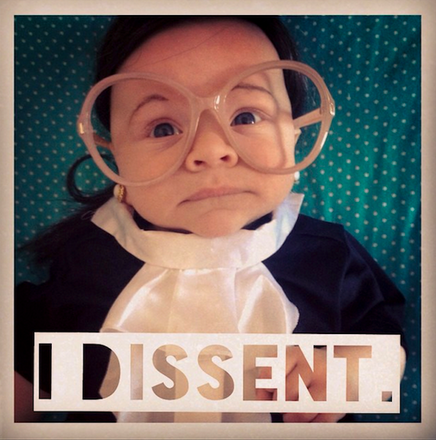
RBG baby

The recent article in the New York Times, “Where Have All the Tomboys Gone?” (which highlights Degeneres’s new GAP line) refers to the term “tomboy” as “retro” and outdated, unnecessary when (of the people interviewed) there’s casual acceptance of girls who don’t want to dress in stereotypically feminine ways and surprise that it would be otherwise (at least in their families). The trend of women adapting “men’s wear” is traced with emphasis that this is a one-way street in the mainstream, i.e. there is never a public trend of men wearing styles designated for women.

“Tomboy” as a phrase might be leaving the American lexicon, but keeping an eye on Halloween costume options is one way to watch levels of crossing and acceptance.  With the awareness that girls adapting into male-designated clothing is always far less objectionable than the reverse, glad as I was to see lists of feminist costume ideas proliferate on the web, I regret that there wasn’t a list for boys or men. While one girl at my son’s preschool chose a male superhero costume (complete with rippling plastic chest), the winks at how “cute” this was, I’m certain, wouldn’t have gone to a boy dressing up as Elsa. Moving beyond just gender, this article, “What Color is Your Princess?” astutely highlights the assumption of whiteness within the princess universe, which is of greater concern to the author than that her son wants to dress up as one at all.

I didn’t know the Onion ventured into video and stumbled on this one from a few years back.  Entitled, “How To Find A Masculine Halloween Costume for Your Effeminate Son” it’s a parody that’s painful to watch as boys who don’t want masculinized costumes are “rehabilitated” into stereotypically “boy costumes” to disguise their features or habits labeled as feminine.  It’s stunning in its spot-on precision about anxiety about boys breaking with male code.

As a yearly barometer, Halloween can offer a quick read of current trends, pop culture, and what gender stereotypes are readily available and which are still transgressive to cross. Yet, studying what commercial retailers and independent outlets do the rest of the year is a far more steady signifier of what change has occurred, and what trend is edging over into expectation.   In a year’s time it will be interesting to see what is (still) considered humorous, provocative, or casually acceptable.  Happy feminist Halloween!



Bucknor is a researcher at the Center for Economic and Policy Research (D.C.)

Here’s what we know: Even with a college degree, young blacks still face lower employment rates and higher unemployment rates than their white counterparts. I’ve shown previously that young blacks are entering and completing college at higher rates than in the past. The third report of my Young Black America series examined the employment and unemployment rates of young blacks and whites from 1979 to 2014, and I made a striking discovery: Employment gaps between blacks and whites have become worse since the onset of the Great Recession. The jobs recovery, apparently, is not colorblind.

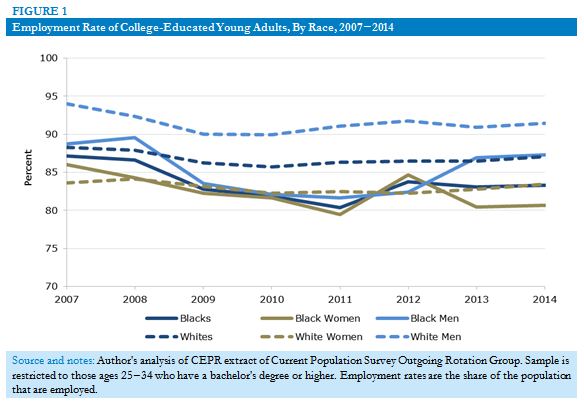
From 1979 until the Great Recession, young blacks with college degrees had employment rates that were basically the same as their white counterparts. However, once the recession hit, employment rates decreased for all – even those with college degrees. At the same time, the gap between blacks and whites widened, with college-educated young blacks being 3.9 percentage points less likely to be employed than their white peers (see Figure 1).

figure 1 bucknor part 3In 2007, 87.2 percent of young blacks with college degrees were employed, and 88.3 percent of their white counterparts were as well. Both rates bottomed out in 2011, with a black employment rate of 80.3 percent and a white employment rate of 86.3 percent. This gap of 6 percentage points for college-educated young blacks and whites represents the largest racial employment gap since 1979.

In 2014, employment rates still hadn’t fully recovered, with young blacks having more ground to make up than whites. During that year, 83.3 percent of young blacks with college degrees were employed, and 87.0 percent of young whites, for a racial employment gap of 3.7 percentage points. Young blacks with college degrees had an employment rate that was still 3.9 percentage points below their pre-recession level. Young whites with college degrees were only 1.3 percentage points below their pre-recession employment level.

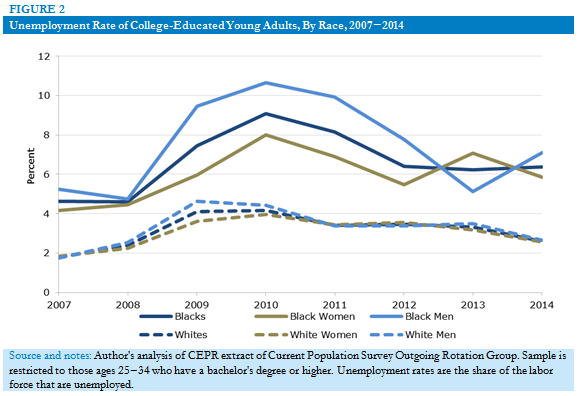
The data on unemployment rates tell a similar story. Even with a college degree, unemployment is a fact of life for many young blacks. In 2007, the unemployment rate of young college-educated blacks was 4.6 percent, 2.8 percentage points above their white counterparts (see Figure 2). Black unemployment peaked in 2010 at 9.1 percent, more than twice the rate of whites (4.2 percent). In 2014, black unemployment dropped to 6.4 percent, still 1.8 percentage points higher than its pre-recession level. Young whites with college degrees had an unemployment rate of 2.6 percent, 0.8 percentage points higher than their unemployment rate in 2007.figure 2 bucknor part 3

Looking at young blacks overall can often mask the different experiences of black men and women. This is certainly true for unemployment rates during the recession and recovery. Black men were hit harder during the recession, and still have higher unemployment rates than black women. In 2007, young black men with college degrees had an unemployment rate of 5.2 percent, and black women had an unemployment rate of 4.2 percent. These rates peaked in 2010 at 10.7 percent and 8.0 percent for black men and women respectively, before falling to 7.1 percent and 5.9 percent in 2014.

By contrast, throughout most of the recession and recovery, white men and women have had virtually identical unemployment rates.

These numbers show that employment and unemployment rates of college-educated young blacks are still far from their pre-recession levels, suggesting that the economic recovery is incomplete. They saw their employment rate drop 6.9 percentage points during the recession, and have only recovered 3.0 percentage points. Their unemployment rate increased 4.5 percentage points, and recovered 2.7 percentage points. Despite the gains in educational attainment that I found in earlier reports in this series, there are still noticeable racial and gender differences in labor market outcomes.

Cherrie Bucknor is a research assistant at the Center for Economic and Policy Research. She is working on a year-long series of reports on Young Black America. Follow her on Twitter @CherrieBucknor.

OctGwP
Photo Credit: Jennifer Rothchild

This month, I bring you a guest post which sheds light on current events, events that literally hit home for me when the Planned Parenthood clinic closest to my university was attacked by arsonists. I welcome back Jennifer Rothchild, Ph.D. Associate professor of Sociology and Coordinator of the Gender, Women, & Sexuality Studies (GWSS) Program at the University of Minnesota, Morris, she is one of the founders of the American Sociological Association’s section on the Sociology of Development. She currently researches gender and development, health, childhoods, and social inequalities by examining the intersections of gender, sexuality, and reproductive health in the United States and abroad.

___________________

“Choose mercy! While there is still time!” A man shouted to me as I walked into a Planned Parenthood office. I couldn’t see him, which made the comment oddly affecting. I kept my eyes forward and pushed through the front door.

More than 20 years ago, my friend Kat had told me about her first trip to Planned Parenthood. As she left that building, a woman standing outside approached her, grabbed her shoulders, and cried, “‘DO YOU KNOW WHAT YOU HAVE JUST DONE? DO YOU KNOW WHAT YOU HAVE DONE?’”

I will turn 45 this February, and yesterday was my first visit to Planned Parenthood. Shame on me: a self-proclaimed activist, and a gender and sexuality scholar. Until now, my privilege had allowed me to get all the women’s health care I needed through medical clinics and private practice physicians. All covered by insurance. But I knew Planned Parenthood was always there, should I ever need their services.

I had a health problem, and this time I chose Planned Parenthood because that is what it is: a health clinic. The woman at Planned Parenthood who booked my appointment warned me: “You should know that this clinic will have protesters. Turn into the parking lot, and a volunteer will help you get by the protesters, and then park.”

There are many misconceptions about Planned Parenthood; here are some facts:

  • Planned Parenthood services include STD/STI (sexually transmitted disease/sexually transmitted infection) testing and treatment for both men and women, cancer screenings, contraception, abortions, and other health services.
  • Abortions make up less than 3% of the services provided by Planned Parenthood.
  • Federal funding for Planned Parenthood is only for Title X: restricted to family planning and STI testing.
  • Planned Parenthood clinics that provide abortion services do not receive any federal funding, even if those particular clinics also provide services that meet Title X criteria.

On a rainy, cold morning, I arrived at Planned Parenthood, and a volunteer waved me into the parking lot. Next to this volunteer stood a protester, holding a sign about texting a certain number before “aborting.” I wondered if these two women talked to each other as they stood together in the rain?

Once inside, I was overwhelmed by a need to express gratitude to everyone I met. I assumed that most Planned Parenthood patients felt same way, if not always vocalizing their sentiments. But I was wrong. My intake nurse told me that just that morning a patient told her, “I hate who you are. I hate what you do. I don’t want to be here, but I need birth control pills.”

Her story made me wonder about the level of denial and disconnect that must be actively maintained to keep those ideas working side by side. In 2012, Frank Bruni wrote in the New York Times about a doctor who performed abortions:

He shared a story about one of the loudest abortion foes he ever encountered, a woman who stood year in and year out on a ladder, so that her head would be above other protesters’ as she shouted ‘murderer’ at him and other doctors and ‘whore’ at every woman who walked into the clinic.

One day she was missing. ‘I thought, ‘I hope she’s O.K.,’ he recalled. He walked into an examining room to find her there. She needed an abortion and had come to him because, she explained, he was a familiar face. After the procedure, she assured him she wasn’t like all those other women: loose, unprincipled.

She told him: ‘I don’t have the money for a baby right now. And my relationship isn’t where it should be.’

‘Nothing like life,’ he responded, ‘to teach you a little more.’

A week later, she was back on her ladder.

That morning, security was at a premium at the Planned Parenthood clinic: a guard stood at the front door, and I needed to show him identification. I was given a name tag that read only “Jennifer.” A few minutes later, “Jennifer R.” was summoned from the waiting room. I wondered how much money could be saved and put to better use if Planned Parenthood didn’t feel compelled by threats and attacks to spend on security measures.

In the waiting room I saw young and old women, white and black and Latina. There were men, too. I couldn’t imagine the individual stories that brought them to Planned Parenthood. But, I might have assumed they all shared was a lack of access and means to the kind of health care that should be their right. According to a 2012 report from the Government Accountability Office, 79% of people receiving services from Planned Parenthood lived at 150% of the federal poverty level or lower (that comes out to around $18,500 per year for a single adult). These people live in vulnerable conditions, where an unplanned pregnancy could result in future burdens, unfair and disproportionate in consequence.

If Planned Parenthood clinics are shut down, we will see not only tremendously diminished reproductive health but also epidemic numbers of unplanned pregnancies and unsafe abortions, as well as greater needs for social services such as WIC. Concerns for women’s health aside, Planned Parenthood delivers mercy upon people who benefit from its services.

The nurse practitioner spent time talking with me, getting to know me. I told her how grateful I was for the work she did. She graciously explained, “I started working here 15 years ago to educate women about their bodies. Women don’t know their bodies.”

Driving out of the parking lot, I stopped and rolled down my window to thank the same volunteer who had stood in the rain when I arrived, waving me into the parking lot. There was now a different protester. This woman was young, white, blonde, and wearing a pink raincoat. She could have been a twenty-something version of me. In her hand, she clutched a brochure limp from the rain. Her sad gaze followed me as I drove away. I wish she saw and knew the things I understood.

I also wish everyone understood that Planned Parenthood volunteers, nurses, and doctors risk their own safety and well-being because women’s health—and women’s lives—hang in the balance. These women and men are standing up and fighting for me, fighting for you.

“Choose mercy.” Yes, we should.