Archive: Jan 2015

legwarmers
My twins

Raising pre-school aged boy/girl twins in a rigidly gender-bifurcated universe where attitudes sloooooowly change is one big gender bender, my friends–I swear. Some days, I get whiplash. Let me show you what I mean.

Last month, the Australian-based initiative called No-Gender December made a valiant stand against the gendered marketing of toys to our children, raising both eyebrows and awareness. I loved it. Huzzah and yay!

But with January comes announcement of the arrival of Heartlake City, a “girl” section of Legoland Florida’s hit theme park scheduled to open this summer. Look at the picture (below, right), and read this post about how the introduction of the girl section (which includes a shopping mall, a convertible where girls can take selfies) implies that all the other sections (dinosaur exploration area, fire station, city streets, pilot school, archeology-themed ride, science area, jousting, playground) are for boys. The creepy tune and lyrics of “Girl Land” from the Free to Be You and Me album come to mind (“you go in a girl, and come out a lady!”). Hiss. Boo.

Heartlake City Legoland
Heartlake City, aka (IMHO) Girl Land

I love Lego, and so do my kids, and I hate that Lego bricks themselves—that once gloriously gender-neutral toy, a Danish toy, for irony’s sake—now have gender.

But the same day I learned about Legoland’s launch of Girl Land, I came across a poster in a coffee shop located on my town’s main drag announcing that come February, About Face Theater is bringing A Kid Like Jake to the Greenhouse Theater Center, along with “weekly post-show discussions around the topics of gender development in children, contemporary parenting and discovering identity for young people.” Huzzah and yay!

Screen shot 2015-01-16 at 5.59.08 PMThis play by Daniel Pearle, an urban drama about an upscale couple annoyingly obsessed with getting their kid into prestigious private kindergarten (the kind that cost an annual $40K), is simultaneously a modern portrayal of a kid with enthusiasms for gender-variant play. The poster I saw in the coffee shop features a little boy, backed turned to the viewer, gazing longingly at a wall onto which a shadow image in the likeness of Disney’s Cinderella is projected at five times his size. “Why can’t a boy be a princess?” the caption reads. Right there on Main Street. Granted, mine’s a progressive town. But I still find cause to celebrate the fact this play, and with it its sweet and beautiful poster, is going around the nation. So I repeat: huzzah and yay!

No Gender December. Girl City. A Kid Like Jake. Yay boo, yay boo, yay.

This whiplash reminds me of a handmade book made by some kid in my elementary school (hello Greeley!) and housed in the school’s library. The book’s title was Fortunately, Unfortunately. On one page, something good would happen to the pint-sized protagonist. (“Fortunately, when I woke up today, Mom made me my favorite pancakes.”) The next page featured the reverse. (“Unfortunately, we were out of syrup, so I had to eat them plain.”) Something delicious would happen, then something annoying would happen that would take that deliciousness away.
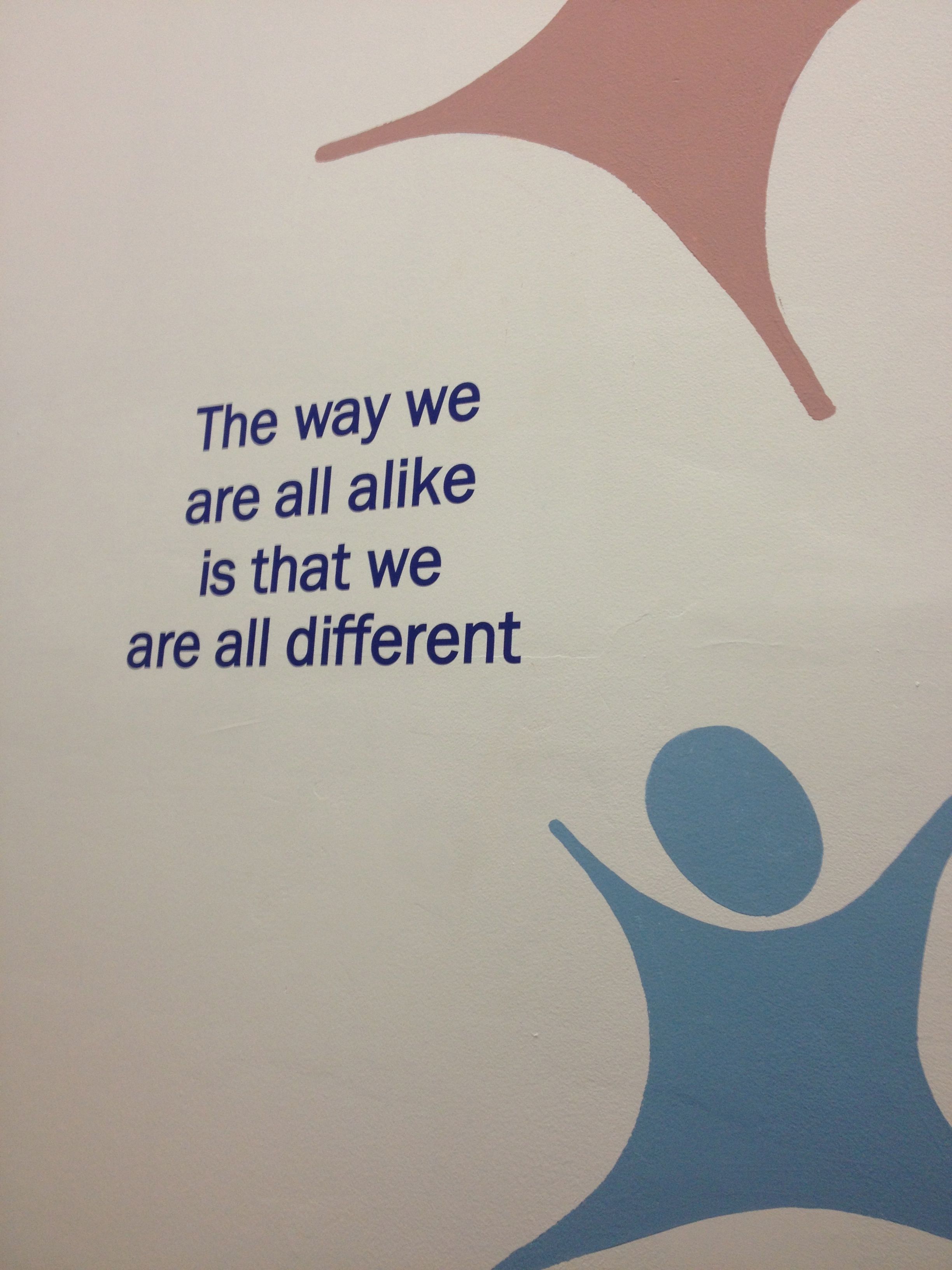
Our preschool rocks

That’s how I feel about our culture’s one-step-forward, two-steps-back slouch toward a world in which a very young boy (like mine, pictured up top) can wear pink and purple legwarmers without bystanders batting an eye. He’s five, and who cares. And fortunately, my two five-year olds go to a remarkable preschool, where messages like this one are plastered on the walls:

Unfortunately, not everyone in our wider community may feel the same way as my preschool community does. Yet.

Fortunately, my daughter does. When my son told his twin sister he was jealous of her new legwarmers, she let him “borrow” them without missing a beat.

Unfortunately, he came home without them on. (Not sure what happened at school – highly likely he just got hot.)

And for one final moment of whiplash, while walking down a main street in town the other day returning to my office, I passed by the new French bakery, with a sign on its door that read “Nous sommes Charlie.”
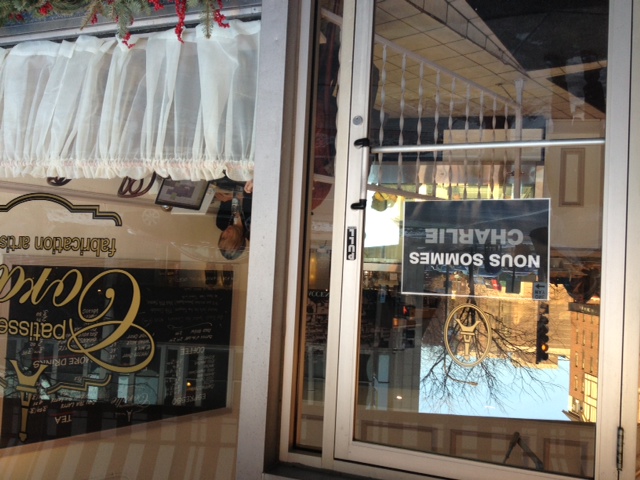
"Nous Sommes Charlie"
“Nous Sommes Charlie”

It broke my heart. And then my spirits rose again.

Because right next door, at an indoor playspace for babies and tots, I saw this:
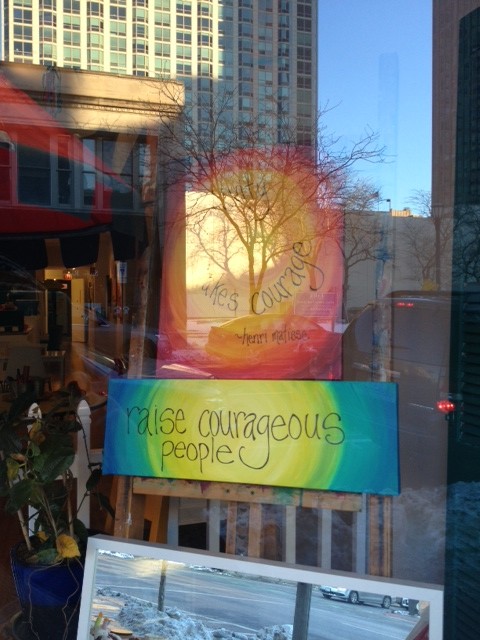
“Raise courageous people”

“Raise courageous people,” the rainbow-colored sign in the window reads. There’s a second sign above the first, with a quote from Matisse: “Creativity takes courage.”

I have a dream, that my two little children–and all our little children–will one day live in a nation where they will not be judged by their anatomy, and what they like to play with, and what they like to wear, but by the content of their character.

Raise courageous people. Raise courage, people.

Though I may have whiplash, I, too, have a dream today.


I invite you to follow me on Twitter @girlmeetsvoice, join my Facebook community, and subscribe to my quarterly newsletter to keep posted on coaching, writings, and talks.
Once again coverage of rape and sexual assault has devolved into a debate over numbers. Discussions of new studies that claim to disprove previous statistics, disagreements about the size of the respondent pool or other aspects of research methodology, the veracity of a particular incident and, of course, the old saw that victims are simply ‘making it up’ crowd the news media.

And no matter how many times researchers explain that many of these comparisons are of the apples-to-oranges variety — that studies vary in the ways they define rape, in what they consider instances of sexual assault, that even relatively small samples can give important clues about attitudes, we continue on the numbers track. Too often prevalence becomes the central issue. The crime itself takes a back seat. As Jennifer Rothchild did here at Girl w/Pen! last month, activists and researchers repeatedly point out that even one rape is one rape too many. These voices seem lost in the news swirl. For many it is easier to debate the extent of the problem than hunker down and take concrete measures to address it. This has been particularly true on many university campuses. A year ago President Obama announced an initiative to address sexual assault on college campuses and by October 2014 over 80 institutions of higher education were under investigation for possible violations of Title IX related to sexual assaults.

The stories of rape victims who have reported their attackers to college authorities and the lack serious consequences these perpetrators faced are astounding. Such responses further victimize the young women–and men–brave enough to speak up. Many survivors leave school rather than run the risk of encountering their rapists on campus. The lesson is obvious. Speaking up is dangerous. Think carefully before you jump from the proverbial fire into the frying pan. It is not surprising that the most recent data from the Bureau of Justice Statistics show that while sexual assault is a serious problem for all women between the ages of 18 and 24, young women attending institutions of higher education are less likely to report sexual assaults than those not in college.

Debates on the prevalence of sexual assault help most when they lead to better data collection efforts. This week I had an opportunity to talk with Jessica Ladd, the founder of Sexual Health Innovations, about procedures to address sexual assaults on campuses. Sexual Health Innovations develops technology to advance sexual health and wellbeing in the US. Their latest effort, Callisto, recently received seed funding from the Google Impact Awards program. Callisto is designed to provide a more transparent, empowering and confidential reporting mechanism for college sexual assault survivors. The website states:

“Callisto allows sexual assault survivors to complete an incident report online, receive a clear explanation of their reporting options, and then either directly submit the report to their chosen authority or save it as a time-stamped record. Survivors saving a record can log back in at any time to officially report their assault or can choose to have their report automatically submitted to the authorities if someone else reports the same assailant.”

The development of Callisto began by listening to the voices of those most involved and affected. The system is based on interviews, focus groups, and surveys with over 50 survivors of campus sexual assaults. Respondents shared their perspectives and the difficulties they experienced in reporting rape. Ladd noted that a critical component of addressing sexual assault adequately is enabling survivors to report their experiences in a timely manner, while also giving them more control and choice in the decision to report as well as in the timing of their reporting. Given the many possible consequences involved in reporting and the traumatic nature of the crime, it is not always a decision that can be made quickly. At the same time, investigators may see waiting to report as a sign of doubt concerning the seriousness and/or the facts of the incident.

A time-stamped, third party sexual assault reporting system such as Callisto provides a confidential record of the attack. Such a report is less likely to be dismissed as a second thought or a reinterpretation of events even if the decision to report is made weeks later. Furthermore, in order for colleges and universities to develop effective policies on sexual assault they must understand the problems on their own campuses. Collecting campus specific information is key.

Better data can foster more effective procedures, but neither data nor policies can ensure redress and justice for students. Ladd points out that Callisto is an aid in the first two steps of what she sees as a five-step process:

  1. Recording and preserving evidence
  2. Reporting the assault
  3. Investigating the incident reported
  4. Adjudicating the case
  5. And finally, reaching a resolution.

Ideally every educational institution would have an advocate available for sexual assault survivors to turn to for confidential information, advice and support. But this advocate would not be responsible for investigating a rape when and if it is reported. Effective support and advocacy require different skills and entail different responsibilities than those of investigation or adjudication. Investigations should be thorough and professional; evidence needs to be considered carefully by administrators who grasp the seriousness of the crime and who are without personal ties to the survivor or the accused. Furthermore, once an investigation is undertaken, a different university staff member may be needed to advise the accused.

These procedures are needed to ensure justice for every student. Institutionalizing them may be complicated. Justice is seldom as simple as we’d like it to be. But fair and just treatment is the only way to assure survivors they will be heard and heeded. The only way to prevent attackers from assuming they will ‘get away’ with no more than a slap on the wrist. Once in place, these five steps can go a long way toward making our nation’s campuses safer for all students.


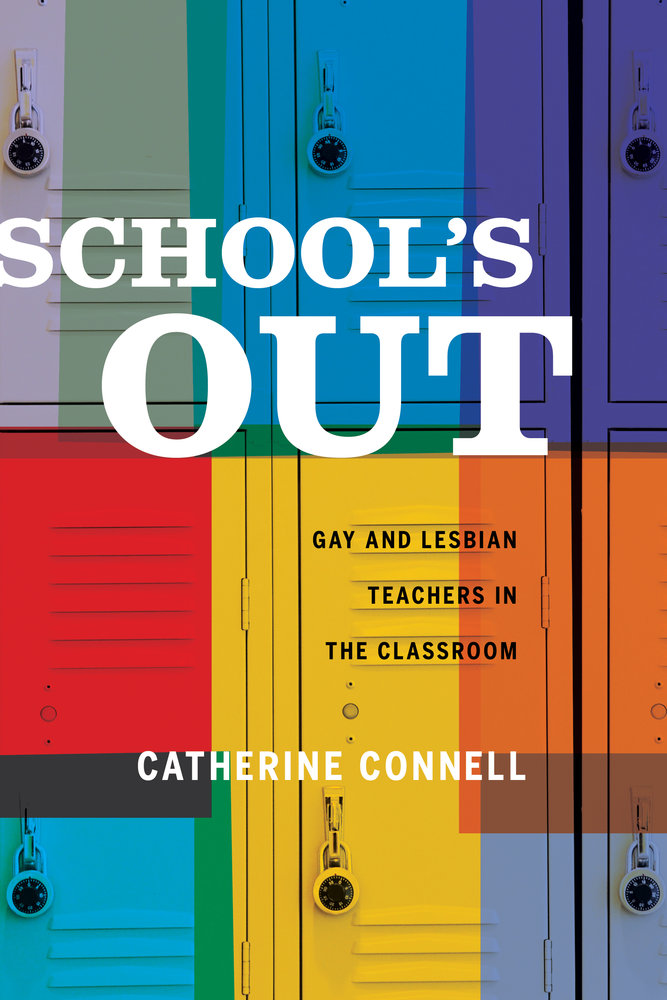
In a recent article in The Atlantic, writer and Teach For America alum Amanda Machado considered the difficulties of being an LGBT teacher in the contemporary US. Machado spoke to a number of teachers who struggle with how, when, or even whether to come out to their students and colleagues. Connell - School's Out (cover image)Their stories closely mirror those of the gay and lesbian teachers I interviewed for my recent book, School’s Out: Gay and Lesbian Teachers in the Classroom. I interviewed 45 gay and lesbian teachers for the project; because I was interested in knowing how context matters for their experiences, about half of the interviews were with teachers in California, a state with multiple legal protections for LGBT teachers, and the other half in Texas, a state with none – LGBT teachers (and all non-federal employees, in fact) can be fired for their sexual identity in the state. In addition to varying the legal context, I also varied school level (elementary, middle, and high school), community (rural, suburban, and urban areas), and school size (small, medium, and large student populations). Across these varied settings, a common theme emerged—gay and lesbian teachers struggle to integrate the dictates of gay pride with the demands of teaching professionalism.
Some would argue that LGBT teachers who come out to students violate the expectations of teaching professionalism by exposing children to unnecessary displays of sexuality. Look no further than the comments on The Atlantic piece for ample evidence of this discourse! Of course, this position neglects the fact that heterosexual teachers put their own sexualities similarly on when they talk about or display pictures of their spouses and children. In the US, teachers have always faced intense levels of moral scrutiny. Gay and lesbian teachers feel even more under the microscope than others. As a result, they struggle with unsupportive administrators and fears of discrimination and harassment, just as Machado describes.

What Machado discusses less directly, however, is the countervailing pressure gay and lesbian teachers feel to live up to the expectations of gay pride. Today, LGBTs are expected to be “out and proud” at all times—this 2013 Huffington Post article by Margaret Cho explains why many feel so strongly about it. While there are compelling reasons to encourage coming out, as Cho enumerates, the insistence that coming out is a political responsibility for LGBTs has its drawbacks. Symbolically, it reinforces very black and white definitions of sexuality—the language of coming out suggests an “always was and always will be” model of sexual or gender identity, which may not be true for all people and limits the possibilities of sexual and gender fluidity. On a more practical level, the dictate to be out ignores the high risks associated with coming out for LGBTs disadvantaged by race, class, ability, health status, and a whole host of other factors. LGBT teachers weighing the costs and benefits of coming out consider much more than the psychological and pedagogical benefits of coming out that Machado describes in addition to the costs of potential discrimination. They must also consider the invisible cost of violating the ethic of gay pride. This added burden puts teachers in a no-win situation, stuck between twin uncompromising expectations of gay pride and teaching professionalism.

The lucky few teachers in my book who were out to their students and maintained a good reputation as educators had a number of characteristics in common—all but one worked in California (where the right to be out is legally protected), they were mostly white and thereby able to avoid the added burden of racial discrimination, and they were all partnered and conventionally gendered, meaning they weren’t easily read as gay or lesbian by their look or comportment. These commonalities point to both institutional and cultural factors that shape LGB teachers’ experiences. First, the fact that only one teacher in Texas in my study was out to his students suggests the power of the legal context to shape LGB teachers’ decisions about whether or not to be out. (Indeed, even that Texas teacher happened to work in one of the few counties in Texas that had local nondiscrimination protections at the time.) The other similarities amongst the out teachers—that they were white, gender normative, and partnered—reveals something troubling about the kind of LGB visibility that is achievable in schools. Just as with coming out, LGB visibility is shaped by pride and professionalism. Not only do schools exert pressure on teachers to meet narrow and normative standards of appearance and comportment, but so does the mainstream gay rights movement. In recent years, there’s been a notable turn toward what scholars call “homonormativity” within the LGBT movement, or the insistence that LGBTs look, act, and live just like their heterosexual counterparts. As a result, teachers who don’t fit the ideal archetype of the LGB teacher face the doubly constraining expectations of the teaching profession and of the LGBT movement.

To promote LGBT visibility for some at the expense of less privileged or normatively presenting others is not the sexual justice I envision for a more equitable future. But given these challenges, how can we get there? First, we need comprehensive, enforceable, and accessible nondiscrimination protections for all LGBTs. Not only were Texas teachers hindered by fears of termination and on-the-job harassment, but many California teachers were too, simply because they didn’t know about or understand the legal protections afforded them by the state! Accordingly, widening that safety net and making sure LGBT workers know about it is an important first step. But that’s just the beginning—the teachers in my study and in Machado’s article also contend with more subtle forms of exclusion and censure, including judgmental expectations of what an “acceptable” gay, lesbian, or bisexual teacher looks, sounds, and acts like—expectations that come not just from the school environment, but from the mainstream gay rights movement as well. Changes in the norms of teaching professionalism and gay pride are necessary to enable sexual justice in schools, for teachers and students alike.

________________________________

C_ConnellCatherine Connell received her PhD in sociology from the University of Texas Austin in 2010 and is currently an Assistant Professor of Sociology at Boston University. Her research focuses on the intersections of gender, sexuality, and work and occupations. She is the author of School’s Out: Gay and Lesbian Teachers in the Classroom (UC Press) and is currently beginning a research project on the legacy of Don’t Ask Don’t Tell within the US military.