Archive: Nov 2014

As Deborah Siegel points on in her latest post here at Girl w/Pen, there’s an abundance of not very helpful ‘noise’ in the media these days about feminists and feminism. My vote for the most unhelpful contribution to a serious discussion of feminist goals is last week’s inclusion of ‘feminist’ in Time magazine’s 2015 annual online poll “Which Word Should Be Banished”.

Reaction to the poll was swift. Time quickly apologized in the wake of protests from groups and individuals proud to identify with the rich history and ongoing work of feminists. (see a few examples here, here and here) Time also published a thoughtful, powerful essay by Robin Morgan, “Feminism is a 21st Century Word”. Morgan discussed the history and definition of feminism, noting the simplicity of the dictionary wording: “the theory of the political, economic, and social equality of the sexes.”

Time’s apology for the inclusion of ‘feminist’ in their poll included the following statement, “While we meant to invite debate about some ways the word was used this year, that nuance was lost, and we regret that its inclusion has become a distraction from the important debate over equality and justice.”

So, end of kerfuffle, on to the next news cycle, right?   Not so fast. Aside from the fact that Time apologized but didn’t actually remove ‘feminist’ from the list, anyone who thinks the episode was an isolated, unimportant case of poor judgment runs the risk of engaging in wishful thinking. The poll “…meant to invite debate about the ways the word was used this year” did nothing of the sort. Yes, it was an opportunity for feminists to speak clearly and publicly about the legacy and the work of feminists. But reasoned debate that included those outside the feminist community? Not so much. Rather, the poll provided a revealing glimpse of the depth of misogyny embedded in our culture.  Too many still think it’s fine to denigrate women and to dismiss objections to the trivialization of  ‘feminist’ as ‘humorless’, or angry man hating, or the knee jerk reactions of rigid ideologues.

I’m disheartened that the experienced journalists at Time were unable to foresee the impact of their word choice. But, then again, power can be a blindfold. The inclusion of ‘feminist’ among trivial phrases such as “ I can’t even’, and ‘sorry not sorry’ and words like ‘kale’ and ‘influencer’ fostered ridicule rather than thoughtful debate. The list was a perfect opportunity for those who troll the Internet with snarky remarks about anyone who is not a white heterosexual male. The ones who attempt to disguise hatred as humor and fool no one.

And yes, I know, I get it, this is the tone of many discussions these days: take no prisoners, relentlessly ridicule anyone you disagree with, and never allow data or conflicting evidence to creep into a viewpoint. In such an environment, the idea that feminism is not women against men, but a complex belief in the equality of women and men is lost. Those in the ‘be sure, hang tough, any disagreement is a personal attack’ crowd rarely see the worth of a discussion in which various perspectives are heard, viewpoints are expanded and mutual learning takes place. Forgetting the full range of responses generated by the poll  and what they reveal about our current cultural divides is dangerous.

My father liked to quote “sticks and stones may break your bones, but names will never hurt you” in advising his children to ignore the teasing of friends. I’m not so sure. Words can hurt. Either/or dialogue kills discussion, shuts off communication, amplifies disagreement, and obscures commonalities. Without thoughtful dialogue, dialogue that includes respect for differing perspectives and experiences as well as a tolerance for ambiguity, I fear we will never achieve the just and equitable world so many of us envision.
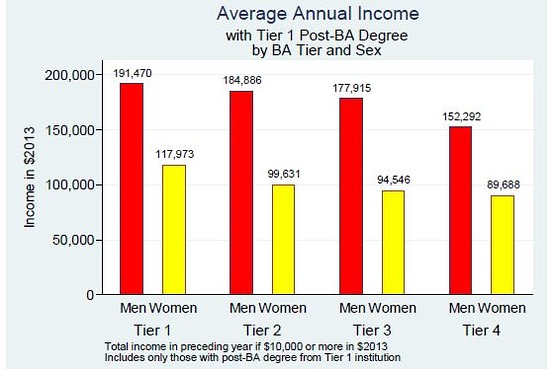


Here’s a graph, courtesy of the Wall Street Journal.this picture

The story the WSJ tells is about the descending steps of income for post-BA degree recipients by “tier” of the institution from which they graduated. The tier captures how elite the institution is considered. This article by Joni Hersch at Vanderbilt is the basis of the article.

Follow the red bars (for men) across from left to right, as the WSJ suggests, and you see inequality. Follow the yellow bars (for women) across from left to right and you see the same pattern of inequality. What makes the higher tier graduates “worth more”? The discussion of it asks us to consider that the value added might not pertain to explicit “merit,” but rather other kinds of cultural “merit” that produce those distinctions. Stuff like where your parents vacationed or what your taste in wine is. This is an important topic of examination.

Meanwhile, the red and yellow bars within each tier demonstrate a whopping gender gap. And that gap is left unremarked. When we look at a graph like this without putting this larger gender inequality up front, we inure people to categorical inequalities, and it makes it easier for readers to persist in seeing such inequalities as natural. Which is, by the way, the root of inequality. Seeing it as natural.

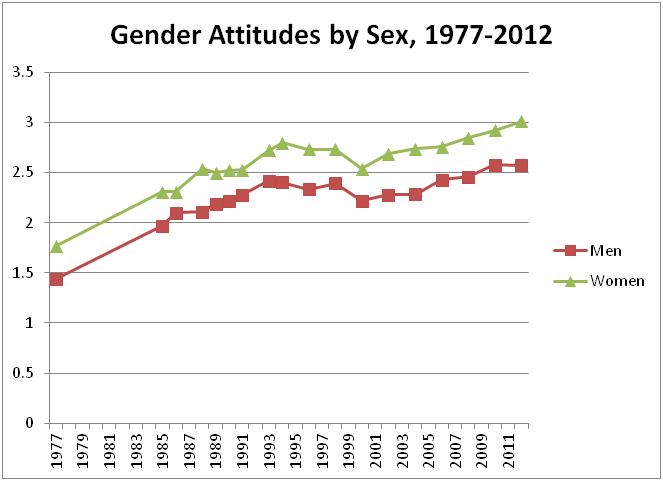
gender attitudes by sex
from Cotter et al. 8/5/2014 at The Society Pages.

It reminds me of this graph from a recent briefing report about an end to the stall in progressive gender attitudes. What I see is that there’s no convergence. The gap persists. And that isn’t natural.

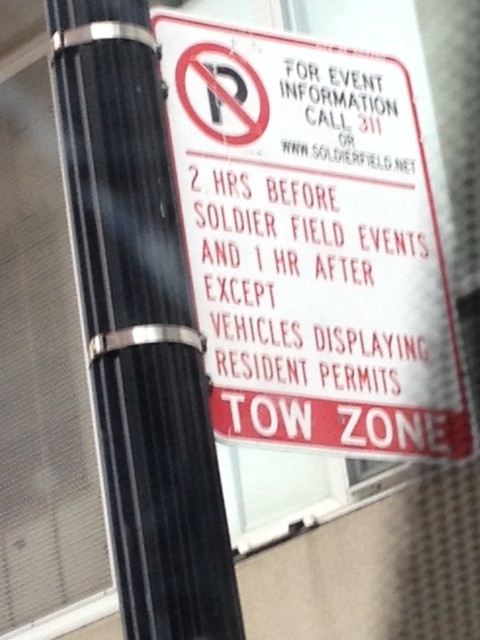
Screen shot 2014-11-16 at 10.55.11 PMHere I sit contemplating equality, the topic of a panel I’m on tomorrow, surrounded by jubilant Bears fans streaming out from Soldier Field. My partner and twins are busy visiting penguins, dolphins, and whales, while I’m illegally parked, waiting in my car. Who else but a non-jock family (and recent Midwest transplants) would head for the Shedd Aquarium on a day when the Bears were playing on home turf next door? For my New York friends, this is equivalent to shopping at Macy’s during the Thanksgiving Day Parade, hoping for a place to park.photo

Pondering the question, “Is what you do about equality, liberation, or both?” in such an atmosphere feels a bit like being teleported to the 50 yard line and declaring to the crowd, “Which way to the fish?”

And in truth, that’s also what it feels like to be concerned about women’s “equal” or even “equitable” representation on the page, in the media, or online at a moment when the media conversation about women is focused on whether Lena Dunham is a child molester, whether Kim Kardashian is a feminist icon, and whether the word “feminist” itself should be banned. The noise from the crowd threatens to drown out everything else.

And yet. I’ve been caught up with the question of women’s representation for a few decades, and with the question of women’s “equal” representation on the page now for a while, through my work with two initiatives—one focused, for starters, on changing the gender ratio of bylines at the world’s opinion forums (The OpEd Project) and the other on disrupting publishing by creating supportive community and, later, “a third way” (She Writes / She Writes Press). Tomorrow’s panel is asking me to interrogate, with precision, what all that effort means.

So allow me, while Bears fans leap over my car and my family enjoys the fish, to think about these and some related ventures together, and out loud.

The OpEd Project (founded in 2008), She Writes (2009), and VIDA, also known as Women in Literary Arts (2009), emerged in the wake of the creation of the Women’s Media Center (2005), an organization that “makes women visible and powerful in the media” and works with the media “to ensure that women’s stories are told and women’s voices are heard,” and in the wake of the earlier Women in Media and News (2001). All these initiatives assume that, in VIDA’s phrasing, “voices change worldviews, and those voices should be multiple and varied.” My OpEd Project sisters and I, in the words of our mission statement and our founder Katie Orenstein, “envision a world in which the best ideas—regardless of where or whom they come from—will have a chance to be heard and shape society and the world.” Kamy Wicoff and I, in our She Writes credo, believe in “empower[ing] and amplify[ing] the voices of women and girls who have not otherwise have been heard” and “in building a platform upon which all of us can stand.”

How do these ventures seek to accomplish these goals? They “increase critical attention to contemporary women’s writing” and “further transparency around gender equality issues in contemporary literary culture” (VIDA). They protest the omission of women’s writing from the pages of career-making journals (VIDA) and from the front-door forums that feed other expressions of thought leadership, punditry, and public influence (OEP). They forge relationships with editors and media institutions that share the mission of changing who narrates the world (OEP). They disrupt the very system they believe excludes women (and others more traditionally without ‘connections’) by creating an alternative press (SWP, led by Kamy and the indomitable Brooke Warner).

And in this multi-faceted fight for women’s share and shaping of public voice, what constitutes a quest for equality and what constitutes a quest for liberation? Feel free to share thoughts here, if you have them.  Join us* at Roosevelt University tomorrow, if in Chicago, and tune in later to an NPR station (I’ll post the link here in this space) for more.

*Fellow panelists are:

Jill S. Tietjen, President, Board of the National Women’s Hall of Fame; Author “HerStory: A Timeline of Women who Changed America,” electrical engineer and CEO of Technically Speaking; Inductee of Colorado Women’s Hall of Fame

Carol Adams, PhD, President and CEO, DuSable Museum of African American History; Ebony Magazine’s “Power 100,” Crain’s “2012 List,” the Illinois Arts Council Governor’s Award in the Arts, and the Outstanding Humanitarian Award from the NAACP

Cecilia A. Conrad, PhD, Vice-President, MacArthur Fellows Program; chairs the Congressionally mandated Committee on Equal Opportunities in Sciences and Engineering, an advisory committee to the National Science Foundation; Author “African Americans in the U.S. Economy”

Marjorie Jolles, PhD, Associate Professor and Acting Director, Women’s and Gender Studies, Roosevelt University, Author “Fashion Talks: Undressing the Power of Style”

Moderator: Betty M. Bayer, PhD, Senior Fellow, The Martin Marty Center, University of Chicago; Professor, Women’s Studies, Hobart and William Smith Colleges

Co-sponsored by Roosevelt University, Hobart and William Smith Colleges, Illinois Institute of Technology, Shimer College

PS. Go Bears!


I invite you to follow me on Facebook and Twitter, subscribe to my occasional newsletter to keep posted, and come visit me at www.deborahsiegelphd.com


I remember thinking to myself when I first came out, “Thank God I don’t have to deal with women like straight men do.” Identifying as a gay man meant I could hold on to the aspects of relationships with women that I enjoy and not have to “deal with the rest.” I admit this is quite shameful for me to say so publicly. However, the more I pay attention, the more I realize how easy it is to be sexist as a gay man. I learned from Madonna that I knew what it felt like for a girl (here). Or so I thought. Because I had experienced homophobia at a young age and realized that being gay was a threat to manhood, I thought I understood sexism. It turns out, I understood more about homophobia and masculinity than sexism.

My simultaneous dismissing of and identification with women exemplifies what Jane Ward calls “queer sexism”. Because some gay men have been denied aspects of male privilege does not mean they don’t still have male privilege, or that they are free of masculine expectations and hang-ups. This type of thinking “obscures the ways that gay men, like heterosexual men, have the privilege of making agentic choices about whether to support or reject feminism, whether to listen to or ignore women, whether or not to leave the party when women arrive, and what to say to the men who do.” (here: 158-9).

Gay men’s well-intentioned yet lopsided relationship with straight women has received a lot of attention in the last few years. Interestingly, they commonly argue for straight women to change their thinking and behavior in order to accommodate gay men. For example, this post (here) on the gay guy/straight girl contract reminds straight women that gay men “don’t want to go shopping” with you; that we are fine with “giving sex tips” but not hearing about your “lady business” (vagina); that “your boyfriend drama bores us”; that you shouldn’t come to our clubs; and that “you are not a gay man in a women’s body.”

Why is it easier to recognize when a straight man reinforces sexism than when a gay man does it? This becomes even further complicated considering that gay men have different experiences of race, gender expression, class status, culture, and regional identity where the enforcement and ideals of masculinity and femininity vary dramatically for people in different contexts. As a well-mannered Cuban-Mexican-American man, with a very proud Mom, I thought I stood for women and anti-sexism. But as my confession exposes, I wasn’t really fighting for women; I was fighting for acceptance of homosexuality and men’s diverse gender expressions. I now understand that sexism and homophobia are different things.

Consider a conversation I had with Thomas, from San Francisco. He told me he had few female friends and that they “are like gay men in a woman’s body.” (It’s a well-worn trope; think of Mila Kunis’ recent claim about “being a gay guy trapped in a women’s body.”) Thomas explained that these women are empowered because they have adopted a form of toughness that keep them from accepting the “bullshit” in the world by standing up for themselves. Thomas made it clear that he has no interest in being friends with women weren’t like “gay men trapped in women’s bodies.”

To illustrate his point, he told me about his co-worker, Jane. “Jane likes to touch men, be aggressive, and do whatever she wants at work.” This sort of aggressive, boundary-crossing behavior led to her termination. Though Thomas found her termination to be unjust, more importantly he was disappointed in her for not fighting her termination. “I cannot stand women like that. In fact, I want nothing to do with women who don’t stand up for themselves, especially when it’s because of discrimination [in his opinion]. I only keep women around who ‘get it’ and don’t take bullshit.” For Thomas, Jane fell short of the gay-man-trapped-in-a-woman’s-body standard. She wasn’t changing for “the better” because she didn’t fully adopt a “gay man’s” “I don’t give a shit” mentality.

For Thomas, “Women have to choose to be liberated in order to deal with the ‘bullshit’ of the world” (sexism). And while he was also dealing with “bullshit” (homophobia) it was clear that he didn’t understand the distinction. For Thomas, it is a women’s “successful detachment” from patriarchal confinements that make her worthy of his friendship. In other words, if a woman could adopt a gay man’s perspective, defined and approved by gay men, then she’s living the way a woman “should.” However, this mentality seems, to be little more than doing what one wants and not having to deal with complaints (a luxury of male privilege). So, while some women are highly empowered and praised for being a “gay man trapped in a women’s body,” those who do not are excluded labeled as women who just “don’t get it.”

Thomas’ struggles with women are part of queer sexism. His story highlights one way some gay men feel license to define and hold women accountable for what is and what is not “right for women.” While it has the superficial vestiges of a progressive and empowering stance on women, Thomas’ assertions are consistent with what Ward calls “queer sexism”—a veiled form of patriarchy that privileges gay men’s ideas of how women should behave and based off how gay men experience oppression.

In order to avoid queer versions of sexism, gay men must be more aware of the power imbalances in their relationships with women, and think critically about the expectations they do and do not have of women. Gay men must be more in touch with how our gay all male contexts often makes women seem invisible or irrelevant to our lives. Fighting for an anti-sexist culture requires more than just fighting for a non-homophobic one.

___________________

A_LopezAndres Lazaro Lopez is a Ph.D. student in the Department of Sociology at Iowa State University in Ames, IA. His research exames the intersections of race and gender in work and culture from a pro-feminist perspective. @alazarolopez