Archive: Aug 2009

Are people really having less sex? Well, at the very least, it looks like they are having less sex outside of their committed relationships, according to a new study written up in Scientific American. But it also looks like people may be making up for having less sex outside of committed relationships by talking about it more. And that is good news for sex.

First the news: In each category surveyed—gay, lesbian, straight—people report fewer affairs now than in the 1970s. Everybody has changed in terms of monogamy: gay men do it (where do it means doing non-monogamy) 59% now versus 82% in the 1970s. Nowadays, straight men do it less—14%. Meanwhile, 13% of straight women and 8% of lesbians do it. As we keep seeing again and again in recent surveys on monogamy, women—lesbian and straight—still report fewer affairs than their male counterparts, but they are catching up with the boys, as UW psychologist David Atkins has shown. On the one hand, affairs overall may be on the decline because of STDS and the like; on the other hand, women may be catching up because they have greater autonomy and economic independence.

That is all interesting, but this is also potentially good news for wild, free-for-all sex. The investigators from Alliant International University in San Francisco showed that over the same period people have also increased how much they talk to their partners about the idea of sex outside of their relationship. (What’s happening in those conversations, report these psychologists, is that they are talking about outside liaisons, and deciding against them.)

But the other discovery here is about the talking. Increasingly, this study hints, people are talking about the notion of sex outside their relationship–talking about forbidden, off-the-approved-roster sex with someone who isn’t an official or legal sweetheart–even if in the end they decide against it. Conversations like that—no matter what the outcome—mean that more and more people are acknowledging, countenancing, and admitting that they and their partners are completely capable of having sexual fantasies about someone other than their official one. We all know that being in a committed relationship doesn’t change our brain structure and doesn’t stop a great, diverse sexual imagination about all manner of things, people, and situations. But when people don’t talk about it, they have to tell one another lies, and pretend like their fantasies don’t exist.

So, maybe people are saying no to the reality of sex with their hot new colleague, but if they are saying yes to a conversation about it with their partner, it might mean that those partners will be better at dreaming up their own edgier, more interesting sex. And, by the way, in a world where women have greater sexual freedom to have affairs, they also have greater freedom to acknowledge desire and have conversations about it that can lead to fewer affairs.

-Virginia Rutter

Somewhere within my past year’s reading the book Maiden USA: Girl Icons Come of Age by Kathleen Sweeney came into my orbit.  It seemed ideal as I traced the history of girls onscreen, on television, and within other forms of media.  Yet I wish I could give Sweeney’s book a more enthusiastic thumbs up.  Listed as a “media artist and writer” Sweeney has taught at various colleges and been active in media training programs for girls.  Her book began as a “curatorial project of films and videos by teenage girls entitled ‘Reel Girls/Real Girls'” which premiered in San Francisco.

Sweeney casts a wide net and she ranges from exploration of the Riot Grrrl movement to a chapter called “Mean Girls in Ophelia Land” which tracks the rise and fall of the “mean girl” movement within popular writing as well as on screen.  She correctly identifies that for the most part the Teenage Girl, (as she capitalizes it) was a “passive helping noun linked to Daddies, Brothers, and Boyfriends,” until certain cultural zeitgeists began to shift. As cultural interest in girls gathered momentum, the growth of what Sweeney names a Girl Icon has grown.  Sweeney is right on point when she chases this emergence through the past almost 20 years.

The book moves at a fast clip – her quick categorizations of Neo-Lolitas, Career Girls, Geek Girls, Cyber Chicks, as well as Supernatural Girls, Amazons, and Brainiacs, among other labels, often struck me as too glib.  Her most intriguing point is what now defines an Icon in contemporary culture, as well as her reinsciption of the term into the word “Eye-con.”  Sweeney calls an “Eye-con” an “image scam that must be navigated and brought to awareness by analyzing and naming its syntax,” not unlike a stereotype.  Eye-cons do their most damaging work, she says, when viewers are unconscious of their influence.  Within the pantheon of the “Eye-con” is the “Girl-con” she says, which are “Icons of girlhood which posit girls as inevitable Victims.”  Examples are “anorexic adolescent models selling a form of starvation beauty.” Media literacy demands that viewers name the Girl-con and then look beyond to alternative role models as Sweeney says she wants to consider Girl Power Icons for the new millennium against a “backdrop of current and retro Girl Iconography.”  Her writing about visual representation and even semiotics is at its strongest when she is doing this kind of analysis.

Yet, while impressive in scope, the book’s very breadth also serves as its limitation as depth is sacrificed for a sweeping survey of the cultural landscape. Sweeney’s enthusiasm for her subject is most strongly felt when she describes her first-hand work with girls.  Her final chapter “Girls Make Movies: Out of the Mirror and Through the Lens” was the most intriguing to me.  Sweeney’s passion as an activist comes out as she describes some of the current programs working with girls to advocate media literacy and develop their skills.  She mentions Reel Grrls in Seattle, Wash., and GirlsFilmSchool in Santa Fe, N.M., among others.  The book’s list of resources is also wonderfully thorough. I suspect undergraduate students would enjoy having this book assigned for its abundance of popular culture references, generous use of chapter subheads and discrete categorizations.

By contrast, another book I came across during my research was Mary Celeste Kearney’s Girls Make Media which became indispensible to me for both its range and its depth.  Kearney is an academic, now tenured at UT-Austin and the book’s research is admirable.  Neatly divided into three sections “Contexts,” “Sites,” and “Texts” Kearney also traces girls’ historical participation with media.  She delves into girls’ entry into the web, also the impact of the Riot Grrrls, zine culture as well as independent filmmaking.  Her focus on what happens when girls take over media production is what makes this book compelling.  At the same time, she contextualizes the institutionalized practices that have keep girls from participating fully.

Particularly exposing is the deeply entrenched sexism in the field of filmmaking (the idea that cameras are too heavy for female techs to lug and “peer networks” or “structures of acquaintanceship” that boys use covertly, but effectively, advance their ambitions and deny girls access).  Kearney’s cataloging is vast and its impact is felt as she reveals just how much girls who make media have to say.  She includes writing about the need for single-sex media education but steps beyond it to show what girls really do when they’re given access to media tools.  Their work often centers around exploration of identity and re-inscription of messages about gender roles that crack open a universe of deeply felt and powerfully smart dialogues about what most girls experience but hadn’t yet had a place to express.

Some of the titles Kearney includes tell a whole story: films such as Taizet Hernandez’s “Are You a Boy or a Girl?” which explores “real-life gender-bending of a young female” or Hernandez’s film “We Love Our Lesbian Daughters,” which explores coming out experiences and Kearney says offers “A rare glimpse into the lives of queer young Latinas” but focuses on sexual identity over ethnic identity.  She groups films about sexual abuse such as “Love Shouldn’t Hurt” by Tamara Garcia or “It’s Never OK” by Arielle Davis, and includes a cache of films about the ubiquitous doll such as in Lillian Ripley’s “What if Barbie Had a Voice?” Just a fraction of other titles include: “Looks Like a Girl” which “broadens young lesbian representations beyond white, Anglo culture,” and “Body Image” by Mieko Krell, meant to “raise awareness about girls’ different relations to and strategies for negotiating dominant beauty standards.”

When exploring girls’ zines Kearney includes telling excerpts as this one from “Bikini Kill: A Color and Activity Book” about why female youth should enact social change: “To discuss in both literal and artistic ways those issues that’re really important to girls: naming these issues, specifically, validates their importance and other girls’ interest in them; reminds girls that they aren’t alone.  To make fun of and thus disrupt the powers that be.”  Even a smattering of the zine titles reads like a found poem: The Bad Girl Club, Bi-Girl World, Lezzie Smut, The Adventures of Baby Dyke, Geek the Girl, Angry Young Woman, Pretty in Punk, Housewife Turned Assassin, Angst Girl, Pixxiebitch, Ladies Homewrecking Journal, From the Pen of a Liberated Woman. The book’s website is also a wonderful resource as the power of the girls’ voices can be felt shouting through the distance.

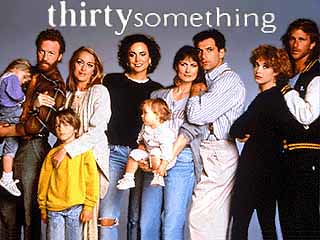
Girl With Pen’s newest Guest Blog comes to you from the awesome Therese Shechter, documentary filmmaker of I Was a Teenage Feminist and The American Virgin. Here, Therese susses out the sexism in the retro TV fave, thirtysomething.

Was thirtysomething anti-feminist propaganda?

There’s been a recent outpouring of hype now that thirtysomething‘s first season is finally out on DVD. If you missed it, the show was an hour-long drama following the lives of a baby boomer-clique living in late-1980s Philadelphia. The show was so popular it even spawned a pithy new suffix of its own. (Twentysomething, fortysomething . . . You get the picture.)

I loved the show because it reflected my own life at the time as a young single career gal surrounded by married and breeding friends. (This was pre-history before Sex and the City). But the mirror it held up to me was warped and disturbing in a way I just couldn’t put my finger on … until I read Susan Faludi’s critique of the show in her 1991 book Backlash:

In ‘thirtysomething,’ a complete pantheon of backlash women is on display–from blissful homebound mother to neurotic spinster to ball-busting single career woman. The show even takes a direct shot at the women’s movement: the most unsympathetic character is a feminist.

Bingo. Through interviews and production materials, Faludi created an astonishing portrait of a show filled with a weirdly aggressive sexist agenda. For example, scripts were specifically written to make wife-and-mom Hope fail at any outside work she ever tried. Repeatedly — and laden with guilt — Hope returned back to husband, home, and child. And lest this plotline seem accidental, it was the clear intention of writer Liberty Godshall (wife of co-creator Edward Zwick) to urge women to stay home while their children were very young:

I wanted to tell women don’t try it–unless, one, you really need to, or you really really want to. Because while the successes are there, the failures and the guilt are there too.

Ironically, Mel Harris, the actress playing Hope, was back at work 9 months after having her real-life baby, stating that she felt she was a “better mother and better person” because she worked. Female viewers told market researchers that they wanted Hope to get a “real” job. The creators disagreed. Faludi quotes co-creator Marshall Herskovitz in a men’s magazine interview about his distress over the women’s movement:

I think this is a terrible time to be a man, maybe the worst time in history … Men come into the world with certain biological imperatives. Manhood has simply been devalued in recent years and doesn’t carry much weight anymore.

Although everyone on the show was miserable some of the time (my friends and I called it “thirtysuffering”) the single women got the worst of it. Melissa wasn’t given any backstory at all until actress Melanie Mayron created a photography career for her character. She was described simply as “man-hungry.” Faludi quotes Mayron as saying:

I remember that message of just because you’re a single woman you must be miserable. That’s not like me or any of my friends.

Career gal Ellyn was also a bitter caricature whose character development was helped only somewhat by the lobbying of actress Polly Draper. She recalls her audition where producers described Ellyn as:

the kind of person who was so irritating you would walk out of the room whenever she walked in. And they wanted her to worship Hope and want to be exactly like her. And I said, ‘Wait a minute, can’t she be okay in her own right?’

Apparently not. She was single and career-oriented, so who could ever love her? In fact, writer Liberty Godshall had considered making her a drug abuser but settled for a simple bleeding ulcer and being dumped by her boyfriend.

Gary, the lone single guy had a decidedly different arc, happily running through women without a neuroses in the world. In season two, he meets the feminist character Susannah. Faludi describes her as:

a social activist who works full-time in a community service center in the city’s ghetto, tending to homeless men and battered wives. Despite her selfless work, the show manages to portray her as inhumanly cold, a rigid and snarling ideologue with no friends.

After Gary gets her pregnant, she’s determined to get an abortion,

But then, at the clinic, she hears the biological clock ringing. “I’ve always put things off,” she confesses to Gary, tearily. “I just can’t make assumptions about the future anymore.” He is triumphant, and she has the baby.

After almost 20 years, I’ll probably find the show lame, with its late-1980s fashions and weirdly sexist messages about how I should live my life. Sad to think I ate it up back then — even with its sour after-taste.

Postscript:
Melissa Silverstein at Women & Hollywood wrote a excellent piece about the several talented women that came out of thirtysomething (although none quite achieved the same level of success as the men) and noted that Zwick and Herskovitz went on to create the groundbreaking yet short-lived series My So-Called Life. I loved that show and especially Claire Danes in the starring role. But I remember wondering about the characterization of her mother: A totally unpleasant and uptight career woman who spent most of her time verbally castrating her nice-guy husband. Now it all makes sense.

About the Author:

Therese Shechter is a filmmaker, writer and activist whose documentary I Was A Teenage Feminist is probably screening in a women’s studies class near you. She’s currently making a documentary about society’s attitudes towards virginity and writes the blog The American Virgin on the same subject. Her production company Trixie Films is based in Brooklyn. You can find Therese’s work on Twitter, Facebook, YouTube, and more Facebook.
As we celebrated Women’s Equality Day* yesterday, we want to talk about one of the most enduring signs of the gender equality gap — the differences in how men and women spend their time on an everyday basis. Many of you have probably heard of the term the “double-shift” when talking about women’s work outside and inside the home, and anecdotally, we all have examples (“I came home from a 12 hour work day and had to pick up his socks.” Or “After work I had to pick up the kids, clean the house, and cook dinner.”) The recently released American time use survey proves what we’ve known all along: women bear the burden of household work.

A couple of snippets:
• At 5:10 pm, 17% of women are doing household activities – 11% of men are.
• At 7:40 am, 11% of women are doing household activities – 6 % of men are.

Really, do check out the link – they’ve done a cool interactive chart where you can compare time use according to age, gender, race, employment, educational attainment, and size of household. Categories vary from “household activities” to “eating and drinking” to (our favorite!) “relaxing and thinking”. The only downside to the chart is that you cannot compare by multiple qualities – for example, are black women doing more household activities than white women at 5:10? Then black men? What about black single mothers? And Hispanic women over 65? (You get the picture.)

Internationally, feminist economists have been arguing for the inclusion of household work into overall GDP estimates – where traditionally, the bulk of women’s work was uncounted, as it did not take place within the marketplace. For the past few years, the United Nations Development Fund has been tracking Gender, work, and time allocation in its Human Development Report. Although only 33 countries reported on time allocation in 2007, the results are nonetheless interesting – globally women aren’t faring that much better in balancing free time and personal care and family care.

Even the “wunderkind” countries of Northern Europe women seem to be putting more time into the children and the chores then men. In Norway, while women and men spent approximately equal amount of time on themselves, women spent more time cooking and cleaning (2:14) than their male counterparts (0:52). Women also spent double the time (34 mins) that men (17 mins) did on childcare.

In Nicaragua, a moderately developed country where interestingly even the one country where women and men have relatively equal free time women, women are the primary caregivers for the children (1:01 hours compared to the 17 mins men spent with the kids), the cooks and cleaners (3:31 hours to 0:31 mins) and less likely to be involved in market activities 28% to men’s 74%.

It is no surprise that the least developed countries have the widest disparities with regards to time. Women in Benin spend much more time (8:03 hrs) on market and non-market activities combined than men (5:36 hrs). Beninese women don’t have much time for themselves (1:32hrs) their children (45 mins) or their household chores (2:49 hrs) and yet they still spend more time on everything, except themselves, than their men. I’m exhausted just blogging about it.

Virginia Woolf spoke of the need of one’s own room and time (and of course money) when writing fiction. And truly, all of these things are needed for most successes. Who knows how much more the world could gain from women if more men got more involved in activities beyond the market? There are signs that times are changing, however: although recent studies do not indicate more equality in household chores, they do point to a shift in younger men’s (Gen X) attitudes and behaviors around fathering. Looks like we are one step closer to taking ALL work activities seriously, whether inside the market or out. And that’s what we call equality.

* Don’t miss the National Council for Research on Women’s tribute to Women’s Equality Day on their blog, The Real Deal. (Full disclosure: both Tonni and I have posts up! We did them in our personal time.)

Catblogging, because I couldn’t resist: Here’s Tula, settling into her favorite nook in our new home… (And props to Virginia for the coining of Tula’s new nickname.)
This here post comes straight from dear friend of GWP and mine, and fellow writer, Daphne Uviller — who I’ve been writing about of late, here and here! –Deborah

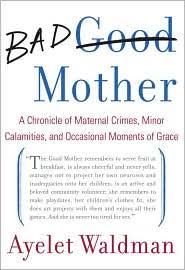
I visited Debbie the other day to try to help her nest a bit, and she gave me two books, one of which was Ayelet Waldman’s Bad Mother: A Chronicle of Maternal Crimes, Minor Calamities, and Occasional Moments of Grace, which she said was a little too much for her (meaning Debbie) at this point.  I agree — it’s not a book that should be read while pregnant, but later, while struggling with what it means to be a good mother or even, as I often do, how to get back to even wanting to be a good mother.

I read the whole book in one sitting and while I disliked a few parts, I admire Waldman for her honesty — I consider myself a very honest writer, but she goes where I hadn’t dared — and her talent and her insight.

Here’s what I took away from it:

1) Men MUST be equal partners, not just pay lip service. Okay, that’s old news, but never bad to be reminded.
2) Men do not worry about being good or bad fathers, they just are what they are. We should follow their example. This is wrapped up in the whole idea of observing, of living in the moment rather than judging and worrying. More old news, but still, good to hear.
3) I’m glad I don’t live in Berkeley.
4) I kind of wished I lived in Berkeley.
5) Part-time work that you love is the answer to the work/life balance conundrum. (She doesn’t state this explicitly, but confirms what I already figured out.  We writers, money permitting, have it made.)
6) I think I’d like to try going on Celexa.

And the chapter on her abortion between her second and third child (she has four) made me weep. It is powerful, powerful stuff.

-Daphne Uviller

For Grandma Marge (may her memory be for a blessing)

Ok, it’s time for me to admit it: I’m getting scared. In less than 10 weeks (knock wood, pu pu pu – sorry can’t help it), my body will somehow, with whatever degree of medical intervention, bear forth two new beings whose well-being will henceforth depend, in very large part, on me. I confess to my husband, my closest friends, and my mother than I’m getting nervous. They offer comfort, try to allay my fears:

“Of course you’re scared. It’s scary.” –Daphne (mother of two)

“You’re focused on the first few weeks. I was too. But three months in, everything changes, and you don’t even remember that blur.” – Rebecca (mother of two)

“Too late now!” – Mom (mother of me)

Gee thanks, Mom.

Again, I must qualify. I feel blessed beyond belief at the bounty of having conceived not just one but two babies, twenty-first century techno style. I marvel at the way things have gone so far. In spite of bouts of stress (a layoff, a move, the start of a new company), these babies have grown the requisite parts. They’ve passed all their tests, independent of the fact that their maternal host has sometimes felt like a chicken without a head. They are of me, but they are not me—a lifelong lesson I’m sure, something they are already teaching me, something I am not yet wholly convinced of but want and need to believe.

My father, a psychiatrist, gets wind that I’m having a minor, belated freak out. He calls from the road 700 miles away to remind me I’m not alone. “It takes a village, Deb, and a village you will have.”

And he’s right. When the babies arrive, my mother will come for a month, and my father will join her when he can. Rebecca will come for a week or so, all the way from California. The twins I grew up with, Molly and Busy, will each come from Chicago for a few days. Courtney will be across the park. Daphne will be nearby, as will myriad others. And then, of course, there’s Marco, my sweet attentive artistic Marco (author of the “2” on my belly in the above photo), who can’t wait to hang our twins’ art on the walls and take them to see Star Wars and play them Superman’s theme. We just don’t know yet, given his new position, the extent to which he will be able to be at home, in the beginning, with me.

But come what may, I will not be alone. It’s my new mantra, and I’m trying to buy it. It’s just that my experience of pregnancy, this experience of being so embodied, has been oddly isolating. I’m a social person who stops pregnant women on the street and cries “solidarity!”, and yet there have been many times when I’ve felt alone, as in existentially, in my discomfort and angst. Locked in, with no escape. I’ve tried hard not to crawl too far into that dark hole—I have a small history of depression—and I’ve been successful at keeping healthy and busy. But every so often, that feeling of aloneless (is it just a fear?) creeps in.

A village you will have.

And I will.  The last village elder, however, is gone, and I’ve been missing her a lot of late.  My Grandma Marge passed away a year ago today. Grandma was a certified nurse—head of the department in her day—and used to bring great comfort whenever I was sick. Pregnancy is not illness, and yet its symptoms have been physically challenging, reminiscent of times I’ve felt ill. Grandma Marge made it our wedding last year, but she died before the technology worked its magic. How she would kvelled and basked in our news, enabled by money that I, her only grandchild, inherited from her. And how I would have loved to have shared the blessing of these babies with her.

If I can write it, maybe I can will it: these are our babies. They are not mine alone. I will be their mommy. But they will have a daddy, and grandparents, and aunts and uncles and cousins and friends, and if I believed, departed great-grandparents watching over them from somewhere. (On top of it all, I recently joined the notorious Park Slope Parents listserv. Never again will I worry about anything child-related alone!)

I am not alone, I am not alone, and yet…I am. It’s my body that’s primarily responsible, and that seems both a miraculous blessing and a bit of a curse. In spite of my feminism, I’ve internalized wholesale the cultural mandate that the buck stops with Mom. Because let’s face it, in reality, so often it does. How desperately, already, I find myself wanting to rewrite that script. But is it feminism, or existentialism, that I’m grappling with here? I’d love your thoughts.

Linda Lowen, About.com’s Women’s Issues blogger, wrote a fabulous write-up of SHE WRITES on Friday and I just wanted to share.

SHE WRITES: The Site for Women Writers

(Thank you Linda! You are the best!)

If you liked Veronica’s excellent Science Grrl post on the gender wage gap, make sure you read Inside Higher Ed’s article , “Hiring Women as Full Professors.” Per IHE‘s Scott Jaschik, University of Texas/Austin released a self study on gender equity last fall, and, by gosh, they used the data to shape their subsequent hiring this spring, and hired more women than they ever have in the past.

The UT report showed gender gaps across the board–hiring, salary, retention, time to promotion and tenure–but the biggest gap was among full professors: After controlling for a lot of stuff, they found that among full professors, men’s starting salaries were on average $12, 229 higher than women’s. Moreover, only 19% of full profs were women. (Sounds like a case of “this food’s so bad and there’s not enough of it!”) The typical response to the wider gap at the top–seen across the country and across professions–has been, jeepers ya’ll this is a problem, but I guess we’ll just have to wait. This takes time!

But UT said, uh, why wait? As Jaschik reports:

“Randy Diehl, dean of liberal arts, said it was important for universities not to simply wait for junior professors to rise through the ranks. He said that the presence of women in the senior ranks is part of what you need to encourage younger women, and that there are issues of bias if an institution doesn’t add women as full professors. Diehl noted, for example, that the highest salaries for full professors go to those who didn’t come up through the ranks, but who were recruited from one institution to another. Universities that rely on gradual promotion from within will not see a narrowing of average faculty salaries between men and women, he said.”

Read the article. Their hires look fantastic. And the dean’s logic: Goes for minority hiring and promotion too, right? (Thanks to Paul Rutter for the heads up!)

-Virginia Rutter

It was recently pointed out to me by my dear observant friend Daphne that when talking about this pregnancy with her, I haven’t once said anything about the fact that there will soon be two new little beings around here (knock on wood) and that I will be their mother. I think the reason for my reticence lies snug inside those two parentheses: knock wood.

I am not, in general, a superstitious person. My grandmother, an orthodox Jew who would have been 100 last week had she lived just two more years, believed in the evil eye. Before getting pregnant, I neither knocked on wood nor spat three times (the Jewish equivalent) when mentioning a hope or a dream. And yet I’ve been a bundle of superstitious tentativeness when it comes to talking about the life forms I’m gestating as real people who will one day exist outside.

Why?

My mother, a therapist, says it’s obvious: “Self-protection, honey,” says she. And it’s true. I’m of advanced maternal age and I’m carrying twins, which automatically throws me into categorical high alert. But I’ve been carrying this unfathomably wondrous primordial soup in my uterus now for almost 27 weeks, and all has unfolded, so far, according to plan. When, I wonder, will I allow myself to hope, to dream, out loud?

I have never, ever wanted something this much. Well, that’s not completely true. I wanted a husband, and then, when the first one didn’t work out so well, I wanted another. I wanted a book contract, and later a second and a third. I achieved those things. I’ve been blessed (if you believe in that sort of thing), and I’ve worked hard to realize my desires. But with pregnancy, it feels different. We did everything in the book—and then some—to get to this point, but from here on in, it’s pretty much out of our hands.

The universe is encouraging, helping gently to push me along. Last week Daphne sent me an envelope in the mail with a note scrawled on the outside: “the first of many hand-me-downs from me!” Inside were two little sets of newborn-sized socks. The gear amasses. My mother-in-law sent baby shoes. A friend from childhood, herself a twin, gave me two matching onesies with images of the Dr. Seuss creatures, “Thing 1” and “Thing 2.” My aunt corralled a gently used double stroller from her physical therapist. My cousin has offered me her breast pump. Soon it will be time to get the babies’ room, currently full of boxes from our recent move, in shape for its forthcoming residents. I’ve been calling it “the second bedroom.” I can barely even say “babies’ room.”

Don’t get me wrong—I’m moved beyond language at the thought that there will be babies. When I see newborns on the street, I choke up. Just thinking about those teeny socks makes me cry. It’s just that somewhere between the concept “babies” and the reality “my babies,” or rather, “our babies,” my thoughts get lost in translation. Lost in gestation, maybe.  (Have any of you, I bet, I hope, felt this way?!)

For now, it’s easier to think of these inexplicable creatures that rumble in my belly as my own private primordial entourage. They’re in there doing their thing, and I’m out here doing mine. I wonder if I should be talking to them more. I try to get my husband to put his mouth near my belly and sing. But we both have trouble, it seems, relating to them as people who can connect to us as “Mom” and “Dad.” It will be different, I know, when we’re all out here living on the same side.

For now, they’ll remain a mystery. They’re abstract to me, but I can’t wait for them to become concrete. Yesterday my friend Kathy suggested I write them a letter. And maybe I will. This is how it might start:

Dear Baby Things (1&2),
Keep cooking. I’m here for you, waiting. You may be my entourage, but I’m your number one fan.
Love,
Your Mama-to-be