My latest Love in the Time of Layoff column is now up at Recessionwire.com. It’s titled “Back to Work”. Marco is freelancing again! Househusband, interrupted indeed. I’m happy, but I’m mixed…
Archive: Aug 2009
Donna Bobbitt-Zeher, a sociologist at Ohio State University, set the world a buzz when word got out of her research on the wage gap over a twenty year span:
The good news for women is that during the time period studied, their average salary increased from 78 cents for every male dollar earned to 83 cents. But when Bobbitt-Zeher controlled for various factors, she found that the share of that gap attributable to selection of major had increased…When controlling for all available factors, [she] found that the choice of major explained 19 percent of the income gap between college-educated men and women for the high school class of 1999, nearly twice as much of an impact as could be documented for the class that graduated 20 years earlier. (emphasis mine)
This wasn’t a shock to me as it was something that many of us who work to increase the number of women in science and engineering already suspected. So when Kate Harding from Salon Broadsheet emailed me for a response I wanted to make sure that people know that it’s not just as simple as English versus Chemistry. “Harder,” male-dominated science and engineering fields, such as computer science, are paid more than female-dominated biological sciences, a “softer” science.
The real question that this wage gap research leads us to is whether or not the increase of women in a career leads to lower wages or not. In 2006, Paula England et al appear (I admit, I only read the abstract) to prove that there is no direct correlation between the increase in women entering a field and the lowering of that field’s wages. But a gendered wage gap is there. England showed it and now Bobbitt-Zeher shows it.
The AAUW also showed this wage gap difference based on major earned 2005 in their “Public Perceptions of the Pay Gap” report, but with a twist:
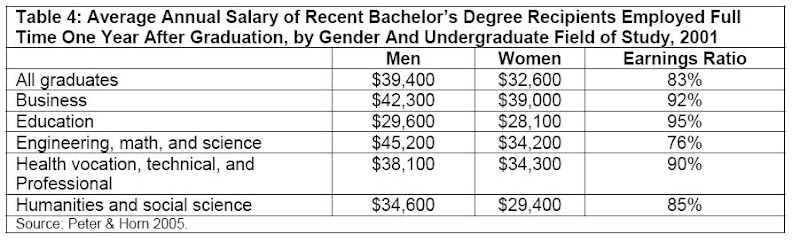
Ironically, the biggest wage gap is in science and engineering! But even with a 24% gap, women are still earning more than almost any other career field. *shaking head*
So what does this all mean?
There isn’t one reason for the wage gap. We can’t wave it away with one explanation (women’s choices) or correct it with one solution, even comparable work legislation.
For me there is an economic justice reason for women to look to science and engineering for a career. Wage gap or not, they will be earning more money. For women who have a gift for math and science and find joy in the work, go for it. But I would never say do it for the money.
Is it gender? Is it how much society respects the vocation? Is it unionization (teachers have smallest gap)?
Again, further research is needed. But whatever it is, women are getting the short end of the pay stick and all of these numbers are about the average man compared to the average woman. I can only imagine what the gap looks like for people of color!
I am so heartened by the comments on my post from last week, “Blogging Pregnancy…or Not.” Thank you, from my heart. I just responded, in comments, more individually, but I wanted to give a group shout out from here too.
You seriously have made my day. It’s been a busy few days with SheWrites.com, but I’m planning on getting back here and writing more VERY soon!
In the meantime, look what I just made — you can make one too:
Visit She Writes

This month, The Man Files brings you Jessica Pauline — a writer and feminist with experience working in some of the dicey-er Los Angeles strip clubs. Lots of ink has been spilled on the sex worker debates. Are women oppressed by sex work? Liberated? Both? How is trafficking distinct from, say, dancing one’s way through law school? In this entry, Jessica leaves those debates for another day and instead turns a keen eye to her observations of the men who make it rain. (—verb: to throw wads of cash in the air for dancers to retrieve as tips.)
Like Jane Goodall and her chimps, I spent a good deal of time during my tenure as a stripper in some of L.A.’s seediest nightclubs observing the behavior of the primates. Not the dancers, mind you — the men who came to watch them.
Based on my humble observations, I came to discover that certain behaviors are both predictable and categorical, and that most hetero men, when confronted with a pair of boobs in a semi-public setting, fall into a few choice archetypes.
Let’s start with what I imagine to be the most common breed of American strip club patron: white, middle-aged men who golf and vote Republican. They swagger in to the club with an air of ownership, their masculinity stuffed into their wallets and tucked neatly into their pressed khaki pants. Observing the dancers with the same level of detached interest that one might imagine they’d use in selecting a prime rib-eye, they pick a girl, begin to talk to her in their most sensual voice while rubbing her back and her leg, and shortly thereafter are ushered back to the VIP room with very little to-do. This is the kind of easy sell around which strip clubs were designed, and for that reason, we’ll call this breed Strip Club Men (SCM).
Now, strip clubs have been around long enough for a type of strip club rebellion to brew amongst men. So imagine, if you will, if the SCM had a son. This son desires nothing more than to be the antithesis to his stuffy, conservative father, and so he becomes sensitive, wears ironic t-shirts to demonstrate the fact that he doesn’t take himself too seriously, and quite possibly sports artistic, sentimental facial hair. Let’s call this breed Feminist Men (FM).
When forced into a strip club, maybe because of a bachelor party, or maybe in search of a place to talk quietly on a Tuesday night, the FM immediately seeks to set himself apart. Rather than sexualize the dancers, he opens with a nice conversation, carefully keeping his eyes above the neck. But as the FM gets less and less guarded, a strange thing begins to happen. He becomes more willing to let his eyes wander down. His friendly conversation becomes more imbued with sexual innuendo. And finally, often after spending copious amounts of money on what he has come to believe is a “real connection,†he tries to get the dancer to go on a date with him. (This, as an aside, is both insulting and never going to happen.)
The final subcategory of men falls deeper into FM territory, and warrants mention simply because of the unique validation that they seek. They’re easy to recognize, because no sooner does some indie chick start swaying her hips to Tom Waits, the King of Melancholy himself, then the Tom Waits Man (TWM) begins nodding in recognition. Before long, he’s dug a crumpled dollar bill out of his pocket and walked up to the stage where he will deposit it, but not until he’s made sure that the dancer sees him so he can compliment her taste to her face and thereby secure his place as profound, mysterious and, of course, different.
Maybe you’ll read this and think that I oversimplify. But since the most honest interaction in sex work is based on a respectful, fun partaking of the service provided, it can’t hurt for men to examine their own behavior with at least as much gusto as I examined it (don’t worry, I took some long, hard looks at myself, too). Without that, gentlemen, you are really just entertainment.
Jessica Pauline is a freelance writer in Los Angeles. An NYU graduate with a degree in music, her writing appears regularly on LAist.com, and has appeared in $pread Magazine, The Printed Blog, the Ventura County Star, and a number of other websites and local papers. She is currently working on a book about her experiences as a feminist stripper, and lives in Silver Lake with her fiance and their dog, Molly.
 I’ve been so busy during this pregnancy either a) puking or b) helping start a social networking site and company that I haven’t found time to write much–or even journal about–the bizarro incredible experience that is pregnancy itself.
Part of me has feared that “pregnant women are smug”, and pregnant women writing about pregnancy are the smuggest of them all. In other words, to say anything in public is to risk falling in with the sanctimonious mommy crowd. Perhaps this fear has something to do with the fact that one of the only times I pregnancy blogged these past few months, over at Recessionwire, I got flamed. (Thin skin anyone? I blame the hormones. Thankfully, the editors took the really nasty ones down.) Of course, it probably didn’t help that I gave that post a sanctimonious title, “The Fortune Within”, though in my defense, I used that title because I had wanted to contrast the way I felt about this much-tried-for pregnancy with the major theme I’d been writing about over there–love in the time of layoff, my lack of fortune without. But apparently some commentors felt that any woman who writes about pregnancy is, well, smug.
So here I am trying again, after recent promptings from friends, therapists, and even my business partner. Why not write about pregnancy, these people ask me, when it’s so foremost on your mind?
Whenever I try to kick myself into writing gear, I start reading again. I realized the only two pregnancy/motherhood-related books I’d read during this pregnancy so far had clinical titles like The Mayo Clinic Guide to a Healthy Pregnancy, and Twins!: Pregnancy, Birth, and the First Year of Life. The first had been given to me by my husband, the second by my husband’s mother. When I gave myself permission to go one step deeper, I had reached for Amy Tiemann’s Mojo Mom: Nurturing Your Self While Raising a Family and Amy Richards’ Opting In: Having a Child Without Losing Yourself . These books helped me feel it was possible to have a kid (two, in my case) and still have a professional life. (THANK YOU, brilliant Amys!) But they didn’t inspire me to write about what I was going through myself.
So the other week, I turned to memoir. Thanks to the “Motherhood Books” group that Jennifer Niesslein formed over at SHE WRITES, I remembered I’d always wanted to read Anne Lamott’s Operating Instructions: A Journal of My Son’s First Year, when the time came. That time, apparently, is now. Anne Lamott is so quirky, so brutally and painfully honest about the horrible things as well as the beauty, that I got inspired. She’s the opposite of smug. And she makes it seem ok to want to tell the truth–which for me, has not been all shiny and baby blue and powder pink. For me, the truth of twin pregnancy at age 40 has so far been about trying to balance physical ailments of striking (yet normal, apparently) proportions with an intense struggle to slow my life down enough to make room for an impending reality for which I feel massively ill-prepared.
And so here I sit, at 5:00am with pregnancy insomnia, tiny miracles kicking around inside me, writing about writing about pregnancy. I don’t think I’m quite writing about it yet, but hey, it’s a start.
(Does this picture make me look smug?!)
 I’m way excited to introduce GWP readers to a new regular blogger, Leslie Heywood. On a personal level, I’m thrilled to have Leslie on board because she was the one who first kicked my ass into gear when I expressed a desire during graduate school to write nonacademically. She made it ok. Better yet, she published me. (Leslie, with Jennifer Drake, edited one of the very first third wave feminist anthologies, Third Wave Agenda: Being Feminist, Doing Feminism
 , and I will be forever grateful to her for encouraging me down the road I am currently on!) So please join me in a warm welcome to prolific author, scholar extraordinaire, athlete,, mother of two, Leslie Heywood! Leslie’s monthly column, Gender Specs, will bring you the latest on gender analysis in evolutionary psychology and other sciences. Here’s her debut post – enjoy, and let us know what you think. -Deborah
After years of working on third wave feminism and women in sport, I got very interested in, even passionate about evolutionary approaches to language, culture, the body, and gender. From a gender perspective, however, the field is sometimes not a pretty place. It still tends to be dominated by a core set of assumptions based in a particular kind of Evolutionary Psychology (EP). It’s enough to send a good feminist screaming in the other direction away from any kind of evolutionary perspective–and in fact it often does.
But there are things about an evolutionary perspective I find very compelling, just not those things associated with this particular brand of EP. So I was very excited when a Newsweek article came out that voiced some of my concerns. On June 20, 2009, senior editor Sharon Begley wrote a feature article, “Why Do We Rape, Kill, and Sleep Around?â€, that articulates some of the main issues and problems inEP. Although is not representative of all work done in evolutionary studies, EP has nonetheless received a disproportionate share of media attention, perhaps because of the number of hoary gender chestnuts it claims to support “scientificallyâ€.
While many insiders will point out that Begley misrepresents the field of behavioral ecology, and some less reactionary forms of evolutionary psychology (see evolutionary biologist David Sloan Wilson), she questions some of the biggies that still stand in some circles, including these:
1.that rape is an adaptive strategy, because it allows men to spread their genes around more (an adaptation is anything that contributes to the evolutionary baseline of survival and reproduction)
2. that men will abuse their stepchildren because their stepchildren don’t have their genes
3. and, my personal favorite—in terms of mate choice, women prefer older men with resources, men prefer young, fertile women with no brains. Or whose brains are irrelevant to their aim, which is reproducing their genes.
It all comes down to the question of gender difference. Are there innate gender differences based in biology? Is there a “mothering instinctâ€? Do fathers want less to do with their children than mothers? Are there “male brains†and “female brainsâ€? Do men only want much younger women whose looks signal fertility, the much-cited waist-to-hip ratio of 0.7? Do women only want older men with resources? All of these assumptions make me shudder. All of these assumptions are contradicted by my experience, and though I might be an “outlier,” I think those who don’t fall smack in the middle of the Bell Curve are still important to the overall analysis about “men” and “women.”
I have never wanted an older man with resources: I wanted to make the money myself, and I prefer someone younger, and hot. I never wanted to “mother†in the sense of being the primary caretaker (although I did want children, and have them), vastly preferring the provider role, and think many men make just as effective primary caretakers as women. It’s a personality thing, and like everything else about gender, I think where a given individual falls on the spectrum occurs on a continuum between the stereotypes of femininity and masculinity. Some women make better providers, some men make better caretakers, and if the statistical aggregate tends to clump around the stereotypes, does that make everyone on the spectrum who doesn’t clump there—a large amount of people overall—mere (in the language of statistics) outliers, “noise†that ignored by the data’s interpreters?
This is an important question, because according to the U.S. Bureau of Labor Statistics, a third of working women in the United States earn more money than their husbands, and that number is increasing: 32.4 percent in 2003, up from 23.7 percent in 1987. Given that families are more and more reliant on two incomes, and that women now have more education, this upward trend should continue. According to the most recent U.S. census data, young women are more likely than men to have graduated from high school and have a college-level education, especially at the level of bachelor’s and master’s degrees. Men still get more PhDs, but the number of PhDs relative to the overall population is what a statistician would call “noise.†(In 2003, for instance, slightly more than 40,000 people in the U.S. earned a doctorate, far less than one percent of the population). But more than thirty percent of the population—women whom ostensibly chose men as life partners who make less than they do—is not statistically insignificant.
So what are some of the EP assumptions, more specifically, that I think are a problem given these statistics? These are the accounts that tend to explain all social phenomena through reference to particularly gendered aspects of physical morphology, the forms of living organisms. Perhaps the most widespread and influential is that expressed by Robert Trivers’ parental investment model (1972), which argues that there is a differential investment in parenting between sexes because of the relative reproductive investments or costs each sex makes or incurs. Human females, who face higher levels of parental investment because they have roughly 400 eggs/chances to ovulate/reproduce over the course of their lifetimes versus the virtually unlimited number of sperm and chances men have, incur much higher reproductive costs and are therefore much more “choosy†or “restrained†when making decisions about with whom they will mate. Stereotypes regarding female passivity and male activity, anyone?
Therefore, this theory claims, there is gender-differentiated mating behavior in terms of the kind of characteristics each sex seeks in long-term mates, which is where my hackles most rise. Given the asymmetry in parental investment of the two sexes, females prefer older men with economic resources for long-term mates, whereas men prefer younger women who exhibit the signs of maximum fertility and health, signs linked to things like youth, breast size, waist-to-hip ratio, neotonous features such as big eyes and full lips. As evolutionary consumption researcher Gad Saad puts it, “two universal and robust findings are that men place a greater premium on youth and beauty whereas women place greater importance on social status and ability to acquire, retain, and share resources. The reason for this pervasive sex difference is that mating preferences cater to sex-specific evolutionary problems†(The Evolutionary Bases of Consumption, 63).
Oh, those sex-specifics. They will get you into trouble every time. What do we do with gender difference if it leads us to this particular place? What different accounts of difference might we raise?
-Leslie Heywood
Adina Nack, Ph.D is the author of Damaged Goods? Women Living with Sexually Incurable STDs (Temple University Press) and her articles have been reprinted in more than a dozen edited volumes. She is an Associate Professor of Sociology at California Lutheran University where she enjoys teaching courses on sexuality, medical sociology, deviance, and pop culture. We’re pleased to have her here again at GWP! – Deborah
I read Naomi’s Wolf’s book The Beauty Myth when it was first published in 1991. As an undergrad growing into my own version of a third-wave feminist identity in beauty-centric southern California, her words rang so true. If knowledge is power, then I and other feminists were certain that soon the tide would turn — girls and women would stop buying into this myth, stop buying magazines that promoted body-loathing, and we would rebel against unrealistic and unhealthy social norms.
Sadly, it’s 18 years later, and her message still resonates with undergrad women (and men) today. As a professor, I had the privilege of meeting Naomi when she came to speak at my campus, California Lutheran University, to talk about the “Beauty Myth” As you watch this clip of her new DVD, I encourage you to ask yourself (1) How many girls and women do I know who believe in this myth? (2) Which corporations are profiting from their misery, and (3) What am I doing to reject the myth and help others reject it?
Personally, I think make-up/hair products/push-up bras are okay as long as you don’t feel like you cannot leave the house without them — costumes can be fun as long as you love and accept yourself when you are ‘un-costumed.’ Eating healthy and moderate exercise are good goals, as long as your self-image and self-worth are not defined by your weight/size. For this post, I won’t weigh in on cosmetic surgery…that’s a whole post unto itself. But, as the mom of a 5-year-old daughter, I make sure to never criticize my appearance in front of her (though, I’m still working on not being critical in my own head), and I aim to de-emphasize physical beauty as a value in my interactions with her. Here’s wishing that Wolf’s The Beauty Myth will strike future generations of college students as truly mythical – outdated, outlandish, and out of touch with their generation…
LOL!
1. National Health Plan=Good for Small Businesses and Self Employment.
2. Small Businesses and Self Employment=Good for Women.
3. You do the math.
Allow me to explain:
Old news: The U.S. hasn’t been able to muster the will to get real health care reform, but we are leaders in entrepreneurship and small businesses. We have that going for us.
New news: Oops. The U.S. has one of the lowest rates of self-employment and small businesses of any comparable rich economy, per a report from the Center for Economic and Policy Research. Check out “An International Comparison of Small Business Employment.”
![]()
“Conservatives and liberals see small business as a way for women to get ahead in the economy. It offers flexible employment–and takes away the glass ceiling because you are your own boss,” comments the report’s lead author and CEPR Senior Economist John Schmitt. “But the numbers on U.S. small business and self employment suggest that the U.S. lags far behind European counterparts.”
Uh, health care issue? The CEPR report explains that one big obvious reason for this surprising weakness might be our lack of availability of health insurance. As Schmitt and co-author Nathan Lane explain, “The undersized U.S. small business sector is consistent with the view that high health care costs discourage small business formation, since start-ups in other countries can tap into government-funded health care systems.”
So, for example, those considering their own business, women with pre-existing conditions or women of childbearing age can have a lot of trouble getting health insurance. Though insurance companies can’t treat pregnancy as a pre-existing condition, the loopholes make the situation look like gruyere cheese. I’m sure GWP readers have a story or two to tell.
All roads lead to health care reform. This is #87 of the 46 million reasons why Americans really do want health care reform. By really do, I mean, 72% of Americans (polled by NYTimes/CBS) support a public option. It gets framed as like “Medicare for All”–and there’s a bill in Congress to support it. Want to do something? Tell your member of Congress about the CEPR’s small business research. And tell your member of Congress that Medicare for All (H.R. 676) is a no-brainer.
 Here we go again, in the New York Times. And this time, they did it smartly, by asking a bunch of kick-ass female thinkers to talk about what the research shows about the differences between women and men as managers. Participants in the forum are:
Alice Eagly, Northwestern University
Leora Tanenbaum, author of “Catfightâ€
Joanna Barsh, McKinsey and Company
Susan Pinker, psychologist and columnist
Gary N. Powell, University of Connecticut
Sharon Meers, former managing director at Goldman Sachs
Do check it out. What do you think?
Donna Bobbitt-Zeher, a sociologist at Ohio State University, set the world a buzz when word got out of her research on the wage gap over a twenty year span:
The good news for women is that during the time period studied, their average salary increased from 78 cents for every male dollar earned to 83 cents. But when Bobbitt-Zeher controlled for various factors, she found that the share of that gap attributable to selection of major had increased…When controlling for all available factors, [she] found that the choice of major explained 19 percent of the income gap between college-educated men and women for the high school class of 1999, nearly twice as much of an impact as could be documented for the class that graduated 20 years earlier. (emphasis mine)
This wasn’t a shock to me as it was something that many of us who work to increase the number of women in science and engineering already suspected. So when Kate Harding from Salon Broadsheet emailed me for a response I wanted to make sure that people know that it’s not just as simple as English versus Chemistry. “Harder,” male-dominated science and engineering fields, such as computer science, are paid more than female-dominated biological sciences, a “softer” science.
The real question that this wage gap research leads us to is whether or not the increase of women in a career leads to lower wages or not. In 2006, Paula England et al appear (I admit, I only read the abstract) to prove that there is no direct correlation between the increase in women entering a field and the lowering of that field’s wages. But a gendered wage gap is there. England showed it and now Bobbitt-Zeher shows it.
The AAUW also showed this wage gap difference based on major earned 2005 in their “Public Perceptions of the Pay Gap” report, but with a twist:
Ironically, the biggest wage gap is in science and engineering! But even with a 24% gap, women are still earning more than almost any other career field. *shaking head*
So what does this all mean?
There isn’t one reason for the wage gap. We can’t wave it away with one explanation (women’s choices) or correct it with one solution, even comparable work legislation.
For me there is an economic justice reason for women to look to science and engineering for a career. Wage gap or not, they will be earning more money. For women who have a gift for math and science and find joy in the work, go for it. But I would never say do it for the money.
Is it gender? Is it how much society respects the vocation? Is it unionization (teachers have smallest gap)?
Again, further research is needed. But whatever it is, women are getting the short end of the pay stick and all of these numbers are about the average man compared to the average woman. I can only imagine what the gap looks like for people of color!
I am so heartened by the comments on my post from last week, “Blogging Pregnancy…or Not.” Thank you, from my heart. I just responded, in comments, more individually, but I wanted to give a group shout out from here too.
You seriously have made my day. It’s been a busy few days with SheWrites.com, but I’m planning on getting back here and writing more VERY soon!
In the meantime, look what I just made — you can make one too:
Visit She Writes
This month, The Man Files brings you Jessica Pauline — a writer and feminist with experience working in some of the dicey-er Los Angeles strip clubs. Lots of ink has been spilled on the sex worker debates. Are women oppressed by sex work? Liberated? Both? How is trafficking distinct from, say, dancing one’s way through law school? In this entry, Jessica leaves those debates for another day and instead turns a keen eye to her observations of the men who make it rain. (—verb: to throw wads of cash in the air for dancers to retrieve as tips.)
Like Jane Goodall and her chimps, I spent a good deal of time during my tenure as a stripper in some of L.A.’s seediest nightclubs observing the behavior of the primates. Not the dancers, mind you — the men who came to watch them.
Based on my humble observations, I came to discover that certain behaviors are both predictable and categorical, and that most hetero men, when confronted with a pair of boobs in a semi-public setting, fall into a few choice archetypes.
Let’s start with what I imagine to be the most common breed of American strip club patron: white, middle-aged men who golf and vote Republican. They swagger in to the club with an air of ownership, their masculinity stuffed into their wallets and tucked neatly into their pressed khaki pants. Observing the dancers with the same level of detached interest that one might imagine they’d use in selecting a prime rib-eye, they pick a girl, begin to talk to her in their most sensual voice while rubbing her back and her leg, and shortly thereafter are ushered back to the VIP room with very little to-do. This is the kind of easy sell around which strip clubs were designed, and for that reason, we’ll call this breed Strip Club Men (SCM).
Now, strip clubs have been around long enough for a type of strip club rebellion to brew amongst men. So imagine, if you will, if the SCM had a son. This son desires nothing more than to be the antithesis to his stuffy, conservative father, and so he becomes sensitive, wears ironic t-shirts to demonstrate the fact that he doesn’t take himself too seriously, and quite possibly sports artistic, sentimental facial hair. Let’s call this breed Feminist Men (FM).
When forced into a strip club, maybe because of a bachelor party, or maybe in search of a place to talk quietly on a Tuesday night, the FM immediately seeks to set himself apart. Rather than sexualize the dancers, he opens with a nice conversation, carefully keeping his eyes above the neck. But as the FM gets less and less guarded, a strange thing begins to happen. He becomes more willing to let his eyes wander down. His friendly conversation becomes more imbued with sexual innuendo. And finally, often after spending copious amounts of money on what he has come to believe is a “real connection,†he tries to get the dancer to go on a date with him. (This, as an aside, is both insulting and never going to happen.)
The final subcategory of men falls deeper into FM territory, and warrants mention simply because of the unique validation that they seek. They’re easy to recognize, because no sooner does some indie chick start swaying her hips to Tom Waits, the King of Melancholy himself, then the Tom Waits Man (TWM) begins nodding in recognition. Before long, he’s dug a crumpled dollar bill out of his pocket and walked up to the stage where he will deposit it, but not until he’s made sure that the dancer sees him so he can compliment her taste to her face and thereby secure his place as profound, mysterious and, of course, different.
Maybe you’ll read this and think that I oversimplify. But since the most honest interaction in sex work is based on a respectful, fun partaking of the service provided, it can’t hurt for men to examine their own behavior with at least as much gusto as I examined it (don’t worry, I took some long, hard looks at myself, too). Without that, gentlemen, you are really just entertainment.
Jessica Pauline is a freelance writer in Los Angeles. An NYU graduate with a degree in music, her writing appears regularly on LAist.com, and has appeared in $pread Magazine, The Printed Blog, the Ventura County Star, and a number of other websites and local papers. She is currently working on a book about her experiences as a feminist stripper, and lives in Silver Lake with her fiance and their dog, Molly.
I’ve been so busy during this pregnancy either a) puking or b) helping start a social networking site and company that I haven’t found time to write much–or even journal about–the bizarro incredible experience that is pregnancy itself.
Part of me has feared that “pregnant women are smug”, and pregnant women writing about pregnancy are the smuggest of them all. In other words, to say anything in public is to risk falling in with the sanctimonious mommy crowd. Perhaps this fear has something to do with the fact that one of the only times I pregnancy blogged these past few months, over at Recessionwire, I got flamed. (Thin skin anyone? I blame the hormones. Thankfully, the editors took the really nasty ones down.) Of course, it probably didn’t help that I gave that post a sanctimonious title, “The Fortune Within”, though in my defense, I used that title because I had wanted to contrast the way I felt about this much-tried-for pregnancy with the major theme I’d been writing about over there–love in the time of layoff, my lack of fortune without. But apparently some commentors felt that any woman who writes about pregnancy is, well, smug.
So here I am trying again, after recent promptings from friends, therapists, and even my business partner. Why not write about pregnancy, these people ask me, when it’s so foremost on your mind?
Whenever I try to kick myself into writing gear, I start reading again. I realized the only two pregnancy/motherhood-related books I’d read during this pregnancy so far had clinical titles like The Mayo Clinic Guide to a Healthy Pregnancy, and Twins!: Pregnancy, Birth, and the First Year of Life. The first had been given to me by my husband, the second by my husband’s mother. When I gave myself permission to go one step deeper, I had reached for Amy Tiemann’s Mojo Mom: Nurturing Your Self While Raising a Family and Amy Richards’ Opting In: Having a Child Without Losing Yourself
So the other week, I turned to memoir. Thanks to the “Motherhood Books” group that Jennifer Niesslein formed over at SHE WRITES, I remembered I’d always wanted to read Anne Lamott’s Operating Instructions: A Journal of My Son’s First Year, when the time came. That time, apparently, is now. Anne Lamott is so quirky, so brutally and painfully honest about the horrible things as well as the beauty, that I got inspired. She’s the opposite of smug. And she makes it seem ok to want to tell the truth–which for me, has not been all shiny and baby blue and powder pink. For me, the truth of twin pregnancy at age 40 has so far been about trying to balance physical ailments of striking (yet normal, apparently) proportions with an intense struggle to slow my life down enough to make room for an impending reality for which I feel massively ill-prepared.
And so here I sit, at 5:00am with pregnancy insomnia, tiny miracles kicking around inside me, writing about writing about pregnancy. I don’t think I’m quite writing about it yet, but hey, it’s a start.
(Does this picture make me look smug?!)
I’m way excited to introduce GWP readers to a new regular blogger, Leslie Heywood. On a personal level, I’m thrilled to have Leslie on board because she was the one who first kicked my ass into gear when I expressed a desire during graduate school to write nonacademically. She made it ok. Better yet, she published me. (Leslie, with Jennifer Drake, edited one of the very first third wave feminist anthologies, Third Wave Agenda: Being Feminist, Doing Feminism
After years of working on third wave feminism and women in sport, I got very interested in, even passionate about evolutionary approaches to language, culture, the body, and gender. From a gender perspective, however, the field is sometimes not a pretty place. It still tends to be dominated by a core set of assumptions based in a particular kind of Evolutionary Psychology (EP). It’s enough to send a good feminist screaming in the other direction away from any kind of evolutionary perspective–and in fact it often does.
But there are things about an evolutionary perspective I find very compelling, just not those things associated with this particular brand of EP. So I was very excited when a Newsweek article came out that voiced some of my concerns. On June 20, 2009, senior editor Sharon Begley wrote a feature article, “Why Do We Rape, Kill, and Sleep Around?â€, that articulates some of the main issues and problems inEP. Although is not representative of all work done in evolutionary studies, EP has nonetheless received a disproportionate share of media attention, perhaps because of the number of hoary gender chestnuts it claims to support “scientificallyâ€.
While many insiders will point out that Begley misrepresents the field of behavioral ecology, and some less reactionary forms of evolutionary psychology (see evolutionary biologist David Sloan Wilson), she questions some of the biggies that still stand in some circles, including these:
1.that rape is an adaptive strategy, because it allows men to spread their genes around more (an adaptation is anything that contributes to the evolutionary baseline of survival and reproduction)
2. that men will abuse their stepchildren because their stepchildren don’t have their genes
3. and, my personal favorite—in terms of mate choice, women prefer older men with resources, men prefer young, fertile women with no brains. Or whose brains are irrelevant to their aim, which is reproducing their genes.
It all comes down to the question of gender difference. Are there innate gender differences based in biology? Is there a “mothering instinctâ€? Do fathers want less to do with their children than mothers? Are there “male brains†and “female brainsâ€? Do men only want much younger women whose looks signal fertility, the much-cited waist-to-hip ratio of 0.7? Do women only want older men with resources? All of these assumptions make me shudder. All of these assumptions are contradicted by my experience, and though I might be an “outlier,” I think those who don’t fall smack in the middle of the Bell Curve are still important to the overall analysis about “men” and “women.”
I have never wanted an older man with resources: I wanted to make the money myself, and I prefer someone younger, and hot. I never wanted to “mother†in the sense of being the primary caretaker (although I did want children, and have them), vastly preferring the provider role, and think many men make just as effective primary caretakers as women. It’s a personality thing, and like everything else about gender, I think where a given individual falls on the spectrum occurs on a continuum between the stereotypes of femininity and masculinity. Some women make better providers, some men make better caretakers, and if the statistical aggregate tends to clump around the stereotypes, does that make everyone on the spectrum who doesn’t clump there—a large amount of people overall—mere (in the language of statistics) outliers, “noise†that ignored by the data’s interpreters?
This is an important question, because according to the U.S. Bureau of Labor Statistics, a third of working women in the United States earn more money than their husbands, and that number is increasing: 32.4 percent in 2003, up from 23.7 percent in 1987. Given that families are more and more reliant on two incomes, and that women now have more education, this upward trend should continue. According to the most recent U.S. census data, young women are more likely than men to have graduated from high school and have a college-level education, especially at the level of bachelor’s and master’s degrees. Men still get more PhDs, but the number of PhDs relative to the overall population is what a statistician would call “noise.†(In 2003, for instance, slightly more than 40,000 people in the U.S. earned a doctorate, far less than one percent of the population). But more than thirty percent of the population—women whom ostensibly chose men as life partners who make less than they do—is not statistically insignificant.
So what are some of the EP assumptions, more specifically, that I think are a problem given these statistics? These are the accounts that tend to explain all social phenomena through reference to particularly gendered aspects of physical morphology, the forms of living organisms. Perhaps the most widespread and influential is that expressed by Robert Trivers’ parental investment model (1972), which argues that there is a differential investment in parenting between sexes because of the relative reproductive investments or costs each sex makes or incurs. Human females, who face higher levels of parental investment because they have roughly 400 eggs/chances to ovulate/reproduce over the course of their lifetimes versus the virtually unlimited number of sperm and chances men have, incur much higher reproductive costs and are therefore much more “choosy†or “restrained†when making decisions about with whom they will mate. Stereotypes regarding female passivity and male activity, anyone?
Therefore, this theory claims, there is gender-differentiated mating behavior in terms of the kind of characteristics each sex seeks in long-term mates, which is where my hackles most rise. Given the asymmetry in parental investment of the two sexes, females prefer older men with economic resources for long-term mates, whereas men prefer younger women who exhibit the signs of maximum fertility and health, signs linked to things like youth, breast size, waist-to-hip ratio, neotonous features such as big eyes and full lips. As evolutionary consumption researcher Gad Saad puts it, “two universal and robust findings are that men place a greater premium on youth and beauty whereas women place greater importance on social status and ability to acquire, retain, and share resources. The reason for this pervasive sex difference is that mating preferences cater to sex-specific evolutionary problems†(The Evolutionary Bases of Consumption, 63).
Oh, those sex-specifics. They will get you into trouble every time. What do we do with gender difference if it leads us to this particular place? What different accounts of difference might we raise?
-Leslie Heywood
Adina Nack, Ph.D is the author of Damaged Goods? Women Living with Sexually Incurable STDs (Temple University Press) and her articles have been reprinted in more than a dozen edited volumes. She is an Associate Professor of Sociology at California Lutheran University where she enjoys teaching courses on sexuality, medical sociology, deviance, and pop culture. We’re pleased to have her here again at GWP! – Deborah
I read Naomi’s Wolf’s book The Beauty Myth when it was first published in 1991. As an undergrad growing into my own version of a third-wave feminist identity in beauty-centric southern California, her words rang so true. If knowledge is power, then I and other feminists were certain that soon the tide would turn — girls and women would stop buying into this myth, stop buying magazines that promoted body-loathing, and we would rebel against unrealistic and unhealthy social norms.
Sadly, it’s 18 years later, and her message still resonates with undergrad women (and men) today. As a professor, I had the privilege of meeting Naomi when she came to speak at my campus, California Lutheran University, to talk about the “Beauty Myth” As you watch this clip of her new DVD, I encourage you to ask yourself (1) How many girls and women do I know who believe in this myth? (2) Which corporations are profiting from their misery, and (3) What am I doing to reject the myth and help others reject it?
Personally, I think make-up/hair products/push-up bras are okay as long as you don’t feel like you cannot leave the house without them — costumes can be fun as long as you love and accept yourself when you are ‘un-costumed.’ Eating healthy and moderate exercise are good goals, as long as your self-image and self-worth are not defined by your weight/size. For this post, I won’t weigh in on cosmetic surgery…that’s a whole post unto itself. But, as the mom of a 5-year-old daughter, I make sure to never criticize my appearance in front of her (though, I’m still working on not being critical in my own head), and I aim to de-emphasize physical beauty as a value in my interactions with her. Here’s wishing that Wolf’s The Beauty Myth will strike future generations of college students as truly mythical – outdated, outlandish, and out of touch with their generation…
LOL!
1. National Health Plan=Good for Small Businesses and Self Employment.
2. Small Businesses and Self Employment=Good for Women.
3. You do the math.
Allow me to explain:
Old news: The U.S. hasn’t been able to muster the will to get real health care reform, but we are leaders in entrepreneurship and small businesses. We have that going for us.
New news: Oops. The U.S. has one of the lowest rates of self-employment and small businesses of any comparable rich economy, per a report from the Center for Economic and Policy Research. Check out “An International Comparison of Small Business Employment.”
“Conservatives and liberals see small business as a way for women to get ahead in the economy. It offers flexible employment–and takes away the glass ceiling because you are your own boss,” comments the report’s lead author and CEPR Senior Economist John Schmitt. “But the numbers on U.S. small business and self employment suggest that the U.S. lags far behind European counterparts.”
Uh, health care issue? The CEPR report explains that one big obvious reason for this surprising weakness might be our lack of availability of health insurance. As Schmitt and co-author Nathan Lane explain, “The undersized U.S. small business sector is consistent with the view that high health care costs discourage small business formation, since start-ups in other countries can tap into government-funded health care systems.”
So, for example, those considering their own business, women with pre-existing conditions or women of childbearing age can have a lot of trouble getting health insurance. Though insurance companies can’t treat pregnancy as a pre-existing condition, the loopholes make the situation look like gruyere cheese. I’m sure GWP readers have a story or two to tell.
All roads lead to health care reform. This is #87 of the 46 million reasons why Americans really do want health care reform. By really do, I mean, 72% of Americans (polled by NYTimes/CBS) support a public option. It gets framed as like “Medicare for All”–and there’s a bill in Congress to support it. Want to do something? Tell your member of Congress about the CEPR’s small business research. And tell your member of Congress that Medicare for All (H.R. 676) is a no-brainer.
Here we go again, in the New York Times. And this time, they did it smartly, by asking a bunch of kick-ass female thinkers to talk about what the research shows about the differences between women and men as managers. Participants in the forum are:
Alice Eagly, Northwestern University
Leora Tanenbaum, author of “Catfightâ€
Joanna Barsh, McKinsey and Company
Susan Pinker, psychologist and columnist
Gary N. Powell, University of Connecticut
Sharon Meers, former managing director at Goldman Sachs
Do check it out. What do you think?