Archive: Apr 2009

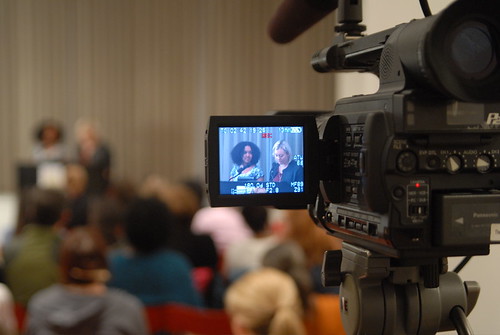
I’m here setting up for my workshop, Blogging Demystified, with Courtney Martin, waiting for participants to walk in and testing the Interwebs. Looks like it works!

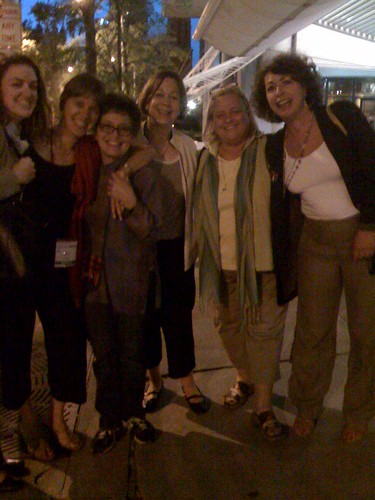
Meanwhile, here’s a pic from dinner last night. From left to right: Courtney, Jacki Zehner, Barbara Dobkin, Lynda Goldstein, and Chris Grumm.  What a group…!

More on all this when I return, I promise.  Off to start the show.

After weeks of anticipation, Girls Write Now will be featured TONIGHT (Tuesday, April 28)* on NBC Nightly News with Brian Williams reported by national correspondent Amy Robach.

NBC Nightly News airs daily at 6:30 PM Eastern/Pacific, 5:30 PM Central. Check out your state’s local listings.

Girls Write Now Day 2009 at The New School

I am SO late to posting this today, but here goes.  Today is (still!) Equal Pay Day.  And this morning, the National Women’s Law Center released some new state-by-state data on the wage gap.  Seems we’re doing a little better here in New York (where women make 82% of what men do) than in my homestate of Illinois (where women make 73%).  But it’s all really quite pathetic.  I mean, this is 2009, for christsake!  Didn’t we all think we’d be a little further along by now?  I mean, seriously, if you want to talk about ways to stimulate the economy, how bout investing in women by paying us what we’re worth!  Jeesh.

For more blogging, raging, ranting, and informative discourse on the subject, go here. For some particularly great posts, check out the one at The REAL Deal, by Kyla Bender-Baird and the one over at Gloria Feldt’s blog.

If you’re like me, after getting all fired up about this issue, you’re gonna want to take action.  You can write to your Senators in support of the Paycheck Fairness Act, by clicking here.

(And thanks to the National Women’s Law Center — and in particular Robin Reed — for spearheading Blog for Equal Pay Day!)

QuiverfullKathryn Joyce is a journalist and author of the new release Quiverfull: Inside the Christian Patriarchy Movement (Beacon Press). A graduate of both Hampshire College and New York University, her freelance writing has appeared in Newsweek, The Nation, Mother Jones, and many other publications. Joyce recently spoke to Girl with Pen about her research experiences, intersectional conflicts within the Quiverfull movement, and the public’s response to her groundbreaking new work:

What experiences in your journalism career prompted a deeper exploration of the Quiverfull patriarchal movement?

I first came across the Quiverfull movement while researching the anti-contraception movement among pro-life pharmacists claiming “conscientious objections” to dispensing birth control. I had been unaware of anti-abortion claims that birth control functions as abortion, and hadn’t known that opposition to contraception had become an important issue among Protestants and evangelicals in addition to traditional opponents among Catholic and LDS churches. Looking into some of the groups that were supportive of the pharmacists’ movement, though, I came across a surprisingly well-organized coalition of evangelical anti-contraception groups, some of whom were arguing that Christians should leave their family size and spacing in the hands of God. As I began to read a number of books that shaped the community and conviction, particularly early movement texts like Mary Pride’s The Way Home: Beyond Feminism, Back to Reality, and Rick and Jan Hess’ Full Quiver: Family Planning and the Lordship of Christ, I began to see a vehement anti-feminism and another, startling motivation for large Christian families as well, as the Quiverfull authors told readers that by having very large families, and teaching their children to do the same, they could win the culture wars through numbers alone.

The oppositions between feminism and Quiverfull Christianity are rooted in the patriarchal traditions of this sect. In your research, did you find any subversive femininst actions taken by former or current Quiverfull followers?

Quiverfull is not a sect of Christianity, but a grassroots movement that spans numerous denominations and church traditions.

That said, there is certainly a feminist subversiveness among women who have left the movement, such as Cheryl Lindsey Seelhoff, Vyckie Garrison and Laura Sutton, as well as other evangelical women who did not follow the Quiverfull conviction but did faithfully believe in the patriarchy doctrines they were taught in their churches. A number of women taught to follow these beliefs have responded by either leaving the faith and conviction entirely, or by attempting to reshape the teachings to fight abuse. However, I think the common thread of all the women I’ve spoken to who contended with these issues is the overwhelming pressure against their leaving these communities, and the financial, emotional and spiritual obstacles they have to overcome in order to do so.

My working title for Quiverfull was “Trust and Obey,” the name of an 1800s Presbyterian hymn that is frequently referenced by Quiverfull supporters as the foundation for their role in life. It reads: “Trust and Obey, for there’s no other way/ to be happy in Jesus but to trust and obey.” The sentiment of the hymn really sums up the role of faith and obedience, or submission, in this movement—that, beyond the demographic dreams of leaders with a vision of thousands of Christian children taking over the country, this movement tells women they must have a faith strong enough to have children they may not necessarily be able to provide for, but to trust instead that God will take care of them if they are obedient to the authorities “he’s placed over them.” It’s a deceptively simple challenge to any woman who is having second thoughts about giving up so much self-determination.

How would you describe the demographics of the Quiverfull movement? In what ways are Quiverfull Christians defined by gender, race, class, and other forms of social and personal privilege?

Quiverfull is largely white, but not entirely so. There are families of color within the movement, as well as prominent biracial couples. I think there are racial undertones to a number of aspects of the movement, particularly its preoccupation with demography and population, and leaders utilizing falling fertility in European countries as a warning that countries that embrace family planning end up “invaded” by hordes of immigrants. Similarly, there are questionable ties between some movement leaders and far-right fringe groups that embrace neo-Confederate notions about slavery and race or immigration. Additionally, one movement author, Charles Provan, author of The Bible and Birth Control, was also notably a Holocaust revisionist. And a very popular author and women’s leader, Nancy Campbell, author of Be Fruitful and Multiply and publisher of the long-running Above Rubies magazine, frequently makes a pitch for large families in order to out-breed Muslims. I don’t think that all Quiverfull people are motivated by racist thinking whatsoever, or even that there’s more racism within the movement than in American culture at large, but I do think that there are troubling undertones to a lot of the messages that the leadership of the movement advances, and the way in which they seem to appeal to people’s racial or immigration fears or biases as a third motivation for having large families beyond obedience to God and the idea of Christian dominion through numbers.

In terms of gender, however, there is absolutely no pretense at equality between the sexes except, as many leaders are fond of repeating, equality under God. Men and women are equal in the eyes of God, they say, but have different roles here on earth. What that translates to in reality is a system of often strict male headship and female submissiveness, where Christian women are never supposed to be out from under the “protective covering” of a male authority any time in their life. Founders of the movement, including Mary Pride, made it clear that the ultimate target of the movement was feministic ideas of equality, and that in order to be good Christian wives, women had to subordinate themselves to their husbands as army privates submit to officers, so that a well-organized Christian army stands a better chance of winning. Other teachers of “biblical womanhood” – the total lifestyle patriarchy advocates promote as an antidote to feminism – include rising early to feed the family, being available anytime to satisfy a husband’s desires (barring a few “ungodly” or “homosexual” acts), seeking his approval regarding work, appearance, and leisure, and accepting that he has the “burden” of final say in arguments. After a wife has respectfully appealed her spouse’s decision — a privilege she should not abuse — she must accept his final answer as “God’s will for her at that time.”

How have the families you interviewed for this book responded to its publication?

I haven’t heard from all of the families I’ve spoken with. Those who have contacted me have generally found the book fair and respectful, although they of course disagree with the position I’m coming from. That’s been the reaction of a lot of reviewers, from Bitch magazine to Christianity Today. And I’ve heard from more women who have left Quiverfull or patriarchal churches, and they’ve remarked that they were surprised a secular outsider could understand the movement so well.

Although I haven’t heard from many critics yet, I think that one response that both I and exited Quiverfull women have heard a lot is that to have a negative experience of this lifestyle means that the woman or her family weren’t “doing it right,” or weren’t following the conviction with the right Christian spirit, but with a “legalistic” spirit concerned more with rules than with following Jesus. While I understand where this response comes from, I have to disagree. While apologists for Quiverfull or patriarchy teachings say that both can be wonderful things if practiced with the correct Christian heart and motivations – with an eye towards glorifying God, and not being mired in “legalistic” rules – in my observation, many, many women described beginning to follow the conviction out of a sense of faith, and very soon found that the lifestyle was one of hard and fast rules, and unforgiving standards that few women could keep up with.

Does the Quiverfull movement have a future? Do you feel that changes in American politics or the economy will impact the success of this growing movement?

I think of Quiverfull as a purist vanguard of the antiabortion and anti-contraception movements. I think there has certainly been a growth in the visibility of very large families following these convictions and lifestyles, but I don’t imagine that huge swaths of the country will begin having 18 children next year. Instead, however, I think they will continue to exist and grow as an ideal of the Christian right family: institutionalized already in the “Natural Family Manifesto” that’s promoted by the World Congress of Families: an interdenominational coalition of religious right groups that includes almost every major religious right political organization in the country. They explicitly endorse women having a “full quiver” of children, and have taken their message to Europe, where they tell countries with declining fertility to fight it (and immigration) by encouraging every woman to have 3-4 children each. Likewise, major denominations such as the Southern Baptist Convention, which has 16 million members, have begun making sympathetic statements in recent years (to complement their existing “complementarian” stance on wifely submission), saying that deliberate childlessness among Christians is moral rebellion against God. So I think they will have a trickle-down influence on religious right standards in that way, and will serve as inspiration to the anti-contraception groups that are trying to promote anti-birth control policy.

New Orleans has become a pilgrimage of sorts for the nation’s youth. It’s something I’ve come to realize in a big way while researching my new book, Do Greaters: The Kids These Days and How They’re Changing the World. Turns out that for Americans, in general, but especially for folks under 35, New Orleans has become the new rite of passage in our understanding of good works.

It’s generally great for the folks who head there. They learn about the complexity of infrastructure, maybe gain a few construction or landscaping skills, meet some new friends, maybe even get a tan. But what is the effect on the native residents of New Orleans?

This is a question I asked in a column over at The American Prospect not too long ago: “Like Juan Ponce DeLeon’s mythological fountain of youth, the Lower 9th Ward has become upper-middle-class America’s source of feel-good absolution….But the darker side of all of this well-intentioned activism is that it has created a revolving door of services and support in a parish that is in dire need of a strategic plan.”

And it’s now being answered by a series of homegrown activists. Some of their answers are chilling, like this one, from Timolynn Sams, executive director of Neighborhoods Partnership Network (NPN), New Orleans native: “We’ve become this laboratory, but we are not guinea pigs. We want to be part of the science, but as the scientists, not the experiment.”

It brings up all sorts of difficult ethical questions. When are our well-intentioned attempts to help more selfish than selfless? What can folks with big hearts, a little extra money, and a lot of energy do to help rebuild New Orleans? Should we urge all the eager post-college grads to head to Detroit and Cincinnati instead? Or will that just engender the same problems?

Food for thought. Would love to hear your ideas…

It’s conference season!

I’m giving a blogging workshop next Thursday at the Women’s Funding Network conference in Atlanta (“Investing in Women: Worldwide Returns”) along with Courtney Martin, and another one (solo) at the National Conference for Research on Women conference on June 12th most likely… More bout that one as it gets closer. In the meantime, here’s info on the NCRW conference — there’s still time to sign up!

IGNITING CHANGE: ACTIVATING ALLIANCES FOR SOCIAL JUSTICE

WHEN: June 10-12, 2009

WHERE: CUNY Graduate Center, 365 Fifth Avenue, New York City

WHY: Join leaders from business, academia, philanthropy, advocacy, and policy communities to devise collective strategies for leadership and change.

Space is limited! To register, click here

Hosted by: The Center for the Study of Women and Society CUNY Graduate Center

Cosponsors: Barnard Center for Research on Women; Center for Women in Government & Society at SUNY Albany; Demos; Girls Inc.; Legal Momentum; Shirley Chisholm Center for Research on Women; U.S. National Committee for UNIFEM New York Chapter; The White House Project; The Women of Color Policy Network at New York University
For more info, contact Kyla Bender-Baird at kbender-baird@ncrw.org, tel.  212-785-7335 x205, or visit www.ncrw.org

See you there!

(Sorry bout all the crazy fonts here…)

Our very own Shira Tarrant, of The Man Files here at GWP, was speaking on WBAI radio today about her awesome anthology Men Speak Out: Views on Gender, Sex and Power. Joining Shira were filmmaker Byron Hurt, author Jeremy Adam Smith (who I met last weekend at CCF!) and author Jacob Anderson-Minshall. The group chatted about some of our favorite topics over here: men, masculinity, sex, relationships, violence prevention, and positive change. Check out the MP3 version here.

Huh?  Recession and sex, in the same sentence?  Check out my latest at Recessionwire, a personal (well, not that personal) riff on a Forbes article that asks whether recession is good for sex.  And I forgot to link to last week’s post, about Marco coming back home…

servicesTravels and graduations behind us, we’re back! This month foremost on our minds is the issue of budget cuts. How many times will history have to repeat itself before we get it right?

Question:
What do cuts in services for disabled and vulnerable people, shoddy food regulation practices that are making people in some states very sick, the recent rise in crime and simultaneous reductions in police resources, and even Nebraska’s inability to provide adequate services for troubled children and their families have in common?

Answer: These recent phenomena can be traced in some part to the reduction in social services that is common in national, state, and local budgets when trying to prevent the onset of a deep fiscal crisis. While these phenomena are all deeply troubling, even more troubling is the fact that there is historic evidence that such cuts do not work and, in many cases, actually have the opposite effect. That is, when the state no longer pays for things like health care, education, and even local security, there are extremely negative consequences for everyday people, especially for vulnerable groups such as the elderly, the disabled, and children, who depend on such services for daily survival.

In the 1980s, the world saw the effect of these policies writ large in the international arena, with so-called “Structural Adjustment Plans”, or plans put in place by the World Bank and the International Monetary Fund (IMF), which laid out various conditions that had to be met by countries in order to get a loan from both establishments. Most of these conditions involved the opening of markets, “free” trade conditions, and extreme reductions in state provisions of social services like health care and education; it was argued that such services should instead be privatized. In short, the prevailing sentiment was this: let the markets take over and we’ll see what happens.

What happened was that structural adjustment plans had disastrous effects, particularly in many parts of Latin America (where the period of heavy structural adjustment has led many to refer to the 1980s as the “lost decade”) and Africa (where 34 countries implemented some form of a structural adjustment plan in the 1980s). Further, women were the ones to bear the brunt of many of the negative effects of these policies. According to Dzodzi Tsikata of the Third World Network, this is because such policies “assume the unlimited availability of women’s unpaid labour and time and… have tended to see women as a resource to be tapped to promote the efficiency of free market policies and to deal with the short-fall in access to social services.” In many instances, this leads to an increase in women’s working burdens and social responsibilities. In other words, women are expected to shoulder the majority of the burden of reductions in state provided services. And this phenomenon is not limited to developing countries (and surely not when the developing countries in question are following the economic prescriptions of their Western donors and lenders) – critics in the US have also argued that domestic budget cuts have a disproportionate effect on women and children.

The USA’s neighbor up north hasn’t done much better. Kathleen Lahley, a Law professor at Queen’s University in Canada outlined in her gender analysis of the 2009 budget, key ways in which the Canadian government has missed the mark. Not only does her analysis make for good reading, it also demonstrates how women in Canada will not directly benefit as much as men will from the $64 billion in spending and tax cuts. Gender equity requirements have not been included in the spending programs – the result is a gender-skewed stimulus.

With so much evidence on the negative effects of cuts to social services, one wonders why this model is still pursued in such a fashion and, further, whether there are any movements (policy or otherwise) to reverse the ongoing trend, particularly as global leaders consider changes to international economic frameworks in light of the recent crisis.

As we can see, leaders in North America don’t seem to be the fastest learners, but what about the rest of the world? The World Bank and the IMF? In 2007 Elaine Zuckerman, a former World Bank economist, challenged the Bretton Woods institutions to improve their track record of short-changing women. For all intents and purposes, it seems that World Bank President, Robert Zoellick, is trying to rise to the challenge. At last month’s G20 meeting in London, he spoke of the Bank’s plan to develop a Vulnerability Framework. The fund would provide support infrastructure, agriculture, small- to medium- size businesses and micro-finance. Past lessons may just be paving the way to a more gender-balanced future for the World Bank. This plan would benefit not only men through infrastructure jobs, but also women who are heavily involved in agriculture, are the majority of small business owners, and represent 85% of the poorest 93 million clients of Microfinance Institutions. This effort would require a contribution of 0.7% of more “developed” countries’ stimulus packages. Maybe this is their way of making up for the gaping holes left at home through budget cuts…nice but gender equality should happen at home too.

Who would have thought that the G20 would bring us even more good news?! We were a bit skeptical at first; the official documents that come out of these meetings rarely mention gender equality. Oh, we of little faith! The G20 countries pledged to support the World Bank’s Vulnerability Framework AND addressed the human dimension to the crisis and the pledge to “build a fair and family-friendly labour market for both women and men.” Steps in the right direction. Let’s hope this will manifest itself in thoughtful gender-conscious budget cuts across the board. The entire Official Communique can be seen here.

Finally, Argentine President Cristina Fernández de Kirchner called for a “new starting point” in hemispheric relations at the recent Fifth Summit of the Americas in Trinidad and Tobago (the country that gave you Blogger TAB 🙂 ). While much attention has been given to Presidents Obama, Castro and Chavez, we recommend you take a look at President Fernandez’s speech, which was in our opinion one of the, if not the, best (though we haven’t been able to find any links to it). Further, the Summit’s Declaration of Commitment’s preamble Point 6 is calypso music to our ears: “We recognize the importance of considering the differentiated needs of women and men in promoting and ensuring the integration of the gender perspective as a cross cutting issue in national and hemispheric policies, plans and programmes to be implemented in the political, economic labour, social and cultural spheres…’’

At the very least, countries globally have demonstrated a rhetorical commitment to gender-balanced recovery and development. It remains to be seen how these plans will be put into action. Judging from past experiences, the best way to ensure that these rhetorical commitments are implemented in practice is through the work of gender researchers, advocates and practitioners, who must hold governments and international organizations accountable for the commitments that they make in these international forums. So, please, join us in reminding local, state, and national leaders to stick to their commitments to build a more gender-inclusive world. Let the fiscal crisis be used as an opportunity to strengthen gender equitable programs – not an excuse to cut much-needed services for women, men, and children.


Image Credit

In a Time magazine article about an Oregon school for troubled youth that is under scrutiny, journalist Maia Szalavitz (author of Help At Any Cost: How the Troubled-Teen Industry Cons Parents and Hurts Kids) deserves huge props for throwing the spotlight on it all.

Check this out: In required seminars that the school calls Lifesteps, students at Mount Bachelor Academy in Oregon say staff members of the residential program “have instructed girls, some of whom say they have been victims of rape or sexual abuse, to dress in provocative clothing — fishnet stockings, high heels and miniskirts — and perform lap dances for male students as therapy.” Think you can treat ADHD by making girls dress up as French maids? Think again.

Coverage at Jezebel, here.