
Uncategorized

Photo by Diane Gregg via Flickr

Last weekend, I read a very interesting column about populist outrage and the American dream. Written by Steven Thomma, White House correspondent of the McClatchy newspaper group, the piece got me thinking once again about the value of sociological research and thought.

Thomma’s article, which appeared in our local paper under the headline “Fading American Dream Promotes New Political Rage,” begins by detailing some of the basic social changes fueling unrest among protestors Left and Right: stagnant and declining wages, increasing health care costs, job loss, and income gaps, as well as ongoing (and ineffective) wars, corporate bailouts, and skyrocketing debt. Very empirical, sociological stuff. Indeed, Thomma drew on research and findings from our field implicitly and quoted Harvard’s Bruce Western directly (on union declines and increasing income gaps in America).

Where the piece really caught my eye–and where Thomma took it up a notch, sociologically speaking–was in situating these structural and demographic shifts in the context of “something deeper” going on in American culture.  Mobility–or the relative lack thereof–and rights were important touchstones for this discussion. However, it wasn’t just the actual facts about mobility (or rights) in the U.S. that are striking, but the American expectation and hope that both should be available and possible. For Thomma, this is where the American dream and the perceived loss of it come in. “The rules,” Thomma writes, “seem to be changing.” With these insights about cultural norms and expectations, we see that our politics, lives, and communities are shaped not only by how things are but how we want and expect them to be–and there is no greater cultural force in America than that crazy, inspiring dream so many of us share. The fact that Thomma quoted a political scientist to set up these points doesn’t make them any less sociological (or useful).

When I finished reading, I was left wondering what sociologists like me might contribute to public understanding on these themes. One contribution I can imagine centers on leadership and the American political structure. An orienting point for Thomma is that populists of both Left and Right are frustrated political leaders who have promised, but failed to deliver, change. Engaged citizens of all stripes, he believes, feel disheartened and betrayed. Clearly our political leaders have often failed us. They haven’t always done as well as they could have. But I think a more sociological orientation to the problem would situate leaders’ shortcomings in the context of our archaic and dysfunctional political institutions–two-party paralysis, decentralization, and so on–and, even more importantly, in the context of a culture that lacks a rich conception of and commitment to the public good andis fundamentally cynical about government itself.

A more sociological orientation would also, I believe, be a bit more critical and forward-thinking about the American dream itself. It wouldn’t just bemoan the loss of the dream as we have known it, but also consider how that dream–and the culture itself–is being (or perhaps  should be) reshaped and tranformed, recast to fit the contemporary moment. It’s possible that new dreams and visions of America could emerge out of this angst–conceptions that would be less driven by utopian visions of limitless mobility and unabated freedom for all and more rooted in a more humble and informed (and yes, sociological) sense of ourselves, our relations to others, and our place in the world. I offer this possibility only hesitantly because it doesn’t sound as uplifting, inspiring, and patriotic as one might like. Nevertheless, I can’t help thinking that such a vision may not only be more realistic and sustainable at this point in our history, it would also be truer to another set of values, ideals, and imaginings that have helped to make America not only a great nation but also a fundamentally good one.
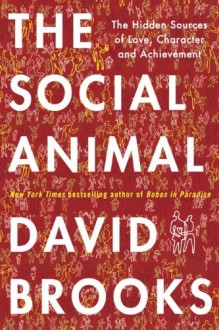
Readers of Contexts will know that one of Chris and my favorite political pundits and cultural commentators is David Brooks of the New York Times. It’s not because we agree with all of his politics and opinions, but  because he is one of the few national media members who regularly reads and consistently draws upon social scientific research. On this point, take a look at his March 17 column “Social Science Palooza II.” I found at least two things interesting about the seven different pieces he profiles. The first is that four of the studies come from psychology. The other is that two of the pieces are based upon work in the domain of sports–one about how fans impact officials (which helps account for the “home field advantage”), the other about the social dynamics that propel swimmers in the last legs of relay races to swim beyond their usual personal limits. Good stuff–and a handy reminder that I want to give Brooks’s new book The Social Animal a read.

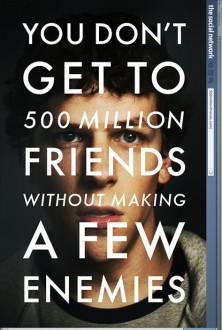
So I finally had a chance to watch the Facebook-inspired, Academy Award-winning film “The Social Network.” I found it very entertaining–Jessie Eisenberg was captivating as Mark Zuckerberg and who among us regular folks doesn’t enjoy seeing some in-fighting among Ivy League elites? That said, I was also surprised and kind of disappointed not to learn more about the social desires and dynamics that Facebook is really tapping into and driven by–I mean, in addition to sex, dating, and scoring drugs. I see the irony of a bunch socially-challenged Harvard misfits producing the most successful social networking medium in the world today. But I think there is–or at least should be–more to the story than that, more to say about why people want and need to connect with one another, why this particular technology has proven so successful and valuable for doing so, and what broader lessons these fundamentally social questions have for the future of technology of/in society. In real life, as I wrote in a post a few weeks ago, Zuckerberg talks a ton about the power and promise of all things social without really filling in the details and the backstory. I guess I had thought the film might help elaboarate that just a bit. Maybe when sociologists make their move into Hollywood, we can do the remake.

Our colleague, Monte Bute at Metro State University in St. Paul, is many things to us: respected sociologist, friend and supporter, blogger (https://thesocietypages.org/monte/), former Contexts’ board member, and valued opinion. He’s also a true class act, and it looks like a lot of people agree.

Today we’re delighted to point you all to Minnesota Public Radio’s wonderful piece about Monte’s approach to life, death, and bringing both into the classroom. Please do check it out at http://minnesota.publicradio.org/display/web/2011/02/23/dying-professor-death/

And, for a little more backstage knowledge on the backstage sociologist, here’s the text of Monte’s “about” page on TheSocietyPages.org:

Monte Bute is an associate professor of sociology at Metropolitan State University in the Twin Cities of Minnesota, where he has taught for the past 25 years. He is also a guest columnist on the opinion page of the St. Paul Pioneer Press.


The title of this blog comes from a 2004 essay, “The Making of a Backstage Sociologist.” For the “Full Monte,” read that narrative and “New Tricks from an Old Dog.”

His teaching and research interests include social theory, public sociology, teaching and learning, social power, protest and social movements, and political theory.

He began teaching at Metropolitan State as an avocation in 1984, and reluctantly began graduate school rather late in life. Bute has published over 60 articles in academic journals and the popular press, and has made over 70 presentations at academic conferences and community events.

Sociologists of Minnesota (SOM) gave Monte the Distinguished Sociologist award in 2004. Bute has received Metropolitan State University’s Outstanding Teacher and Excellence in Teaching awards. He is also the recipient of awards from Minneapolis Community and Technical College, the Jobs Now Coalition, and the Job Training Partnership Association.

Bute is past president of both Sociologists of Minnesota and the National Council of State Sociological Associations (NCSSA). He has also served as editor of Sociograph, associate editor of the Sociological Imagination, and is currently on the editorial board of Contexts, a journal of the American Sociological Association. Monte has been a fellow of the National Endowment for the Humanities (NEH) and the Humphrey Institute of Public Affairs, University of Minnesota.

Bute comes to both sociology and academic life by a rather circuitous route. Majoring in American studies and European humanities, he dropped out of college in 1967 and landed in Berkeley and the Haight-Ashbury district of San Francisco.

Monte then spent the next two decades on the ramparts of social change, working as a grassroots organizer and independent scholar for organizations representing the unemployed, tenants, welfare recipients, union members, and students. He served on the Governor’s Poverty Commission in 1986-87 and was the lead author of A Poverty of Opportunity: Restoring the Minnesota Dream.

Having become a social scientist by the seat of his pants, Bute adheres to Alfred Schutz’s distinction between scholarship aimed at the “expert” and scholarship directed to the “well-informed citizen.” For over 40 years Monte has been nurturing the development of well-informed citizens.

Edited on March 6, 2011 to add that the Star Tribune is joining in on the Monte-love with a photo gallery in today’s edition: http://www.startribune.com/galleries/117466018.html.

Flickr photo by San Diego Shooter

Last week it was announced that, after many years of (our) waiting and hoping, former Minnesota Twins pitcher Bert Blyleven had been voted into the Major League Baseball Hall of Fame. In yesterday’s local paper, Blyleven was asked about the speech he planned to make when he is officially inducted in Cooperstown, NY on July 24.

Here’s what he said:
“A Hall of Fame speech is not talking about yourself; it’s talking about the people who helped you get where you’re at right now. There are so many great people who helped me.”

We loved the response, and it is not just because Bert is a Minnesotan or because we are trying to get him to circle us on television broadcasts next season. (Blyleven does color commentary for Twins games and is known for circling fans in the crowd with his telestrator.) We loved the quote because it is so thoroughly sociological, recognizing that all of Blyleven’s accomplishments are not fully his own and in fact the result of lots of cooperation and assistance from others along the way.

NYU sociologist Dalton Conley talked about this recognition that we all stand on the shoulders of others when he did a special video chat with our intro undergrads here last spring—but he added a twist. Conley talked about how he always asks his own intro students how they had come to their academic success and being enrolled at his/their prestigious institution. His white students, Conley told us, typically talk about how hard they had worked in high school and throughout their lives; students of color, in contrast, usually tell him about all the people who had helped them along the way. Hall-of-famers in the making? Circle them, Bert!

Photo by Hawks and Doves (Flickr)

“I am a blogger no longer.” That’s what Marc Ambinder wrote last fall in announcing that he was leaving the Atlantic Monthly.com to become the White House correspondent for the National Journal.

The announcement made waves on the Internet because he is one of the first and most successful electronically-based political reporters the web has ever known.

Ambinder described blogging as an “ego-intensive” process where one has to put one’s self in the narrative even when doing straight reporting of the news. Ambinder set this in contrast to good print journalism which he described as “ego-free,” “let[ting] the story and the reporting process… unfold without a reporter’s insecurities or parochial concerns intervening.”

Even more to the core of his frustration were concerns about writing and editing: “I loved the freedom to write about whatever I wanted but I missed the discipline of learning to write about what needed to be written. I loved the light editorial touch of blogging but I missed the heavy hand of an editor who tells you something sucks and tells you to go back and rewrite it.”

What editors wouldn’t love to hear that? But Ambinder’s post and his job change also got us thinking about was how, in the social sciences, we don’t just have editors, we have a whole community of scholars who contribute to our thinking, who review our work, and who confirm and help disseminate our ideas and information.

The community-driven, collaborative nature of the scientific process can be cumbersome and time-consuming—basically, it’s on the other end of the spectrum of blogging. That’s often frustrating, especially when we think we have something of real value to contribute to public discussion and debate right now (!).  It all takes a lot of time and rarely culminates in definitive conclusions or easy answers. But it’s what we do and what (we believe) our communities need. When it works, it sings; its value is obvious, immediate, palpable.

Sociologists love all things “social,” and we use the word all the time in Contexts. We’ve used it in titles—“the good, the bad, and the social” (Fall 2010), “all politics is social” (on our cover Fall 2008), and, of course, “understanding people in their social worlds” (Contexts’ tagline). Another place the term pops up regularly these days is in media, news, and communication technologies—all of which we now call, almost without thought, “social media.”

Map of the Internet ca. 2006, via xkcd.com

A recent interview with Financial Times (FT.com), Facebook founder Mark Zuckerberg illustrates. FT reports that, “In sweeping terms and with no sense of irony,” Zuckerberg will tell anyone who’ll listen:

Our goal is to make everything social.

The Internet wunderkind goes on: “If you look five years out, every industry is going to be rethought in a social way. You can remake whole industries. That’s the big thing.”

The reporter summarized their interview, writing, “Zuckerberg uses the word ‘social’ a lot, and it’s not always obvious what he means. He is not simply talking about telling your friends what you had for breakfast with a status update. To Zuckerberg, a more social world is one where nearly everything—from the web to the TV to the restaurants you choose to eat at—is informed by your stated preferences and your friends’ preferences, and equipped with technology that lets you communicate and share content with people you know. What Zuckerberg is talking about is a new way of organising and navigating information.”

From an academic standpoint, it’s easy to be critical—”social” seems to be reduced to individual choices or friendship circles, and ideas about networking and communication are so easily put into service for big business. And then there are all the complexities of what it means to socialize on an individual basis through technological means that can, themselves, be isolating.

That said, for sociologists who often complain about the lack of an informed, sociological perspective in mainstream media and public discourse, this pervasive attention to the social should be seen as an opportunity. Not just in terms of how we use social media (though obviously we are trying to do that here at TSP), but in terms of expanding conceptions of “the social” and perhaps even bringing a more socially-oriented—dare we say, sociologically-oriented?—perspective into mainstream media and public discourse. Probably won’t hurt in the classroom, either.

What makes a social science blogger or blog post unique? Too often, not enough. Social scientists who only offer up their personal opinions about the daily news end up being just another voice in the crowded echo chamber. What we need are social science bloggers who can insert real knowledge and the unique perspective of their disciplines, data, and insight into the mix.

Chris Kelty makes this point (and others) in his recent post about blogging in anthropology. Kelty also offers some great tips on how social scientific bloggers can make more meaningful, substantive contributions. We especially like Kelty’s suggestion to blog about a journal article you’ve read recently:

“Think,” he writes, “how pleased you would be if someone blogged about your research… This exercise hones two valuable skills: a) the ability to communicate what an article says and why it is important better than the article does itself and b) the ability to do so in a language and tone that flatters the author, provokes your audience to [consider social science] thought, and doesn’t take you longer than a couple of hours.”

Does this sound a little like our citings posts? Hopefully so.

Garrison Keillor likes to talk about how early exposure to The New Yorker shaped his life and career. The magazine’s sophistication and sensibility seemed worlds away from his everyday life, but its sparkling writing and urbane sensibility shone like a beacon to the small-town kid from Anoka, Minnesota.

Our adolescent experience was more downmarket. Chris, for example, would soak up every pulpy page of Creem magazine, from its cheap glossy cover to the snarky back-page captions accompanying snapshots of Iggy Pop and Blondie. The writing was a revelation, with everything from a perfectly-crafted Cameron Crowe feature to the wondrous wordbombs of Lester Bangs. For his part, Doug found himself immersed in Sports Illustrated, where more than a few great writers discovered that sportswriting is among the most flexible and creative outlets in American journalism.

Neither Contexts nor The Society Pages will ever out-gonzo Creem, out-hyperbolize SI, or out-refine Keillor’s Updike-era New Yorker, but we certainly aspire as editors to the inspirational and declarative power of such magazines. Whether in print or online, a well-constructed magazine conveys a sensibility and cultivates a vibe. More than that, it gives us concrete examples and directives for action.

Around here, we get especially excited about pieces that convincingly show us how social science matters for the world. For example, Contexts’ Is Hooking Up Bad for Young Women? brings high-quality evidence to questions about the sexual lives of young people that confirms some of our suspicions (women have better sex in relationships than in hookups), while busting some oft-repeated myths (the costs of bad hookups are usually much lower than the costs of bad relationships) and communicating it all effectively, using telling descriptors like “limited liability hedonism.”

We’d like to think such features inspire other social scientists to tackle issues front-and-center on the public radar, to bring high-quality evidence to bear, and to tell clear and convincing stories. Our editorial mission is to help showcase and propagate such work, in hopes of energizing and inspiring more social scientists to reach out to a public audience. And if they happen to write like John Updike or Lester Bangs, all the better.

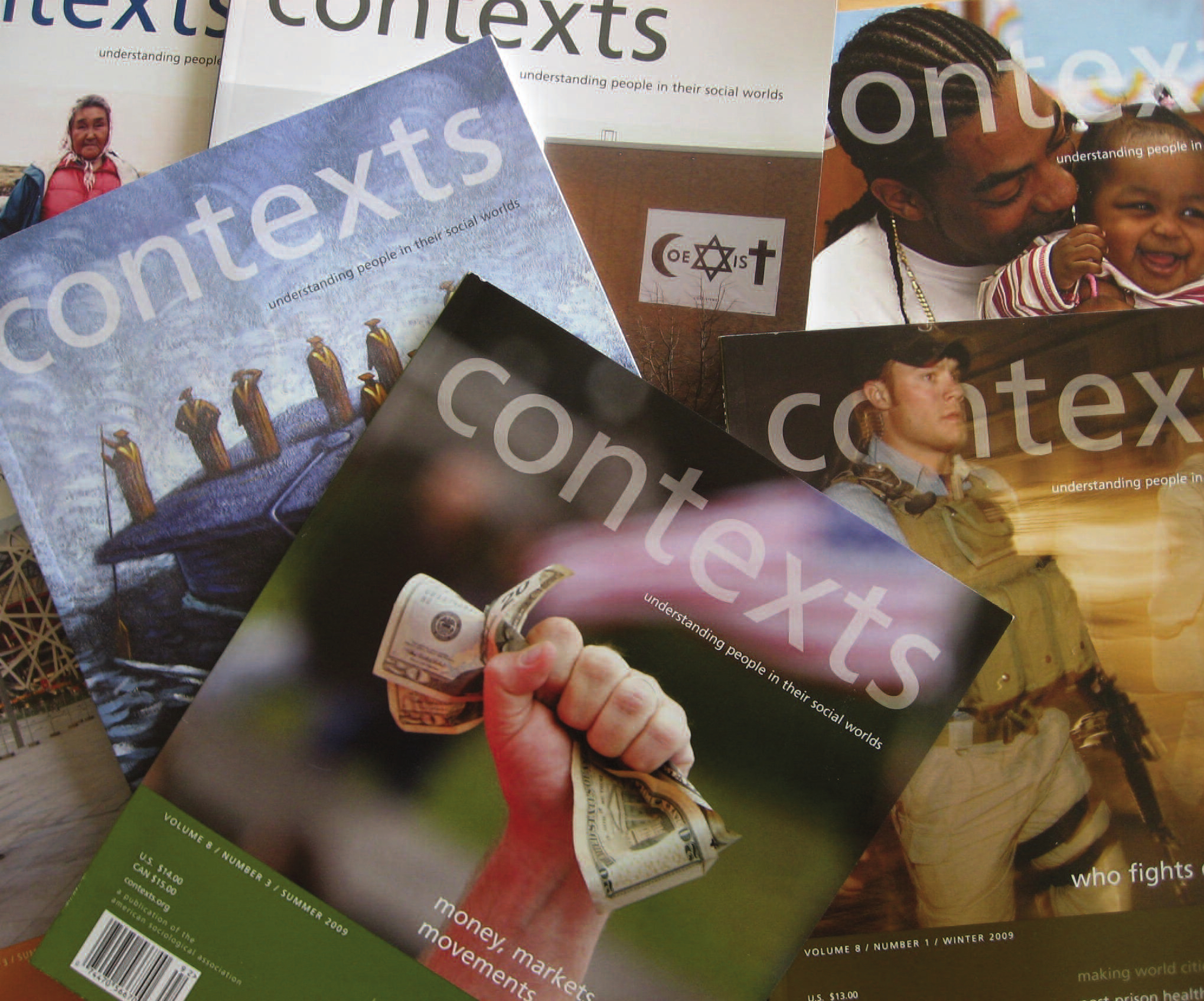
In our role as the editors of Contexts magazine, we come across a lot of great — some might say excellent — writing. So this year, with the blessing of Contexts’ founding editor, we established the Claude S. Fischer Awards for Excellence in Contexts to recognize some of the most accessible and engaging pieces from the magazine. The nominees were hand-picked by the Minnesota graduate student board, and the winners were selected by Contexts’ editorial board, comprised of esteemed sociologists from around the world.

At Contexts’ editorial board’s annual meeting this past Monday, we had the pleasure of announcing the inaugural winners of “The Claudes.” Please join us in heaping praise on these authors, who have done so much to help bring sociological insights to the wider world, and in recalling some of the great Contexts content from 2008 and 2009.

And the winners are…

Best Feature:
Rethinking Crime and Immigration,” by Robert J. Sampson. Winter 2008.

Best Photo Essay: It’s a tie!
“Smoke Damage,” by Michael Schwalbe. Spring 2008.
Looking for a Way Home,” by Jennifer Whitney. Summer 2008.

Best Culture Review:
Peeing in Public,” by Harvey Molotch. Spring 2008.

Best Book Review:
The Most Dangerous Crime Rankings,” by Richard Rosenfeld and Janet L. Lauritsen. Winter 2008.

Best “One Thing I Know”:
Immigration’s Complexities, Assimilation’s Discontents,” by Rubén G. Rumbaut. Winter 2008.