

Archive: Apr 2025

A prison watchtower silhouetted against the sky, with barbed wire fencing in the foreground.prison guard tower” by Rennett Stowe is licensed under CC BY 2.0.

Extensive research has examined how prison affects the lives of adults once they leave the system. However, scholars have been limited in their ability to investigate how prison affects the lives of people who are incarcerated consistently or intermittently during their “coming-of-age” period. These long-term prison sentences (10 years or more, although not always continuous) are difficult to study because scholars are often unable to enter prisons to conduct research, leaving a gap in our understanding of a particularly vulnerable population of young people. 

David Knight addressed this issue by conducting research with consistently and intermittently incarcerated African American and Afro-Latino men, as Black men make up roughly half of adult male sentences which last for 5 years or longer. 

The interviewees were with 18 to 34 years olds and were either incarcerated at the time of the interview or had been incarcerated during their teenage and adult years. Knight concluded that young men who were incarcerated early in their lives in both groups understood their identities as deeply connected to prisons. Rather than just thinking about prisons as places, many interviewees understood their experiences even outside of the physical space as defined by their incarceration. They described their lives, from childhood to adulthood, and even after being released, as restricted and deprived in comparison to their peers.

  • “In prison, you still [get] older year after year. You still turn eighteen…still turn thirty…but it’s the setting that makes you act a different way…Instead of getting your own apartment…a single cell…The first time you may fill out a job application is for a prison job.”

Knight also found that some who were continuously incarcerated described being detained during their youth as a means of ‘protecting’ them from dangers from the ‘outside’, such as violence and addiction.

  • “When I look back at my teenage self…it’s a good thing I came to prison, if only for the fact that I can really stop and listen…it would have been bad for me, way worse than it is now.”

Although mortality rates are often lower inside prisons than outside of prisons, Knight’s interviewees describe their experiences as dehumanizing, degrading, and debasing. In other words, we can understand these sentiments as a commentary on the lack of support for marginalized communities, rather than support for what is happening in prisons themselves.

This research highlights that prisons are not just physical spaces, but institutions that profoundly shape identity and future life opportunities. Incarcerated youth, during critical developmental years, are further marginalized from peers who experience key educational, social, and personal milestones. As prisons increasingly become environments where young men and women grow up, it is crucial to continue studying how they shape the transition to adulthood.
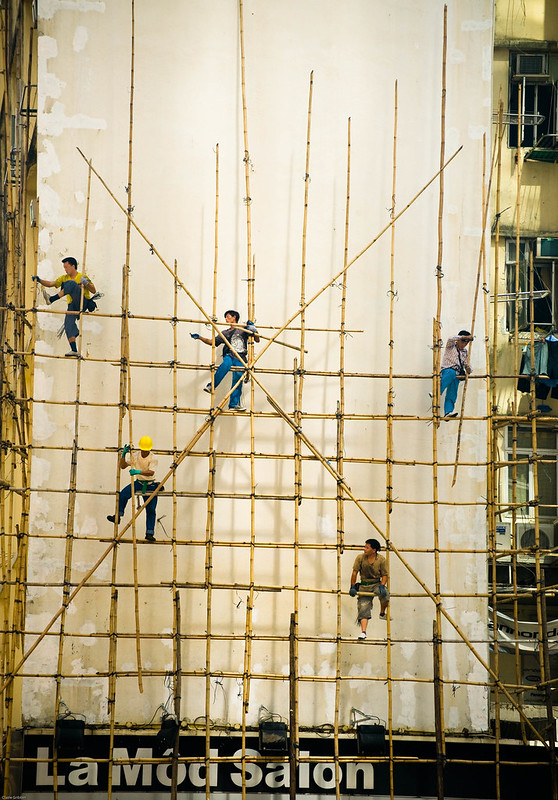

Bamboo Scaffolding in Causeway Bay neighborhood” by gribbly is licensed under CC BY 2.0.

The construction industry is widely recognized as one of the most dangerous industries around the world. In Hong Kong, the scaffolding industry is viewed as particularly dangerous and is particularly stigmatized, in part due to the widespread use of bamboo for scaffolds. Official regulations have increasingly viewed the use of bamboo (rather than steel, the most common alternative) in the scaffolding industry as dangerous and have made efforts to limit and regulate the practice, which has drawn greater scrutiny and stigma to the occupation. In the face of these threats, how do workers learn to manage risk while maintaining respectability?

“Macho” culture has long been part of the answer. Previous research has established that construction workers are often looked down upon by wider society because of the “dirtiness” of their work, and these Hong Kong scaffolders are no exception. Because the bamboo scaffolding trade in Hong Kong is relatively easy to enter and relies on on-the-job training, most apprentice scaffolders are young men who have few career options. Many of the men in the industry have connections to criminal gangs, contributing to scaffolders overall having a reputation for being criminals and ex-convicts. Additionally, the highly visible and public nature of scaffolding work makes bamboo scaffolders especially vulnerable to overt prejudice from the rest of society, with passersby sometimes cursing at and threatening scaffolders as they work.

Researchers Ken Kamoche and Kuok Kei Law sought to identify how bamboo scaffolders in Hong Kong navigated the risks of their work and the social stigma associated with it. Through interviews with a variety of workers and contractors in the bamboo scaffolding industry, Kamoche and Law found that scaffolders managed the danger and stigma of their work by leaning into a particular expression of masculinity: the scaffolders (all of whom were men) portrayed themselves as tough, macho men who were unafraid of danger. This was visible in the culture at the construction sites, which featured camaraderie, swearing, and competitive public displays of bravado and risk-taking (such as throwing bamboo poles to other workers, jumping from heights, and failing to follow safety regulations or use personal protective equipment).

As legal regulation and standardization of construction in Hong Kong has grown, and the wider society increasingly sees the bamboo scaffolding industry as a dying trade, scaffolders have struggled to convince others that scaffolders’ informal knowledge of working with bamboo is legitimate. In the midst of the inherent risks of their work, the stigma associated with it, and the precariousness and uncertain future of the industry itself, bamboo scaffolders worked to establish their identities as tough, masculine, and fearless, able to dismiss both the dangers of the job and the prejudice of those around them.

Image by Jordyn Wald.

“Time to BeReal. 2 mins left to capture a BeReal and see what your friends are up to!” This is the daily notification users receive on BeReal, an app designed to promote authenticity by prompting users to share unfiltered photos from both the front and back cameras at a random time every day. BeReal attempts to constrain users to post within a 2-minute window with zero retakes, but many users circumvent these constraints by delaying posts or retaking their photos. The one caveat? If a user chooses to retake photos, they are labeled as “retakes” and your followers can see this label. So, how “real” are users truly being?

Through a series of interviews with BeReal users, Annika Pinch and colleagues set out to understand how young adults perceive and define their own authenticity on BeReal over time, as well as how they assess the authenticity of others on the app. BeReal was initially understood by participants as a refreshing alternative to highly curated social media platforms, encouraging authenticity through its posting constraints. However, over time, participants began to observe a shift toward performative behaviors, mirroring patterns seen on other platforms. 

For example, participants would actively resist BeReal’s constraints of posting within a 2-minute window by delaying posts to capture more interesting moments in their day. Ignoring the app’s initial notification and delaying posting became more socially acceptable. Even so, participants still grappled with how to evaluate the authenticity of others. Some viewed retakes or delayed posts as inauthentic, while others believed curated posts could still reflect genuine self-expression. As one participant said, “I hate her BeReals. I’m like, You’re defeating the whole purpose of the platform’ and it annoys me to see it… she’s unaware that we can see that she’s retaken it nine times.” 

Authenticity on BeReal is shaped by both platform constraints and social norms that emerge among users. Pinch and her colleagues found that while social media apps can push for authenticity through strict platform design, eventually, these features will clash with users’ need for control of how they present themselves online. For sociologists, this study offers another example of the enduring relevance of Erving Goffman’s insights on the presentation of self and impression management.