Archive: Nov 2019

A father and his daughter draw together with colored pencils. Photo via Pxhere.

Society has always put a lot of pressure on parents, but in the past, parenting standards have differed by social class. In the late twentieth century, middle- and upper-class families differed from poor and working-class families in terms of both their beliefs about good parenting and the actual parenting practices they used. But recent research suggests that, nowadays, people from all social classes have begun to share beliefs about “good” parenting. 

To understand how people’s beliefs differ by social class, Patrick Ishizuka surveyed American parents with children living at home. Because parenting pressures have historically targeted women, he also investigated how “good” mothering differs from “good” fathering. He asked people to rate examples of parenting behaviors on a scale from “poor” to “excellent.” The parenting behaviors described had previously been found to be popular among either working class or middle class families, and the examples varied in whether the parent described was a mother or a father.

Ishizuka found that participants from all social classes gave the best ratings to parenting behaviors which were previously associated with middle class families. Described in 2003 by Annette Lareau as part of a parenting model called “concerted cultivation,” these behaviors included signing kids up for structured, adult-led extracurricular activities; encouraging children to explain their thoughts and feelings, discussing misbehavior, and negotiating; and prompting children to speak up about their individual needs to adults in settings like school and the doctor’s office. Ishizuka’s participants rated these behaviors more positively regardless of whether a mother or a father was using them.

This study demonstrates that cultural norms of child-centered, time-intensive parenting are now widespread. But even when people believe certain parenting strategies are ideal, they don’t always act on those beliefs, often because they lack the necessary resources. While survey research cannot tell us how people are parenting in practice, Ishizuka’s findings are important because they reveal the high expectations people now hold for mothers and fathers of all social classes. 

Minnesota Atheists are among the many individuals who identify as nonreligious. Here they march in the Twin Cities Pride Parade. Photo via Wikimedia Commons.

Social scientists assume that people want to feel certain about their beliefs and identities and that religion helps people find this sense of security. Thus, the modern rise in people who do not identify with a religion must have led to increased anxiety, depression, or social isolation. However, in this new article, Jacqui Frost demonstrates that some nonreligious people have certainty in their beliefs and others experience uncertainty as positive and motivating. 

Frost conducted interviews with fifty non-religious people, including those who identified as atheist, agnostic, or nothing in particular. Frost interviewed people involved in either social or political nonreligious organizations and people not involved in any belief-based groups. In these interviews, Frost asked people to explain how they came to their current nonreligious beliefs.

Frost found that some nonreligious individuals felt certain in their beliefs. For some, this confidence led them to join nonreligious organizations and have frequent discussions about their beliefs. Other nonreligious people were sure in what they believed but did not consider these beliefs important in their daily life.

Other nonreligious people in Frost’s study were not sure what they believed, but were okay with that. These individuals found the uncertainty associated with their nonreligious beliefs to be “freeing.” For these nonreligious people, not being sure about their religious beliefs motivated them to remain skeptical and ask questions throughout their life. Their embrace of uncertainty turned some of these individuals away from nonreligious social and political groups whose beliefs and values they found too narrow and specific.

Popular culture suggests that the decline in religious affiliation is one sign of increasing social chaos. However, Frost’s new article shows that uncertainty is not always a bad thing. Rather than being anxious and socially isolated, nonreligious people find meaning and connection whether they are sure, or not-so-sure, what they believe. 

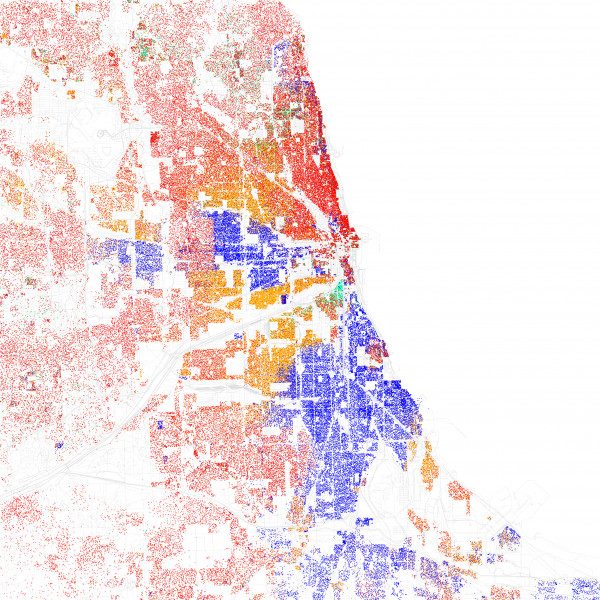
Map showing Chicago’s racial diversity. Each dot represents 25 residents: Red is White, Blue is Black, Green is Asian, Orange is Hispanic, and Yellow is Other. By Eric Fisher via Flickr.

Since the mid-20th-century, research has linked racial residential segregation to a variety of unequal outcomes between racial groups, including education, health, incarceration, and employment. Segregation seems to be slightly declining recently, particularly as the USA becomes more racially diverse. This does not mean, however, that residential segregation is no longer relevant. Long-lasting legacies and impacts of racial segregation remain. Michael Light and Julia Thomas analyze how residential segregation between blacks and whites relates to racial disparities in violence and victimization. 

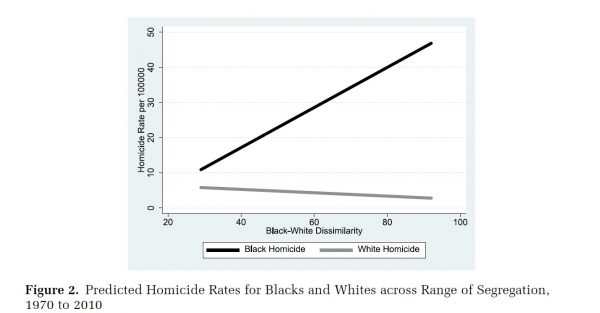
Using decades worth of data from 1970 to 2010, Light and Thomas explore neighborhood segregation and violent crime in several large metropolitan areas across the country. Taking into account the level of non-black and non-white residents, Light and Thomas compare the risk of being the victim of a violent crime for blacks and whites across areas with differing levels of black-and-white segregation. 

As the above graphic from the article shows, the impact of racial residential segregation differs across race. Increasing segregation is linked to higher victimization for blacks and low victimization for whites, but the slopes of these relationships are not equal. In essence, segregation hurts blacks more than it helps whites; racial segregation itself is not only a product of racial inequality; it also another driver of such dynamics. 

This research highlights how violence is yet another factor related to racial residential segregation that hurts blacks and helps whites.  Notably, the data show that metros with more integrated neighborhoods seem to have less violence overall. Thus, as America becomes more racially diverse, racial residential integration may reduce racial inequality as well as inequality in violent crime and victimization. 

Picture of woman prepping healthy meals for her family
Photo by monicore, Needpix.com CC.

Married couples are sharing household chores more than ever before, but women still do more than men. While sociologists already know a great deal about gender differences in couples’ physical and emotional work, new research shows that there’s even more to gendered differences in household labor. Women are often responsible for the lion’s share of another form of invisible household work: cognitive labor.

Allison Daminger interviewed middle- and upper-middle class, married couples living in the Boston area. All were between 35-50 years old, had at least one Bachelor’s degree, and were living with at least one child younger than 5 years old. Most of the couples were heterosexual. Daminger interviewed each partner separately to encourage respondents to share their honest perspective. 

Respondents discussed the typical chores of household labor: cooking, cleaning, shopping, mowing the lawn, etc. But many couples also talked about a sort of “project manager” category of family responsibilities, which includes anticipating the needs of family members, identifying options for meeting those needs, deciding among the options, and monitoring the results. Daminger labeled these tasks “cognitive labor,” and identified nine domains in which cognitive labor occurs: food, childcare, scheduling and logistics, cleaning and laundry, finances, social relationships, shopping, home and car maintenance, and travel and leisure. Cognitive labor in the food domain, for instance, includes responsibilities like deciding what meals to cook and ensuring a consistent supply of groceries. These responsibilities are added on to the work that must be done, for instance, soothing a tantruming toddler displeased by the dinner menu.

Daminger found that, like emotional labor, cognitive labor is often invisible and is a frequent source of conflict. Overall, the women in the study were responsible for a larger amount of the anticipation and monitoring work than their male partners. But when it came to decision-making — the part of cognitive labor most closely linked to power and influence — partners shared the work of decision-making much more equally. Daminger argues that cognitive labor is thus an overlooked, yet potentially consequential, source of gender inequality at the household level. 

To read more about emotional labor, check out these posts here and here.