sex work

A review of Future Sex (2016) by Emily Witt.

Emily Witt’s (2016) book Future Sex chronicles her search for sexual self-realization as a New Yorker in her early 30s migrating to tech-centered San Francisco. The book is based both in interviews and personal experiences, stringing vignettes together into chapters with topics including polyamory, Orgasmic Meditation, Internet porn, and Burning Man. In this review, I highlight the chapter on her Cam sites experience.

But first, I will start with a broad overview. A major theme in the book is the kind of existential angst that comes from having too many choices. Witt feels daunted by her sexual freedom as a millennial—the limitless range of sexual partners and practices—first made possible by the sexual revolution, and then by the Internet. more...

I need to start this essay by making one thing clear: I will not in any way suggest that cam girls or the work that they do is problematic. On the contrary, this essay is aimed at appreciating some of the complexity involved in this form of sex work. In particular, it examines how the culturally ubiquitous trope of the Manic Pixie Dream Girl (MPDG) shapes the expectations an audience might place on cammers (especially young cis-women cammers) and how cammers anticipate and capitalize on such expectations. more...
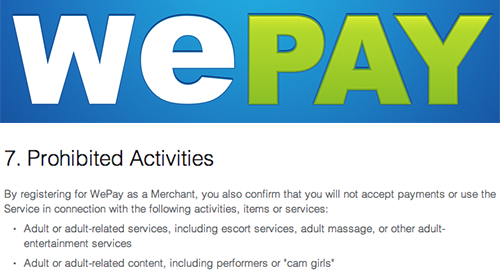
WePay Prohibitions

Last week I wrote about how–despite their supposed libertarian principles–Wall Street and Silicon Valley firms (most notably, Chase and Amazon) had embarked on systematic campaigns of discrimination against sex workers, seemingly intent on expelling sex workers from the financial system. I concluded that discrimination propelled by market forces is no less reprehensible and no less deleterious in its consequences than discrimination driven by personal prejudice. And, I argued that we should hold accountable those who let a commitment to profit trump their commitment to fighting discrimination.

This weekend–almost as if to make a spectacle out of how vicious the campaign against sex workers has become–WePay took the unfathomably callous action of cancelling a fundraiser for Eden Alexander, a porn performer who experienced some very serious and acute health issues and was in desperate need of financial assistance to pay medical/personal care bills. Alexander tweeted the cancellation notice that she received from WePay: more...

"Most Downloaded Woman" (ft. Danni Ashe) by Faith Holland
“Most Downloaded Woman” (ft. Danni Ashe)
Art used with permission of Faith Holland*

Over the course of the past few weeks, two major US corporations—Chase Bank and Amazon—have each undertaken campaigns apparently aimed at expelling sex workers from the financial system, despite the fact that this work is completely legal and the compensation is above board.

Social media has be buzzing with reports from porn performers of vaguely worded letters from Chase stating “we recently reviewed your account and determined that we will be closing it.” At the Cybogology-sponsored Theorizing the Web conference, porn performer Stoya described her experience: “I’ve personally had issues with Chase, which is why I was giggling, because they shut down my business account but then didn’t understand why I wanted to close my personal account.” While Chase and other financial institutions (e.g., Paypal, Square, WePay, City National Bank, and J.P. Morgan) have long engaged in ad hoc discrimination against sex workers, Chase’s recent actions are unprecedented in that they appear to indicate a systematic effort to uncover and blacklist anyone involved in sex work. more...

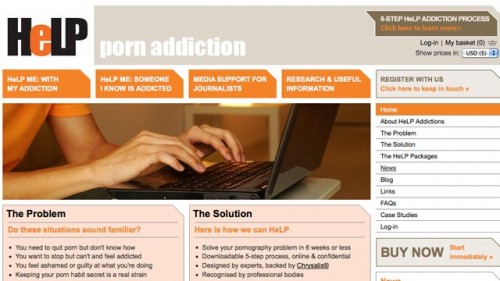
Irony? A porn addiction helpsite (via ABCnews.com)

“The internet is for porn.” Given that, pornography addiction and internet addiction  frequently show up together in the same discussion. The two have some important features in common being medicalized descriptions of certain sets of behaviors: the problematization of pornography addiction rests in part on the idea that unhealthy levels of consumptions of  porn precludes healthy, fulfilling relationships with “real people”. Jenny Davis’s post earlier this week on the “problem with internet addiction” highlights the same issue: the idea that digital interaction is somehow a zero-sum game, wherein more of the “virtual” means less of the “real”, instead of merely a part of the whole of augmented social interaction:

If we understand the internet as a means of sociality, a venue for business communications, an outlet for creativity, a source of news gathering and a space of recreation, then indeed, an addiction to internet technologies would be an addiction everyday life.

more...

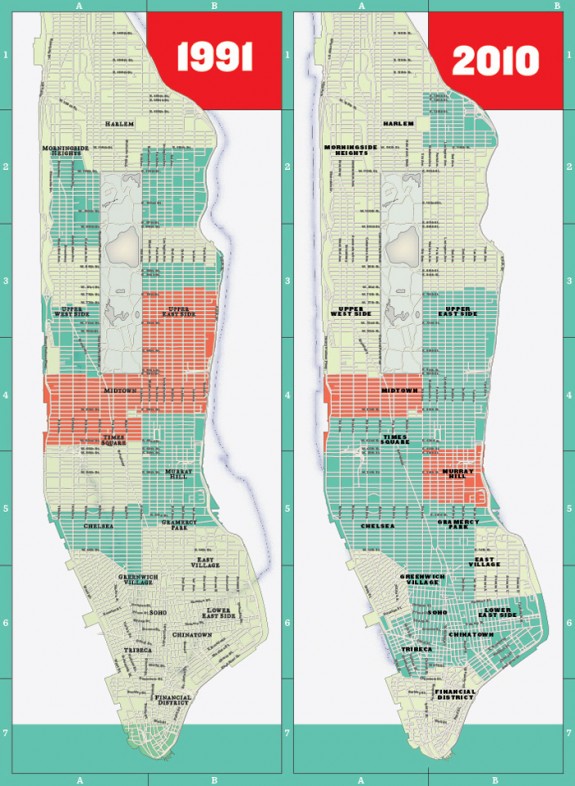
FlowingData posted this great infographic that shows how prostituion in Manhattan is increasingly dispersed. The Internet allows sex work to be less anchored by physicality when much of the process happens online. More analysis here.