
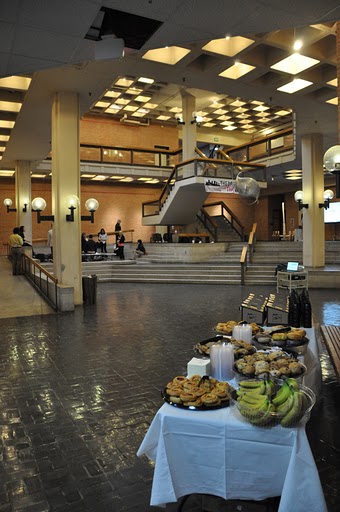
Theorizing the Web 2011 was held on April 9th 2011 at the University of Maryland’s Art-Socy building.  It far exceeded our expectations in every way.  We received over 100 abstract submissions of which were able to accept 53%.  We were joined by Internet research experts from around the world, including presenters who traveled from Hong Kong, New Zealand, and Europe.  The conference pushed the capacity limits of the venue with over 230 official registrants and easily 250 people in attendance throughout the day.  Events ran from registration at 8 AM and ended with an afterparty that wound down around 11 PM.  The program was packed with as many as five concurrent panels in early sessions.  The plenary sessions by George Ritzer and Saskia Sassen as well as danah boyd‘s keynote drew audiences of over 150 people.
Sessions covered a wide range of topics pertaining to the social web, including the politics of infrastructure; the role of social media in contemporary social uprisings; the reproduction of race, class, gender, sexuality, and their intersections in a digital milieu; the co-determinacy of the online and offline world (i.e., “augmented reality”) and the dangers of viewing them in isolation; the performance of the self through one’s online Profile and the increasing need to accept the cyborg subject as sociology’s proper unit of analysis; the Internet as more post-Modern than the original objects of analysis under consideration by the post-Modern theorists; the new economies of the Web and the limits of traditional (e.g., Marxian, neo-liberal) modes of thought; the reconfiguration of norms pertaining to privacy/publicity; the democratization of (formerly expert) knowledge via crowdsourcing (e.g., Wikipedia); and the capacity of art to capture/predict our changing relationship with technology. more...

George Ritzer’s Theorizing the Web 2011 plenary talk is also available.  It streams below or can be downloaded here.

This content is reproduced from the Center for the Advanced Study of Communities and Information website.

Last weekends Theorizing the Web 2011 conference (TTW2011) was a great time. I’ve been working along with Ben Shneiderman and Marc Smith on developing techniques and tools (namely NodeXL [1]) to make sense of social media data – particularly relational data from sites like Twitter and Facebook ([2], [3]). I thought I’d take the opportunity to do a bit of quick-and-dirty analysis and visualizations of the Twitter network around the conference. Here are a few snapshots. I’d love to hear reactions and thoughts on ideas for further analyses and reactions of how well these visualizations represented conference attendees’ experiences.

Size by Betweeness


more...

Several video clips were captured of danah’s keynote.  They are presented here in chronological order.

more...

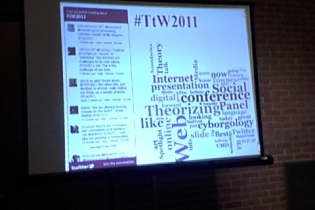
Theorizing the Web 2011 featured several projected installations.  In this post, I want to highlight the Twitter visualize produced by Vicky Lai, an undergraduate at the University of Maryland. Vicky explained her project to me, saying:

The tweet cloud generator was inspired by research with the Social Media Micro-Modeling group at UMD and started as a final project for a Digital Cultures and Creativity course. Originally designed to visualize popular words in a Twitter user’s social network (of followers/following to a certain depth), the project was modified to collect tweets containing “#ttw2011” and visualize the most frequent words. Word clouds are generated by IBM’s word cloud generator, the program used on the popular Wordle site.

The visualization automatically regenerated a couple times each minute, which enabled attendees to watch different words trend over time as the conversation in the conference itself shifted. more...

Bonnie Stewart

This content is reposted from Bonnie Stewart’s cribchronicals blog.

Theorizing the Web 2011 was a wicked conference. It was also a bit of a meta-experience in augmented reality.

Maybe not textbook augmented reality, admittedly, since – as happens at geek conferences – the sheer multitude of smart phones and laptops present overpowered the wireless system and the majority of us couldn’t get online much. I was disappointed that I couldn’t tweet a few of the presentations: one of the joys of digital participation is in turning a monologue into a forum, a conversation of sorts. more...

Plenary: Saskia Sassen

Audio from Saskia Sassen’s plenary address, entitled “Digital Formations of the Powerful and the Powerless” is now available; it streams below or can be downloaded here.

Introduction: Sarah Wanenchak

Plenary Address: Saskia Sassen

Q&A: Saskia and audience

Installation at TtW2011

Saturday was Theorizing the Web, the culmination of weeks, nay, months of planning, organizing, and seemingly endless design work. In addition to building the website, laying out the programs, designing collateral and getting personalized nametags completed, I added on another project to my list called Public/Private. Projected in the main atrium, it consisted of a Twitter feed styled to match the TtW branding, and an ever-changing image next to it.  This project was far more experimental than anything I’d attempted before, and like many experiments it had mixed results.

Functionally, it did exactly what I wanted it to do; it took all of the conference-related tweets with the hashtag #ttw2011 and performed a Google image search for non-common words, then displayed the first medium-sized result along with the feed. As I hoped, some of the images directly illustrated the words searched while others left us either scratching our heads or laughing.  One of the great aspects of the search function is the image cache, which has left me with a permanent record of what words were searched and all the images displayed with them. more...

The opening remarks stream below or download them here.

Theorizing the Web included a pre-conference discussion about art in the digital age.  The forum took place at the Irvine contemporary gallery and included Gaia, Yoko K, and Dr. Martin Irvine.

Work by Gaia

Audio recordings of the intro, Yoko K’s performance, and the discussion (with Gaia, Yoko K, and Dr. Martin Irvine) are available for download and also stream below.
