
youth

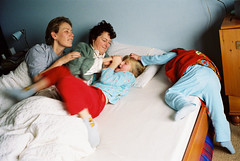
madreslesbianas88.jpgA recent New York Times article reported on some of the data that is known about gay and lesbian parenthood and how children of same-sex parents turn out. 

The Williams Institute at UCLA finds that approximately 115,772 American same-sex couples have children.  

Summarizing the state of the field:

Until relatively recently, we didn’t know much about the children of same-sex couples. The earliest studies, dating to the 1970s, were based on small samples and could include only families who stepped forward to be counted. But about 20 years ago, the Census Bureau added a category for unwed partners, which included many gay partners, providing more demographic data. Not every gay couple that is married, or aspiring to marry, has children, but an increasing number do: approximately 1 in 5 male same-sex couples and 1 in 3 female same-sex couples are raising children, up from 1 in 20 male couples and 1 in 5 female couples in 1990.

Concerning child outcomes:

“These children do just fine,” says Abbie E. Goldberg, an assistant professor in the department of psychology at Clark University, who concedes there are some who will continue to believe that gay parents are a danger to their children, in spite of a growing web of psychological and sociological evidence to the contrary.

In most ways, the accumulated research shows, children of same-sex parents are not markedly different from those of heterosexual parents. They show no increased incidence of psychiatric disorders, are just as popular at school and have just as many friends. While girls raised by lesbian mothers seem slightly more likely to have more sexual partners, and boys slightly more likely to have fewer, than those raised by heterosexual mothers, neither sex is more likely to suffer from gender confusion nor to identify themselves as gay.

Gender plays a key role in the differences that are known between children of heterosexual and sexual minority parents:

More enlightening than the similarities, however, are the differences, the most striking of which is that these children tend to be less conventional and more flexible when it comes to gender roles and assumptions than those raised in more traditional families.

There are data that show, for instance, that daughters of lesbian mothers are more likely to aspire to professions that are traditionally considered male, like doctors or lawyers — 52 percent in one study said that was their goal, compared with 21 percent of daughters of heterosexual mothers, who are still more likely to say they want to be nurses or teachers when they grow up. (The same study found that 95 percent of boys from both types of families choose the more masculine jobs.) Girls raised by lesbians are also more likely to engage in “roughhousing” and to play with “male-gendered-type toys” than girls raised by straight mothers. And adult children of gay parents appear more likely than the average adult to work in the fields of social justice and to have more gay friends in their social mix.

Same-sex couples, it seems, are less likely to impose certain gender-based expectations on their children, says M. V. Lee Badgett, director of the Center for Public Policy and Administration at the University of Massachusetts at Amherst and author of “When Gay People Get Married: What Happens When Societies Legalize Same-Sex Marriage.” Studies of lesbian parents have found that they “are more feminist parents,” she says, “more open to girls playing with trucks and boys playing with dolls,” with fewer worries about conforming to perceived norms.

They are also, by definition, less likely to impose gender-based expectations on themselves. “Same-sex parents tend to be more equal in parenting,” Goldberg says, while noting that no generalization can apply to all parents of any sexual orientation. On the whole, though, lesbian mothers (there’s little data here on gay dads) tend not to divide chores and responsibilities according to gender-based roles, Goldberg says, “because you have taken gender out the equation. There’s much more fluidity than in many heterosexual relationships.”

Halloween PumpkinsUSA Weekend recently highlighted the growing fascination that Americans have with our favorite blood-sucking friends: vampires.   This phenomenon is underscored by the recent success of the Twilight series, HBO’s second-most watched series ever True Blood, and the popularity of the new CW network show The Vampire Diaries.

Karen Sternheimer, sociologist at the University of Southern California, provides commentary: 

“One reason for the intense teenage interest in newer stories, especially Anne Rice’s The Vampire Chronicles, Twilight and The Vampire Diaries, is the sense that the vampires are outsiders among us. In True Blood, they’re simply trying to fit into society. Often, they’re also seen as more vulnerable and less predatory.  Vampires look like us, but they’re different, and those are experiences that a lot of young people can relate to, especially dealing with not just the physical aspects of relationships when you’re young but also the emotional aspects, the danger vs. the draw of that so-called ‘forbidden love’ that really resonates with a lot of young women.”

Charlaine Harris, author of the Sookie Stackhouse novels (upon which True Blood is based), provides additional commentary: 

“Vampires never have to go on Social Security, they never have to have a hip replacement, they’re never going to need bifocals  They just won’t have the problems of aging that humans face, and that’s very appealing, especially perhaps to Americans.”

On that note, pay attention to how many little vampires you see roaming the streets tomorrow night.

2009.06.13 - Stella & Jolene swingset 23This weekend I came across a press release from Media Newswire highlighting new research by University of Chicago sociologist Mario Small about how child care centers serve a function that is often overlooked — “they connect parents with each other as informal advisors in child rearing and with agencies that help with the challenges of parenting.”

About the study:

The centers become locations where parents can build “social capital”—the contacts they need to navigate through problems, such as concerns for a child’s development and finding good health care and schools. The concept of social capital, developed at the University over decades, helps explain the powerful effect of personal connections on social status and financial success.

Unacquainted parents often become dependent upon each other through networks at their children’s day care centers, said Mario Small, Professor in Sociology at the University of Chicago and author of Unanticipated Gains: Origins of Network Inequality in Everyday Life. The book, one of the first to look at the impact of child care centers on parents, finds a wide range of different outcomes for parents depending on their day care or preschool of choice.

“Parents come to school to find someone to care for their children, and they end up learning ways of taking care of each other,” Small said. “When you are a parent, particularly a first-time parent, the best resource you have is another parent.”

Mothers particularly build up their network, or social capital, in a variety of ways. By working together on fundraising activities or taking field trips, they meet others who can provide helpful advice about a child’s health, or help care for a child when parents have an emergency.

The research showed benefits for poor and non-poor parents. Mothers with children in child care centers had at least one more good friend than other mothers, for instance. Non-poor mothers who made friends at day care centers were nearly 60 percent less likely to be depressed than those who did not make friends. Poor mothers were less likely to experience homelessness if their children were enrolled in day care centers, even if they had experienced homelessness before.

Small’s research included more detailed findings about variations in the benefits of these centers…

Small found that not all the networks are equal, however. Some centers encourage connections by organizing parties and events around Mother’s Day. Child care centers that have strict pick-up and drop-off times are more likely to have strong parent networks because more parents gather at the same time and likely know each other.

The differences emerged from research based on Small’s “Childcare Centers and Families Survey” of 300 randomly sampled centers in New York in 2004. In addition to interviews with parents and center staff, the research also included data from the Fragile Families and Child Wellbeing Study of 3,500 mothers of children born between 1998 and 2000 in the nation’s 20 largest cities.

The information about services and connections with social service providers was particularly helpful to poor mothers. Agencies find centers a convenient way to reach the families they seek to serve. “Part of the reason the centers can serve as brokers is that they deal with a very targeted population,” Small said.

Non-profit organizations, for instance, interested in reaching disadvantaged children with opportunities such as exposure to arts programs, or gifts at Christmas, find it convenient to work through day care centers, he found. Agencies providing health care assistance and information about domestic violence also find it useful to visit day care centers and post notices of their services on bulletin boards, he found.

“The reason this happens is because of the professional ethos of the centers. Over and over I heard center directors say, ‘You can’t take care of the child without taking care of the family,’” he said.  Some centers, such Head Start, receive government funding and are required to provide resource information.

Small found that centers in poorer neighborhoods, at least in New York, are more likely to get services than those in more well-to-do neighborhoods. The experience may vary in other parts of the country.

Read more.

Day 143/365: only one at the park

Science Daily posted a release on new work by Markella Rutherford of Wellesley College to be published in the upcoming issue of Qualitative Sociology about how children today enjoy more freedom from chores and other demands at home, but are more restricted in their activities when they are outside of the house.

Rutherford’s project:

Children have certainly mastered the art of selecting, negotiating and even refusing the chores their parents assign to them. This growth in personal autonomy at home over the last few decades could be the result of shrinking opportunities to participate in activities outside the home, without Mom and Dad looking over their shoulder, according to Dr. Markella Rutherford from Wellesley College in the US. Her analysis of back issues of the popular US magazine, Parents, maps how the portrayal of parental authority and children’s autonomy has changed over the last century…. She analyzed a total of 300 advice columns and relevant editorials from 34 randomly chosen issues of Parents magazine, published between 1929 and 2006, to see how parental authority and children’s autonomy have been portrayed over the last century.

The findings:

The articles in Parents showed that children were increasingly autonomous when it came to their self-expression, particularly in relation to daily activity chores, personal appearance and defiance of parents. In contrast to this increased autonomy that child-centered parenting has given children, the 20th century has seen, in other ways, children’s autonomy curtailed, through increasingly restricted freedom of movement and substantially delayed acceptance of responsibilities. Children now have fewer opportunities to conduct themselves in public spaces free from adult supervision than they did in the early and mid-twentieth century.

Read more about the study.

bennyThe New Mexico Business Weekly ran a story about a new study from the National Association of Colleges and employers about new employment statistics for college graduates. The bottom line… sociology majors aren’t doing so hot.

The paper reports:

College graduates from the class of 2009 who have been able to find jobs are landing starting salaries comparable to those offered a year ago, a new report has found.

This year’s graduating class held its ground with average starting salary offers, demonstrating that employers are reluctant to significantly tinker with starting pay despite the recession, a report by the National Association of Colleges and Employers found.

The average starting salary offer for new college graduates is $49,307, which is less than 1 percent lower than the average of $49,693 that 2008 graduates posted last year at this time, according to a news release Wednesday.

Although engineering majors seem to be doing quite well, liberal arts majors appear to fall slightly behind.

Liberal arts grads experienced a decline of less than 1 percent from $36,419 last year to $36,175, the study found.

Among the liberal arts disciplines, English majors posted a 1.1 percent increase in their average salary offer to $34,704. The salary offers for history majors rose 1.7 percent to $37,861. Psychology majors’ average salary offers grew 2.1 percent to $34,284. Sociology majors, on the other hand, saw their average offers fall 4.4 percent to $33,280.

Read more.

At the end of last week the New York Times ran an article about how the effects of parental imprisonment have led to a ‘tide of troubled kids.’

The Times reports (with sociological commentary):

The chances of seeing a parent go to prison have never been greater, especially for poor black Americans, and new research is documenting the long-term harm to the children they leave behind. Recent studies indicate that having an incarcerated parent doubles the chance that a child will be at least temporarily homeless and measurably increases the likelihood of physically aggressive behavior, social isolation, depression and problems in school — all portending dimmer prospects in adulthood.

“Parental imprisonment has emerged as a novel, and distinctly American, childhood risk that is concentrated among black children and children of low-education parents,” said Christopher Wildeman, a sociologist at the University of Michigan who is studying what some now call the “incarceration generation.”

Work by sociologist Sara Wakefield offers additional insight:

Quantifying other effects of parental incarceration, like aggressive behavior and depression, is more complex because many children of prisoners are already living in deprived and turbulent environments. But researchers using newly available surveys that follow families over time are starting to home in on the impact.

Among 5-year-old urban boys, 49 percent of those who had a father incarcerated within the previous 30 months exhibited physically aggressive behaviors like hitting others or destroying objects, compared with 38 percent of those in otherwise similar circumstances who did not have a father imprisoned, Dr. Wildeman found.

While most attention has been placed on physical aggression, a study by Sara Wakefield, a sociologist following children in Chicago, found that having a parent imprisoned was a mental-health tipping point for some. Thus, while 28 percent of the children in her study over all experienced feelings of social isolation, depression or anxiety at levels that would warrant clinical evaluation or treatment, about 35 percent of those who had an incarcerated parent did.

And additional sociological commentary…

With financial woes now forcing many states to rethink the relentless expansion of prisons, “this intergenerational transfer of problems should be included as an additional cost of incarceration to society,” said Sarah S. McLanahan, a sociologist at Princeton University and director of a national survey of families that is providing data for many of the new studies.

Read more.

The Philadelphia Inquirer ran a story about the recently-released paperback edition of a volume edited by Elijah Anderson entitled, Against the Wall: Poor, Young, Black and Male. The collection of sixteen essays, includes work by William Julius Wilson, Gerald D. Jaynes, and David Kairys, with a foreword by Cornel West.

The Inquirer reports:

They are overrepresented in the ranks of the unemployed and the incarcerated, and underrepresented as college students, as live-in husbands, and as fathers raising children. They are more likely than most to die early and violently. Perhaps most important, young black men are among the most misunderstood people in America.

To bring awareness and understanding to their plight and to offer solutions, sociologist Elijah Anderson has brought together a roster of eminent and emerging social scientists and activists in his latest work, Against the Wall: Poor, Young, Black, and Male.

The review goes on to say…

Anderson has made certain to include the perspectives of emerging young thinkers as well, including his son Luke, a community organizer in Chicago; Waverly Duck, a postdoctoral fellow in sociology at Yale; and Imani Perry, a professor of law at Rutgers-Camden who is joining the faculty at Princeton University.

Anderson has long contended that in impoverished black communities, income is derived from three main sources: low-paying jobs, welfare, and an irregular, underground economy based on bartering, borrowing, hustling and street crime.

The failure of any one of those sources, he asserts, pushes individuals to one of the two others, and the disappearance of low-paying jobs and welfare drives people to the underground economy, which is governed by violence. This assertion is the premise of Anderson’s seminal books Code of the Street: Decency, Violence, and the Moral Life of the Inner City (1999) and A Place on the Corner (1978).

In his own essay, Anderson writes that inferior schooling, employment discrimination, and stereotypes have taken a heavy toll on the social capital of young black men.

“All this set the stage for the situation we face today. The social costs of impoverishment fell particularly hard on the heads of young black men who are feared by the rest of society and left to fend for themselves by white authorities,” Anderson writes. “In his alienation and use of violence, the contemporary poor young black male is a new social type peculiar to postindustrial America. This young man is in profound crisis. His social trajectory leads from the community to prison or cemetery, or at least to a life of trouble characterized by unemployment, discrimination and participation in an oppositional culture – which is how he goes about dealing with the alienation from society.”

The overwhelmingly positive review encourages interested readers to seek out this book to better understand an array of social problems, but reviewer Vernon Clark notes that “a weakness of the book is that the prescribed solutions are not nearly as concrete or commensurate in number as the relentless documentation of the problems and the long list of them.”

Read more.

Torrie and KelliYesterday Newsweek ran a story entitled “Like A Virgin No More: MySpace Generation Brides Go For Sexy, Not Virginal,” and explored “why modern brides are opting for racy gowns, wild bachelorette parties and sexy Maxim-style pre-wedding photo shoots.”

Newsweek reports:

Two decades ago, when young girls wondered how brides were supposed to look and behave, they’d most likely conclude—with some prompting from Cinderella—that on their big day they’d be a princess. They’d be blushing, virginal and wrapped from head to toe in tulle and lace.

So why is it that these days, some brides seem to be taking their cues more from Jessica Rabbit than Cinderella? More vamp than virgin, they’re having bachelorette parties that are as raunchy as their fiancés’ sendoffs. They’re selecting cleavage- or lower-back-baring bridal gowns that might get a gasp from conservative relatives. “A big-selling style is a sheer lace corset midriff,” says Millie Martini Bratten, the editor in chief of Brides magazine. “It’s clearly meant to look like you’re seeing through someone’s shirt.” And today’s wife-to-be is hiring photographers for what are called “boudoir shoots,” where they pose Maxim magazine-style in lingerie or nothing at all and give the prints to their grooms—a trend that Bratten says began about three years ago. “It’s the ultimate display of freedom and empowerment,” says Bee-Bee Kim, the founder of Weddingbee.com, a wedding-planning site that gets more than a million unique visitors a month.

What is going on here? Lucky for us, they consult several sociologists…

The rise of the bride who is more bold than blushing can be explained by a host of sociological factors, most of which have nothing to do with the word “bridezilla.” For one, our entire culture is loosening up and becoming more sexualized, and taking the wedding ceremony—and young girls’ dreams of what theirs will be like—with it.

This is, after all, is a generation that is comfortable with “sexting” and posting provocative pictures of themselves on Facebook and MySpace. And it’s an age when respected actresses and role models pose seductively on the covers of the lad magazines. “In American society now, you see little girls being sexed up,” says Chrys Ingraham, a sociologist and author ofWhite Weddings: Romancing Heterosexuality in Popular Culture, a critique of the wedding industry. “You can’t disconnect that from the way the wedding industry is going. We have 13-year-olds getting makeovers and having oral sex.”

The first glimpse of the bride as sexpot came with racy bachelorette parties. According to the sociologist Beth Montemurro, author of Something Old, Something Bold: Bridal Showers and Bachelorette Parties, these become more popular after sexually liberated working women started appearing on television programs likeMoonlighting or Murphy Brown  in the late ’80s and ’90s. Women decided they wanted a real night out, too, instead of afternoon gifting and the bride in a hat made of ribbons from the presents she got. “The women I interviewed didn’t like bridal showers,” Montemurro says. “They saw their fiancés going out and having these nights where they were drinking, and thought, ‘It’s not fair that I’m in this stilted ritual where I have to act very feminine and proper while the guys are going out and having fun’.” Strip clubs, bars and whoever makes those glow-in-the-dark penis-shaped rings capitalized on this sentiment by marketing to brides, and women everywhere adorned in condom-covered veils went out to celebrate.

Newsweek’s assessment?

While most sociologists agree that women admitting to lust and wanting to be sexually empowered is a good thing, they see a problem with making exhibitionism the centerpiece of the wedding ceremony: it might crowd out other aspects of the marriage. “You’re highlighting what should just be a piece of the relationship,” says Stephanie Coontz, a social historian and the author ofMarriage, a History: How Love Conquered Marriage, which looks at how recent the idea of marrying for love is. “I worry that it can take over. The message you’re sending about your appearance can override other conversations you should be having about your future.” And in what she wants for the future, Jessica Rabbit has got nothing on the average American bride.

Read more.

KARPOV THE WRECKED TRAIN
The New York Times has posted a story entitled, “For Teenagers, Hello Means ‘How About a Hug?'” But does the dramatic rise in teen hugging really signal a culture shift?

The Times reports:

There is so much hugging at Pascack Hills High School in Montvale, N.J., that students have broken down the hugs by type:

There is the basic friend hug, probably the most popular, and the bear hug, of course. But now there is also the bear claw, when a boy embraces a girl awkwardly with his elbows poking out.

There is the hug that starts with a high-five, then moves into a fist bump, followed by a slap on the back and an embrace.

There’s the shake and lean; the hug from behind; and, the newest addition, the triple — any combination of three girls and boys hugging at once.

There seems to be some inter-generational bewilderment about these rituals…

Girls embracing girls, girls embracing boys, boys embracing each other — the hug has become the favorite social greeting when teenagers meet or part these days. Teachers joke about “one hour” and “six hour” hugs, saying that students hug one another all day as if they were separated for the entire summer.

A measure of how rapidly the ritual is spreading is that some students complain of peer pressure to hug to fit in. And schools from Hillsdale, N.J., to Bend, Ore., wary in a litigious era about sexual harassment or improper touching — or citing hallway clogging and late arrivals to class — have banned hugging or imposed a three-second rule.

Parents, who grew up in a generation more likely to use the handshake, the low-five or the high-five, are often baffled by the close physical contact. “It’s a wordless custom, from what I’ve observed,” wrote Beth J. Harpaz, the mother of two boys, 11 and 16, and a parenting columnist for The Associated Press, in a new book, “13 Is the New 18.”

“And there doesn’t seem to be any other overt way in which they acknowledge knowing each other,” she continued, describing the scene at her older son’s school in Manhattan. “No hi, no smile, no wave, no high-five — just the hug. Witnessing this interaction always makes me feel like I am a tourist in a country where I do not know the customs and cannot speak the language.”

For heaven’s sake, call in the sociologist!

Some sociologists said that teenagers who grew up in an era of organized play dates and close parental supervision are more cooperative with one another than previous generations — less cynical and individualistic and more loyal to the group.

But Amy L. Best, a sociologist at George Mason University, said the teenage embrace is more a reflection of the overall evolution of the American greeting, which has become less formal since the 1970s. “Without question, the boundaries of touch have changed in American culture,” she said. “We display bodies more readily, there are fewer rules governing body touch and a lot more permissible access to other people’s bodies.”

Hugging appears to be a grass-roots phenomenon and not an imitation of a character or custom on TV or in movies. The prevalence of boys’ nonromantic hugging (especially of other boys) is most striking to adults. Experts say that over the last generation, boys have become more comfortable expressing emotion, as embodied by the MTV show “Bromance,” which is now a widely used term for affection between straight male friends.

…But some sociologists pointed out that African-American boys and men have been hugging as part of their greeting for decades, using the word “dap” to describe a ritual involving handshakes, slaps on the shoulders and, more recently, a hug, also sometimes called the gangsta hug among urban youth.

Read more.

Nicely ScrewedEarly this week USA Today ran a story about last weekend’s Council on Contemporary Families conference in Chicago, during which experts discussed how topics such as sexual orientation, sexual labeling, and gender-bending were no longer “x-rated or adults-only topics, but rather subjects that young people talk about as they figure out how they fit in.” Psychologist Braden Berkey told conference attendees, “Youth are saying they don’t want to be defined by gender or orientation.” 

USA Today reports:

Berkey is founding director of the Sexual Orientation and Gender Institute at the Center on Halsted, which opened in 2007 to offer support services and programming for the area’s lesbian, gay, bisexual and transgender community. He talked about the evolution of sexual and gender labels and how young people today are trying to dissolve them. He says the terms created in the early days, such as lesbian, gay, bisexual and transgender, are giving way to other descriptions, such as polygender or multisex. Young people, he says, reject narrow gender definitions and say they don’t want to be defined by their sexuality.

However, a presentation by sociologist Barbara Risman of the University of Illinois at Chicago suggested that for the middle-schoolers she’s studied, attitudes about sexual orientation are less open-minded, especially for boys. She says these boys fear the label “gay.”

More from Barbara Risman…

Among boys, “homophobia in middle school is used to police gender,” she says. In-depth interviews with 43 students at an urban middle school in the Southeast found vast differences between the sexes.

“Today, girls are free to do sports and be competitive. No one thought they had to play dumb to get a boyfriend. The women’s movement has done great things for middle school girls,” she says.

“It’s another story with boys. I feel like we’re in a time warp. We have not dealt with men and masculinity in a serious enough way,” she says.”Boys police each other. There’s no room not to do anything not traditionally masculine.”

Risman says it’s important not to generalize the findings to most American children, but she says the fact that boys are labeled quickly suggests that this is a developmental stage. The study, she adds, was limited by many rules requiring parental permission for contact with minors.

Risman says it’s the stigma of homosexuality that looms among young boys. Being emotional or caring too much about clothes or liking to dance are reasons that boys give for describing someone as “girlish,” she says.

Read more.