
sexuality

  • Arlie Russell Hochschild (Professor Emerita of Sociology at the University of California, Berkeley) appeared on Next Question with Katie Couric, discussing her book Stolen Pride: Loss, Shame, and the Rise of the Right. The book describes how residents of Pikeville, KY, a small city where 80% of 2016 voters supported Donald Trump, felt a pervasive sense of economic loss and why Trump’s messages resonated with them. In response to the 2024 election, Hochschild comments: “I feel like America is now living with two denials. There’s the denial of the Democratic side of America that is [] really denying what a big sector of America that has faced tremendous loss and has lost faith in the government’s response to that… But there’s a denial on the Right side of the aisle. Republicans that may have voted for a man for one reason—the border, the price of gas. But we are facing, I think, a danger to democracy and I think there is a discounting and a denial of that on the Right side of America.” Stolen Pride was recently recognized by the New York Times as one of the 100 Notable Books of 2024.

  • On Dec. 3rd, South Korean President Yoon Suk Yeol declared martial law, prompting widespread protests. He rescinded the decision six hours later. Gi-Wook Shin (Professor of Sociology and Director of the Asia-Pacific Research Center and Korean Studies Program at Stanford University) described the decision as a “surprising last-ditch move by Yoon to grab political power” amid low approval ratings. Shin appeared on NPR’s All Things Considered, discussing the future of democracy in Korea: “I think for a short term, there will be a lot of uncertainties and maybe instability in politics and society, maybe even in the economy. But in the long run, I think Korea has strong democratic institutions… And I remain optimistic, especially that such a move like martial law, you know, failed, you know, quite badly and very quickly.”

  • The New York Times ran an opinion piece featuring Allison Pugh’s (Professor of Sociology at John Hopkins University) new book The Last Human Job: The Work of Connecting in a Disconnected World. Pugh’s work reveals how technology––particularly artificial intelligence–has permeated work that requires “connective labor” and how “being able to have a human attend to your needs has become a luxury good.” However, Pugh commented that a dystopian future is not inevitable despite advances in interactive AI, because “humans lose interest in interacting with machines after a while, partly because of machine predictability.”

  • The Ink ran an article featuring Musa Al-Gharbi’s (Assistant Professor in the School of Communication and Journalism at Stony Brook University) new book We Have Never Been Woke: The Cultural Contradictions of a New Elite. “One of the key arguments of the book,” Al-Gharbi explains, “is that in many respects — and somewhat troublingly, from my perspective – social justice discourse is increasingly used by symbolic capitalists [elites who are committed to social justice], by the winners and the prevailing order of people who have been succeeding and flourishing, to justify inequalities. People who are losing, and suffering, and getting left behind, who feel like their values and interests are not reflected in our institutions, we [symbolic capitalists] point to those people and say, Good. They deserve to be marginalized. They deserve to be ignored. And we do this in the name of social justice. We use social justice, in many cases, to legitimize inequalities.”

  • Danielle Lindemann (Professor of Sociology at Lehigh University) was quoted in an Epic Stream article about what reality television reveals about our culture. Lindemann argues that reality TV provides a reflection of real-life people and social problems (like inequalities based on race, class, gender, or sexuality): “For all of its extreme personalities and outlandish premises, reality TV reflects how regressive we truly are.”

  • Scott Schieman (Professor of Sociology at the University of Toronto) wrote an article for The Conversation on how accurately the ‘unhappy worker’ narrative reflects American workplace satisfaction. Schieman identified “perception glitches” (the difference between how people felt about their own job and how people believe most American workers feel about their jobs) in job satisfaction, stress, compensation, management-employee relationships, and putting in ‘above-and-beyond’ effort. Schieman’s research suggests an “everything is terrible, but I’m fine” mindset, both “ch
  • Boris Kagarlitsky (prominent Russian sociologist and editor in chief of the Marxist online publication Rabkor) was recently sentenced to five years in prison for criticizing the war in Ukraine. Natalia Zviagina, Amnesty International’s director for Russia, characterized the sentence as an “abuse of vague anti-terrorism legislation,” commenting that “by targeting Boris Kagarlitsky, a distinguished sociologist known for his critical stance against government policies, the Russian authorities are showing, once again, their relentless assault on all forms of dissent.” This story was covered by The Washington Post.
  • Christina Ciocca Eller (Assistant Professor of Sociology and Social Studies at Harvard) recently published a study modeling a new potential rating system for U.S. higher education institutions. “Essentially, the [current] rankings don’t account for anything that happens after students walk through the college gates,” Eller argues. Eller’s proposed system focuses instead on the equalizing effect of colleges (how much schools are “leveling the playing field” across students). This story was covered by The Harvard Gazette.
  • Tina Fetner (Professor of Sociology at McMaster University) recently released a new book, Sex in Canada: The Who, Why, When, and How of Getting Down Up North. As the first national survey of sexual behavior of the general population of Canada, Fetner’s work fills a gap in national research. “If we move away from the taboos and shame, we can see that our sexual behaviour is much like any other social behaviour,” Fetner commented. “It is shaped by social norms, regulated by social institutions, and influenced by our cultures.” This story was covered by Brighter World and Vancourver is Awesome.

Photo of a pregnancy test by Johannes Jander, Flickr CC

New York recently changed their abortion laws to allow late-term abortions when the circumstances put the mother or the fetus at risk. The law has since spurred controversy, causing a backlash in many states to limit abortion access and curb women’s reproductive rights. The law and its political backlash highlight how we often think about pregnancy as a yes-or-no answer, an all-or-nothing commitment. But a recent article in The Upshot emphasizes how this binary view of pregnancies as either “planned” or “unplanned” is inaccurate. Recent research shows that in 9 to 19% of pregnancies the mother was not sure what she wanted at the time. However, most service providers do not account for this kind of ambivalence.

Sociologist Heather Rackin argues that the distinction between  “unintended” vs. “unwanted” pregnancies is important:

“It might not be that unintended pregnancy has all these negative consequences that we think about…for some people, it might have positive consequences.”

However, when pregnancies are unwanted, mothers tend to lack resources needed to raise a child. Family planning services can address this distinction by providing continual care depending on the needs and desires of their patients. To reduce the number of unwanted pregnancies, doctors have been encouraged to ask patients about their desires to become pregnant. For those that may not want to be pregnant, contraceptive methods with more efficiency than birth control may be ideal. On the other hand, doctors can provide prenatal guidance and a contraceptive method that is reversible for patients who are uncertain.

In short, pregnancy and parenthood are complex — decisions to raise a child cannot be reduced to whether a pregnancy is planned or unplanned.

Photo by Hillel Steinberg, Flickr CC

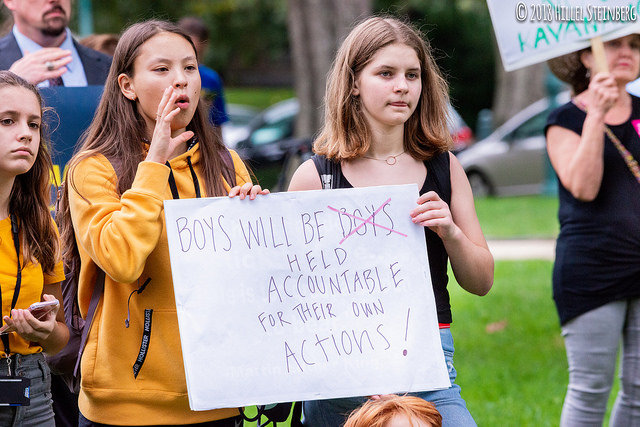
The recent Gillette ad questions the beliefs underlying the phrase “boys will be boys,” and challenges viewers to reconsider how young boys learn what it means to “be a man” in American society. The ad has since spurred controversy, and some observers have even claimed that masculinity is “under threat.” In a recent Vox article, Tristan Bridges describes how the ad reflects broader societal issues around masculinity, and explains why some men may view the ad as an attack on masculinity.

American masculinity tends to promote potentially harmful characteristics in men, like showing toughness instead of acknowledging emotions. Many men feel as though they must prove this masculinity to others. Bridges explains that when men feel that their masculine identity is threatened, they tend to overcompensate in aggressive ways. For example, Bridges mentions a study where men who were told they had traits categorized as more highly feminine were more likely to blame victims of sexual assault and defend perpetrators than those who did not get feedback that threatened their masculinity.

Bridges argues that the Gillette ad may be one of the only times men explicitly see beliefs about masculinity under scrutiny:

“Men are not used to having masculinity defined for them, and sometimes they don’t realize the little ways these really problematic stereotypes of masculinity can crop up in their own lives.”

According to Bridges, this traditional messaging of masculinity is harmful to boys’ emotional and mental health because they are taught to respond to threats rather than accept challenges and critically question their behaviors and mentalities around masculinity:

“We’re not very good at talking with men about how to be challenged and not feel like your gender is threatened…We now talk to boys about consent, but not how to “retain their dignity” in the face of rejection.”

This leads to boys dealing with frustrations around their masculinity by being aggressive or dominant; both are behaviors that can have serious repercussions, not just for themselves, but for the people around them. 

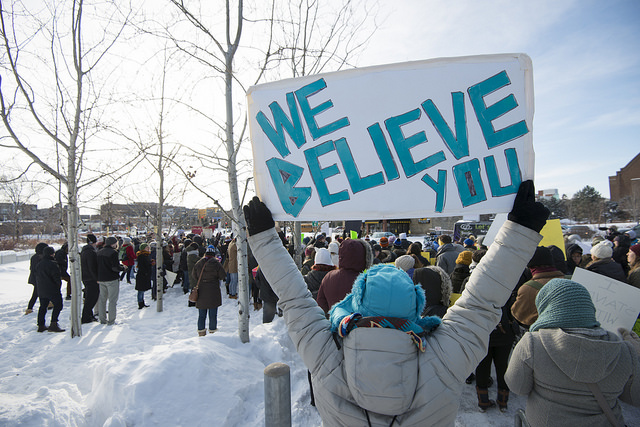
A marcher holding a sign that says, “we believe you.” Photo by Fibonacci Blue, Flickr CC

Since Surviving R. Kelly aired on Lifetime, we’ve seen a rise of activists led by Black women calling for the #MuteRKelly campaign, which dissuades music labels, radio stations, and other music platforms from selling, distributing, and promoting R. Kelly’s music. But despite the recent backlash, fans across the country continue to show their support for the R&B star. While some attempt to separate their feelings about the art from the artist, others dismiss Black women’s claims of R. Kelly’s abusive behaviors altogether. Much of this support comes from other Black R. Kelly fans. The documentary and the subsequent controversy also shed important light on an issue that is often missing from the public sphere: the plight of Black women and girls who experience sexual violence. Saida Grundy’s recent piece in The Atlantic helps us break down how Black support for R. Kelly remains despite the shocking revelations from Black women.

Rape myths have long obscured sexual victimization by suggesting that “real rape” occurs by strangers in a dark alley, women who dress “proactively” and show signs of intoxication “ask for it,” and men are not responsible for assault because they are unable to control their sexual impulses. According to Grundy, Black survivors and victims encounter a distinct set of racialized rape myths both from the broader public and from members of their own racial/ethnic community.

“With racialized rape myths, people compound untrue narratives about sexual assault with their own self-interests. For example, some African Americans might think defending Kelly is a way to push back against the history of false rape allegations from white women against black men — allegations that functioned as assaults on black communities, as they were commonly used by whites to justify the lynching of African American men during the Jim Crow era.”

Grundy echoes work by Black feminist scholars, such as Beth Richie, who argue that Black women and girls experience a “trap of loyalty,” where they are expected to resist racism against Black men by excusing or altogether denying abusive behaviors, even at the risk of concealing and enduring their own abuse. Furthermore, recent reports illustrate how Black girls are viewed as more adult and consequently less innocent than white girls. These myths surrounding innocence create interlocking gendered and racialized messages about Black girls’ and women’s sexuality that suggest they are “fast,” hypersexual, and deserving of men’s and boys’ unwanted advances towards them. In the age of #MeToo, disrupting racialized rape myths and the broader rape culture allows us to understand the race- and gender-specific mechanisms that damage Black girls’ and women’s credibility and impede disclosure and reporting on their experiences with sexual violence.

Photo of a person with their back to the camera facing a train as it rushes past. Photo by Georgie Pauwels, Flickr CC

Despite growing research that people are having less sex in the United States, the perception that “everyone is doing it” persists, especially for young people. In a recent article, The Atlantic asked social scientists why young people aren’t having more sex.

Lisa Wade, author of the book, American Hookup Culture, says that one of the reasons for is that young people are more likely to have sex within relationships than in hookups, and always have been:

“Go back to the point in history where premarital sex became more of a thing, and the conditions that led to it…Young women, at that point — [the 1940s and 50s] — innovate ‘going steady.’ If you [go out with someone for] one night you might get up to a little bit of necking and petting, but what happens when you spend months with them? It turns out 1957 has the highest rate of teen births in American history.”

Part of the reason young people today are having sex more in relationships than in hookups — at least for women — might be that they are avoiding bad sex. According to Paula England, women report sex in hookups is less pleasurable than sex in relationships. Based on recent trends, it appears as though fewer young people are actually having relationships at all, marriage or otherwise. And the rise of online dating apps means that people meeting online are marrying more quickly, which might mean they are dating less overall, according to Michael Rosenfeld.

Despite a decline in sex overall for young people, this decline likely does not affect all young people equally. Since research shows that a good sex life appears to contribute to happiness and other health benefits, this also means that those who do not have a fulfilling sex life also do not reap those benefits. The article’s author, Kate Julian, concludes,

“Like economic recessions, the sex recession will probably play out in ways that are uneven and unfair. Those who have many things going for them already — looks, money, psychological resilience, strong social networks — continue to be well positioned to find love and have good sex and, if they so desire, become parents. But intimacy may grow more elusive to those who are on less steady footing.”

Photo by NCDOTcommunications, Flickr CC

Intersectionality is a term frequently used in many different contexts, from social movements to academic research to everyday speech. A recent article in The New York Times explores how intersectionality — defined as “the complex and cumulative way different forms of discrimination like racism, sexism and classism overlap and affect people” — influences men and women of color in the workplace.

The article draws from a recent non-profit study surveying 1,600 participants in workplaces ranging from corporations to higher education. Most respondents said they were “highly on guard at work,” which often meant they actively repressed traits others might perceive as frightening or intimidating. For example, they arrived early to meetings so they would be seated when others arrived in order to appear less threatening.

While the majority of workers in the study reported this need to be “on guard” to protect themselves against racial and gender bias, the types of stereotypes various groups face are not the same. For example, African-American women tend to face the stereotype of “the angry black woman,” while Latinas face stereotypes about being “too emotional or too wedded to their families.” Sociologist Yung-Yi Diana Pan notes that Asian-Americans are sometimes identified as “being workhorses without creativity” and “passive and acquiescent,” and this may lead to fewer promotions according to a recent report by the Ascend Foundation. 

Part of the problem, according to sociologist Lata Murti, is that women of color are constantly compared to professional white women — the “invisible norm.” So, what is the solution? Latasha Woods, brand manager at Proctor & Gamble argue it starts with leadership:

“We need leadership that truly cares about inclusion — a lot care about diversity, but how do you foster inclusion? People spend a lot of time on what they know the boss cares about. If they see the boss cares about inclusion they will too.”

Photo of two people walking through rows of large columns. Photo by Roman Boed, Flickr CC

Despite the longevity signified by the phrase, “till death do us part,” many American marriages are not so permanent. The statistic that half of marriages end in divorce has been cited for decades, but research by Philip Cohen shows that divorce rates have been falling for the last few years, even after accounting for demographic changes over that time. In a recent article in The Atlantic, Andrew Cherlin provides an unromantic explanation for the recent trend: “In order to get divorced, you have to get married first.”

In other words, declines in divorce are more driven by who is getting married than increased marital stability. Historically, divorce rates have been highest among Americans without a college degree. However, this group is now more likely to delay or forego marriage than they were 20 or 30 years ago. Victor Chen suggests that one factor responsible for marriage declines among people without a college degree is lack of jobs. Well-paying jobs for the less educated have become sparse as the American economy has transitioned away from manufacturing. Without stable employment, it is harder to maintain long-term romantic partnerships.

Another factor could be a rising acceptance of cohabitation, which has decreased the pressure for couples in their 20s to marry. Delaying marriage has benefits for marital quality. Cherlin explains:

“If you’re older, you’re more mature … you probably have a better job, and those things make it less likely that you’ll get into arguments with your spouse.”

However, declines in marriage do not necessarily mean that Americans are getting better at long-term partnership. Rather, relationship volatility is moving from the context of marriage to cohabitation, where it is harder to measure. These falling marriage rates among the less-educated parallel a growing gap between the richest Americans and everyone else. College graduates, who are more likely to marry, are better positioned to endure economic uncertainty and build wealth through their pooled incomes. This leads Cohen to conclude that marriage is “an increasingly central component of the structure of social inequality.” In other words, while declining divorce may look like a positive trend at first glance, it may speak more to growing inequality than it does enduring love.

Photo by Steve Rainwater, Flickr CC

Supreme Court nominee — now associate justice — Brett Kavanaugh gave an interview to Fox News where he claimed that he could not have assaulted Dr. Christine Blasey Ford because he did not have sex until many years after high school. In a recent op-ed for Huffington Post, sociologist Sarah Diefendorf argues that this ‘good guys’ defense perpetuates an erroneous belief that rapists are fundamentally bad people who are incapable of becoming successful and accomplished people, like Brett Kavanaugh. Diefendorf explains,

When Kavanaugh or other men respond to allegations of sexual assault by making themselves look like good guys, they’re trying to pin the blame on other “bad” men as failures of masculinity. This good guy defense is brilliant. It allows men to make the problem of sexual assault and rape about being an individual ― the work of bad men, not a bad culture ― when we know that it is actually a widespread cultural problem.

Instead of a binary where there are ‘good’ and ‘bad’ guys, Diefendorf cites social science research about how young men learn that masculinity means exerting dominance. This can mean symbolic domination, like calling another man a ‘fag’ or bragging about sex with women, or physical domination, like sexual assault. Citing her own research, Diefendorf points out that dominance work is a show for other men. She writes,

My research suggests that masculine bonding at the expense of women might be even stronger among men who are virgins. I spoke to men ages 19 to 25 who were virgins to understand how virginity affected how they saw themselves as men. Male virginity is often stigmatized, so the men I spoke to had to find other ways to be accepted as manly. They would talk to other men about sex frequently to show how hard it was to keep themselves from doing it.

Social science can remind us that masculinity carries assumptions of domination and is a powerful cultural force in shaping behavior — a force that can affect even those who present themselves as ‘good guys.’

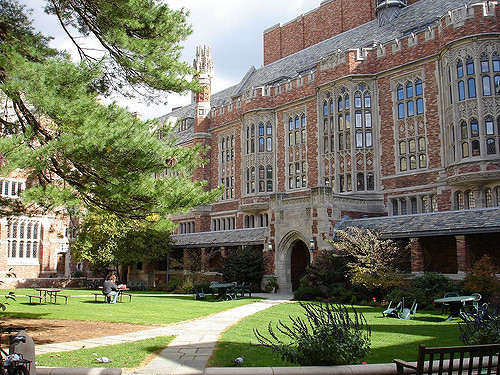
Photo of Yale Law School courtyard. Photo by stepnout, Flickr CC

More than 20 million people tuned in to the Ford-Kavanaugh hearing on Thursday. Many sociologists provided perspectives on the hearing, outlining everything from the myths about rape to the connections (and differences) with the Anita Hill and Clarence Thomas case. In an op-ed for The Washington Post, Shamus Khan provides his take on how class privilege shaped many of Brett Kavanaugh’s actions.

In his book Privilege, Khan followed students at St. Paul’s, an elite private school in New Hampshire. He describes how elite institutions, including the ones Kavanaugh attended, like Yale, foster privilege among their predominantly upper-class student bodies. This privilege includes ideas that students are “exceptional” and that the “rules don’t really apply to them.” As Khan explains in the article,

“What makes these schools elite is that so few can attend. In the mythologies they construct, only those who are truly exceptional are admitted — precisely because they are not like everyone else…Schools often quite openly affirm the idea that, because you are better, you are not governed by the same dynamics as everyone else. They celebrate their astonishingly low acceptance rates and broadcast lists of notable alumni who have earned their places within the nation’s highest institutions, such as the Supreme Court.”

These narratives of privilege among the elite can have some pretty nasty implications. Khan cites research by economist Raj Chetty demonstrating that admission to an Ivy League school is rarely the result of educational aptitude, but rather extreme family wealth. He asserts that this class privilege, masked by notions of “exceptional qualities,” is tied to beliefs about special treatment among the elite. For example, Kavanaugh’s supporters argue that he deserves the Supreme Court nomination and accountability for actions he committed years ago doesn’t really apply to him. Khan illustrates further how this privilege also shaped Kavanaugh’s actions on Thursday:

“This collective agreement that accountability doesn’t apply to Kavanaugh (and, by extension, anybody in a similar position who was a youthful delinquent) may help explain why he seems to believe he can lie with impunity — a trend he continued Thursday, when he informed senators that he hadn’t seen the testimony of his accuser, Christine Blasey Ford, even though a committee aide told the Wall Street Journal he’d been watching.”

In short, Khan’s research demonstrates how class privilege has shaped Kavanaugh’s actions from the outset, and how this privilege is cemented by the institutions and social circles around him.