

immigration

Rebecca Hanson (Professor of Sociology at the University of Florida), David Smilde (Professor of Sociology at Tulane University), and Verónica Zubillaga (Sociologist and Co-Director of the Network for Activism and Research for Coexistence) wrote an article for the New York Times in response to the Trump administration’s deportations of Venezuelan men to El Salvador. Hanson, Smilde, and Zubillaga note that the Venezuelan gang Tren de Aragua lacks organizational power and political aspirations in the U.S.: “Organized crime is far less portable than people usually think. It typically involves control of illicit markets, which in turn depends on relationships with local people and officials. These networks are not easily transferable and limit mobility.” The authors challenge these inhumane deportations: “The mass criminalization, arbitrary detainment and violation of due process that have characterized the Trump administration’s actions so far have echoed some of the tactics of the Venezuelan regime many of these young men presumably fled from. It reduces U.S. credibility and emboldens authoritarians everywhere.”

Rebecca Hanson, David Smilde, and Verónica Zubillaga

Oneya Fennell Okuwobi (Assistant Professor of Sociology at the University of Cincinnati) wrote an article for Salon highlighting the unintended consequences of diversity initiatives–in particular, that they tend to benefit corporations, not employees. Okuwobi explains how many workplaces engage in “diversity displays,” focusing on external appearances. “While workplaces receive the bulk of benefits, employees of color receive the burdens of upholding the image of diversity, with serious costs in terms of additional work, questions about our capabilities, and the need to fit the appearance of diversity that our workplaces desire.” Okuwobi writes more on this topic in her new book, Who Pays for Diversity: Why Programs Fail at Racial Equity and What to Do About It

Oneya Fennell Okuwobi

Lucius Couloute (Assistant Professor of Sociology at Trinity College) wrote an article for The Conversation on how U.S. parole systems contribute to recidivism. Couloute argues that although parole was “originally designed to help those convicted of crimes reintegrate into society – through mentorship, supportive services and other resources,” it now serves as a system of punitive surveillance that creates “hidden traps rather than pathways to success.”


Lucius Couloute

Lucius Couloute (Assistant Professor of Sociology at Trinity College) wrote an article for The Conversation on how U.S. parole systems contribute to recidivism. Couloute argues that although parole was “originally designed to help those convicted of crimes reintegrate into society – through mentorship, supportive services and other resources,” it now serves as a system of punitive surveillance that creates “hidden traps rather than pathways to success.”The New York Times ran an article on how I.V.F. technologies may be changing the way we view and relate to embryos. Time-lapse microscopy, a technology that has been widely used since the early 2010s, allows for observation of embryo developments. Many clinics share this video footage with patients on the day of their embryo transfer, before they know if the transfer was successful. The article cites research from Manuela Perrotta (Sociologist at the Queen Mary University of London), finding that some clients experience a deep connection with the video footage. “​​I felt like it was, it was a baby,” one patient told Perrotta and a research co-author. “It sounds really weird, but it felt like I was looking at a potential baby there, and watching it move and do all the stuff, and I just looked, it looked — I know it wasn’t just cells for me.”

Manuela Perrotta and Lucius Couloute

This week, Christine L. William’s (Professor of Sociology at the University of Texas) work on workplace inequality was featured in a question on Jeopardy!: “Similar to a barrier to women’s rise, this ‘escalator’ coined by sociologist Christine Williams invisibly lifts men.” This story was covered by the ASA.

Christine L. William

Photo of the wall in Nogales that divides Mexico and the United States. Photo by Jonathan McIntosh, Flickr CC

Current pressure for a wall on the United States’ southern border has been a centerpiece in politics and the media, but push for a wall is one recent development in a complex history of border politics. For centuries, the border has been a site for war, conflict, immigration, and trade. A recent article in The Washington Post highlights how these historic events have contributed to defining what the border means today, and how — especially in recent decades — this has led to calls for heightened security and enforcement.

The border itself is a powerful political symbol. According to sociologist Douglas Massey, it is not just

a border but the border, and its enforcement has become a central means by which politicians signal their concern for citizens’ safety and security in a hostile world.”

Recent work by Massey highlights how throughout history this “hostile” world has been defined and composed of dissident actors — drug traffickers, terrorists, communists, or criminals — with politicians using them as political chips to peddle and spin different narratives on how and why we should protect the border.  

This research demonstrates that whether the southern border is an invisible line, physical fence, or wall, it continues to be a symbolic boundary for people who hold a profound fear of those who are non-white or of different cultural backgrounds. For example, recent political positions towards Central American migration to the United States seem to echo historic anti-immigrant attitudes. During the late 19th century, Chinese laborers were banned for decades from immigrating to the U.S. for their perceived cultural and economic threat to American society.

As debates continue over the construction of a southern wall, it is worthwhile to question if anti-immigrant attitudes and fears are haunting reverberations of the past. Recognition of the complex history of the U.S.-Mexico border and its connection to fear of crime and xenophobic attitudes may be a useful starting point so that today’s politics do not become “another brick in the wall” in the history of the border.

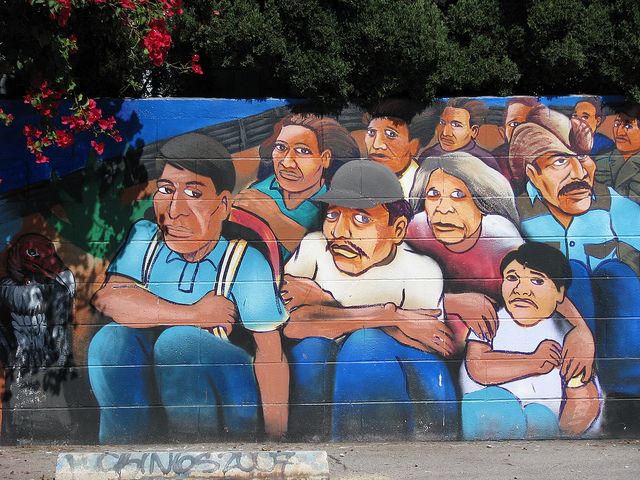
Photo of a mural in Los Angeles, California of people huddled together and a wall in the background. Photo by claumoho, Flickr CC

Even after signing a resolution to suspend the longest government shutdown in U.S. history, President Trump remains committed to delivering his long-promised southern border wall. In defense of the wall and the recently failed $5.7 billion Senate proposal, Trump again made comments on national security that contradict numerous studies and immigration scholars. However, the wall is not the only immigration policy proposed by the administration that could have dire social repercussions.

In a recent op-ed for the MinnPost, an interdisciplinary team of expert immigration scholars at the University of Minnesota, including Ryan Allen, Jack DeWaard, Erika Lee, and Chris Levesque, argues that the administrative changes to the ‘public charge’ rule is one such policy. The ‘public charge’ rule is a policy used to evaluate non-U.S. citizen applicants for U.S. residency by how likely they are to become dependent on the government for support. The Trump administration aims to make it easier for government officials to decide an immigrant is ineligible for residency if they are in need of or use government assistance programs. The research team highlights serious consequences of such a policy: in the wake of this announcement, many legal immigrants who are entitled and in need of health and social assistance programs fail to use them out of fear. This could produce detrimental effects on public health by spreading certain diseases across communities and reducing economic productivity.

The research team, which includes community stakeholders and activists, is committed to igniting critical discussions that address these challenges faced by individuals and families who immigrate to U.S. communities. In a sole-authored piece for the Pioneer Press, Jack DeWaard writes,

“…discussions and debates about U.S. immigrants, immigration and immigration policy must start with the very simple recognition that immigrants are people — often facing incredible hardships — seeking to do the best for themselves, their children and their families against a backdrop of widening inequality, both globally and within the U.S. With this as the starting point, say what you will about issues like the economic impacts of immigration…, men and women of character and integrity neither promote nor sit idly by as immigrants, including young children, are…denied their rights…in the process for doing what any person in their position would do — namely, ask for help.”

Photo by Fibonacci Blue, Flickr CC

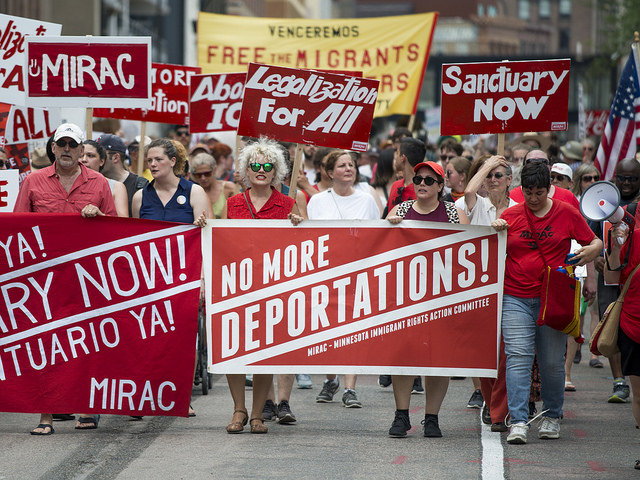
The current immigration policies and practices of the Trump administration have received significant scrutiny. Many detainees are subjected to inhumane treatment in Immigration and Customs Enforcement (ICE) facilities around the nation, demonstrated in recent reports of  sexual assault and the potential death of a migrant child upon release from detention. In a recent article in The Conversation, sociologist Tanya Golash-Boza argues that the criminalization and deportation of immigrants is nothing new, but rather that the Trump administration’s actions are part of a broader pattern of mass deportation.

In 2003, the Department of Homeland Security was created, and upon its inception housed both ICE (which was also formed in 2003) and Customs and Border Protection to enforce immigration laws. According to Golash-Boza, the transferral of immigration law enforcement from the Department of Justice to the Department of Homeland Security served two purposes: changing the tone of immigration enforcement as an issue of national security and a massive cash flow to immigration law enforcement agencies.

Even though immigration is central to Trump’s image and platform, deportations were actually highest under President Obama, with three million people deported during his tenure. Tough immigration enforcement has occurred across party lines and is about more than just ICE. Golash-Boza expands,

“For the past 20 years, aggressive immigration law enforcement has been a constant across Democrat and Republican administrations. Democratic President Bill Clinton signed laws in 1996 that greatly expanded deportations. Republican George Bush created the Department of Homeland Security and, in effect, ICE. The creation of the Department of Homeland Security led to a spike in the number of people deported from the U.S.”

Golash-Boza’s research demonstrates that ending mass deportation in the United States will require more than just standing up to Trump and ICE, but addressing our history of aggressive immigration policies and its connections to the “war on terror.”

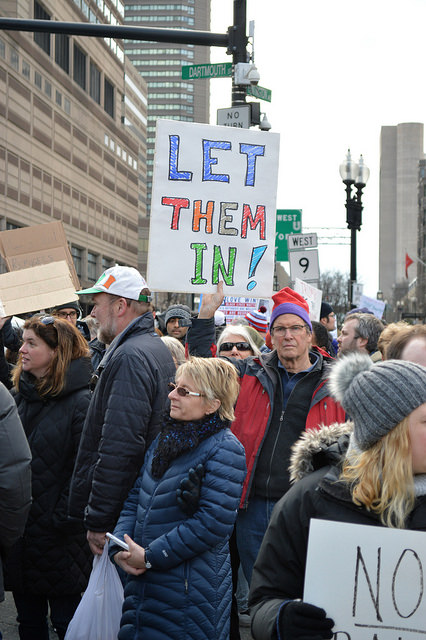
2017 Immigration Rally in Boston. Photo by Terry Holt, Flickr CC

Throughout history, immigrant groups have been used as scapegoats for social problems — be it the continually unfolding European refugee crisis or the aftermath of the Holocaust. And those in favor of xenophobic policies, tend to encourage these negative sentiments against immigrants to garner support these types of policies. In the United States, many politicians demonize immigrants for their supposed violence, but a recent article in The New York Times features research that undermines the foundations of this contention. A team of researchers, led by sociologist Robert Adelman, examined 200 cities across the United States to uncover the relationship between immigration and crime trends over the course of several decades. Their study concluded that while immigration has risen in almost every city since the 1970s, crime has not:

“In 136 metro areas, almost 70 percent of those studied, the immigrant population increased between 1980 and 2016 while crime stayed stable or fell. The number of areas where crime and immigration both increased was much lower — 54 areas, slightly more than a quarter of the total. The 10 places with the largest increases in immigrants all had lower levels of crime in 2016 than in 1980. And yet the argument that immigrants bring crime into America has driven many of the policies enacted or proposed by the administration so far: restrictions to entry, travel and visas; heightened border enforcement; plans for a wall along the border with Mexico…But while the immigrant population in the county has more than doubled since 1980, overall violent crime has decreased by more than 50 percent.”

And while the researchers cannot use this evidence to establish whether an increase in immigration reduces crime, they clearly show that an immigration influx is not the disastrous picture painted by many news sources and politicians:

“In general, the study’s data suggests either that immigration has the effect of reducing average crime, or that there is simply no relationship between the two, and that the 54 areas in the study where both grew were instances of coincidence, not cause and effect. This was a consistent pattern in each decade from 1980 to 2016, with immigrant populations and crime failing to grow together.”

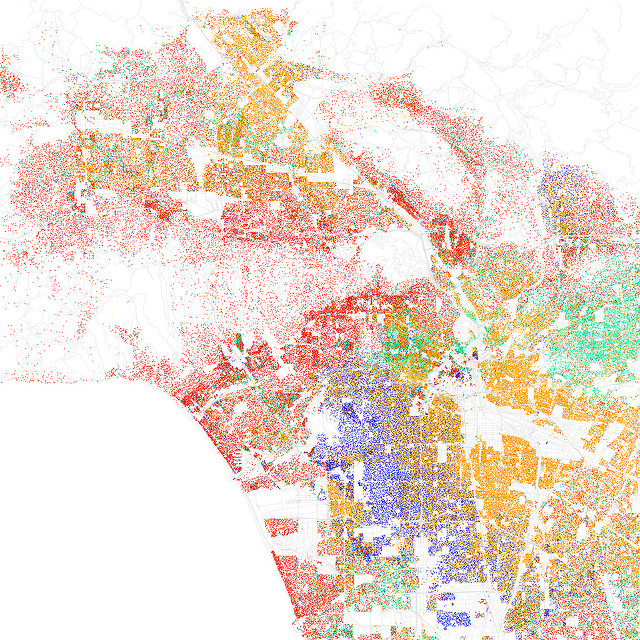
Racial Dot Map for Los Angeles based on 2010 Census. Photo by Eric Fischer, Flickr CC

The United States Census is a trusted source for population data. But, like all large-scale survey projects, the census must make decisions about how to define and analyze elements for categorizing data, like racial group.  In a recent article in The Washington Post, sociologist Richard Alba argues that the census over-estimates counts of racial and ethnic minorities, a move that can seriously affect politics and policies in the United States.  

Alba particularly has a problem with how the census counts mixed-race youth. For young people from a mixed Hispanic and White background, the census only counts them as Hispanic, not as both White and Hispanic — similar to the age-old idea of the “one-drop rule” instituted for Black people in the United States. This way of counting leads to an over-estimate of Hispanics in the United States, and this may fuel White fears about becoming a minority in the near future.

Alba points out that, “distorted census data can result in inaccurate statements of ‘fact’ and misleading projections for the future.” Take, for example, President Trump’s desire to limit immigration from African countries and encourage immigration from European countries like Norway. Alba argues that the lack of fundamental changes to the 2020 census will only continue to fuel misperceptions about racial and ethnic change in the United States:

“Census statistics will continue to roil the public discussion of diversity, by exaggerating white decline and the imminence of a majority-minority United States. Political figures and pundits who oppose immigration and diversity could exploit that, peddling an alarmist narrative that doesn’t fit with the long-standing reality of mixing between immigrant and established Americans.”

Photo by Ray_LAC, Flickr CC

With the current presidential administration’s promises to build border walls and increase deportations, it may be surprising that Latinx immigrants report experiencing less discrimination than those born in the United States. According to a recent survey featured in NPR’s Code Switchonly 23% of Latinx immigrants report experiencing discrimination, while 44% of Latinx born in the United States report discrimination. 

Sociologist Emilio Parrado told NPR that perceptions and experiences of discrimination are related to an individual’s level of participation in and adaption into United States culture. Research suggests that Latinx born in the United States may face more direct discrimination than immigrants, because they are more likely to engage in competitive workforce and social settings. 

“Discrimination is a strategy of the dominant group to protect itself, to protect the benefits that they have, so discrimination is something that emerges not when people are culturally different, but that emerges when people compete.”

Parrado also argues that many immigrants come to the United States without knowing the contextual “rules” of interactions with others, which makes it harder to  immediately identify instances of discrimination or racism.

“For immigrants, there is a process of learning that you are being discriminated against…Immigrants tend to think that it’s their own fault, that it’s because they don’t know the rules, or they don’t know English.”

Thus, past research may not fully capture how much discrimination is occurring simply because people may not recognize it as such. In response, some children of Latinx immigrants who were born in the United States are trying to educate their families on what discrimination looks like.

Photo by John Morton, Flickr CC

As the election edges ever closer, the phenomenon of Donald Trump continues to grow. Trump has a realistic opportunity to become the next president of the United States, but a recent jump in immigrants applying for citizenship this year might change the outcome once November comes.

Manuel Pastor, professor of sociology and director of the Center for the Study of Immigrant Integration at USC, recently wrote an article in the LA Times about the increasing number of applications for U.S. citizenship.  From March to June of 2016, the number of immigrants who applied to become naturalized citizens is up 32% over the previous year, and many of these naturalized citizens might be eligible to vote this coming November.  A new report from the Center for the Study of Immigration Integration examined how significant an impact this increase in naturalized citizens might have if they are eligible to vote in the 2016 presidential election. Pastor explains,

“[T]he newly naturalized voters we counted could make a difference. In Florida, they constitute more than 6% of the voting age population. In Nevada, that share is more than 5%; in Virginia, 4%; and in Arizona, 3%. The results in recent general elections in these states have been so close that these new citizens — if they are registered and turn out — could tip the tallies.”

Photo by John Walker, Flickr CC

When it comes to evaluating immigrant groups, some groups, such as Hispanics, are often derided or seen unfavorably, while other groups, such as Asian immigrants, are held in high-esteem as the “model minority.” But as described in a new article in LA magazine by sociologist Jennifer Lee, we need to rethink the way that we define “success” for America’s immigrant populations. 

As Lee and co-author Min Zhou describe in their book The Asian American Achievement Paradoxthe advantages that Asian second-generation immigrants often have over other immigrant groups is that many of their parents have college degrees. As other research has established, you are much more likely to graduate from college if your parents have. Lee and Zhou found that the proportion of Chinese second-gen immigrants who went to college is in fact the same proportion for Mexican second-gen immigrants. Lee explains,

“Graduating from college is no easy feat, but it’s far easier when your parents have paved the path before you…Often overlooked is the remarkable progress that the children of Mexican immigrants in L.A. have made. In just one generation they have doubled the high school graduation rates of their parents, doubled the college graduation rates of their fathers, and tripled that of their mothers. Factoring in where they began, the children of Mexican immigrants come out ahead of all immigrant groups.”

Unlike other immigrant groups whose parents are more likely to have college degrees, Mexican second-gen immigrants have experienced the most “success,” overcoming the odds of often being the first person in their family to attend college. 

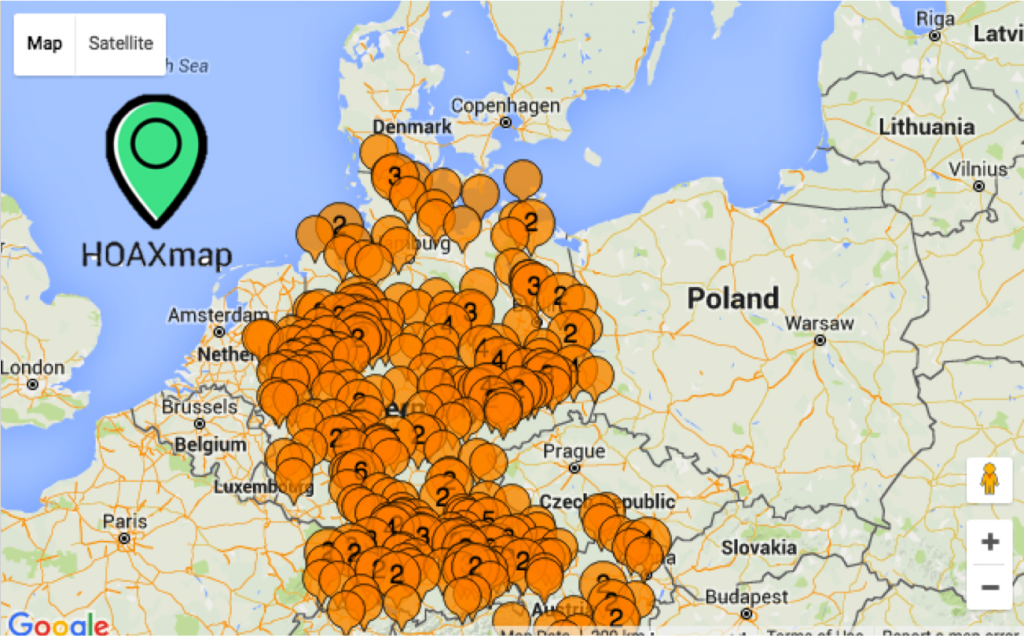
Click to visit Hoaxmap.

Over a million migrants and refugees entered Europe in 2015, leading many to dub this mass migration a “crisis.” Many are seeking asylum, especially those from countries experiencing considerable violence like Syria, Afghanistan, and Iraq. Many Europeans have reacted to the influx with fear, spreading stories that associate refugees and migrants with crime (something social scientists like to call “crimmigration”). In response, two German women created Hoaxmap to track and dispel rumors about refugees in Germany (a country that has been particularly welcoming to immigrants, per its Chancellor Angela Merkel’s directives). Of the 40 types of rumors tracked on Hoaxmap, most pertain to theft or sexual assault.

The discrepancy between documented and rumored crimes may reflect the way rumors spread and their connections to real events that people believe are plausible. Sociologist Gary Alan Fine, recently featured in an Atlantic article, agrees: “Once you have a plausible story then the criteria for information you need in order to believe [a new story] is much lower, because you would say ‘this is like what happened elsewhere.’” In fact, almost half of the rumors about sexual assault and rape associated with the contemporary immigrants cropped up in the two months following reported New Year’s Eve assaults on women in Cologne. Sociologist Mar Warr concurs that “even a small increase in apparent risk (like a locally reported rape or rapes) can generate substantial and widespread fear.” In reality, most crime in destination locations appears to have been directed at asylum seekers, rather than perpetrated by them.