economy

Respect
Reuters reported yesterday on how the downturn in the economy is a ‘double whammy’ for police in many cities as they face budgets cuts while they simultaneously brace themselves for a rise in burglaries, robberies and theft.

Although there has long been debate over the connection between crime and the economy, most of the criminologists, sociologists and police chiefs interviewed by Reuters forecast a rise in crimes in certain categories in the coming months as the United States heads deeper into recession territory.

Crime has increased during every recession since the late 1950s, said Richard Rosenfeld, a sociologist at the University of Missouri-St Louis.

Those interviewed stressed they were not talking about an increase in overall levels of crime, which have been falling in the United States since the 1990s, but an uptick in opportunistic crimes like theft and burglary. They say most crimes will still be committed by career criminals but that others in the ranks of the newly unemployed could become drawn in for a variety of reasons.

Reuters also draws upon the work of another sociologist to help explain the potential impact of budget cuts on urban crime…

Lesley Williams Reid, a sociologist at Georgia State University who has studied urban crime, said any cuts to police budgets would be bad news, particularly if the economic downturn is prolonged and more people become unemployed.

“I don’t want to add to a culture of fear, but there is a clear reason to be worried about how this is going to affect crime rates,” she said.

Read more from Reuters.

I recently discovered a series on Chicago Public Radio which features reports from Greg Scott, a sociology professor and documentary filmmaker. 

The most recent installment explores the daily lives of women working as prostitutes on Cicero Avenue in Chicago’s West Side. Scott’s story paints a vivid picture of the complex relationship between sex and pride for these women…

Listen to ‘Women of the Brickyard’ here.

For more of Scott’s stories, look here.

Manhattan SkylineThe New York Times reports this morning on the concern among New Yorkers about whether crime will return to the city ‘with a vengeance’ as the economy continues to falter. The Times contends, “Expert opinions differ, but the question is hardly illogical. The last time stocks on Wall Street fell hard, in 1987, crime was exploding, and the city saw historic highs in murders in the following years.”

And the Times calls in a sociologist…

“Every recession since the late ’50s has been associated with an increase in crime and, in particular, property crime and robbery, which would be most responsive to changes in economic conditions,” said Richard Rosenfeld, a sociologist at the University of Missouri-St. Louis. Typically, he said, “there is a year lag between the economic change and crime rates.”

The Times adds…

New York, of course, has over the last 15 years seen an extraordinary drop in crime, from the most serious to the mildly irritating. But across all those years, economists and sociologists have debated how much of the success was attributable to new trends in policing and how much to other factors, including a robust economy.

Read the full story.

IMG_1579The Christian Science Monitor reported this morning on the enduring signs of US power despite the economic crisis. Many people seem panicked about America’s status as a superpower, so the Monitor investigated scholarly opinions as to whether ‘the American century’ is over. 

Sociologist Immanuel Wallerstein brings his take to this coverage…

Still, what seems clear is that the experience of the Bush years, now drawing to a close amid the worst economic calamity in eight decades, have bolstered those who long predicted a clipped American eagle. “What George Bush did was turn a slow decline into a precipitous one,” says the noted Yale University sociologist Immanuel Wallerstein, who has been predicting the end of the American empire since the 1980s.

“We’ve had two standout factors: the Iraq war, which not only demonstrated but actually accelerated this decline in power, and then the way this president put the American government in such deep debt,” Mr. Wallerstein says. “What we see playing out before us is the culmination of these actions.”

The Monitor concludes….

But for the moment, it’s the financial crisis that is providing a gauge of America’s enduring leadership capacity. With many economists citing international coordination as key to righting the global economic ship, one test will come Friday when finance ministers of the world’s seven major economies meet in Washington.

Read more.

L1030439

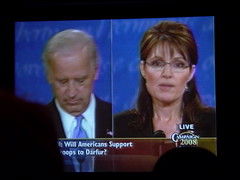
Eleanor Clift of Newsweek, has recently written about how vice-presidential candidate Sarah Palin is reigniting the culture war as her ‘everywoman’ act plays well with audiences. She suggests that this might indicate that the GOP will try to once again paint Barack Obama as an elitist.

In her article Clift included commentary from sociologist Todd Gitlin, who spoke at a Pew Forum discussion in Washington as to whether the cultural war will have an impact come November…

Todd Gitlin, a professor of journalism and sociology at Columbia University, speaking from the progressive side, said the culture war always matters, but that it may not be decisive, with economic issues making it harder for Republicans to get traction on lampooning Obama as an elitist, in the way they turned John Kerry into a windsurfing Frenchman. Gitlin described the presidential election as a “quadrennial plebiscite of who we are,” with Americans casting their vote for the candidate that best embodies who we are as a nation.

Newsweek’s commentary on the vice-presidential candidates in this culture war…

Nobody wants to be an elitist. In politics, it’s a deadly label. What we saw in Thursday night’s debate were two competing strains of populism. Biden, the Irish-Catholic kid from Scranton, represents Main Street populism, the people against the powerful, anti-corporatism, little guy kitchen-table values. Palin is wooing the same working-class constituency that could decide the election in battleground states like Ohio and Pennsylvania with her pro-gun, family and religious down-to-earth values.

Read more here.

rush-hour escalatorsA new article from the ‘Health’ section of Newsweek magazine explores how the gloom and doom of current economic news might have a real physical effect on us. The fear of losing one’s job is a daily concern for many Americans and the physical and mental health consequences are now being documented by social science research.

A psychologist weighs in…

Layoffs create a sense of hopelessness. Stress-related complaints such as insomnia and headaches tend to follow, lingering even after victims find new jobs, says University of Michigan psychologist Richard Price, who tracked more than 700 layoff victims for two years. Research based on 17 years of Pennsylvania unemployment records concluded that employees affected by a mass layoff at a plant were 15 percent more likely to die of any cause over the next two decades. Experts blame the cascade of misfortune that often ensues after a layoff, including the loss of health insurance.

The sociological perspective…

Your health can suffer simply from fear of losing your job, says Sarah Burgard, a sociologist at the University of Michigan. After crunching data from two large national surveys, she concluded that chronic job insecurity over a two-year period rivals the anxiety of a job loss or a major illness. Burgard adjusted her data for what psychologists call “neuroticism” and found that even people who aren’t typically worriers report worse health when they believe their jobs are in danger. Fears of poor job prospects may have similar consequences. 

Full story.

wall of random foodThe Houston Chronicle reported today on the growing number of families (specifically in San Antonio) who are turning to food banks and other forms of public assistance under the strain of high food prices and a precarious economy. 

The alarming trend, exemplified in San Antonio…


The San Antonio Food Bank helped 315,869 families in the fiscal year that ended in June, an 85 percent increase from the previous year. The food bank gave away about 30 million pounds of food in the last fiscal year, only second to the 33 million pounds it gave away when thousands of Hurricane Katrina evacuees arrived here. “Even though we are not dealing with a natural disaster, we are dealing with a disaster nonetheless,” said Zuani Villarreal, the food bank’s director of development. The number of people on food stamps in Bexar County climbed from the previous year by 10,000 people in August, said Stephanie Goodman of the state’s Health and Human Services Department in Austin. Statewide, enrollment increased by 190,000 people.


A sociologist weighs in…


Johnnie Spraggins, a University of Texas at San Antonio sociology professor, said the economy is affecting everyone, but San Antonio has a large population of working poor.

“Basic things like bread and milk are rising, and people can’t do without them, so they turn to the food bank and food stamps,” he said.

Full story.

A Sign of PeaceThe Minneapolis Star-Tribune reports on the difficulty graduates face finding employment after completing college. Some of these students are choosing programs like the Peace Corps which are becoming increasingly difficult to be placed in.

Star-Tribune reporter Emma Carew writes:

This year, as the economy hit a downturn and employers cut jobs instead of creating them, a record number of graduates applied to programs that try to change the world — something experts believe is a top priority for today’s youth.

At Teach For America, a two-year program that places college graduates in low-performing schools around the country, the number of applicants fell in 2007 but this year jumped 36 percent to nearly 25,000 would-be teachers. Only 3,700 are placed. When the program began in 1990, 2,500 students applied. Even the Peace Corps, now in its 47th year, has had a 14 percent increase in applicants so far this year over last.

And the sociological commentary…

Teresa Swartz, professor of sociology at the University of Minnesota, said current college graduates are experiencing an extended period of adolescence, as the gap between high school and adulthood widens.

It’s harder for students to make livable wages right out of school, so they spend a few years exploring, she said.

Read more.

The latest issue of Newsweek surveys a number of recent economic studies which suggest that economic growth may have a great deal to do with attitudes of a nation’s people. Newsweek writer Stefan Theil writes,

Much of the worldwide economic and political debate these days circle around ensuring continued growth—which, it’s hoped, will help various countries escape the global downturn, create more jobs and finance the rising cost of social services. What the conversation overlooks is that it turns out some countries might not want to grow.

These recent studies have been best summarized by Meinhard Miegel, of the think tank Denwerk Zukunft, who found that “while two thirds of Germans favor economic growth in principle, only about a sixth of them are willing to work for it. The rest value leisure, safety and early retirement over work and achievement. Given these attitudes, says Miegel, the popular idea that a low-birthrate country like Germany can grow its way out of the rising costs associated with an aging population ‘is reckless and built on sand.'”

But where does Weber come in? Theil continues…

Miegel might be unduly pessimistic, but he is part of a growing movement of experts who argue that economic growth is actually dependent on a state of mind. In fact, the idea goes back to Max Weber, the German sociologist who argued more than a century ago that England’s Protestant work ethic gave rise to modern capitalism. Today’s Weberians aren’t sociologists wielding historical arguments, however, but economists, pollsters and biologists working with actual numbers and data sets. Their interest in how personal attitudes might affect growth is part of the broader reinvention of economics, in which the classical view—that people make rational choices in a world of perfect information—is coming under increased scrutiny. The movement also reflects rising concern over whether growth can be increased—especially now with the ugly specter of stagflation in large parts of the globe.

Economists now claim Weber as their own…sociologists don’t work with ‘actual numbers and data sets?’

Read on.

meet the managersA recent broadcast from Minnesota Public Radio‘s Midmorning program, titled “Women, Earning Power, and the Economy,” took an in-depth look at the complex factors that determine how women are faring in today’s economy. In an attempt to discern the what has the greatest impact on women’s earning potential, this piece discusses a number of possible reasons beyond conventional explanations such as marital status and number of children.

This broadcast includes commentary from two sociologists: Leslie McCall, professor of sociology at Northwestern University and Maria Kefalas, professor of sociology and director of the Institute for Violence Research and Prevention at St. Joseph’s University.

Listen online.