
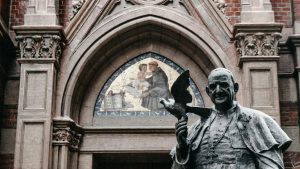
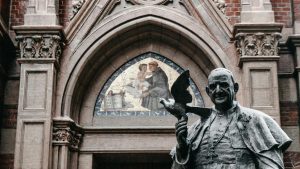
EWTN News wrote a piece on Sean M. Theriault’s (Professor of Government at the University of Texas at Austin) researches how Pope Francis differs from his predecessors. In the study, he focuses on the Pope’s actions regarding policy, appointments, and papal trips. Theriault found that Francis focused more on issues like immigration and refugees than traditional diplomatic concerns in his papal addresses. He accelerated diversity by appointing cardinals from Laos, Sweden, and Brunei. Francis also sought to spend more time with marginalized visiting prisons and homeless centers on his papal trips. Theriault says that “in the long run, Pope Francis’ legacy is going to be far more pronounced precisely because he was succeeded by Leo, who is bringing along the whole Church and institutionalizing that vision in a way Francis just did not know how to do.”


In an article for CNBC, Danielle J. Lindemann (Professor of Sociology at Lehigh University) explains the ways watching reality TV can change your behavior. Lindemann says, “there’s a lot of research that shows people are consuming these shows more actively and, whether good or bad, learning from the shows.” Reality TV has become a staple in American culture with shows like “Love Island USA”, “The Bachelorette”, and “Survivor” averaging millions and even billions of views. Three ways Lindemann cites that watching reality TV can change your behavior include: 1) making you more, or less, empathetic, 2) influence how you perceive conflict or approach dating, and 3) foster closeness between you and other viewers of the shows you love.


The Guardian ran an article about the ways Florida sociology professors are quietly defying restrictions on teaching race and gender. Many are acting out of professional responsibility rather than defiance in order to provide students with a full rigorous education. Zachary Levenson (Associate Professor of Sociology at Florida International University) comments on the nature of the restriction saying, “What I find most concerning is that we’re in this phase now where instead of telling us what not to teach, they’re telling us what to teach.” Other scholars argue that removing examination of race, ethnicity, and sexual orientation will hollow out the field and mischaracterize the discipline. The bans are also impacting students whose identities, history, and lived experiences are being dismissed as unimportant. Faculty have built networks across all the campuses to exchange information, organize learning opportunities, and draft public statements or seek legal analysis. However, tensions are high as tenure and adjunct positions are being challenged and professors face risks of public scrutiny and censorship. In spite of the heightened scrutiny professors refuse restrictions and continue teaching, uncertain of the future of the discipline’s critical core under immense political scrutiny.


Megan Thiele Strong (Associate Professor Department of Sociology and Interdisciplinary Social Sciences at San José State University) wrote an op-ed in the Chattanooga Times Free Press, arguing that campaigns of misinformation, exclusion, and censorship are threatening the position of sociology and sociologist. People in society are currently sociologically ignorant. The discipline is rarely taught in K-12 and is being restricted within higher education. Trump’s regime and those in power target and undermine the knowledge of the discipline using anti-public strategy to suppress and shift our culture away from important conversations about inequality. Strong argues that we need sociology in all levels of education and public space: “Talking about these injustices or expanding opportunity to discuss our shared social structure isn’t radical. It’s the ‘justice for all’ part of our pledge of allegiance.”
Comments 6
Greg — May 9, 2026
Interesting report
Greg — May 9, 2026
This is a thoughtful roundup of how sociology enters public conversation through media, education, and culture. I was especially struck by the link between reality TV, social learning, and everyday behavior, as well as the discussion of what is lost when teaching about race and gender is restricted. Those examples show that people do not develop communication, empathy, or social expectations in isolation—they learn them through institutions, stories, and repeated interaction. That is one reason this piece feels so timely.
I’m currently working on Social Interaction Trainer (https://social-interaction-trainer.com), a project that uses interactive scenarios to help people practice conversation, read emotional cues, and respond more thoughtfully in everyday situations. In that sense, the themes here resonated strongly with me. Our project explores how tone, timing, conflict, and empathy shape outcomes in social exchanges, which overlaps with the broader sociological question of how people learn to relate to one another. Articles like this are a strong reminder that sociological insight belongs in public life, not only in journals or classrooms.
Greg — May 9, 2026
This is a thoughtful roundup of how sociology enters public conversation through media, education, and culture. I was especially struck by the link between reality TV, social learning, and everyday behavior, as well as the discussion of what is lost when teaching about race and gender is restricted. Those examples show that people do not develop communication, empathy, or social expectations in isolation—they learn them through institutions, stories, and repeated interaction. That is one reason this piece feels so timely.
I’m currently working on Social Interaction Trainer ( https://social-interaction-trainer.com ), a project that uses interactive scenarios to help people practice conversation, read emotional cues, and respond more thoughtfully in everyday situations. In that sense, the themes here resonated strongly with me. Our project explores how tone, timing, conflict, and empathy shape outcomes in social exchanges, which overlaps with the broader sociological question of how people learn to relate to one another. Articles like this are a strong reminder that sociological insight belongs in public life, not only in journals or classrooms.
Greg — May 9, 2026
This is a thoughtful roundup of how sociology enters public conversation through media, education, and culture. I was especially struck by the link between reality TV, social learning, and everyday behavior, as well as the discussion of what is lost when teaching about race and gender is restricted. Those examples show that people do not develop communication, empathy, or social expectations in isolation—they learn them through institutions, stories, and repeated interaction. That is one reason this piece feels so timely.
I’m currently working on Social Interaction Trainer , a project that uses interactive scenarios to help people practice conversation, read emotional cues, and respond more thoughtfully in everyday situations. In that sense, the themes here resonated strongly with me. Our project explores how tone, timing, conflict, and empathy shape outcomes in social exchanges, which overlaps with the broader sociological question of how people learn to relate to one another. Articles like this are a strong reminder that sociological insight belongs in public life, not only in journals or classrooms.
Gemini Omni — May 20, 2026
Really enjoyed this thoughtful roundup—it's a great example of how sociology can make public debates feel more grounded and relevant. I'm building Gemini Omni AI, a browser-based workspace for turning prompts and reference images into cinematic short videos.
Cetățuia Park — June 15, 2026
Interesting roundup of media reports. The piece on regional broadcast consolidation caught my eye—I've been wondering how that might affect local news coverage in smaller markets. Do you think we'll see more independent outlets emerging as a counter-trend?