cohabitation

Sociologist Arielle Kuperberg conducted new data analysis exclusively for this CCF briefing report that shows how cohabitation has changed from 1956 to the present. This new brief also includes findings from her forthcoming journal article in Marriage and Family Review. Historian Stephanie Coontz, CCF’s research director, reflects on what Kuperberg’s discoveries tell us about the state of close relationships in this interview on American Intimacy in Times of Escalating Inequality.

The most common path to marriage these days includes cohabitation, according to research presented to the Council on Contemporary Families by sociologist Arielle Kuperberg (UNC-Greensboro). In “From Countercultural Trend to Strategy for the Financially Insecure: Premarital Cohabitation and Premarital Cohabitors, 1956-2015,” Kuperberg reports how cohabitation raised eyebrows forty years ago. She shows that in the past decade, though, an overwhelming majority of Americans approve of it. There’s an asterisk: For a highly religious minority for whom “direct marrying” might be preferable, living together before marriage has as much to do with economic resources as with values. Kuperberg’s report offers three big findings:

Cohabitation before marriage is the norm. Kuperberg reports that 70 percent of marriages start with living together. Furthermore, only 17 percent of Americans disapprove of “premarital cohabitation.” And it is with good reason, she shows, since cohabitation has ceased to be a risk factor for divorce.

Since it’s so common, who is least likely to cohabit least before marriage? College graduates—who married directly 40 percent of the time between 2011 and 2015, twice as often as people without a college education. To be clear: A majority within all educational groups—including college graduates—cohabit before marriage. Not only do less-educated people cohabit more; Kuperberg notes that “working-class couples move in together earlier in their relationships than college-educated couples, often because of financial difficulties or housing needs.”

More religiously observant people are the most likely to be direct marriers—but only if they can afford it.Among highly religious college graduates, only 35 percent cohabited before getting hitched (versus 60 percent overall). Yet, equally religious people who did not have a high school degree lived together before marriage 97 percent of the time. The greater practice of premarital cohabitation among people with less education—and most likely lower incomes—may have to do with access to resources.

Cohabitation is no longer a countercultural trend, but instead is an unremarkable practice. In the past, worry about propriety and reputation created strong cultural pressures against living together before marriage. That is no longer the case. Now, economic inequality seems to shape the choices of religiously observant people with low levels of education, who tend to have lower incomes than equally observant people who have completed college. What Kuperberg’s study adds up to is that there may be less choice about close relationships than meets the eye today.

FOR MORE INFORMATION, PLEASE CONTACT:

Arielle Kuperberg, Associate Professor and Director of Undergraduate Studies in Sociology and Cross-Appointed Faculty in the Women and Gender Studies Program, the University of North Carolina at Greensboro; atkuperb@uncg.edu.

Stephanie Coontz, Professor of History and Family Studies, The Evergreen State College, coontzs@msn.com; 360-556-9223.

A briefing paper prepared for the Council on Contemporary Families

In the early 1960s, fewer than 3 percent of women who married for the first time had lived with their husband before the wedding. As late as 1968, news of a college student living with her boyfriend touched off a national scandal. As you can see in Figure 1 (below), even by the end of the 1970s, fewer than one-third of first marriages began after premarital cohabitation. Since the mid-1990s, however, cohabiting before marriage has become the norm. Between 2011 and 2015, around 70 percent of women marrying for the first time had lived with their husband before marriage, and a 2015 national poll of U.S. adults found that only 17% believed living together outside of marriage was not an acceptable way of life.

Note: Numbers calculated from the 1988 National Survey of Families and Households (1946-1985, N=4,356) and National Survey of Family Growth (1986-2015, N=9,480) and based on women <36 at first marriage. 

As I show in a new article in the journal Marriage & Family Review based on an analysis of national data on more than 13,000 women who married between 1956 and 2015, the characteristics of couples who live together before marriage have changed over time. Despite the widespread acceptance of premarital cohabitation, its practice has changed in ways that reflect a growing divide between Americans with a college degree and those with some or no college education. This change has interacted with differences in premarital cohabitation between more- and less-religiously-observant Americans in some surprising ways.

Early cohabitation rates: Only small differences between more- and less-educated Americans.Throughout the earliest period, from 1956 to 1985 (see Figure 1), when premarital cohabitation was still practiced by a minority of couples, the few couples who lived together before marriage generally belonged to one of two distinct groups. One was composed largely of couples with the lowest level of education: 27 percent of premarital cohabitors had less than a high school education when they moved in together. But an even larger group of early cohabitors had higher levels of education; 31 percent of cohabitors had at least some college education when they moved in together.

Whether college grads or people without a high school degree, cohabitors transgressed powerful social norms when they decided to live together before marriage. This is likely for different reasons: The least educated women may have delayed marriage until they were more financially stable or to save money for a wedding, while more highly educated women were more likely participating in a new countercultural trend that stemmed from the sexual revolution of the 1960s. Still, overall there were no significant differences between rates of premarital cohabitation among couples with different levels of education during the period from 1956 to 1986.

When rates of cohabitation began to change by education. Beginning in the late 1980s, however, premarital cohabitation began to grow most rapidly among the least educated Americans. Between 1986 and 2000, premarital cohabitation rates grew more quickly among couples who had not completed high school than among any other group. At the next levels of education, differences in cohabitation rates remained small. Their rates grew more slowly, and there wasn’t a big difference among couples with at least a high school degree over this time period.

All that growth meant that, starting in 1995, a majority of first marriages have begun with premarital cohabitation. Here’s where a new educational divergence occurred: Since 2000, cohabitation rates of the most educated couples have grown markedly more slowly than those of all other educational groups – people with high school diplomas and even ones with some college. By 2011-2015, women who married directly, without first cohabiting, were a minority in every educational group. Even so, marrying directly was twice as common among women with a college degree as among women who had a high school diploma or less. More than 40 percent of women with a bachelor’s degree married in the so-called “traditional” way, without having first cohabited. But fewer than 20 percent of women who had never attended college did so.

In other words, although acceptance of premarital cohabitation is equally high among highly-educated as among less-educated Americans, the actual rates of cohabitation among couples with a bachelor’s degree or higher are much lower than those of any other educational category. College-educated couples, often considered the group most likely to challenge traditional relationship and sexual norms, are now the group most likely to practice the traditionally “respectable” route to marriage – with women moving in with their husbands only after the wedding.

Religion, Education, and Cohabitation. Direct marriers became an increasingly select group in another way as well, as you can see in Figure 2. Not only did they tend to be more educated than average, they were also more religious. In 2011-2015, 73 percent of women who married without first cohabiting attended religious services at least once a month, compared to only 46 percent of premarital cohabitors. While almost a third (29 percent) of women who cohabited before marriage never attended religious services, this was true of only 10 percent of women who married directly.

In a new analysis for this report, I found that the education gap in premarital cohabitation was even larger among women who attended religious services at least once a month than among women as a whole (see Figure 2). Among women who had a college degree and regularly attended religious services, only 35 percent cohabited before marriage. By contrast, among women who did not attend college but attended religious services regularly, a full 86 percent cohabited before marriage. The difference is even greater when we look only at equally-religiously-observant women with no high school degree, 97 percent of whom cohabited before marriage!

These figures suggest that in today’s social and economic environment, it has become harder to act on one’s personal values in the absence of the good economic prospects conferred by a college education. The majority of young adults today believe that living together before marriage is okay, and research from the early 2000s found that these rates do not differ by education. But among those who do not share this acceptance of cohabitation yet lack the high levels of education associated with stronger labor markets and greater financial stability, contemporary economic circumstances make it harder to live up to their values. The highly religious may sometimes marry even without that financial stability due to the strong social disapproval of their peers and a belief that “God will provide.” But others facing financial insecurity resulting from their low levels of education are more reluctant to make that leap, even when they would prefer to marry directly.

Note: Numbers calculated from the National Survey of Family Growth and based on women <36 at first marriage.  (N=553; Frequent Religious Service Attenders, N=315)

Even More Evidence that Resources Influence Romantic Decisions. In addition to being more likely to cohabit before marriage, recent research finds that working-class couples move in together earlier in their relationships than college-educated couples, often because of financial difficulties or housing needs. Among college-educated couples, financial difficulties seldom play a part in the decision to cohabit. Increasingly, then, the ability of couples to make decisions about cohabitation and marriage based on their values seems to depend upon their financial circumstances. And this can have consequences for relationship stability. As I show below (Figure 3), premarital cohabitation no longer predicts divorce, but moving in together rapidly does increase the possibility that a relationship will dissolve without moving on to marriage.

The Relationship of Cohabitation and Divorce Reversed over Time. In a new analysis prepared for this report and shown in Figure 3, I find that the relationship between premarital cohabitation and divorce has also changed over time. Not surprisingly, those who were willing to transgress strong social norms to cohabit from the 1950s to 1970 were also more likely to transgress similar social norms about divorce. Indeed, in that earlier period, people who lived together before marriage were 82 percent more likely to divorce than people who moved in together only after marriage. But as cohabitation became more widespread, its association with divorce faded. In fact, since 2000 premarital cohabitation has actually been associated with a lower rate of divorce, once factors such as religiosity, education, and age at co-residence are accounted for.

Note: Numbers calculated from the 1988 National Survey of Families and Households (1956-1985, N=3,594) and National Survey of Family Growth (1986-2015, N=9,420) using Cox regressions and based on women <36 at first marriage. Controls for age at coresidence, age at coresidence squared, raised not religious, religious attendance, race, education at marriage, mother’s education, prior cohabitations, lived with both biological parents at age 14, birth prior to coresidence, began coresidence while pregnant. **p<.01

But the likelihood of divorce, other research shows, also varies by education and economic stability. Regardless of whether people live together before marriage or not, college-educated couples have far lower rates of divorce than couples with a high school diploma or less. On average, women with a high school diploma or less have a 60 percent chance of a marriage ending in divorce within 20 years. The chance that a woman with a college degree will divorce within the same time period is nearly three times lower — about 22 percent.

Arielle Kuperberg is Associate Professor and Director of Undergraduate Studies in Sociology and Cross-Appointed Faculty in the Women, Gender and Sexuality Studies Program at the University of North Carolina at Greensboro. She is also the editor of the CCF blog @ The Society Pages. Follow her on twitter at @ATKuperberg and reach her at atkuperb@uncg.edu.

photo by mastertux via pixabay

A short interview with Stephanie Coontz by Virginia Rutter on a new CCF study.

VR: You edited the new brief report on cohabitation trends from the Council on Contemporary Families. In it, Arielle Kuperberg reports that premarital cohabitation is more common—occurring before 70 percent of marriages. But what does this new research tell us about Americans’ intimate lives? 

SC: First of all, it adds to our understanding of how quickly the norms and dynamics of personal relationships are changing. Until 1970, couples who cohabited before marriage were 82 percent more likely to divorce than those who married directly. That extra risk is now gone. Similarly, until the 1980s, marriages in which wives had more education than their husbands had a higher risk of divorce than other couples. But since 1990 that extra risk has also disappeared. Despite constant claims to the contrary, it is no longer true that marriages where the wife earns more than her husband are at higher risk of divorce. Finally, couples where the wife did most of the childcare and housework used to report better sex lives than couples with a more egalitarian division of labor. Now the opposite is true.

Within couple relationships there are many signs of growing equality. But that leads to a second contribution of the paper, which illustrates the growing inequality among couples on the basis of higher education, and in turn on their prospects for earning a family wage.

VR: Cohabitation looks like it is useful and valuable to many—as Kuperberg shows in the reversal of that out-of-date link between cohabitation and divorce. (See her awesome Figure 3 for a visual of the reversal!) But some people don’t want to cohabit. What do you think of Kuperberg’s findings about religion, escalating inequality, and access to “direct marrying”?

SC: Despite the widespread social acceptability of premarital cohabitation, a minority of Americans, especially those with strong religious beliefs, continue to disapprove of the practice and prefer to marry directly. Kuperberg highlights the painful dilemmas facing those who hold more traditional values but lack the resources to act on them. While two-thirds of religiously-observant women with a BA or higher did not cohabit before marriage, this was true of only 14 percent of equally observant women who did not attend college — and of just three percent of religiously-observant women without a high school diploma. As Kuperberg suggests, this is almost certainly not because of different values but of different options.

I agree that this gap likely reflects the difficulties that less-educated couples face in meeting the increasingly high economic bar for marriage. And it is especially troubling that the gap used to be just between the least-educated women and everyone else but is now greatest between the most-educated women and everyone else. The same escalating inequality between the most highly-educated Americans and others who work just as hard but are paid drastically less is also seen in rates of non-marriage and out-of-wedlock childbearing.

This divergence is likely to continue, given recent evidence that, as yet, the only group to have recovered fully from the Great Recession is people with a bachelor’s degree or higher.

VR: So what do you make of that? Growing equality within couples, and growing inequality between couples?  

SC: For one thing, it means that much family instability results not from people’s different values or “culture” but from their inability to meet the high interpersonal and economic expectations of marriage that most Americans now embrace. I am thinking of the economically insecure people who move in together rapidly and then don’t move on to marriage, resulting in a lot of churning; the growing numbers of people who are not seen as marriageable by others due to poor job prospects or low wages (low-income men right now have the worst marriage prospects); youths who lack the kind of life opportunities that give them incentives and tools to defer childbearing.

For another thing, when people feel that they are being excluded from the American Dream, they often embrace short-term coping mechanisms or compensating behaviors that make their personal lives and relationships even more difficult. And with higher wage inequality, fewer work-family protections, and a weaker social safety net than other advanced industrial economies, the U.S. imposes exceptionally heavy penalties on people who become single parents or do not complete higher education, leading to lower rates of social mobility – and higher rates of personal problems. As I’ve written elsewhere, the long-standing American myth that individuals succeed purely on their own, on the basis of their personal “grit,” actually undermines people’s ability to establish families that can thrive.


Stephanie Coontz is author of Marriage, A History: How Love Conquered Marriage. Follow her at @StephanieCoontz. Virginia Rutter is co-editor of Families as They Really Are. Follow her at @VirginiaRutter.

A new article published in Journal of Marriage and Family examines the relationship of cohabitation and divorce, and claims that recent research that finds that premarital cohabitation does not impact divorce rates is incorrect. They find that in the first year of marriage, premarital cohabitation is associated with lower divorce rates compared to those who directly marry (because those who would have divorced quickly are filtered out by premarital cohabitation), but that afterwards premarital cohabitation is associated with higher divorce rates. These effects “cancel each other out,” making it appear as if cohabitation is not associated with divorce, when, according to them, it still is; just not in very early marriage.

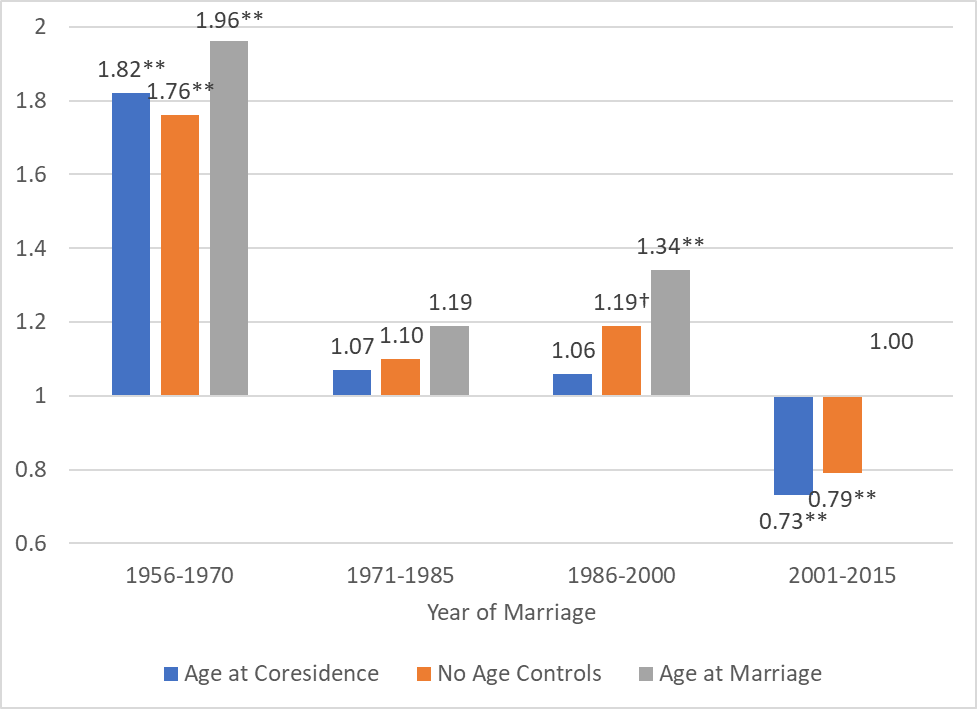
However this research makes an important omission. They account for the age at which women married their first husband, but don’t account for the age at which they moved in together.  As my past research has shown, accounting for age at marriage but not the age at which couples moved in together artificially inflates the association between premarital cohabitation and divorce for recent cohorts, compared to statistical models that account for the age at which couples moved in together, or even statistical models that do not account for age at all.

This inflation happens because the older that couples are when they move in together with the person they will eventually marry (whether at marriage or beforehand) the less likely they are to divorce.  When accounting for age at marriage only, researchers are comparing couples who married directly at, for example, age 24, to those who moved in together at perhaps age 21 and then married at age 24.

My research argues that a more accurate comparison would compare those who moved in together at, for example, 21 (and then eventually married) to those who both moved in together and married at age 21.  When doing so, the relationship between premarital cohabitation and divorce disappears for some cohorts; and in very recent cohorts, as I show in my recent CCF report, reverses, with premarital cohabitors having a lower risk of divorce compared to couples that marry directly. In other words, the reason premarital cohabitors seem to have a higher risk of divorce is not because cohabitation causes divorce; it’s because premarital cohabitors who eventually marry select partners and move in together at earlier ages compared to other couples who marry at the same age, when they are less prepared for the roles and responsibilities that are associated with eventual successful marriages.

To demonstrate the importance of how researchers account for age on research findings, I recalculated the odds ratios for the relationship of premarital cohabitation and divorce that I present in my recent CCF report on changing cohabitation over time (which accounts for age at coresidence), in statistical models that either account for age at marriage instead, or don’t account for age at all. As you can see in Figure 1 below, models that account for age at marriage show a stronger association between cohabitation and divorce. In the most recent cohort, this effect appears neutral, but when accounting for age at coresidence instead (or even if not accounting for age at all) premarital cohabitation is associated with a lower risk of divorce.

Figure 1: Odds Ratios for the Association Between Premarital Cohabitation and Divorce in First Marriages in Four Cohorts: The Importance of Age Controls

Note: Numbers calculated from the 1988 National Survey of Families and Households (1956-1985, N=3,594) and National Survey of Family Growth (1986-2015, N=9,420) using Cox regressions and based on women <36 at first marriage. Controls for raised not religious, religious attendance, race, education at marriage, mother’s education, prior cohabitations, lived with both biological parents at age 14, birth prior to coresidence, began coresidence while pregnant. Age at Coresidence models additionally control for age at coresidence and age at coresidence squared.  Age at Marriage models additionally control for age at marriage and age at marriage squared. †p<.10, **p<.01

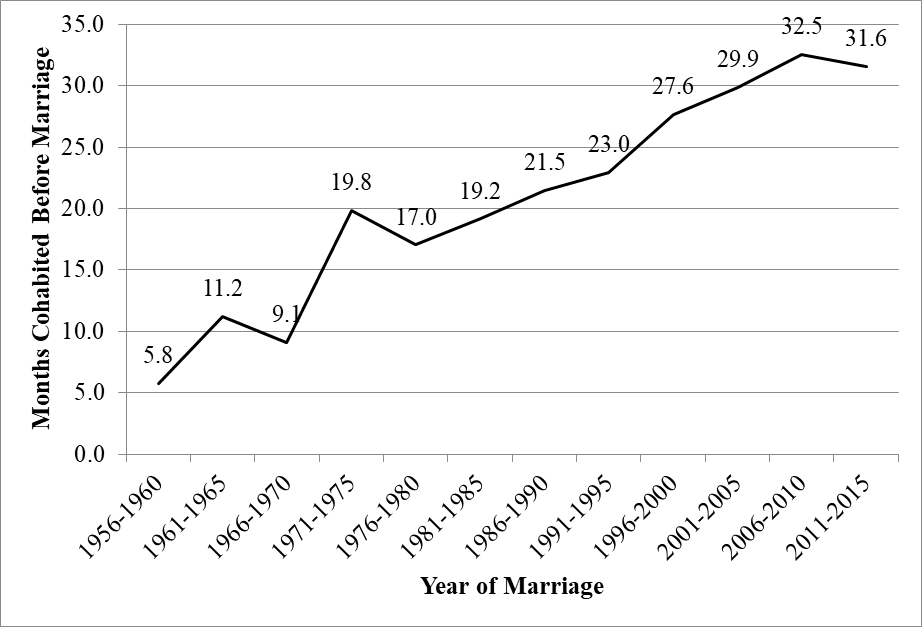
In my new article recently published in the journal Marriage & Family Review I show that the length of time that couples live together before marriage has grown in recent decades (See Figure 2), increasing the importance of correctly accounting for the age at which couples move in together, as it grows further and further from the age at which these couples marry.

Figure 2: Average Duration of Premarital Cohabitation with First Husband among Premarital Cohabitors who Married before Age 36 (Months)

While the overall pattern in this new research of lower divorce rates in the first year of marriage after cohabitation seems plausible, accounting for age at marriage rather than age at coresidence artificially inflates the divorce rates of premarital cohabitors across all marriage durations, calling into question whether premarital cohabitation is in fact associated with higher divorce risks at later marriage durations, as found by the authors. A comparison that accounted for age at coresidence instead of age at marriage would likely have led to significantly different findings.

Arielle Kuperberg is Associate Professor and Director of Undergraduate Studies in Sociology and Cross-Appointed Faculty in the Women and Gender Studies Program at the University of North Carolina at Greensboro. Follow her on twitter at @ATKuperberg and reach her at atkuperb@uncg.edu.


Picture by Pexels via pixabay

50 years ago a student was expelled from Barnard College for living with her boyfriend. In March 1968 an article published in The New York Times discussed a young unmarried couple that was living together but not married, sparking a national scandal and debate about morality. It was quickly discovered that the woman in question was Linda LeClair, who was later expelled from Barnard College over the matter; this incident was later dubbed “The LeClair Affair.”

In the years after The LeClair Affair, premarital cohabitation became trendy, and by the early 1970s every women’s magazine had published articles about celebrities living with unmarried partners. Rates of cohabitation skyrocketed; in the late 1960s less than 7% of first marriages among young women aged 18-35 began in premarital cohabitation. By the early 1980s over 40% of first marriages in this group were among couples that lived together beforehand, and rates rose to nearly 70% in the early 2010s*.

In the 1980s concern grew over this increase and debate raged over whether cohabitation was the reason for a recent increase in divorce. Some said it was the type of people who cohabited that had a higher divorce rate because of their lower levels of financial preparedness, lesser religiosity, and higher likelihood of having divorced parents, while others argued it was the act of living together itself that caused couples to later divorce. More recently, research (including mine) has found cohabitation is not associated with a higher risk of divorce once factors like the ages at which they form their unions are taken into account, and that this is true even if couples have a child prior to marriage.

But even though it doesn’t cause divorce, there is still a problem with premarital cohabitation: as cohabitation went from new trend to the new normal, it has also increasingly been undertaken by those who don’t have the financial means to marry directly. Gaps in education between premarital cohabitors and couples that marry directly have been growing steadily since the 1970s. In 2010-2015, nearly 50% of young women marrying their first husband without living together first had a college degree; this rate was only 34% among women marrying after living together first*.

This growing gap positions cohabitation as a new facet of family inequality. Young adults want to pay down debt and become financially stable before entering marriage; this is an increasingly elusive goal, especially for those who do not complete a degree, so they enter cohabitation instead of marriage while waiting for more financial stability. Those with less education also are more likely to rush into cohabitation to make ends meet, some before they are ready, or with a less-than-ideal partner that a longer courtship would have revealed.

Today’s Linda LeClair wouldn’t be living with her boyfriend because it is trendy, but because she is up to her eyeballs in student loan debt, driving an Uber to survive, and struggling to establish herself in a career that could bring some stability and health insurance. After decades of disinvestment in public higher education by state governments, a minimum wage that has not kept pace with inflation, and an increasing number of young adults working in the “gig economy” that offers no stability and few benefits, it’s no wonder that young adults today have the highest rates of premarital cohabitation in U.S. history – and also have the lowest rates of marriage and childbearing. More affordable public higher education and more stable job opportunities that pay a living wage for young adults at all levels of education would allow more to shape their relationships according to their desires, instead of out of financial necessity.

*Numbers based on author’s analysis of the 1988 National Survey of Families and Households (N=3594) and multiple waves of the National Survey of Family Growth (1995, 2002, 2006-2010, 2011-2015, N=9420), examining women who married between age 18 and 35.  

Arielle Kuperberg is an Associate Professor of Sociology and Director of Undergraduate Studies at the University of North Carolina at Greensboro. Follow her on twitter at @ATKuperberg


Screenshot courtesy Letta Page

Over at Families as They Really Are, Erin Anderson has posted about men’s lagging uptake of family leave when it is available. Over here, we have prepared a round-up on how men are doing in families by looking back at papers from the Council on Contemporary Families.

An issue related to use (or not) of family leave has to do with the underlying security of jobs: In the CCF June 2013 Symposium on the Equal Pay Act, economist Heidi Shierholz wrote about the erosion of men’s wages in the past few decades. She explains, “In the late 1970s, after a long period of holding fairly steady, the gap in wages between men and women began improving. In 1979, the median hourly wage for women was 62.7 percent of the median hourly wage for men; by 2012, it was 82.8 percent. However, a big chunk of that improvement—more than a quarter of it—happened because of men’s wage losses, rather than women’s wage gains.” Read more here.

Some models show how to change men’s behavior. Anita Patnaik wrote this spring about Quebec’s non transferrable leave program and the positive results. In particular, the study demonstrates just how effective this generous benefit is in getting fathers more involved at home. With new benefits, fathers increased their participation in parental leave by 250 percent. In households where men were given the opportunity to use this benefit, fathers’ daily time in household work was 23 percent higher, long after the leave period ended. Background and details of economist Ankita Patnaik’s innovative study are provided in this briefing report.

Men’s engagement is looking pretty good, too, to several international scholars.Oriel Sullivan and colleagues compare national patterns in gender equity and housework, and note in their 2015 CCF brief, that the trend of men’s engagement with family is fundamentally forward and upward. “We argue that like most momentous historical trends, we shouldn’t expect progress towards gender equality to happen in an uninterrupted way. Just as we still see cold snaps within a process of longer-term climatic warming, the progress of gender equality should be seen as a long-term, uneven process, rather than as a single, all-at-once revolution.” You can read more here.

Arielle Kuperberg, also writing in a 2015 CCF brief, highlights good news about men in families more recently, too. In a report on cohabitation trends and best methods for studying those trends, she finds that marriage doesn’t have the kind of traditionalizing impact on participants than it has in the past. In reviewing some of the 21st century data (versus data from the 1990s), she noted, “By 2001-3, however, men who had lived together before marriage and men who were living together without marriage and thought they would marry their partner were doing the same amount and the same type of housework. This suggests that marriage had ceased to have any effect in making men feel that they ought to play more traditional roles, or can opt out of less traditional ones.” She notes, however, that when children arrive, some of this ground is lost. Read her report here.

Originally posted 9/30/15

John Lester via flicker Commons

So, things change. In March, Stephanie Coontz commented on the popular concern that Angelina Jolie and Brad Pitt had been “leading young couples astray” through their premarital cohabitation and childbirth, pointing to Council on Contemporary Families (CCF) research that has demonstrated that both premarital cohabitation and having a baby before marriage actually don’t make a couple more likely to divorce than those who begin their families after marriage. Research has shown that the concern about premarital cohabitation addressed by Coontz in her 2016 revised and updated book, The Way We Never Were, has abated – Americans now hold more favorable views about cohabitation.

Nonetheless, Jolie and Pitt did divorce later this year, though probably not due to their pre-marital cohabitation. Pitt’s divorce is, remarkably, a “gray divorce.” Media coverage concerning gray divorce, or divorce of those over 50, has given the floor to CCF scholars to set the record straight about divorce, a trend about which the general public is becoming less accepting: the percentage of respondents to the National Survey of Family Growth who said that “divorce is usually the best solution when a couple who can’t seem to work out their marriage problems” declined by almost 9 percent for women and 5 percent for men, to 38 percent and 39 percent, respectively, between 2002 and 2011-2013. These beliefs are reflected in practice, too: couples who married in the twenty-first century have lower divorce rates than those who married earlier. (Keep in mind: fewer people marry these days.)

But gray divorce is becoming more common. Today, it’s estimated that 15 percent of people over 50 have been divorced, and that almost 25 percent of divorces in the United States are between people over age 50. When put in historical perspective, this shouldn’t be surprising: Vicki Larson of Quartz recently wrote,

Our current contract—“until death”—might have worked when people didn’t live all that long (according to the American [historian] and author Stephanie Coontz, the average marriage in colonial times lasted under 12 years); or when many women died in childbirth, freeing men to marry multiple times (which they did); and when men of means needed women to cook, clean and caretake, and women needed men for financial security. But that isn’t why we marry nowadays.

In an article about Sarah Jessica Parker’s new HBO program Divorce, CCF historian Steven Mintz pointed out in Time that the freedom to divorce has long been an American ideal, whose justification can be traced to the ideology of the American Revolution. Ronald Reagan, a famous conservative, helped to change divorce laws so that people could do so when they had “irreconcilable differences,” according to Stephanie Coontz.

Vicki Larson of Quartz suggested, in light of a longer history of divorce in the United States and more recent social changes such as increasing life expectancy and gender equality, that it might be appropriate for us to “rethink ‘until death’ [do us part].”

Braxton Jones is a graduate student in sociology at the University of New Hampshire, and serves as CCF Graduate Research and Public Affairs Scholar.


Photo via VelvetTangerine, Flickr CC.

One of the consistent findings of sociological research in recent decades has been that couples who had a child before getting married had substantially higher odds of divorcing than couples who married first. This held true even when researchers controlled for other factors that tend to distinguish such couples from those who marry directly—education, family background, race and ethnicity. But considering the tremendous increase in premarital cohabitation and childbearing over the past quarter century, and in light of new evidence that many other longstanding “laws” of marriage and divorce have been overturned (e.g., see “It’s Not Just Attitudes: Marriage Is Also Becoming More Egalitarian”; Are Individuals Who Marry at an Older Age Too Set in Their Ways to Make Their Marriages Work?), we set out to investigate whether this particular sociological “rule” still applies. more...

photo via pixabay.com

Last month, the Council on Contemporary Families (CCF) released a brief report, “The way we still never were,” to coincide with the new, revised, and updated 2016 version of Stephanie Coontz’s classic book, The Way We Never Were: American Families and the Nostalgia Trap. As a result, journalists identified many trends they saw as positive:

more...

the way we never wereAnother Quarter Century of Family Change and Diversity

Editor’s note: In 1992—the year the U.S. presidential campaign erupted into a culture war over family values—Stephanie Coontz published The Way We Never Were: American Families and the Nostalgia Trap. The title itself offered the pithy concept, and the book demonstrated that diversity and change have always been hallmarks of American family life: “Leave It to Beaver” was not a documentary. This week (March 29, 2016) Coontz released a substantially revised and updated edition of The Way We Never Were. Below, she provides a brief review of ten things that have changed for the better in the past quarter century, three that have stayed the same, and two that have gotten worse.

In 1992, political leaders and pundits were predicting that changes in family forms and gender roles were leading America into disaster. Were they right? 

  1. Whatever happened to the Super Predators? In the early 1990s criminologists were predicting “a blood bath of violence” unleashed by “tens of thousands of severely morally impoverished juvenile super-predators” – all supposedly a result of rising rates of unwed births. But between 1993 and 2010, sexual assaults and intimate partner violence reported dropped by more than 60 percent. According to the FBI’s Uniform Crime Reporting Statistics, the murder rate in 2013 was lower than at any time since the records began in 1960. Since 1994, juvenile crime rates have plummeted by more than 60 percent, even though the proportion of children born out of wedlock has risen to 40 percent.
  1. How about crack babies? In the 1980s and 1990s, newspapers headlined an epidemic of “crack babies” in the inner city, with kids permanently damaged by their mothers’ use of crack cocaine during pregnancy. This led to a wave of punitive legal actions against such women. But follow-up studies have since revealed that children from the same high-poverty areas who had not been exposed to cocaine in utero were equally likely to have developmental and intellectual delays as babies born with cocaine in their systems. As I documented in The Way We Never Were, the big risk to these children was the pollution, violence, and chronic stress of deeply impoverished and neglected communities – including lead poisoning damage that was going on for years before it hit the headlines in 2016 because of the disaster in Flint.
  1. Did career women start “out-sourcing” their children’s developmental care? As women gained more high prestige jobs in the late 1990s, that’s what many experts feared. In fact, however, even as mothers’ work hours increased, their child-care hours increased too, while fathers’ child-care time tripled. Today, both single and working moms spend more time with their children than married homemaker mothers did back in 1965.

more...