
Families as They Really Are

via Flickr Commons, credit Talk Radio News Service

President Obama recently announced that all federal employees would have access to six weeks of paid leave to care for a new child. He also emphasized the importance of access to affordable childcare in last week’s State of the Union address. Policy initiatives in these areas are an important first step toward bringing the United States up to speed with other nations. Indeed, the United States remains the only country in the industrialized world that does not legislate any form or length of paid family leave, childcare costs remain high, and, for most workers, career success remains contingent on particularly long and/or inflexible work hours.

Many scholars have argued that this current state of affairs is, in large part, responsible for the stalled progress toward gender equity we’ve seen since the late twentieth century: despite their dramatic rise in employment, women still comprise only a small fraction of elite business and government leaders, and they still do the lion’s share of housework and caregiving. This may not be surprising, given that men and women lack access to supportive work-family policies that could otherwise ease the disjuncture between the demands of modern employment—which are currently premised on a worker who is continuously available and who bears few obligations outside of work—and the often intense demands of raising children. Indeed, many women who “opt out” of full-time careers report doing so not because it was their ideal preference, but because the inflexibility of their workplace or the high costs of childcare left them with few options.

However, identifying the extent to which supportive work-family policies may exert a direct effect on individuals’ preferences and choices about how they organize their work and family life has been challenging. Whereas some individuals may make decisions in response to a constrained set of options, others’ decisions may be based on deeply held, and possibly internalized, beliefs and expectations about gender—beliefs which still tend to prescribe men greater responsibility for earning and women greater responsibility for caregiving. Methodologically, disentangling these two possibilities is difficult.

In a new study (pdf),which will appear in the February issue of American Sociological Review, we use a novel technique to shed light on this puzzle. We conducted a survey experiment with a nationally representative sample of unmarried American men and women between the ages of 18 and 32 who do not have children. Each respondent expressed how he or she would ideally prefer to divide work and domestic responsibilities with a future partner. We also varied two aspects of the survey for some subgroups of respondents. Some participants were told to state how they would ideally organize their future work and family responsibilities, assuming that supportive work-family policies—specifically, paid family leave, subsidized childcare, and flexible workplace practices—were in place. For others, we made no mention of such policies, and also removed an egalitarian relationship as an option from the set of choices listed on the survey.

Our results underscore the notion that the current workplace climate fuels the persistently gendered division of labor in employment and in the family. When respondents were simply asked to state what kind of relationship they preferred, the majority of men and women, regardless of their education level, opted to share earning and household/caregiving responsibilities equally with their partner.

Their study found people's "personal" choices varied depending upon workplace policies. (photo Chris Martin via Flickr Commons)
Their ASR study found people’s “personal choices” varied depending upon workplace policies. (photo Chris Martin via Flickr Commons)

Moreover, if told to assume that supportive work-family policies were in place, women were even more likely to prefer an egalitarian relationship and much less likely to want to be primarily responsible for housework or caregiving. This finding shows that supportive work-family policies directly affect the way that young women would prefer to structure their work and family life.

And finally, when participants were not able to select an egalitarian option—a situation that simulates reality for many families in today’s policy environment—they largely favored more traditionally gendered preferences. For example, when respondents could not select an egalitarian relationship – because we had removed it from the survey response options – men gravitated toward a relationship in which they would be primarily responsible for earning, whereas their spouse would be primarily responsible for housework and caregiving.

These findings suggest that, if we were to change the workplace policy environment, we would likely see changes in how people decide to balance work and family life, with fewer women “opting out” and more men taking on a greater share of caregiving responsibilities. At the same time, our results imply that supportive work-family policies are a key mechanism that can promote gender diversity in work organizations—a message that should be of interest to business leaders who now know that such diversity is critically linked to their bottom line.

To be sure, implementing supportive work-family policies that work are an economic and political challenge, and gender inequalities persist even in countries where supportive policies are widespread. But, our findings suggest that these policies do have the power to foster more gender-egalitarian preferences and attitudes, with broad implications for gender inequality in the workplace and the home. In short, such policies may empower people to live the kind of life they would ideally like to live, an ideal that is now more gender-egalitarian than in previous generations, and that is premised on more women “leaning in” at work and more men “leaning in” at home.

Sarah Thébaud is an assistant professor of Sociology at the University of California, Santa Barbara. David S. Pedulla is an assistant professor of  Sociology at University of Texas at Austin.

from Wikimedia Commons

A briefing paper released by the Council on Contemporary Families today analyzes recent data on parenting practices compiled by the U.S. Census Bureau. Sandra Hofferth, Professor, Family Science, at University of Maryland’s School of Public Health, notes that although the Census Report found some differences by family type, most American parents — married, divorced, or single — read to their children, monitor their children’s media youth, and engage their children in extra-curricular activities.

Overall, reports Hofferth, more than 90 percent of American children were read to during the week. Married parents reported reading to children aged 3-5 an average of 6.8 times a week, compared to 6 times a week for single parents of children the same age. “About half of all 6-17 year olds ate breakfast with their family at least 5 days per week. Nine out of 10 parents of children under 12 had rules about television viewing. And one-fifth to two-fifths of all children participated in sports as an extracurricular activity.”

In general, differences between family types were significant but small. Almost 13 percent of 6-11 year-old children of married parents were enrolled in gifted classes, compared with almost 11 percent of children living with a single parent. Slightly more teenaged children living with a single parent ate dinner with a parent at least 5 days a week than did children living with two married parents. However, only 34 percent of teenagers in single-parent homes, vs. 44 percent of teens from married couple families, participated in sports activities. Children of cohabiting couples had the lowest rates of shared family dinners and extracurricular activities.

Hofferth explains that many of these differences are more closely related to income than to family structure. 42.5 percent of teenagers in families with incomes 200 percent or more of the poverty level participated in sports, compared to only 22.5 percent of teens in poor families. This is a difference of 20 percentage points, compared to only a 10-point difference by family structure.

Such income differences are especially worrisome, Hofferth writes, because more than one-fifth of children of all ages, and more than a quarter of children under age six, live in families with incomes below the poverty line. Another recent report finds that more than half of students in U.S. public schools now come from low-income families.

The negative impact of poverty on parents’ involvement in extracurricular activities may be especially strong in the United States, which has higher levels of extreme poverty than other developed nations, suggests Virginia Rutter, a sociologist at Framingham State University and a Senior Scholar with the Council on Contemporary Families. A recent study of the United Kingdom found that poor parents were equally engaged with their children as middle class parents, despite fewer material resources. The lower level of support systems for low-income families with children in the U.S. may help account for such differences, notes Rutter.

Read Hofferth’s complete commentary here at CCF@ The Society Pages.

Photo courtesy of U.S Department of Agriculture.
Photo courtesy of U.S. Department of Agriculture.

President Obama’s forceful comments on the need for federal support of child-care programs were one of the most notable aspects of his recent State of the Union address. As he said, “It’s time we stop treating child care as a side issue, or a women’s issue, and treat it like the national economic priority that it is for all of us …. In today’s economy, when having both parents in the workforce is an economic necessity for many families, we need affordable, high-quality child care more than ever … [It is] a ‘must-have,’ and not a ‘nice-to-have.’”

As a longtime advocate for quality, accessible child care, I was heartened to hear these words at such a high-profile time. It occurred to me that it had been more than 40 years since a U.S. president had so visibly addressed the child-care issue—and on that occasion, the message had been very different.

In December 1971, President Richard Nixon vetoed the Economic Opportunity Amendments of 1971, primarily because the measure would have allocated some $2 billion for a Comprehensive Child Care Development Bill, which Congress had recently passed to pay for an extensive network of child-care facilities across the country. Nixon’s veto message remains, in my view, one of the most striking documents in the history of American family policy.

Denouncing the bill for its “family-weakening implications,” Nixon went on to say that the appropriate response to the challenge of implementing child-centered policy “must be one consciously designed to cement the family in its rightful position as the keystone of our civilization.” Nixon continued:

Other factors being equal, good public policy requires that we enhance rather than diminish both parental authority and parental involvement with children … for the Federal government to plunge headlong financially into supporting child development would commit the vast moral authority of the National Government to the side of communal approaches to child rearing over against the family-centered approach.

The back story of the passage of the Comprehensive Child Care Bill, the controversy it created, and the pressure on Nixon to veto it are all topics very pertinent to the divisions over gender politics that still are such a factor in our society today. Seen as the first legislative victory of the recently reemerged women’s movement, the bill’s passage was a collaborative effort involving union women, feminist activists, children’s advocates such as Marian Wright Edelman, and sympathetic (mostly male) elected officials, led by Sen. Walter Mondale (D-MN) and Rep. John Brademas (D-IN).

Although many Republicans had voted for the bill, it still sparked a furor among many conservatives still reeling from the rapid cultural shifts of the 1960s and 1970s—particularly the rise of feminism. Conservative journalists denounced the bill; Nixon’s most hard-right staff members, including Pat Buchanan, urged him to oppose the bill on ideological grounds as well as fiscal ones. This was because Nixon had recently announced his intention to travel to “Red” China and normalize relations—a move that enraged many conservatives of that period. It was therefore no accident that the language of the veto contained a negative comment about “communal approaches to child-rearing.” (Buchanan had also reportedly wanted to include the phrase “the Sovietization of American children,” but that phrase did not make the final cut.)

After Nixon’s veto, a later attempt in 1975 by Mondale and Brademas to offer a scaled-down version of their original ambitious bill never even made it out of Congress. This time around, their efforts were met by an incredibly well-organized campaign by operatives in the just-emerging New Right, known today as the Christian right. In this pre-Internet, pre-cell phone era, these conservative groups subjected thousands of mothers of young children to a massive misinformation blitz about the bill, instructing them to write letters to their representatives. As journalist Gail Collins remarked, “The writers [of these letters] appeared to believe that [the bill] would allow children to organize labor unions, to sue their parents for making them do household chores and make it illegal for a parent to require their offspring to go to church.”

In retrospect, the virulent backlash—from President Nixon, from housewives writing letters in church basements—against these attempts at expanding federal involvement in child-care programs can be understood as the beginning of the culture wars in America. Indeed, as Onalee McGraw, a leading conservative spokeswoman of that era, put it, the anti-child care campaign was “the opening shot in the battle over the family.”

To be sure, the child-care issue did not last long as a mobilizing issue for social conservatives—too many women, including conservative ones, were going to work. And in the years following the Roe v. Wade decision of 1973, the New Right found a much more fruitful issue on which to focus.

In contrast to the hopefulness expressed in the early 1970s by those who supported a national child-care program, which would have targeted all children with parents paying on a sliding income scale, today child care is like virtually all other social programs in the United States—that is, deeply stratified by class. Wealthy parents typically have live-in nannies and send their children to extremely expensive preschools; middle-class parents, often with great difficulty, send their children to the best programs they can afford and are lucky enough to find a place in; and poor parents, if they are not fortunate enough to have reliable relatives living nearby, are subject to programs of varying, often dismal, quality. What is clear is that parents are on their own, needing to devise private solutions to what Nixon himself framed as a private problem.

It is too soon to say whether President Obama’s positive vision for child care as a governmental responsibility will overcome the negative one of Richard Nixon and the culture warriors who advised him. In some respects, the situation of the two presidents, with respect to child care, are mirror images of each other. In the 1970s, there was a Congress who wanted a national child-care policy and a president who opposed it; with Obama, the opposite, sadly, seems true. But if nothing else, Obama’s speech reaffirmed for a broader audience what those in the reproductive justice movement already know—that is, how crucial quality, affordable child care is for families in order to adequately care for the children they wish to have.

Carole Joffe is a professor at the Bixby Center for Global Reproductive Health at the University of California, San Francisco.  On twitter: @carolejoffe.

*This was originally posted at rhrealitycheck.org.

credit: Jessica Paoli via Creative Commons

CCF circulated many useful briefing reports this year– covering issues ranging from hooking up to Civil Rights to research methodology. Here are the five most talked about pieces—as measured by media impact:

In addition to these widely covered pieces, over the course of 2014, at least 27 CCF experts provided media with updated perspectives on research through interviews, news articles, and opinion pieces, on topics ranging from politics to pop culture. In working toward CCF’s mission to increase public knowledge about family diversity and change, these combined efforts led to more than 250 media citations. This makes a difference! From my vantage point as CCF’s public affairs intern, I am eager to see how CCF will continue to reach forward towards transforming dialogue in 2015.

Braxton Jones is a senior sociology major at Framingham State University (MA) and a CCF Public Affairs Intern.


Cross posted on the Family Inequality blog.

Disability is a very broad concept, representing a wide array of conditions that are not easily captured in a simple demographic survey. However, disabilities are very prevalent, especially in an aging society, and the people who experience disabilities differ in important ways from those who do not. Previously I reported — in a preliminary way — that people with disabilities are much more likely to divorce than those without. Here I present some numbers on marriage rates.

This isn’t the kind of thorough, probing analysis this subject requires. But I have two reasons to do it now. First is that I hope to motivate other people to pursue this issue in greater depth. And second, I want to highlight the importance of the data I’m using — the American Community Survey (ACS) — because it might be not available for much longer. These questions have been slated for demolition by the U.S. Census Bureau on cost-saving grounds. I put details about this issue — and how to register your opinion with the federal government — at the end of the post.

Disabilities

The ACS asks five disability questions (I put the shorthand label after each):

  1. Is this person deaf or does he/she have serious difficulty hearing? (Hearing)
  2. Is this person blind or does he/she have serious difficulty seeing even when wearing glasses? (Vision)
  3. Because of a physical, mental, or emotional condition, does this person have serious difficulty concentrating, remembering, or making decisions? (Cognitive)
  4. Does this person have serious difficulty walking or climbing stairs? (Ambulatory)
  5. Does this person have difficulty dressing or bathing? (Independent living)

These aren’t perfect questions, but they cover a lot of ground, and the ACS — which involves about 3 million households — can’t get into too much detail.

One great thing about having these questions on the giant ACS is you can use the data to get all the way down to the local level, or into small race/ethnic groups. And with the marital events questions, you can combine disability information and marriage information.

First-marriage rates

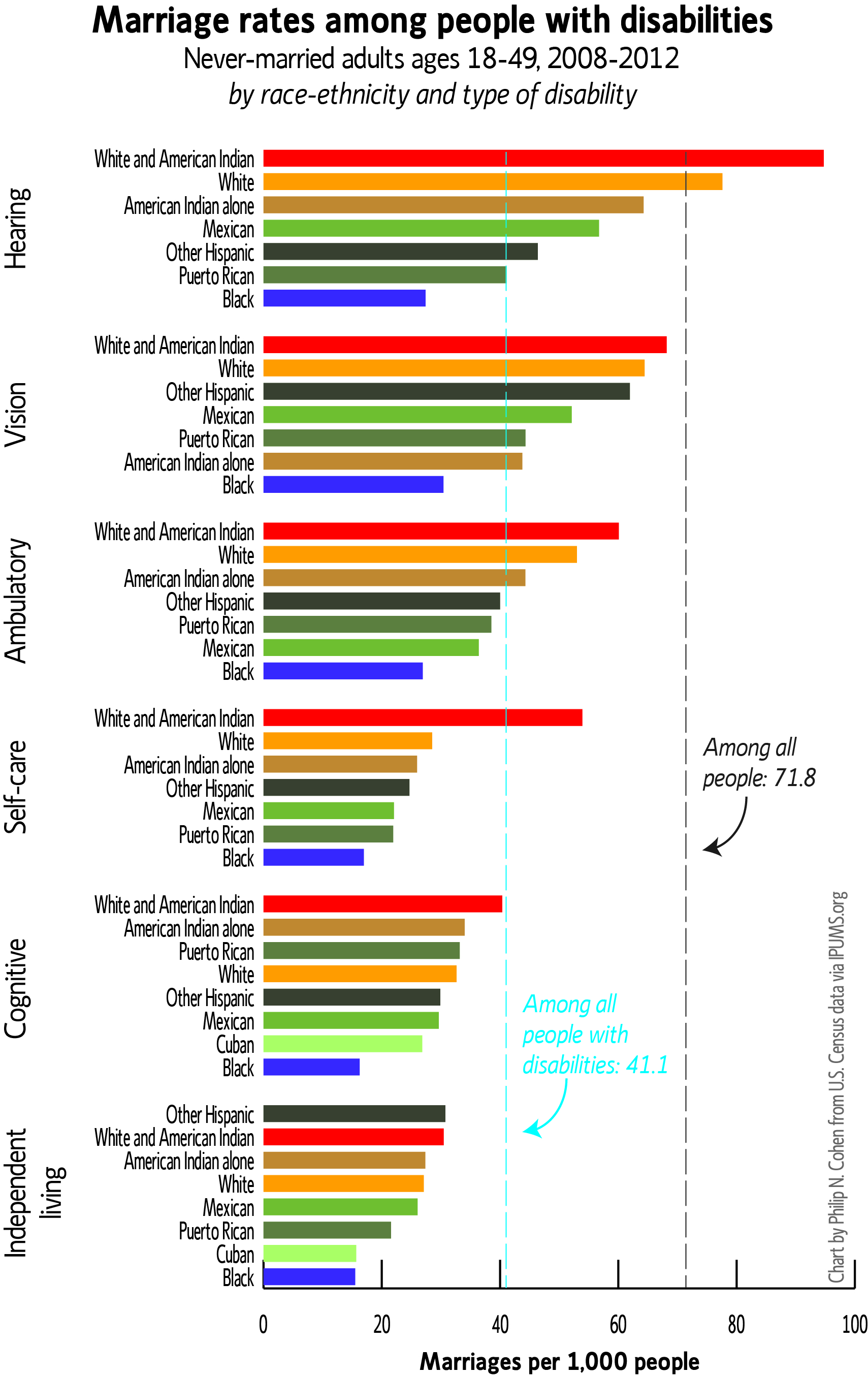
Using marital events (did you get married in the last year), marital history (how many times have you been married), detailed race and ethnicity breakdowns, and the disability questions above, I produced the following figure. This uses the combined 2008-2012 ACS data because these are small groups, but even with five years of data these groups get quite small. There are about 90,000 non-Hispanic Whites with a cognitive disability in my sample, but only 356 people who are both White and American Indian with a hearing disability (the smallest group I included). This sample is people ages 18-49 who have never been married (or just got married).

disab-marriage-rates

The overall first-marriage rate for people ages 18-49 is 71.8 per 1,000. For people with disabilities it’s 41.1 (shown by the blue line). So that’s much lower than for the general population. But there is a very wide variation across these groups, from 15.5 per thousand for Blacks with disabilities in independent living all the way up to above the national average for Whites and White/American Indians with hearing disabilities. (For every condition, Blacks with disabilities have the lowest marriage rates.)

I don’t draw any conclusions here, except that this is an important subject and I hope more people will study it. Also, we need data like this.

In previous posts demonstrating the value of this data source, I wrote about:

Whether you are a researcher or some other member of the concerned public, I hope you will consider dropping the government a line about this before the end of the year.

The information about the planned cuts to the American Community Survey is here: https://www.federalregister.gov/articles/2014/10/31/2014-25912/proposed-information-collection-comment-request-the-american-community-survey-content-review-results:

Direct all written comments to Jennifer Jessup, Departmental Paperwork Clearance Officer, Department of Commerce, Room 6616, 14th and Constitution Avenue NW., Washington, DC 20230 (or via the Internet at jjessup@doc.gov).

Comments will be accepted until December 30.

Michelle Janning is CCF's new co-chair.
Michelle Janning is CCF’s new co-chair.

In the wake of widespread layoffs of journalists who cover family issues and the closure of several journalism centers that have traditionally featured new family research, the Council on Contemporary Families held a meeting of their national board over the weekend in Walla Walla, Washington, hosted by Whitman College. The agenda included the election of a new Co-Chair and discussion of how to further expand the dissemination of new research to the press and public in the context of the current crisis in print media.

Michelle Janning, Professor of Sociology at Whitman College, was elected a new co-chair of CCF, replacing family historian Stephanie Coontz, who will now devote herself exclusively to her role as Director of Research and Public Education. Janning, who has researched work-family issues, cross-cultural childhoods, changing gender roles, and family dynamics, joins continuing co-chair Joshua Coleman, a San Francisco-based clinical psychologist and author of several books on marriage relationships and the interactions between parents and adult children.

According to Coleman, Janning’s recent work in organizing the 2014 CCF conference, “How Technologies Are Changing the Way Families Live and Love,” puts her at the forefront of CCF’s work in reporting on emerging family trends. Whitman College has recognized the importance of her new position at CCF by providing student assistance, meeting facilities, travel funds, and funding for an annual speakers series on diversity and families. These services are funded by the Whitman Provost and Dean, the Department of Sociology, and the Robert and Mabel Groseclose Endowed Lecture Fund.

Also at the meeting, CCF’s board planned a series of briefing papers summarizing new research on marriage trends, cohabitation, parent-child relationships, and the implications of same-sex marriage, which is now legal in 31 states, containing almost 200 million Americans. Board members also evaluated updates to recent briefing papers on the diversification of  the living arrangements of America’s elementary school children and on the impact of sharing housework on the sex lives and marital satisfaction of couples.

Recent and new briefing reports are available here at The Society Pages. Views and perspectives found on this page!

By Georgiana Bostean and Leah Ruppanner

We face a care crisis in the United States—the older adult population is growing rapidly, yet systems to provide care for them are inadequate, relying largely on informal, unpaid care. The U.S. population ages 65 and over is projected to double in the next 25 years, creating unprecedented need for caregivers as the largest cohort ever, the baby boomers, enters old age. If you live in the United States and have aging parents, chances are good you will be tasked with caring for them in their later years, especially if you are a woman or member of a racial/ethnic minority group. Who steps in to be a caregiver, and the implications of caregiving, are important social, political, and ethical questions. How will we meet the care needs of older adults? And what are the costs of caregiving to the family members with aging relatives?

Taking care of aging relatives has its rewards and its challenges. It can provide a sense of meaning and improve social relationships. But it can also be stressful and have health-harming effects, impairing immune function and accelerating immune system aging. And it turns out that the benefits and harms to caregivers depend partly on the social context in which the caregiving takes place.

To help figure out how caregivers are affected in different social contexts, we studied 22 European countries to assess whether those in countries with greater societal pressure for informal family caregiving – in the form of strong social norms for familial care or limited public transfers for old age programs – have lower well-being than caregivers in countries with weaker familial care norms and more old age public transfers. We found that strong norms in favor of caregiving at home — and less government support for elder care — are associated with increased harms for female caregivers.

Sociologists often point out how macro-level forces (such as social norms) affect individual outcomes. Our recent research, just published in European Sociological Review, sought to understand how two features of different countries — social norms surrounding caregiving, and public funding for old age programs — are associated with individual caregivers’ well-being.

In the United States, how to provide care for aging family members is largely an individual decision, but social norms and public policies exert powerful influence on individuals’ ideals and ability to act on and carry out those ideals. Caregiving work has historically fallen to women and minorities, reflecting a system of “coerced care,” as Evelyn Nakano-Glenn calls it. Caregivers are not literally forced into their family roles. Rather, certain population groups experience social pressure through norms, and lack of institutional support.

Research suggests that when people are expected to do something based on their social status, but they do not have the resources to fulfill those expectations, they experience health-harming role strain. Caregiving, therefore, may be most deleterious to health when individuals are expectedto provide care, but lack the resources to do so effectively. In such contexts, when alternate options are unavailable, women particularly may step into caregiving roles and suffer health consequences as a result. Many studies find that caregiving affects women more than men; for example, caregiving daughters report greater depression while caregiving sons do not. Thus, coerced care can harm caregivers’ well-being, particularly for women.

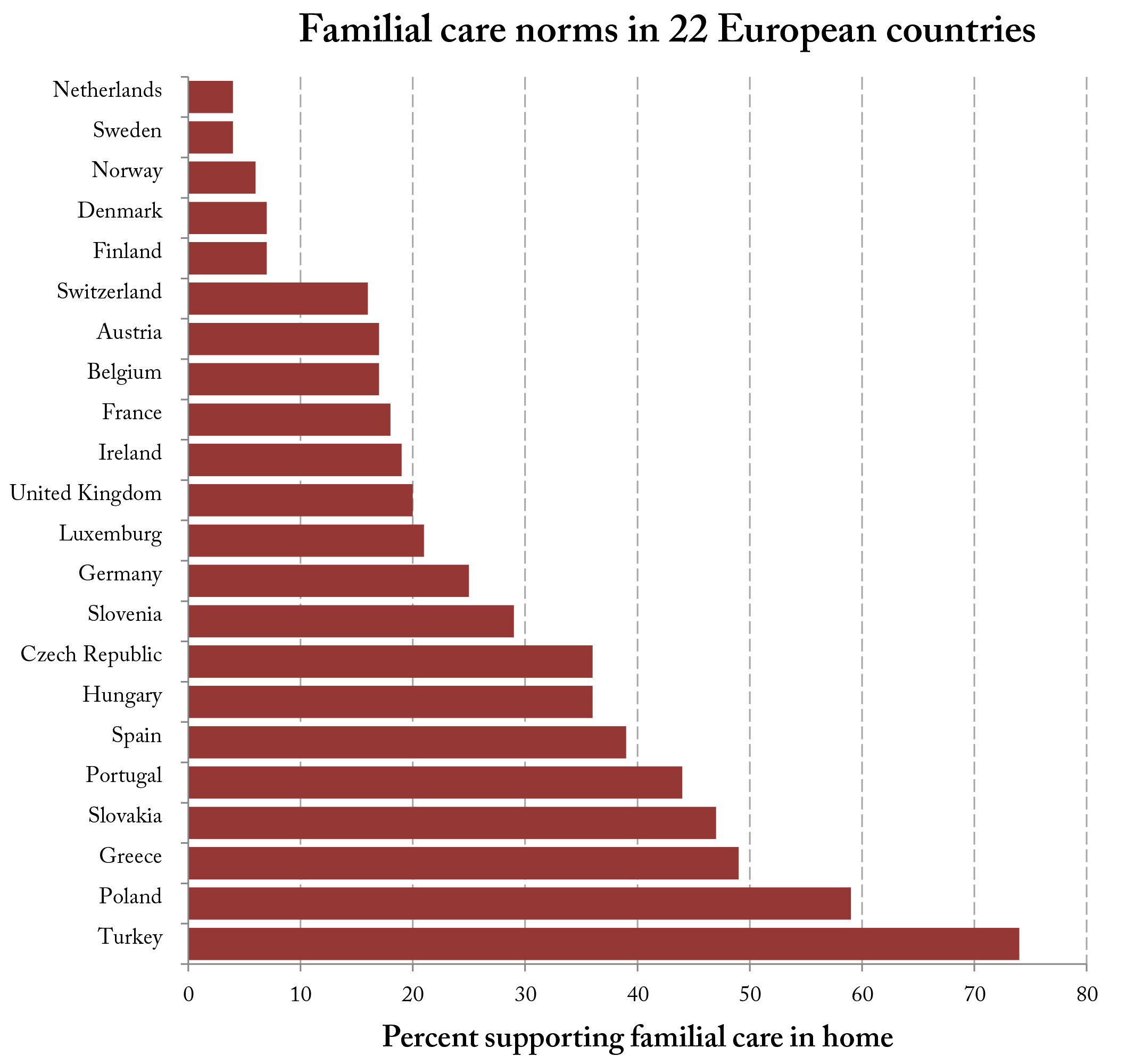
In our study of 22 countries, we found substantial variation in people’s attitudes about whether care for aging parents should be provided by adult children in-home. Support for familial care ranged from 4% in Sweden and the Netherlands, to 59% in Poland, and 74% in Turkey.

familial care norms.xlsx

So, do country differences in familial care norms impact individual well-being?

Our results surprised us. We expected that caregivers in countries with strong familial care norms (i.e., where caregiving for aging parents is expected to be provided in their children’s home) would report worse well-being than those in countries with weaker familial care norms — because they were pressured into the caring role. We found, however, that only female caregivers’ well-being was worse in those countries. Female caregivers also have lower well-being in countries with fewer public transfers to support care for the aging. So, women in countries where there are strong social norms for familial in-home care – and where market or government subsidies for old age care are not readily available – may be more severely disadvantaged by caregiving responsibilities. This is consistent with research showing that female caregivers are more likely to be stressed, depressed, drop out of the labor force, and be sandwiched (caring for both a child and older adult).

That female caregivers in ostensibly coercive contexts report worse well-being may reflect role strain, related to lack of financial, socio-emotional, and other resources. Consider what it takes to provide care for an older adult, especially long-term. In the United States, taking time off from work to provide care for a family member is difficult, even a financial hardship for many. There is no federal paid family leave policy, and only about half of workers are eligible to take leave under the Family Medical Leave Act (meaning they may take up to 12 weeks off, mostly unpaid, without losing their job); thus, the economic implications of caregiving for a family member—be it a newborn, disabled person, or aging adult—can be disastrous for many families.

With over 65 million informal family caregivers in 31% of U.S. households, the current system is unsustainable. As the burden of care and the number of caregivers increase, so too will the social, economic, and health costs of caregiving. Middle-age adults who are beginning to experience their own health issues face compounding health effects of caregiving, leading to health risks earlier in life. This will inevitably strain the health care system as the number of caregivers grows.

What can we do to mitigate this bleak situation? First, we need a wide-ranging discussion about the vast challenges of informal caregiving in the current system, and how to promote equitable sharing of caregiving work in society. Second, we must address policy deficiencies, including the current piecemeal state-based approach that leaves many caregivers exposed. Potential starting points include broad policies to support caregivers through increased paid home care and community-care services. Recent innovative programs – like the one introduced for Pennsylvania, and federal respite care provisions – are first steps. Comprehensive federal policy changes that extend current family leave policies would also support caregivers, including paid and longer leave, and broader definitions of “family,” which would expand the range of people eligible and able to provide care.

Caregivers provide a valuable service to their loved ones and to society. Providing support for them is as pressing a social problem as providing care for the boomers heading toward old age. As older adults account for a larger share of the U.S. population, shifting demographics create unprecedented challenges for individuals and policy-makers alike. There is no better time to begin planning for this immediate future.

Arielle Kuperberg,  Assistant Professor of Sociology, The University of North Carolina at Greensboro, is author of this week’s briefing report at CCF@TSP. Here she answers the questions that keep coming up when people talk about cohabitation these days.

Apples via Creative Commons by Nina Matthews

Lots of people keep asking, Does living together before marriage increase your chance of getting a divorce?  In my recently published study, I finally answer this question with a definitive “no!”

For decades, researchers have found a connection between premarital cohabitation and divorce that no one could fully explain.   Despite these studies and warnings from well-meaning relatives about the dangers of “living in sin,” rates of living together before marriage have skyrocketed over the past 50 years, increasing by almost 900% since the 1960s. I found in my study that almost two-thirds of women who married between 2000 and 2009 lived with their husband before they tied the knot.

With the majority of couples now living together before marriage, if cohabitation somehow caused couples to divorce, you would think that divorce would be more common in recent generations of young adults, who were much more likely to live together before marriage compared to earlier generations. But recent research has found that for young adults born in 1980 or later, divorce rates have been steady or even declining compared to earlier generations.

What explains the connection between cohabitation and divorce?

We already knew that some of the connection between cohabitation and divorce is a result of the type of people who live together before marriage. In my study I find that compared to those who married without living together first, premarital cohabitors have lower levels of education, are more likely to have a previous birth, and are more likely to be black and have divorced parents, all factors that numerous studies (including mine) have found are related to higher divorce rates.

My study found that the rest of the connection between divorce and cohabitation can be explained by one thing that previous researchers never took into account: the age at which couples moved in together. Cohabitors moved in together at earlier ages (on average) than couples that didn’t live together before marriage, and since living together at younger ages is associated with higher divorce rates, cohabitors are more likely to divorce.

Why does moving in when you are younger increase your divorce rate?

Younger couples are (on average) less prepared to run a joint household together, and may be less prepared to pick a suitable partner than couples that settle down when they are older (on average- remember this doesn’t apply to every couple!). People change a lot in their early 20s, and those changes sometimes cause incompatibilities with a partner who was selected at a younger age. These incompatibilities lead to higher average divorce rates among those who moved in with their eventual spouse at a young age, even if they waited to marry until they were older.

My research shows that waiting until you are 23-24 or older to settle down with a partner is associated with around a 30% risk of divorce if you marry that partner. Moving in earlier leads to a much higher divorce risk- for instance couples that move in at age 18-19 face almost a 60% risk of divorce if they eventually marry, and couples aged 21-22 when settling down have a 40% risk of divorce after marriage.

Are cohabitation and marriage different types of relationships? Why get married at all?

A frequent question I’ve been asked is: does this mean cohabitation and marriage are basically the same? One reporter asked me about a recent study in which couples were threatened with a mild electrical shock while holding the hand of their married or cohabiting partner, where married couples were shown to be calmer than cohabiting couples. Doesn’t this show that cohabitation is a different type of relationship than marriage is?

Absolutely! My own research has shown that although cohabitation and marriage aren’t drastically different types of relationships for couples that lived together before marriages, some differences in behavior are pronounced, and the longer a couple has been married, the greater these differences grow. The public commitment, legal binds, and social expectations that come with marriage affect behavior in numerous ways which can’t be discounted.

So should you live together before marriage? Should you get married at all? That’s up to you! But living together won’t increase your chances of getting a divorce if you choose to go that route.

Cross-posted on Family Inequality.

Last year I posted a list of blog pieces by subject, to help people teaching family courses generate ideas and discussion. Now my book is done and some of that material is in there. If you use the book for your class, we’ll give you all kinds of awesome teaching materials. But if you’re not using it (yet), here’s another list of blog posts to supplement your course. I hope this is useful whether you’re assigning the book or not, and even if you’re teaching something besides a family course.

This is organized according to my table of contents. Please let me know what works and what doesn’t, and offer your additional suggestions in the comments.

1. Introduction

  • What current demographic facts do you need to know? These 22 demographic data points are a good place to start. What else is necessary knowledge just to get through the day without being grossly misled or misinformed?
  • High marks for Census: Describes the cultural shift at the Census Bureau that followed from Obama’s election and the decision to start counting gay and lesbian married couples. Also, a nice video they made explaining how a small error in a large population (mis-marking the sex box) can dramatically distort the number of a small population within it (same-sex couples).
  • Millennial, save thyself: Are millennials in trouble because their ties to marriage, work, and religion are weak? It’s “kids these days” all over again. With some simple data analysis and trends.

2. History

3. Race, ethnicity, and immigration

  • Black is not a color: Black and White are social, not biological, classifications. So why do we treat the words as if they were just colors?
  • Immigrant health paradox update: What can we learn from the surprisingly low infant morality rates of immigrants? Maybe healthier people migrate, but after a generation (or less) in the U.S., their advantage appears to erode.
  • The world that Sabta made: My grandmother lived from 1913 to 2009, and came to the U.S. from Poland in 1921, the youngest passenger on the S.S. Ryndam. Hers is one of the great stories of the century, leaving a mark that goes well beyond her 50+ great-grandchildren.

4. Social class

5. Gender

6. Sexuality

7. Love and romantic relationships

  • Is dating still dead? The death of dating is now 50 years old, and its been eulogized so many times that its feelings are starting to get hurt.
  • Online dating: efficiency, inequality, and anxiety: I’m skeptical about efficiency, and concerned about inequality, as more dating moves online. Some of the numbers I use in this post are already dated, but this could be good for a debate about dating rules and preferences.
  • Is the price of sex too damn low? To hear some researchers tell it in a recent YouTube video, women in general — and feminism in particular — have ruined not only sex, but society itself. The theory is wrong. Also, they’re insanely sexist.

8. Marriage and cohabitation

9. Families and children

10. Divorce, remarriage, and blended families

11. Work and families

12. Family violence and abuse

13. The future of the family

  • Tripping on tipping points: Minority births are now the majority. Is this a tipping point, a milestone, or a watershed? On the importance of accurately representing trends.
  • Dependency futures: An NPR story (linked here) on retirement prompts a look at how US demographic trends may be moving toward a future with more old-age dependency.
  • Marriage is declining globally: Can you say that? Yes, you can say that. But will it continue? We should be careful with predictions, but lots of demographic evidence suggests it will.

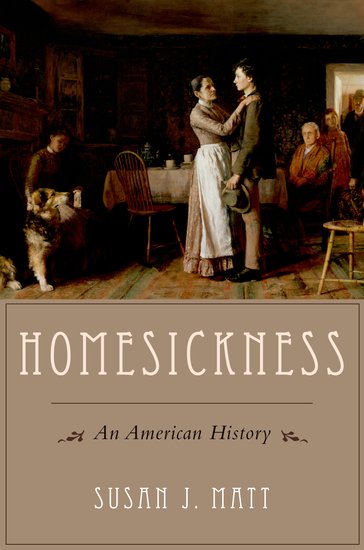
Susan J. Matt is author of Homesickness: An American History (Oxford University Press, 2011). She is Presidential Distinguished Professor and Chair of the History Department at Weber State University, in Ogden, Utah. She tweets at @alongingforhome.

Not long ago, The Onion ran an article with the headline “Unambitious Loser with Happy, Fulfilling Life Still Lives in Hometown.” The piece quoted a friend of the “loser,” who said, “I’ve known Mike my whole life and he’s a good guy, but it’s pretty pathetic that he’s still living on the same street he grew up on and experiencing a deep sense of personal satisfaction . . . .[H]e’s nearly 30 years old, living in the exact same town he was born in, working at the same small-time job, and is extremely contented in all aspects of his home and professional lives. It’s really sad.”

While the article was fiction, the attitudes it encapsulated were not. Americans disparage those overly attached to home. The homesick, boomerang kids, and tightly bonded families seem antithetical to American individualism. We are supposed to be a nation of restless movers who break ties to home with ease. When individuals stay in place, it contradicts our mythology. What is wrong with these people?homesickness

That’s a question being asked with increasing frequency about the rising generation, for nearly 22 percent of all adults in their 20s and 30s are living with their parents, the highest rate since the 1950s. And the media have not been kind to them: CBS News observed “… for many boomerang kids, living in a parent’s home becomes a crutch, enabling them to put off making grown-up decisions . . . .” Others have termed them the “Go-Nowhere Generation.”

The message is that staying home shows immaturity and a fatal lack of ambition. It is a sign of emotional neediness and dependence, traits widely stigmatized in American society. However, the expectation that individuals should leave home in their early 20s, and do so easily, is of recent vintage. Only in the last century did Americans come to see young adults who were emotionally close to kin and geographically rooted as psychologically immature and destined for economic failure.

In the nineteenth century, Americans believed that love for home was an ennobling emotion, evidence of a tender heart and a strong family life. Writers and preachers lavished praise on those who loved home, while physicians suggested that wandering too far from it could be fatal, for they believed people could die of acute homesickness.

In contrast, during the 20th century, as corporations and the military began to deploy people across the nation and the globe, strong attachments to family and place became a problem, obstacles to the smooth flow of capital and personnel. The love of home became an archaic emotion in a modern society dependent on a fungible, mobile workforce.

By mid-century, experts were arguing that tightly bonded families were out of place in America. Sociologist W. Lloyd Warner explained that because the economy required individuals to move frequently, “families cannot be too closely attached to their kindred. . . or they will be held to one location, socially and economically maladapted.” Those who tried to maintain strong kin ties were criticized. In 1951, psychiatrist Edward Strecker, preoccupied with the Cold War and the need for a mobile fighting force, accused American mothers of keeping their “children enwombed psychologically,” failing to “untie the emotional apron string . . . which binds her children to her.” He dubbed these women the nation’s “gravest menace.”

Today, we continue to believe young adults should leave home. When they don’t, their living choices are chalked up to poor employment prospects. While economic realities surely play a part in their residential choices, the media give short shrift to other motives. The idea that families might be drawn together by feelings of affection is left out of the equation, as is the possibility that this generation wants to become something other than mobile individualists. Yet there’s considerable evidence that millennials hold values that center more on family and less on high powered careers. A recent poll found them far less concerned with financial success than the population at large. They also are closer to their parents, whom they fight with less, and talk with more than earlier generations.

For decades we’ve assumed that leaving home in one’s early twenties is natural, a sign of healthy psychological adjustment; but we should remember such expectations are historically contingent. Today’s millennials remind us there are other ways of organizing family life than the model we’ve grown accustomed to, and prompt us to recognize that values other than individualistic, market-driven ones frequently motivate human behavior. We can learn from them that staying close to home does not make one an “unambitious loser.”