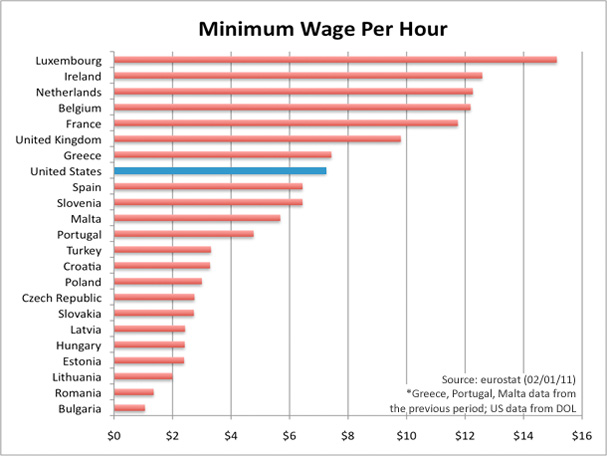
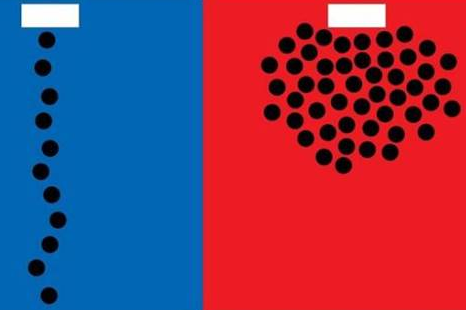
I am trying to re-enter society after several days being sick, so I’m going with something short and simple today. Eden H. sent in this chart, found at Business Insider, that compares hourly minimum wages in a number of European countries to the U.S.:
The European data are available from Eurostat (though note they report minimum wages in terms of Euros per month, not hour, so the data was converted for the chart).
Mihai L. sent in a Romanian commercial for wafers that suggests that women have been slowing down progress and re-writing history since the cavewoman days!
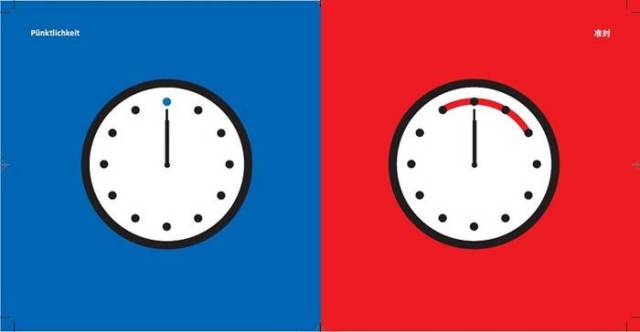
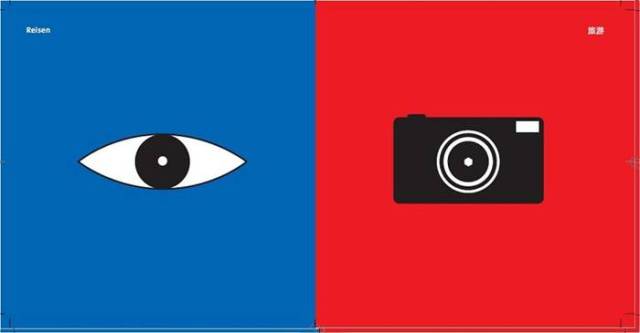
Natasha L. sent in another example of stereotypes tied to nationality/region in the form of a set of comical visual distinctions between “Westerners” and “Asians,” found here, by an artist named Yang Liu. [Note: Natasha and I both assume they're supposed to be comical or even satirical, particularly of the way that non-Western countries are generally stereotyped as being less professional, less punctual, less rational, and so on, though we might be wrong.] Some examples:
“Opinion”:
“Punctuality”:
“Traveling”:
“In the Restaurant”
“Queue when Waiting”
Regardless of the artist’s intent (whether they’re supposed to be satires of this type of thinking, etc.), I’m sure many people will laugh and see some elements of truth to some of the images. But I’m betting you could tell people they represent almost any set of nationalities and people would also laugh and say “OMG, it’s totally true!” It’s Germany and Spain! It’s the U.S. and Mexico! It’s Venezuela and Greece! You could also probably change this to “men” and “women” and get the same reaction. It’s the stereotypical categorization we think is funny–the idea that groups of people are systematically different, whether it’s based on gender, class, race, nationality, region within a country, and so on (particularly if these differences might lead to sitcom-like hijinx and misunderstandings!).
For a fun little activity to get across the way in which stereotypes are inconsistent and meaningless, you might present these images, not tell your students what they’re supposed to represent, and ask them what groups they think are being portrayed (either out loud or in writing), then use their guesses, which will probably vary widely and draw on lots of different human categories such as class, gender, race, and so on, to talk about stereotyping (which may or may not be negative, of course) and how little we pay attention to what the actual contents of our stereotypes are. Another good example of this would be the way that ethnic groups are often defined as having uniquely loud and boisterous families–I think of it as the “My Big Fat Greek Wedding” syndrome. Well, if Italians, Irish, Greeks, Jews, Russians, Mexicans, Spaniards, Chinese, people from the Southern U.S., New Yorkers, etc. etc. etc., all have big loud families…doesn’t that kind of indicate that lots of families are just big and loud, regardless of background?
Thanks, Ashley and Natasha!
NEW! Robin sent in a link to an article in the Guardian about a Czech artist who pulled off a hoax by creating a set of sculpture that represent stereotypes of various European countries, which he said were created by 27 different artists.
Romania
Luxembourg is made of gold…and is for sale:
Poland has priests raising a rainbow flag. I didn’t know if the rainbow flag has the same association with gay rights in Poland as it does here, but Spiegel Online says it’s a gay pride flag:
Bulgaria is apparently supposed to be the floor of a urinal, though Spiegel Online says it’s a Turkish toilet, apparently also called a squat toilet:
Bulgaria’s not happy about it and has demanded the sculpture be taken down.
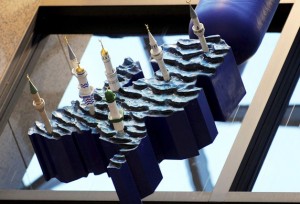
Holland has been flooded, but minarets stick out of the water to remind us about increasing concerns expressed by many Dutch about the Muslim community in the Netherlands since tension increased after the Mohammad cartoon incident:
There is ongoing debate about whether this image of Germany, showing the country’s many autobahns, is supposed to look like a swastika:
And of course France has a large banner that says “Strike!”
Apparently Great Britain was represented simply as a blank space.
MissCegenation (see her take over at Reciprocal Crap Exchange), Miguel E. (of El Forastero), Breck C. (also of Reciprocal Crap Exchange), Rachel N., Laura M.D., and Z. (of It’s the Thought that Counts) all sent in links to Burger King’s “Whopper Virgins” viral video campaign (we’ve never had so many people send in the same thing; clearly it touched a nerve):
There are several interesting things going on here. One is the exoticization of the “whopper virgins.” The taste tests were conducted in Thailand, Romania, and Greenland. We’re clearly supposed to find it charmingly cute that they’re unfamiliar with hamburgers. They don’t even know how to eat them! We get to see people taking their “first bite of a hamburger,” and wonder at their unfamiliarity with how to pick one up and eat it. This short video about the Thailand taste tests illustrates this with the dramatic voiceover about people who have “never even seen a burger. Who don’t even have a word for burger.”
There’s also a certain level of ethnocentrism here; note the comment that these are people who “really live outside of things.” That all depends on what you mean by “things,” which here seems to be defined by exposure to TV and hamburgers. The implicit understanding, of course, is that these are people who live in a backward, “traditional” culture, which is fascinating to outsiders but, ultimately, very bizarre. However, I am sure that if asked these people would feel they live “inside of” many things, just not the things considered important to this marketing team.
You might also use this to talk about the pervasiveness of advertising. As the video makes clear, they went to Thailand, Romania, and Greenland in hopes of finding people who hadn’t been exposed to Burger King or McDonald’s advertising, since it would be “impossible” to find such people in the U.S.
I also think the documentary element to the video is fascinating. I’m assuming the teams did travel to these areas, and the video claims they are all “real people,” not actors (who are, apparently, imaginary). But I have a suspicion that some elements were staged. Of course the taste-tests were staged, but I notice that almost everyone in the videos is wearing “traditional” clothing. I might be wrong, but it doesn’t strike me as the type of clothing people would wear every day–they seem like pretty fancy clothes that you’d wear for special occasions, but maybe I’m wrong. If anybody knows more about how people in these areas usually dress, let me know. Of course, it’s entirely possible that people dressed up in their fancier clothes entirely on their own because they wanted to look nice when being filmed. But I wonder if they were encouraged to dress in clothing that would make them seem more exotic, rather than showing up in a t-shirt (which is, by now, fairly universal, though I’m certain there are still groups who have not adopted t-shirts).
The second half of the video, where the Burger Team goes to villages in each country and makes them Whoppers, is also interesting in the way it portrays the team as philanthropists giving these communities a unique cultural experience. I mean, I guess they are, and I don’t want to fall into the trap of romanticizing “traditional” groups and implying that they should be shielded from “modern” innovations because it would ruin their culture. And it doesn’t seem like the marketing team is really trying to build brand loyalty, since it’s unlikely they’re going to be opening stores in any of these areas (although they do make sure to wrap the burgers in Burger King wrappers). It does, on the other hand, make the video seem more like a documentary and less obviously like a commercial, which adds to its effectiveness as a viral ad. I dunno. Maybe this is just an example of a corporation doing something nice, and I can’t get over my general distrust of marketers.
Another interesting angle you might bring up in discussion is the spread of fast-food culture and standardized, relatively cheap production processes in general, often referred to as “McDonaldization.” There’s also an entire book on the subject of McDonald’s in Asia, called Golden Arches East: McDonald’s in East Asia (edited by James L. Watson). I sometimes assign the chapter “McDonald’s in Hong Kong: Consumerism, Dietary Change, and the Rise of a Children’s Culture” in my intro classes to talk about cultural change; it’s fascinating how McDonald’s is to some degree undermining parental authority by appealing directly to children and empowering them to demand their favorite meals.
Laura sent us a link to a story about criticism of the campaign, found here.
And just an aside here: What’s the difference between a “village” and a “small town”? The word village seems to bring up certain assumptions about both quaintness and backwardness (and cultural isolation). I grew up in a town of slightly less than 300 people. Nobody ever called it a village. Is it a village if you don’t have paved roads, and a small town if you do? I’m just askin’.
Sociological Images encourages people to exercise and develop their sociological imaginations with discussions of compelling visuals that span the breadth of sociological inquiry. Read more...