Tag Archives: nation: Portugal

The Great Income Divergence

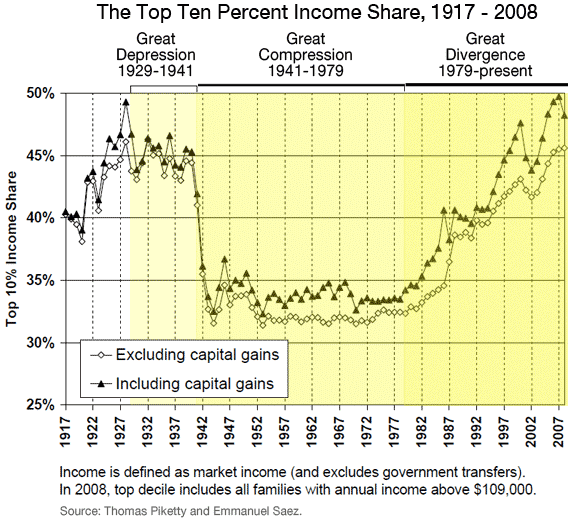
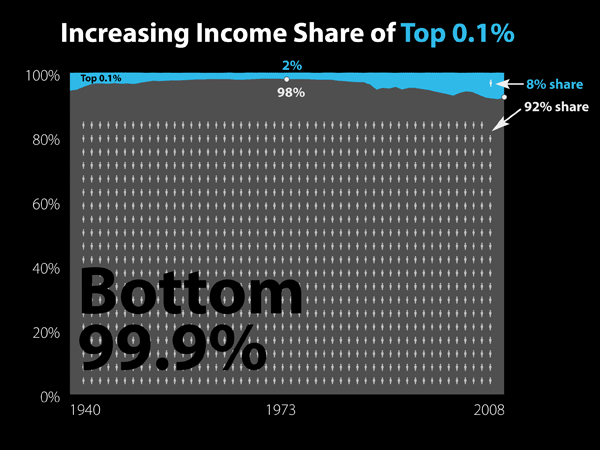
I’m back! I was in the middle of moving and just overwhelmed with everything. Anyway. Talking Points Memo posted a link to an article at Slate about income inequality in the U.S., and particularly the increasing proportion of total U.S. income earned by the very rich. Timothy Noah refers to the “great compression” as a time period when income concentration among top earners dropped significantly, and argues that in the past three decades we’ve seen a “great divergence,” with increasing income inequality hitting levels not seen since the Great Depression:

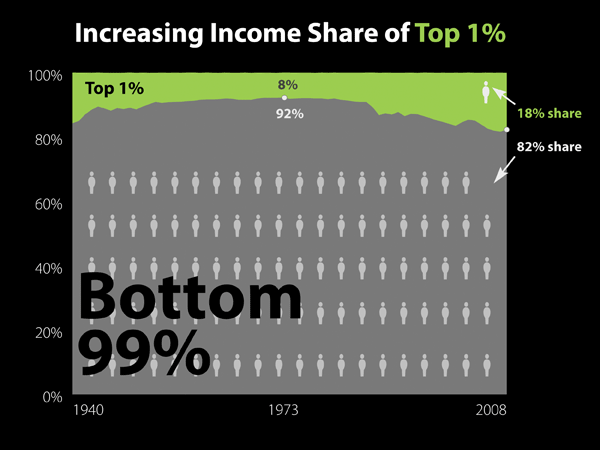
A slideshow accompanies the article, providing more info on the changes Noah discusses. A few examples (the slideshow provides the data source used to create each image):

Even among the very rich, we see increasing divergence, with the super-ultra rich, the top 0.1% of earners, now making 8% of all U.S. income:

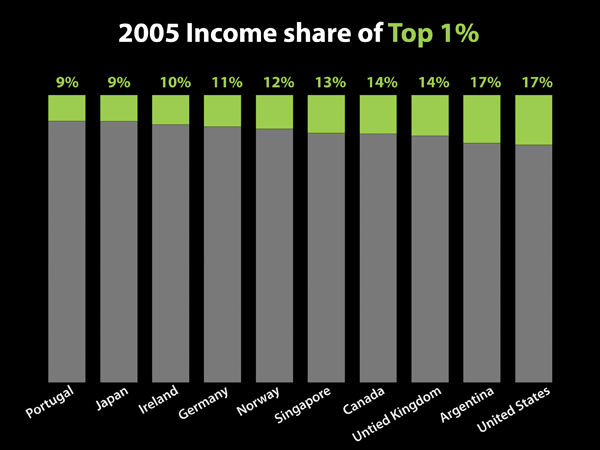
A comparison to some other countries (I don’t know why these specific nations were chosen for the comparison):

Keep in mind, this data includes only income. Wealth — the worth of all assets, including retirement and savings accounts, stocks, homes, cars, and anything else of value — is much more unequally distributed.

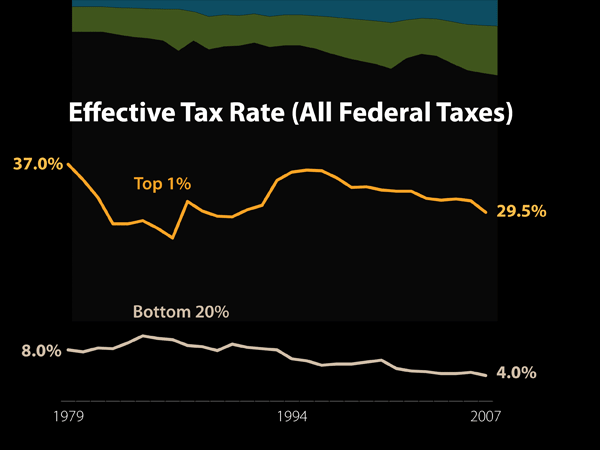
Congress is about to be embroiled in a major debate about whether to extend the tax cuts on high incomes; as both sides weigh in, here’s some context to keep in mind:

The effective tax rate is what people actually pay, as opposed to what their tax rate theoretically is. While we’ve certainly seen a large drop since the late ’70s, Noah argues that, compared to other economic changes, the effective tax rate hasn’t affected the rise in income inequality much. It plays a role, yes, but changing the tax rate on the very rich doesn’t affect the overall distribution of income a huge amount, in part because the effective rate, what people end up actually paying, generally ends up being smaller than what they theoretically owe based on the stated tax rate, once you take into account deductions, write-offs, loopholes, and so on.

So…happy post-Labor Day!

Are Americans More Patriotic than Citizens of Other Countries?

Claude Fischer at Made in America offered some data speaking to the idea that Americans are especially patriotic. That they, in other words, are more likely than citizens of other nations to think that “We’re Number One!”

Fischer provides some evidence by Tom Smith at the International Social Science Programme (ISSP; Tom’s book).  The ISSP, Fischer explains…

…involves survey research institutions in dozens of countries asking representative samples of their populations the same questions. A couple of times the ISSP has had its members ask questions designed to tap respondents’ pride in their countries… One set of questions asked respondents how much they agreed or disagreed with five statements such as “I would rather be a citizen of [my country] than of any other country in the world” and “Generally, speaking [my country] is a better country than most other countries.”

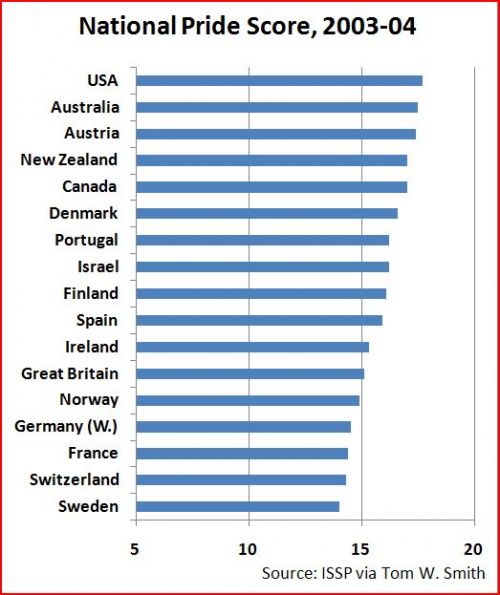
Smith put responses on a scale from 5 to 25, with 25 being the most patriotic.  Here are the results from some of the affluent, western democracies (on a shortened scale of 5 to 20):

As Fischer says, “Americans were #1 in claiming to be #1.”  Well, sort of.  Americans were the most patriotic among this group.  They turned out to be the second most patriotic of all countries.  Venezuela beat us.

(In any case, what struck me wasn’t the fact that the U.S. is so patriotic, but that many other of these countries were very patriotic as well!   The U.S. is certainly no outlier among this group.  In fact, it looks like all of these countries fall between 14 and 18 on this 20-point scale.  Statistically significant, perhaps, but how meaningful of a difference is it?)

Fischer goes on to ask what’s good and bad about pride and closes with the following concern for U.S. Americans:

We believe that we are #1 almost across the board, when in fact we are far below number one in many arenas – in health, K-12 education, working conditions, to mention just a few. Does our #1 pride then blind us to the possibility that we could learn a thing or two from other countries?

Global Recognition of Same-Sex Marriages

Courtesy of FiveThirtyEight, this graph shows the increase since 2001 in the number of people worldwide who live in jurisdictions where gay same-sex (or homogamous, if you prefer) marriage is legal. As of 2010, roughly 250 million people live in such areas (each column represents the total number for that year, broken into individual colors to show the number in each region):

The spike in 2008 is due to the California courts recognizing same-sex marriages, so the U.S. data pushed the total number upward; that, of course, was quickly reversed by Prop 8, so that bump disappears in 2009. Currently within the U.S., same-sex marriages are legal in Vermont, New Hampshire, Iowa, Connecticut, Massachusetts, and Washington, D.C., while apparently New York, New Mexico, California, and Rhode Island don’t allow them to be performed but recognize those performed elsewhere (a friend of mine who lives in Rhode Island couldn’t marry his boyfriend there, but drove a half hour from their home into Massachusetts to do so and then went home, where his out-of-state marriage was then entirely legal). California recognizes those same-sex marriages that occurred between June and November 2008, before Prop 8 passed. Within Europe (which is all thrown together here, unfortunately), as far as I know the specific countries where it’s legal are Sweden, Norway, the Netherlands, Belgium, Spain, Portugal, and Iceland), with Portugal and Iceland both doing so this year. In Mexico, same-sex marriages are legal only in Mexico City, but if performed there, must be recognized in other areas. And Argentina became the first country in South America to legalize them just last Thursday. (I’m not including domestic partnerships and other arrangements that are somewhat equivalent to, but clearly distinguished from, marriage here; adding those would certainly increase the number significantly.)

This is a small percentage (about 3.7%) of the total global population of nearly 7 billion, and they are highly concentrated in (Western) Europe and North America, with those in Africa, Asia, and Central and South America largely excluded. But the global pattern is a slow but steady rise over time just over the past decade in the recognition of same-sex marriages.

National Personifications

Dmitriy T.M. sent us a link to a story at Slate about (mostly European) “national personifications” — that is, human figures used to represent particular countries, their citizens, or ideas of the national character.  Personification is contentious in that it aims to represent a diverse society with a single person, often representing a simple idea.  Accordingly, we sometimes see divergent, or even conflicting, personifications.

Many personifications in Europe and areas once colonized by them connect the nation to noble ideas and values through the use of Latin-derived names and the use of robes, poses, and other elements of classic statues and paintings to adorn a female figure. For instance, the United Kingdom’s Britannia (an emblem that first emerged when Britain was still ruled by Rome) is a goddess-like figure wearing a Roman-style helmet who has, over time, come to represent the nation and the idea of liberty:

The U.S. has a similar figure, Columbia:

More popular characterizations also emerge, often representing the national character not through goddess-like imagery but as an Average Citizen.  For instance, much more familiar in the U.S. than Columbia is Uncle Sam. He differs from many other national personifications in that he doesn’t represent the U.S. citizenry or the idea of the nation in general; he specifically represents the U.S. government and is best known for wanting “you” to join the military, buy war bonds, and such:

And in addition to Brittania, the U.K. is also personified by John Bull:

According to the Slate article, John Bull presents the British people as middle-class, smart in a common-sense way, and also somewhat suspicious of authority — that is, John Bull is a personification that separates the citizenry from government (the source of authority) to some extent, and thus has been used in many political cartoons to question government policies (whereas Uncle Sam has often been used to advocate them, since he represents the government itself).

Going a step further, Portugal’s Zé Povinho, a working-class personification, actively mocks the powerful, including political elites:

Competing personifications may be used by different political factions. For instance, those in favor of and opposed to Irish independence used female emblems of Ireland. Opponents of Irish nationalism used the figure of Hibernia, represented as the younger sister of Brittania and in need of her sister’s protection from the brutish (male) nationalist forces:

Nationalists responded with Kathleen Ni Houlihan, “generally depicted as an old woman who needs the help of young Irish men willing to fight and die to free Ireland from colonial rule, usually resulting in the young men becoming martyrs for this cause”:

The gender element in these competing personifications is interesting: in both cases Ireland is a woman in need of protection, but who see needs protected by (a stronger sister or men) and from (men in both cases) differs.

So here we have just a small handful of national personifications that may coexist fairly harmoniously while serving different purposes (say, Brittania and John Bull) or actively conflict (representations of Ireland). Various groups in a nation (political elites, different social classes, rebels, etc.) are unlikely to identify equally with a single personification; thus, the figures used to represent a country or its citizens can become sites of political or cultural contention, defining who has the most legitimate claim to being the backbone of the nation (the middle-class John Bull, the working-class Zé Povinho) or framing independence or other political movements.

Comparing the Gender Wage Gap Across Countries

Ok, so we know that, in the U.S., full-time female workers make about 85 cents for every dollar made by full-time male workers.  But how does the U.S. compare to other countries?  This graph, sent in by Katrin from the OECD Fact Blog, shows that we do better than some, but worse than most developed countries:

We do as badly as Switzerland, Finland, and Portugal.  We do better than the U.K., Canada, Germany and, especially, Japan and Korea.  But we do significantly worse than 13 other countries… with Belgium, New Zealand, and Poland leading the way with the smallest wage gap (at 10% or smaller).

An International Sampler of Ads Featuring George W. Bush

This Australian ad for Lipton tea suggests that it’s mind clarifying qualities are so good that it could help even George Bush achieve the feat of naming all 50 states.


This Brazilian ad for Rolling Stone, featuring a picture of George W. Bush, reads: “We don’t show naked women to sell more. At the most, we show some asses.”


This Chinese Greenpeace ad, portraying Bush’s spin on global warming, reads: “Everyone’s entitled to an opinion. Voice yours at forum.greenpeace.org.”

This Chinese ad for an erasable pen reads: “Everyone makes mistakes.” 


In Malaysia, Bush is used to sell Smart cars.  Text: “Still looking for weapons of mass destruction.  Not smart.” 


Also in Malaysia, Amnesty International makes fun of Bush in their effort to inspire opposition to Guantanamo Bay.  “Write to him and help stop torture at Guantanamo Bay.  Remember, use simple words.”

This is a Mexican ad for a dog kennel.  “We don’t discriminate any kind of breed.”  (The source says that, in Mexico, like in the U.S., “dog” is a name for a bad person.)

 This ad for a Mexican newspaper reads: “Such a complex world needs a good explanation.”


This is an ad for the movie American Psycho in New Zealand.


In Portugal, playing war games (paint ball) is advertised as equivalent to playing George W. Bush.


This Swiss ad threatens, if you fall off your bicycle without a helmet, you may end up as dumb as George W. Bush.

These and more borrowed from here, found via adfreak.


Update: There have been some really nice points in the comments about how, in the process of making fun of Bush, we are also seeing the further stigmatization of ”people with developmental disabilities, brain injuries, and psychological diagnoses” (that from Penny in the comments).