Tag Archives: nation: Israel

Global women’s progress report

Cross-posted at Family Inequality.

I have criticized sloppy statistical work by some international feminist organizations, so I’m glad to have a chance to point out a useful new report and website.

The Progress of the World’s Women is from the United Nations Entity for Gender Equality and the Empowerment of Women. The full-blown site has an executive summary, a long report, and a statistics index page with a download of the complete spreadsheet. I selected a few of the interesting graphics.

Skewed sex ratios (which I’ve written about here and here) are in the news, with the publication of Unnatural Selection, by Mara Hvistendahl. The report shows some of the countries with the most skewed sex ratios, reflecting the practice of parents aborting female fetuses (Vietnam and Taiwan should  be in there, too). With the exception of Korea, they’ve all gotten more skewed since the 1990s, when ultrasounds became more widely available, allowing parents to find out the sex of the fetus early in the pregnancy.

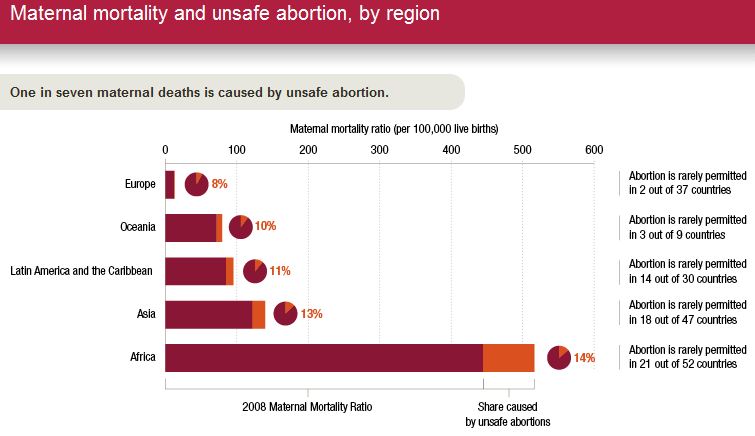
The most egregious inequality between women of the world is probably in maternal mortality. This chart shows, for example, that the chance of a woman dying during pregnancy or birth is about 100- 39-times higher in Africa than Europe. The chart also shows how many of those deaths are from unsafe abortions.

Finally, I made this one myself, showing women as a percentage of parliament in most of the world’s rich countries (the spreadsheet has the whole list). The USA, with 90 women out of 535 members of Congress, comes in at 17%.

The report focuses on law and justice issues, including rape and violence against women, as well as reparations, property rights, and judicial reform. They boil down their conclusions to: “Ten proven approaches to make justice systems work for women“:

1. Support women’s legal organizations

2. Support one-stop shops and specialized services to reduce attrition in the justice chain [that refers to rape cases, for example, not making their way from charge to conviction -pnc]

3. Implement gender-sensitive law reform

4. Use quotas to boost the number of women legislators

5. Put women on the front line of law enforcement

6. Train judges and monitor decisions

7. Increase women’s access to courts and truth commissions in conflict and post-conflict contexts.

8. Implement gender-responsive reparations programmes

9. Invest in women’s access to justice

10. Put gender equality at the heart of the Millennium Development Goals

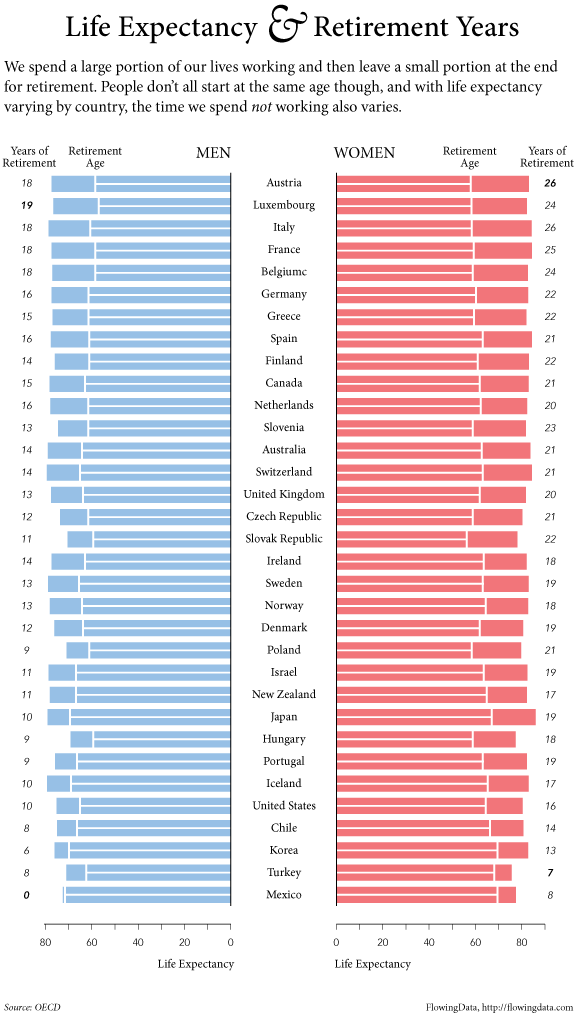
Cross-National Comparisons of Years in Retirement

Does American prosperity translate into long retirements?  Not compared to other developed countries in the world.  Flowing Data borrowed OECD numbers on life expectancy and age of retirement to calculate the average number of years in retirement for men and women across many different countries.  The portion of each bar with the line is the average number of years working, while the non-lined portion represents years in retirement.

Largely because of life expectancy, women enjoy more years than men in all states except Turkey, but the number of years varies quite tremendously, from an average of zero years for men in Mexico, to an average of 26 years for women in Austria and Italy.  The United States is way down on this list, not doing so well relatively after all.

International Comparisons of Equality and Prosperity

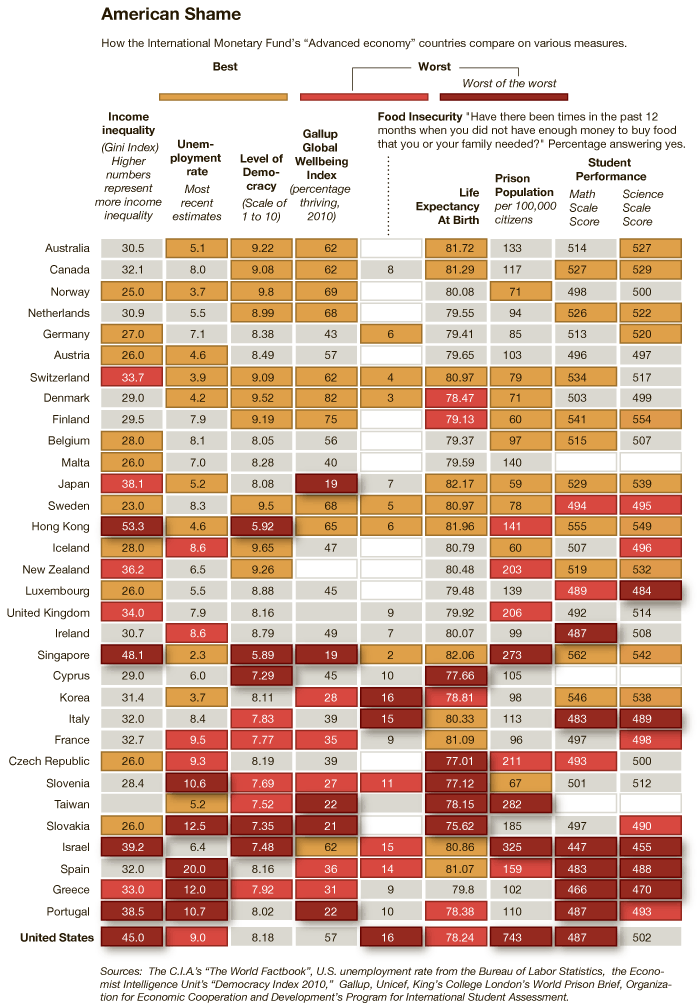
An infographic accompanying an article at the New York Times reveals how “advanced economies” compare on various measures of equality, well-being, educational attainment, and more.  To illustrate this, for each measure countries that rank well are coded tan, countries that rank poorly and very poorly are coded orange and red respectively, and countries that are in the middle are grey.  The countries are then ranked from best to worst overall, with Australia coming in #1 and the United States coming in last.  You might be surprised how some of these countries measure up.

Thanks to Dmitriy T.M. for the link.

Depicting Women in the Israeli Defense Force (Potentially NSFW)

I’ve written previously about the portrayal of women in the military — in particular, the U.S. Navy’s attempts to redefine femininity to make the Navy more appealing to women by assuring them they can be strong, smart, and still go shopping and stuff. Katrin sent in an example of a 10-minute Israeli Defense Force recruitment video that does something similar. The women are pretty, all with long hair, most wearing makeup, and the woman they focus on is shown playing the piano in an elegant formal dress and earrings:

Ultimately, rejecting that world of nice clothes and piano-playing for the more masculinized role of a combat soldier (Israel is one of the few countries that allows women to serve in combat positions) is clearly depicted as the preferable choice. And, interestingly, the IDF is shown as an escape from sexual harassment by men.

However, IDF women are being portrayed in another way as well: a number of former female IDF soldiers posed for Maxim magazine back in 2007. The first line of the article:

They’re drop-dead gorgeous and can take apart an Uzi in seconds. Are the women of the Israeli Defense Forces the world’s sexiest soldiers?

I’m putting the images after the jump because they’re potentially not safe for some workplaces — the women aren’t nude, but they are quite scantily clad.

(more…)

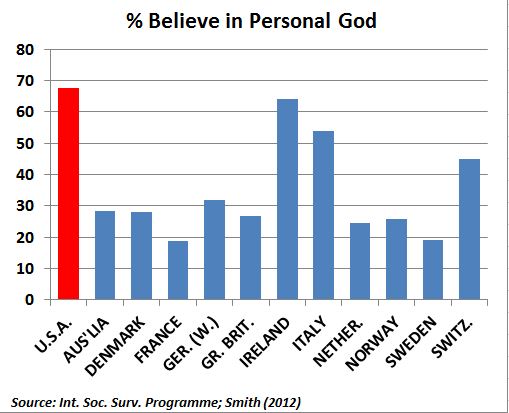
Are Americans More Patriotic than Citizens of Other Countries?

Claude Fischer at Made in America offered some data speaking to the idea that Americans are especially patriotic. That they, in other words, are more likely than citizens of other nations to think that “We’re Number One!”

Fischer provides some evidence by Tom Smith at the International Social Science Programme (ISSP; Tom’s book).  The ISSP, Fischer explains…

…involves survey research institutions in dozens of countries asking representative samples of their populations the same questions. A couple of times the ISSP has had its members ask questions designed to tap respondents’ pride in their countries… One set of questions asked respondents how much they agreed or disagreed with five statements such as “I would rather be a citizen of [my country] than of any other country in the world” and “Generally, speaking [my country] is a better country than most other countries.”

Smith put responses on a scale from 5 to 25, with 25 being the most patriotic.  Here are the results from some of the affluent, western democracies (on a shortened scale of 5 to 20):

As Fischer says, “Americans were #1 in claiming to be #1.”  Well, sort of.  Americans were the most patriotic among this group.  They turned out to be the second most patriotic of all countries.  Venezuela beat us.

(In any case, what struck me wasn’t the fact that the U.S. is so patriotic, but that many other of these countries were very patriotic as well!   The U.S. is certainly no outlier among this group.  In fact, it looks like all of these countries fall between 14 and 18 on this 20-point scale.  Statistically significant, perhaps, but how meaningful of a difference is it?)

Fischer goes on to ask what’s good and bad about pride and closes with the following concern for U.S. Americans:

We believe that we are #1 almost across the board, when in fact we are far below number one in many arenas – in health, K-12 education, working conditions, to mention just a few. Does our #1 pride then blind us to the possibility that we could learn a thing or two from other countries?

It’s Not the Size of the State, but the Ambulation of the Nation

Who says size doesn’t matter?  This ad for Israeli tourism thinks it is playing with gender and sexuality, perhaps in ways that turn stereotypes on their heads.

Instead, though, the ad agency actually reproduces a long list of stereotypes, including:

(1) men’s fears of emasculation, and the assertion that whatever is down there is a site of worship, and has brought the driest areas to life;

(2) anti-feminist jabs at women’s sexual “experience” leading to being sexually judgmental (as she seems to criticize his equipment);

(3) racialized masculine sexuality (as the man of color responds defensively about just how big his, uh, map must be);

(4) a market-based sexual reciprocity that suggests that oral sex is not a matter of pleasure for the person performing it, but a credit for later, equivalent service (and he has to promise to go south with her).

A visit to the website — a Canadian ad agency promoting Israeli tourism — leads off with a cavalcade of steamy fun-filled images, making Israel look like Spring Break or the intro to CSI Miami.

—————————

Michael Kimmel is a pre-emminent sociologist whose work on masculinities has re-shaped our understanding of gender.  His most recent book, of many, is Guyland: The Perilous World Where Boys Become Men.

If you would like to write a post for Sociological Images, please see our Guidelines for Guest Bloggers.

Where are the Women? Where are the Men?

SocProf, from The Global Sociology Blog, has an interesting post about gender in the public sphere. Here is a photo (from Echidne of the Snakes) of the “first spouses” of the G20 nations (that is, the spouses of the political leaders of the G20):

g20_glamour_spouses_expires_1

Except…someone’s missing. Two of the G20 countries (Germany and Argentina) have heterosexual, married female leaders, and their husbands aren’t in the photo. I don’t know why–were they not invited to the event? Did they choose not to come? SocProf asks, “Would the husbands have looked out of place here? Would this have been embarrassing to them?”

But SocProf points out that a different disappearing act recently occurred in Israel:

…look what happened in reverse in a group photo of the newly-formed Israeli cabinet. On top is the traditional cabinet group photo, at the bottom is the “touched-up” version that appeared in [the ultra-Orthodox newspaper Yated Neeman]… notice the difference?

30-world_160567s

Indeed, the two female Cabinet members have been photoshopped out.

SocProf says,

[In the G20 photo]…the men are not visibly absent. It is their presence that would be noticeable. And also note the setting in which the women pose, the soft colors, pink carpet and sofa with pastel background. It looks like a somewhat formal yet a little domestic setting.

The bottom photo is formal, no pink or pastel there! Icy grey with flags and orderly pose…It is a perfect illustration of the gendered domains: where men belong and where women belong.

Taken together, the three images, though taken for different purposes in different places, provide a great illustration of how we often make people who don’t fit cultural gender norms invisible…sometimes very literally.

Also see our post on an ultra-Orthodox newspaper that airbrushed girls out of a photo of children.

UPDATE: Commenter Liz says,

I object to the use of the word ‘airbrushing’, because that’s not what happened: those photos were edited, manipulated, or fabricated, but airbrushing is a specific photoshop tool for minor modification. You can’t completely change the reality of a photograph with an airbrush, unless someone would like to tell me that those two male stand-ins are actually just drawings made with photoshop.

If you use the same word (airbrushing) for taking out a model’s cellulite as well as removing heads of state from photographs, you trivialise what’s been done. Digital editing is only going to become more and more common, and it’s important to find the right words to explain how a photo has been altered.

Good point–thanks for pointing the language issue out. I didn’t know what airbrushing referred to, exactly, and had just heard it used to describe altering an image in general.

“1 Shot, 2 Kills” Army T-Shirts

Captain Crab sent in a story at E&P Pub about some t-shirts that Israeli soldiers were wearing that have sparked a controversy in Israel after it was reported on by Haaretz. Here’s an image (found at Sky News):

15245789

The shirt on the left shows a pregnant woman, clearly meant to be Arab/Palestinian, in crosshairs and says “1 Shot 2 Kills.” The one on the right has a kid carrying a gun in crosshairs and says “The smaller, the harder,” or maybe “the smaller it is, the harder it is.” This next one has a woman crying next to a dead child and a condom wrapper situated  like crosshairs and says “better use Durex.”

15245919

That one apparently is meant to imply that it would be better if she’d used contraception and the child was never born, but I was really confused by it at first. Given the widespread use of rape in war (in a general sense, not specifically this conflict)*, my first thought, before I realized that was a child next to her, was that it meant a “better use” for her was to have sex with her. Not that the actual meaning is any nicer.

According to the Chronicle Herald, soldiers wore the shirts to celebrate finishing basic training.

It’s an interesting/repulsive example of dehumanizing the group defined as the enemy (they aren’t people, they’re “kills”), as well as how women’s reproductive capacity is often seen as a threat or potential weapon–by reproducing, women create more enemy soldiers.

CLARIFICATION: These weren’t official shirts given out by the Israeli military, in case that wasn’t clear. It’s not yet known who created them, but it was something that soldiers themselves appear to have come up with, not anything officially sanctioned by the military. Whether supervisors knew about them and did anything before the newspaper articles started coming out, I don’t know, but now the army says those who were caught wearing them will be disciplined.

* If you are interested in a first-hand account, A Woman in Berlin is a first-person journal account, published anonymously by a female German journalist, of her experiences in Berlin during the two months that Soviet troops occupied the city after the Nazis were defeated. Soviet troops took part in widespread and repeated rapes of the women they found living in the city, who found that their best defense was to try to connect themselves to one or two high-ranking Soviet officers, hoping the men would protect them from being raped by other soldiers (and maybe bring them some food, since most were on the brink of starving) in exchange for the women “willingly” having sex with them (as “willingly” as you can when your option is “if I don’t let you have sex with me, you’ll let all those other men rape me”).