violence

4244539669_8dceaae1ba_z

In a widely-shared article on The Intercept, Sam Biddle made the point that, “Trump’s anti-civil liberty agenda, half-baked and vague as it is, would largely be an engineering project, one that would almost certainly rely on some help from the private sector.” The center of his article, that of the six major tech companies he requested comments from only Twitter gave him an unequivocal statement that they would not help build a Muslim database, was chilling even though most of the companies just never responded. The role of engineers and designers in carrying out political ends often relegated to business’s policies. That is, engineers themselves are seen as completely beholden to whatever their bosses decide their job should be. I want to look at this from a different angle: why are engineers so willing to defer responsibility for their actions and why are they so often in positions to do so? more...

LeeAt this point everyone is undoubtedly aware of the school shooting at Umpqua Community College in Oregon, though I am certain the method by which we came across the news varied. Some of us were notified of the event by friends with fingers closer to the pulse, and still more of us learned about it first-hand through a variety of content aggregation platforms, such as Reddit.

I would hazard that the majority of people learned about it first and foremost through social media;  primarily Facebook or Twitter. I certainly did. A friend first told me about it through Facebook Messenger, and almost immediately after she did, I started to see articles trickling into my newsfeed in the background of my Messenger window. And the moment that happened I shut my Facebook tab down, despite the fact that I compulsively, addictively, have it open almost all the time.

Facebook, when taken on the whole, is a fantastic way for people to compare each others’ lives and share pictures of kittens and children, but when it comes to a tragedy, the platform is woefully inadequate at allowing its users to parse and process the gravity of events as they unfold. It is a thorough shock to a system that thrives on irreverent links and topical memes, and when faced with an item that requires genuine reflection and thought, it is often simpler – indeed, even more beneficial – for users to turn their heads until the kittens may resume. more...

Would if this were true?

The Facebook newsfeed is the subject of a lot of criticism, and rightly so. Not only does it impose an echo chamber on your digitally-mediated existence, the company constantly tries to convince users that it is user behavior –not their secret algorithm—that creates our personalized spin zones. But then there are moments when, for one reason or another, someone comes across your newsfeed that says something super racist or misogynistic and you have to decide to respond or not. If you do, and maybe get into a little back-and-forth, Facebook does a weird thing: that person starts showing up in your newsfeed a lot more.

This happened to me recently and it has me thinking about the role of the Facebook newsfeed in inter-personal instantiations of systematic oppression. Facebook’s newsfeed, specially formulated to increase engagement by presenting the user with content that they have engaged with in the past, is at once encouraging of white allyship against oppression and inflicting a kind of violence on women and people of color. The same algorithmic action can produce both consequences depending on the user. more...

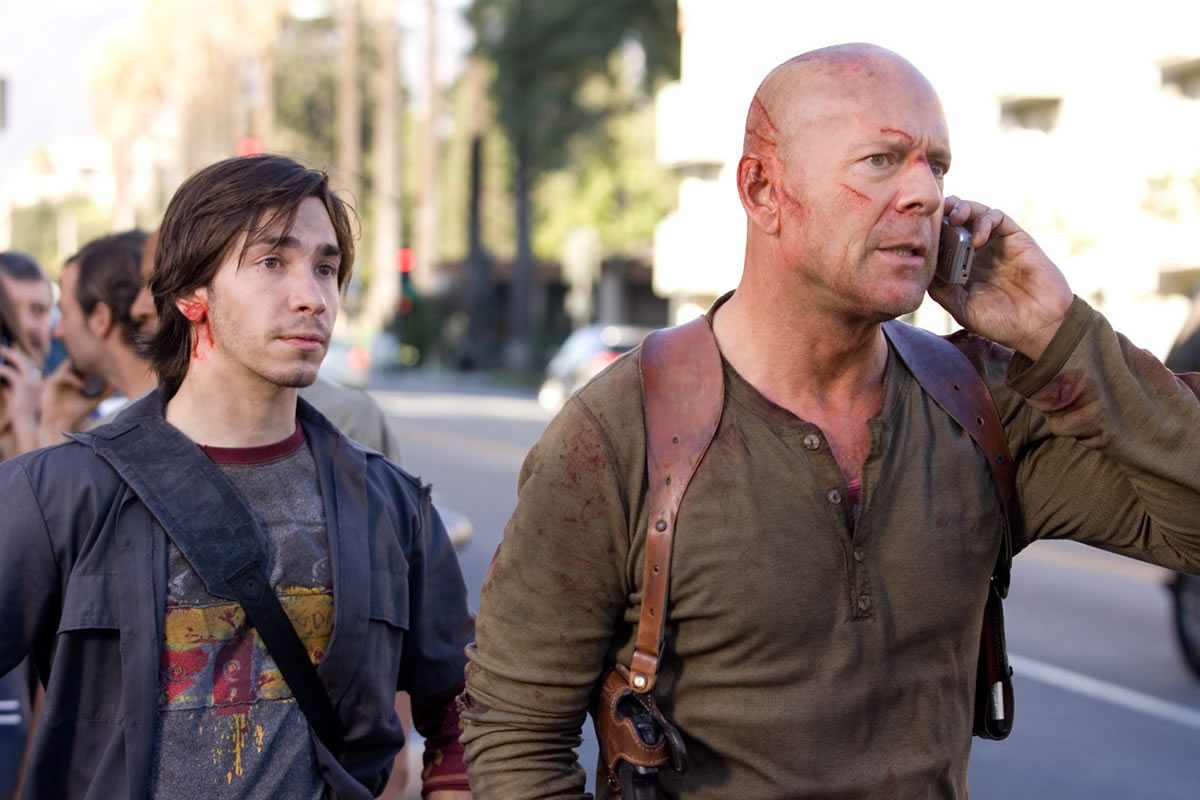
Scene from Die Hard 4: Live Free or Die Hard

David Graeber has republished his popular essay Of Flying Cars and the Declining Rate of Profit in his new book Utopia of Rules with some small changes that go toward supporting the book’s over-all argument that the hallmark of American neoliberalism is not dynamism and a freeing up of individuals to peruse “creative class” jobs but rather a bureaucratization of every aspect of life. This total bureaucratization (almost literally) papers over the structural violence that supports capitalism. Of Flying Cars specifically argues that the utter failure to deliver on the implicit promises of Jetsons-level automation by the 21st century is not necessarily a matter of market forces (no one actually wants a flying car!) or technical impossibility (Moore’s law hasn’t delivered thinking computers yet!) but is in fact a product of both squashing the imagination through bureaucratic devices, and the immense devaluing of labor and elimination of corporate profit taxation that leads to paltry civilian research and development. In essence, capitalism in its present form, is anathema to the future it once promised.

Graeber states in the beginning of the essay that he is puzzled by the near silence from those people who saw the moon landing on their televisions but today do not, themselves, live on the moon (or can easily teleport there, or take a drug that might extend their life to the time that both of those things are available). “Instead,” he writes, “just about all the authoritative voices—both on the Left and Right—began their reflections from the assumption that a world of technological wonders had, in fact, arrived.”

Graeber relatively quickly drops the issue of how our collective expectations of the future could be so quickly and completely re-aligned (his answer is postmodernism) and goes on to explain why such an alignment has become necessary (capitalism’s secret love of bureaucracy) but I want to dwell on the “how” question a little bit longer by offering up a corollary to Of Flying Cars. The argument that follows is also a reprinting of my own work, an article published in a 2012 issue of the International Journal of Engineering Social Justice in Peace, co-authored with Arizona State University’s Joseph R. Herkert. I want to argue that our expectations for the future are purposefully managed through a circulation of imagined threats to capitalism, the popularizing of narratives that flesh out that threat, and the re-articulation of those imagined threats as real ones that must be met with massive government funding. I will demonstrate this process using a beloved and uniquely American franchise: Die Hard. more...

Ellen Pao, CEO of Reddit. image credit: Christopher Michel

An unfortunately predictable thing happened on Reddit last week. Reddit’s corporate administrators announced that they would be shutting down “five subreddits that break our reddit rules based on their harassment of individuals.” These were fairly small subreddits, except for r/fatpeoplehate which had 150,000 subscribers at time of banning. The primary mission of r/fatpeoplehate was to find pictures of fat people, make fun of them in the comments and –if at all possible—find these people and harass them for being fat. [If you’re unfamiliar with the structure and vocabulary of Reddit I’ve provided a primer at the bottom of this page.]

The administrators were careful to point that they were “banning behavior, not ideas.” That is, while they know that there are dozens of subreddits devoted to white supremacy, tactics for violent raping women, and doxxing young women for espousing feminist beliefs on Tumblr, (yes, all of those exist and they are a lot bigger than you or I want to believe) those communities should rest assured that they will be safe so long as moderators make overtures to discouraging collective behavior that goes beyond reaffirming each other’s dangerous and hateful thoughts.

One could be forgiven for thinking that banning such disgusting behavior from a small minority of people would be met with some “that makes sense” head nods and any sort of outrage would be directed at the failure to ban more subreddits, not less. What in fact happened was quite the opposite: within the day there were dozens of new subreddits playing host to the kind of content and behavior that characterized r/fatpeoplehate. What’s more disturbing though, is that the content from these new subreddits were making it to the frontpage with thousands of votes. There were also countless posts calling for Reddit’s CEO Ellen Pao to do everything from resign to defile herself. As of writing, a full four days after the announcement, there’s an “Ellen Pao Must Resign” subreddit with over seven thousand subscribers that are still able to get links to the front page. more...

Pe

On January 9th, people donning the symbols of Anonymous promised a “massive reaction” to the shooting deaths of over a dozen people in Paris. Posted to YouTube and Pastebin under the hashtag #OpCharlieHebdo, Anonymous proclaimed, “It’s obvious that some people don’t want, in a free world, this sacrosanct right to express in any way one’s opinions. Anonymous has always fought for the freedom of speech, and will never let this right besmirched [sic] by obscurantism and mysticism.” Obviously what happened in Paris was a despicable act and I have little sympathy for the perpetrators but their actions weren’t random. What happened in Paris is the beginning of a fight between fanatics who hold polar opposite views on free speech and the battle lines being drawn are dangerously close to the ones that outline the War on Terror.  more...

10478531_709285209106941_4100531665819266605_n

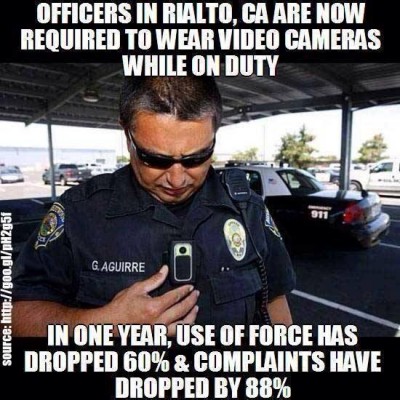
The murder of Mike Brown by Ferguson police officer Darren Wilson has catalyzed an already fast-growing national conversation about outfitting police officers with cameras like the one shown above. These cameras, the logic goes, will keep officers on their best behavior because any abuses of power would be recorded and stored for later review. Officer’s behavior, much like an increasing amount of civilian behavior, will be subject to digital analysis and review by careful administrators and impartial juries. This kind of transparency is extremely enticing but we should always be critical of things that purport to show us unvarnished truths. As any any film director will tell you: the same set of events recorded on camera can look very different when viewed from different angles and in different contexts. more...

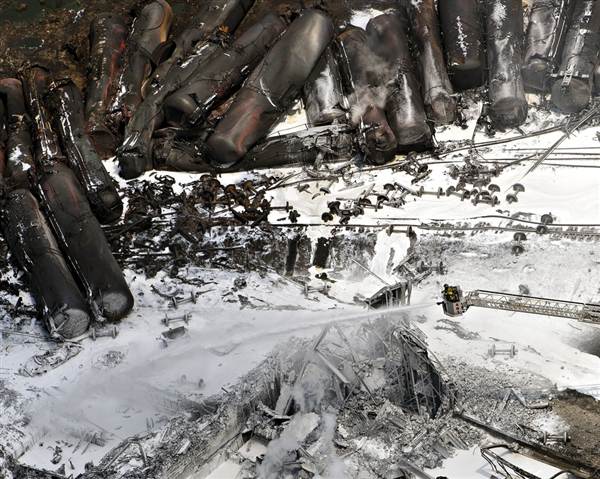
An entire train full of crude oil slides and tumbles 11 miles down hill. Image from NBCNews

One morning, in the seventh grade, my math class was told to prepare for a surprise standardized writing test. A writing test with no warning in math class wasn’t the weirdest thing we had been asked to do. Jeb Bush was our governor and Florida was a proving ground for what would later be called “No Child Left Behind.” Tests were common and testing different kinds of tests were even more common. You never knew if the test you were taking would change your life or never be seen again. This one was a little bit of both. The prompt was really strange, although I don’t remember what it was. As a life-long test taker (my first standardized test was in the 4th grade) you become a sort of connoisseur of writing prompts. This one didn’t seem to test my expository or creative writing skills. It just felt like a demand to write and so we did. We wrote for about half an hour. more...

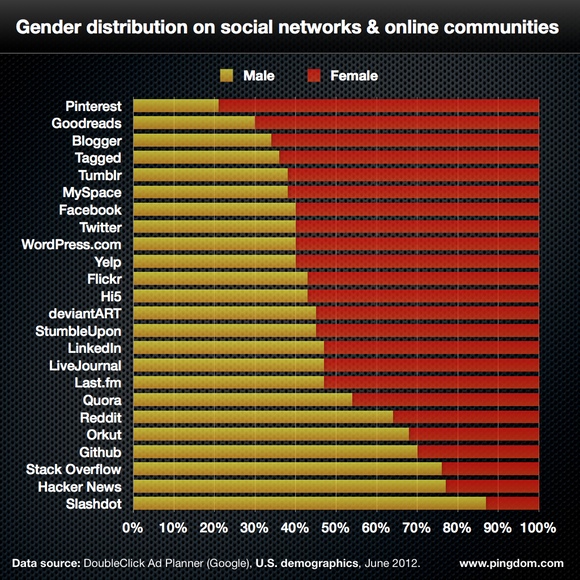
Just about every social media network that relies on voting has more men than women in their user base.
Just about every social media network that relies on voting has more men than women in their user base. Graph from pingdom,com

The merits of voting[1] have come under scrutiny as of late, thanks in part to Russell Brand’s comments on the topic in his guest edited edition of the New Statesman. (Oh and I think there might have been an interview as well.) I’m highly suspicious of voting as well, which is why my ballots are mostly blank except for the one or two things I think might be strategically useful in later direct action. I voted earlier this week in a local election because my city is still small enough that there are very real and tangible differences to electing one counsel person over another: One city council person authorizes citizen working groups to organize municipal composting while another led the charge to close an indy media center that hosted an Iraqi artist because… terrorism.[2] A lot has already been said about the efficacy of voting and why it alone cannot possibly bring about the fundamental change that politicians promise. Besides, if you’ve read your Zinn, you know that all the important stuff happens between elections anyway. What I want to touch on today however, has less to do with government elections, and more to do with the abstract concept of voting. Why is it that, if voting is implemented within a system, do we automatically assume that it is more democratic? What happens to social networks and web platforms when we install voting as the overriding system of displaying public opinion? Why shouldn’t the critique of voting in general be directly imported as a critique of the social networking sites that use voting as the primary form of interaction on the site? more...

put down the mcdonalds
Submitted by Reddit User JackInov

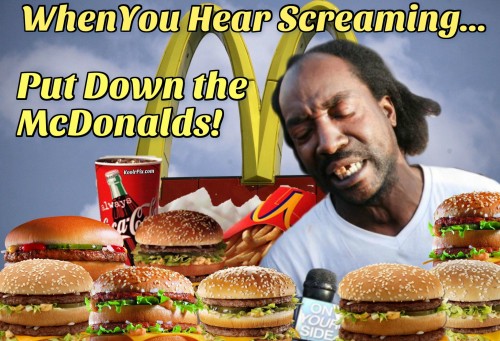
I don’t recommend doing it, but if you search for “Charles Ramsey” on Reddit, something predictably disturbing happens. First, you’ll notice that the most results come from /r/funny, the subreddit devoted to memes, puns, photobombs, and a whole bunch of sexist shit. Charles Ramsey, in case you don’t know, is the Good Samaritan that responded to calls for help by Amanda Berry- a woman that had been held captive for 10 years in a Cleveland basement, along with Gina DeJesus and Michelle Knight. The jokes on Reddit are largely at the expense of Ramsey, poking fun at his reaction to a police siren or his reference to eating ribs and McDonalds. As Aisha Harris (@craftingmystyle) said on Slate: “It’s difficult to watch these videos and not sense that their popularity has something to do with a persistent, if unconscious, desire to see black people perform.” more...